Energy as the Operating System of Power
Why energy defines the structure, limits, and distribution of modern power
Quick view- Strategic Tipping Point
System Navigation>
- Energy-Bound
System
- Global
System Power — Comparative Architecture
- System Diagnostics — Energy as the Operating System of Power
- Energy Constraint and the Monetary Ceiling
- Energy Geopolitics and the Global Paradigm Shift
- Energy as the Operating System of Power ext
- Global System Power — Comparative Architecture
- Energy as the Operating System of Power — G2 Comparative
Global Order Under Stress
- System Re-Concentration
- Security Architecture
- LNG / NATO
- Defense = Monetary Power
- New Monetary Cold War
- OPEC Fracture
Monetary Layer
Keynote
Power in the modern system is often explained through:
finance
technology
institutions
These are visible layers.
They are not foundational.
In an Energy-Bound System, power originates in a deeper structure:
→ the capacity to produce, control, and scale energy
Energy is not one variable among others.
It is:
→ the operating system through which all other forms of power are expressed
I. The Return of Material Power
For several decades, advanced economies operated under an implicit assumption: energy was abundant, scalable, and politically manageable.
That assumption no longer holds.
Energy has re-emerged as the structuring layer of geopolitical power. It now functions as the operating system through which industrial scale, technological concentration, monetary stability, and defence credibility are organised.
Where energy depth exists, power compounds.
Where energy is externally priced, volatile, or
infrastructure-constrained, sovereignty becomes conditional.
This is not an ideological shift.
It is a material one.
II. The Base Layer of Power
All advanced systems depend on energy.
Not abstractly, but materially:
industry requires energy to produce
infrastructure requires energy to operate
compute requires energy to scale
societies require energy to sustain stability
Energy therefore determines:
cost structures
production capacity
system resilience
This makes energy the base layer of power.
Everything else sits on top of it.
III. The System Chain
Power does not emerge randomly.
It follows a structured sequence:
Energy → Industry → Capital → Technology → Security → Currency
Each layer depends on the stability and cost of the previous one.
energy sets the cost base
industry converts energy into output
capital scales capacity
technology increases efficiency and control
security stabilises system alignment
currency reflects system dominance
This is not a metaphor.
It is a system architecture.
Break the base layer, and instability transmits upward.
IV. Constraint Defines the System
The defining condition of the current era is not abundance.
It is constraint.
Energy is:
geographically uneven
politically contested
infrastructure-bound
slow to expand at system level
This creates an Energy-Bound System.
In such a system:
cost differences persist
volatility transmits across sectors
expansion is limited by physical infrastructure
Constraint does not affect all systems equally.
It produces divergence.
V. From Constraint to Asymmetry
When energy cost and availability diverge, systems separate.
Lower-cost, higher-control systems can:
→ sustain industrial margins
→ attract capital
→ scale compute faster
→ reinforce monetary and strategic power
Higher-cost, externally exposed systems face:
→ margin compression
→ weaker reinvestment
→ slower technological scaling
→ growing strategic dependence
This produces:
→ structural asymmetry
Not cyclical imbalance.
Not temporary distortion.
But system position.
VI. Technology as an Energy Multiplier
Technology does not dissolve energy limits.
It amplifies them.
Artificial intelligence, data infrastructure, semiconductor fabrication, and industrial automation all depend on continuous, reliable, high-load electricity.
Compute is no longer abstract.
It is:
→ energy-bound
Where electricity is abundant, scalable, and competitively priced, digital advantage compounds.
Where it is volatile or constrained, cost pressure transmits upward into industry, defence, and fiscal stability.
Technological divergence increasingly follows electricity depth.
VII. Energy and Monetary Power
Currency strength is often treated as a function of:
institutional credibility
liquidity depth
financial design
These matter.
But they are downstream.
Monetary strength ultimately depends on the productive and strategic capacity of the underlying system:
industrial resilience
capital attraction
productivity stability
energy cost structure
This is formalised in:
→ Energy Constraint and the Monetary Ceiling
When energy cost disadvantage persists:
→ monetary flexibility narrows
→ capital reallocates
→ currency vulnerability rises
Monetary power is therefore:
→ an expression of energy-backed system capacity
VIII. The Logic of Concentration
In an energy-bound system, power does not distribute evenly.
It concentrates where:
energy is abundant or controllable
infrastructure scales
capital accumulates
compute can expand
The default tendency is not decentralisation.
It is:
→ concentration around energy and infrastructure nodes
This is why the global system is not flattening.
It is reorganising around architectures of energy depth, industrial capacity, and system control.
IX. From Operating System to Sovereignty
If energy is the operating system of power, sovereignty is the capacity to control that operating system.
Sovereignty now rests on three capabilities:
operational control — absorbing shocks without systemic breakdown
architectural control — shaping pricing, integration, and infrastructure design
temporal control — expanding capacity at strategic speed
States lacking control over price transmission, grid integration, storage buffers, and deployment timelines may retain formal sovereignty while losing operational autonomy.
Energy depth without coordination produces vulnerability.
Markets without system control produce volatility.
Policy without infrastructure produces rhetoric.
Sovereignty is not insulation from interdependence.
It is position within it.
X. Strategic Implication
Power in the modern system is not primarily financial, technological, or institutional in isolation.
It is systemic.
Defined by:
energy availability
cost structure
infrastructure depth
and the capacity to scale
All other forms of power follow from this foundation.
Final Insight
Energy does not simply influence power.
It defines:
its structure
its limits
its distribution
In an energy-bound world:
Energy sets the ceiling of sovereignty.
And increasingly:
Energy sets the ceiling of technological and monetary power.
Final Line
Energy defines the system.
Systems define power.
Power defines sovereignty.
Reading Tree — System Navigation
Global System Architecture framework
I. Core Doctrine — How the System Works
- Energy-Bound
System
- Energy as the Operating System of Power. ext - Geopolitics in an Energy-Bound System_(Extended Background)
- The Global Energy Paradigm Shift - Energy, Industry, and the Reorganisation of the World Economy
- Energy Geopolitics and the Global Paradigm Shift - Why Decarbonisation Has Become a Competitiveness Strategy
- Global Energy System Transition - System Power in an Energy-Bound World
- Energy Sovereignty as System Control - Power, Capacity, and Agency in an Energy-Bound World
- Global System Power — Comparative Architecture
- Energy as the Operating System of Power — G2 Comparative
TECHWAR
EU SOVEREIGNTY
- Compute Locality: Energy, Privacy and Sovereignty
- Distributed Sovereignty Systems
- .Europe’s Strategic Response - Energy, Compute, and the Reconstruction of System Power
These establish the foundational principle:
→ energy defines the structure, limits, and distribution of power
II. Comparative Systems — How Power Is Expressed
- Global System Power — Comparative Architecture - Energy, Industry, Capital, and Control in an Energy-Bound World
- System Diagnostics — Energy as the Operating System of Power - _Comparative Validation Across the United States, China, and Europe
- Energy as the Operating System of Power — G2 Comparative - How the United States, China, and Europe express power under energy constraint
- US Energy and Monetary Power - Why Energy Surplus Anchors Currency Dominance in an Energy-Bound System
- The Tech War Is an Energy War - _A misnamed conflict: the Real Constraint Behind the Tech War
- Centralised vs Distributed Systems Doctrine - How power scales in an energy-bound world]
This shows how different systems organise power under the same constraint:
- United States → integrated dominance
- China → scale and coordination
- Europe → constraint and fragmentation
III. Transformation Layer — How the System Is Changing
- Petrostate vs Electrostate
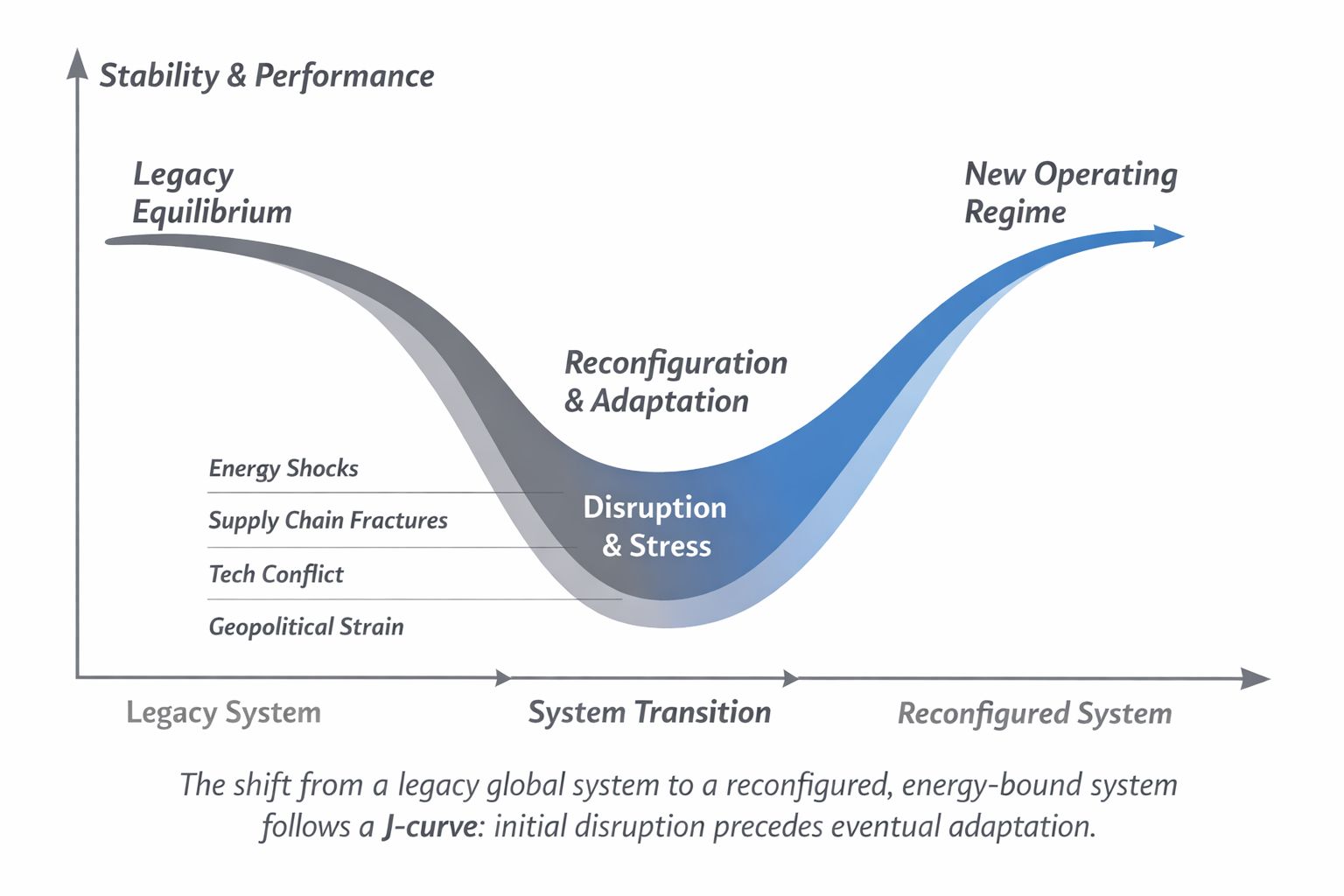
- The Energy J-Curve
- Energy System Transformation — The Transition Layer - Electrification, Infrastructure, and the Cost Reordering of Power
- Energy Systems — Cross-Panel Index - Energy as the Operating System of Power
- The System Is Not Fragmenting — It Is Re-Concentrating - Energy, Infrastructure, and the Reconfiguration of Global Power Energy Sovereignty as
These explain why transition initially intensifies divergence before stabilisation.
IV. Monetary Layer — From Energy to Currency
These formalise how energy cost structures shape monetary power.
V. Structural Asymmetry — Winners and Constraints
These show how divergence becomes persistent and self-reinforcing.
VI. System Convergence — Energy, Industry, Compute
- Energy–Industry–Compute Convergence
- Energy–Compute–AI Stack (Cost Layer - Why energy cost determines the scalability of compute and AI
- Energy–Capital–Compute Architecture - How energy surplus becomes monetary and technological power
- A Simple Guide to the Global Compute Shift - Energy, Microprocessors, and the Architecture of Sovereignty
- System Foundations of the Energy–AI–Industrial Economy - How energy, compute, and industry reorganise economic power in an energy-bound world
This shows:
→ how energy and AI become a single system
VII. Applied Layer — System in Practice
- Energy Sovereignty as System Control
- Energy Leverage
- Energy Shock Transmission Chain (Global Framework)
- US Energy and Monetary Power
- Gulf Petrodollar Architecture
These apply the doctrine to sovereignty, exposure, and transmission:
- energy exporters
- capital flows
- system nodes
VIII. European Constraint Layer
- Energy as Europe’s Strategic Constraint - Why the Energy Paradigm Shift Determines Sovereignty in the AI Era
- Energy Constraint and the Monetary Ceiling (EU)
- Europe’s Challenge — Structural Compression
These show:
→ how constraint materialises within Europe
IX. System Transmission
These explain:
→ how energy shocks propagate through the system
X. Suggested Reading Path (Mobile-Friendly)
- Energy-Bound System
- Energy as the Operating System of Power
- G2 Comparative
- Energy Geopolitics and the Global Paradigm Shift
- Petrostate vs Electrostate
- Energy Constraint and the Monetary Ceiling
- Europe’s Energy Paradigm Shift
- Investor Framework
Related Analyses
Decarbonisation and Industrial Transformation
Centralised vs Distributed Systems ### Infrastructure, Compute, and System Geography
Related System Layers
Dynamics — Index Reference ## European Structural Constraint
Global and Geopolitical Extensions
- Corridors, Chokepoints, and the Geography of Leverage
- Technology Standards and Digital Control Layers
- Finance, Sanctions, and the Upper Layers of System Control