GLOBAL
System Power in an Energy-Bound World
Energy systems increasingly define the structure of global power — shaping industrial capacity, compute infrastructure, capital formation, monetary resilience, and sovereignty in an energy-bound world.
The GLOBAL panel establishes the structural framework of the project.
It explains how the transition from fossil-fuel dominance toward electrified infrastructure is reorganising the hierarchy of power. Energy is no longer merely a commodity input. It is becoming the operating system through which industry, compute, capital, currency, infrastructure, and sovereignty are constrained, scaled, and contested.
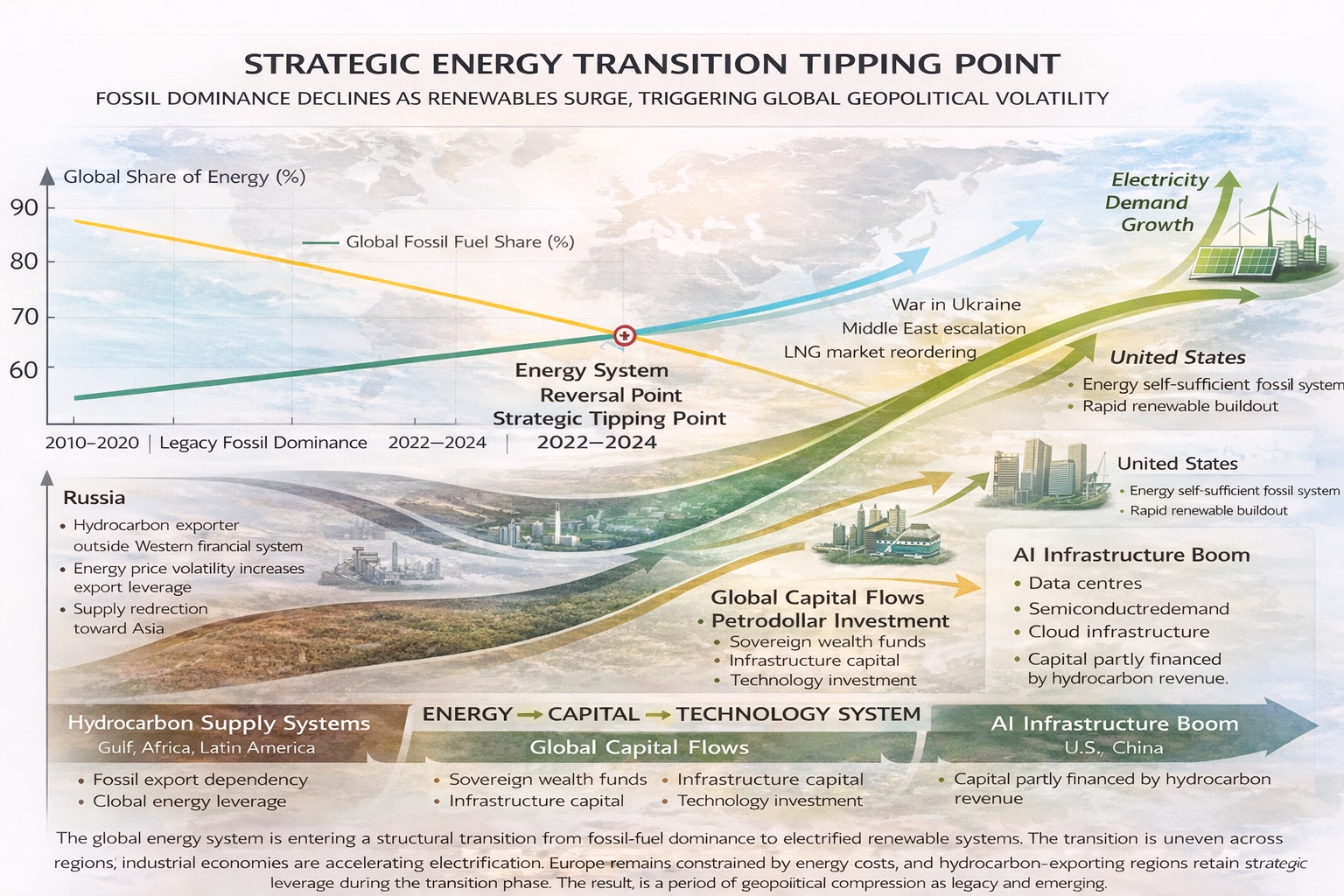
The global energy system is crossing from fossil-fuel dominance toward electrified infrastructure. This transition is not linear. It follows a J-curve in which legacy systems remain indispensable even as electrified systems scale under increasing geopolitical, industrial, monetary, and infrastructural pressure.
Canonical System Core
These texts define the foundational architecture of the project.
They establish the primary system logic through which the rest of the platform should be read.
The System Logic
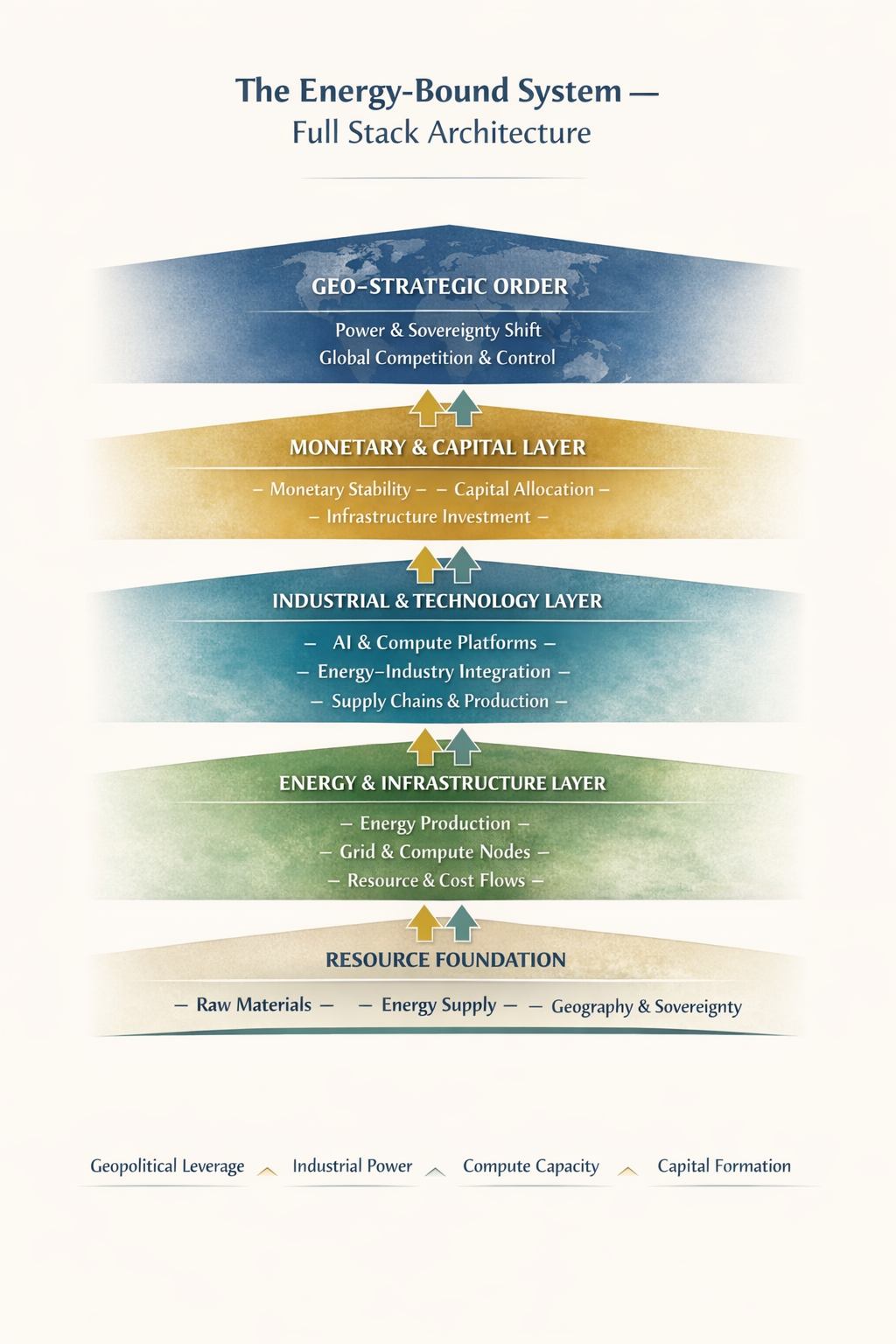
Power in the emerging global order propagates through a structured chain:
Energy → Infrastructure → Industry → Compute → Capital → Currency → Sovereignty
Each layer conditions the next.
Energy availability and cost shape industrial capacity. Industrial capacity determines the ability to build and operate compute systems. Compute capacity reorganises capital concentration, platform power, technological leverage, and industrial ecosystems. Capital formation then determines monetary resilience and strategic autonomy.
Sovereignty therefore becomes increasingly systemic rather than purely institutional.
System Structure
GLOBAL
System transformation of energy, infrastructure, industry, capital, and currency

↓

TECHWAR
Competition over compute, semiconductors, platforms, ecosystems, and control layers

↓

EU SOVEREIGNTY
Regional capacity to convert energy, infrastructure, industry, and capital into agency
GLOBAL defines the system.
TECHWAR explains how control over the system is contested.
EU SOVEREIGNTY examines whether Europe can operate inside that system with strategic agency rather than structural dependency.
I. Foundational Laws and Doctrines
These texts define the operating doctrines of the system.
Core Reading
Extended Reading
II. Energy Transition and System Transformation
The energy transition is not simply an environmental transition. It is a structural transformation of industrial civilisation.
It reshapes cost structures, industrial geography, infrastructure investment, capital allocation, and the monetary foundations of power.
Core Reading
Extended Reading
III. AI, Compute, and Physical Constraint
Artificial intelligence has become physical.
Its strategic limits are increasingly determined not only by software capability, but by electricity, chips, cooling systems, grids, industrial supply chains, capital intensity, and geographic infrastructure.
Core Reading
Extended Reading
IV. Monetary Power and Capital Architecture
The monetary layer is being reorganised by the energy transition.
The petrodollar system linked oil flows, surplus recycling, financial markets, and dollar dominance. In the emerging system, monetary power increasingly derives from the capacity to finance, build, absorb, and govern energy and infrastructure systems.
This produces a deeper hierarchy:
Energy → Infrastructure → Capital → Currency
Core Reading
Extended Reading
V. Structural Asymmetry and System Transition
The emerging system does not affect all actors equally.
States and regions with cheap energy, infrastructure depth, industrial ecosystems, compute capacity, and monetary resilience gain structural leverage. States that lack conversion capacity face rising dependency even when institutional ambition remains high.
Core Reading
Extended Reading
VI. Global System Competition
The global order is not simply fragmenting. It is being reorganised around energy leverage, infrastructure control, technological systems, monetary adaptation, industrial scale, and security enforcement.
Core Reading
Extended Reading
VII. Systems Under Constraint
This series examines how global systems behave when physical limits, infrastructure bottlenecks, monetary stress, and geopolitical fragmentation compress the operating environment.
Core Reading
Extended Reading
VIII. Evidence and Validation Layer
The evidence layer validates the system framework through data companions, transmission chains, maps, infrastructure analysis, and applied case studies.
Core Evidence
Extended Evidence
IX. Conversion Interfaces and System Geography
The system described above becomes visible at strategic interfaces where energy flows, logistics, capital systems, cables, industrial ecosystems, grids, and compute infrastructure converge.
The Mediterranean is one of the most important of these conversion interfaces.
It is not simply a region. It is a strategic conversion layer between:
Gulf capital
African electrification
European industry
maritime logistics
subsea infrastructure
future AI-energy geography
Core Reading
X. Systemic Pathways and Reading Gateways
This project should not be read as a linear sequence of essays.
It functions as a systemic architecture of analysis through which different readers may enter from different layers:
energy
artificial intelligence
infrastructure
monetary power
industrial strategy
geopolitical competition
Mediterranean conversion systems
technological sovereignty
The pathways below function as structured gateways into different dimensions of the system.
Energy Transition Path
The energy transition as a structural transformation of the global economy and the hierarchy of geopolitical power.
Systemic Sovereignty Path
Sovereignty as the outcome of energy, industrial, technological, infrastructural, and monetary capacity.
AI Infrastructure and Compute Path
Artificial intelligence as a physical and infrastructural system.
Monetary and Infrastructure Power Path
The emerging monetary system under conditions of energy constraint and infrastructural competition.
Mediterranean Conversion Path
The Mediterranean as a strategic conversion interface between energy systems, infrastructure systems, industrial geography, logistics corridors, and future compute infrastructure.
Global System Competition Path
The reorganisation of global power around energy systems, industrial scale, technological control, infrastructure depth, and monetary adaptation.
Strategic Conclusion
GLOBAL is not merely a panel of geopolitical analysis.
It functions as the foundational systemic layer of the project.
It defines:
the logic of power
the role of energy
the structure of infrastructure
the organisation of industrial systems
the scaling of compute
the formation of capital
the resilience of monetary systems
and the architectures of sovereignty
within a world where energy, infrastructure, and technology are increasingly converging into a unified strategic system.
The central argument of the GLOBAL layer is therefore that the emerging international order will be determined less by abstract financial scale alone and increasingly by the capacity to convert energy into infrastructure, infrastructure into industrial and compute capability, and capability into durable strategic sovereignty under physical constraint.