Infrastructure Currency Doctrine
From Petrodollars to Infrastructure Currency
War, energy systems, and the reconfiguration of monetary power
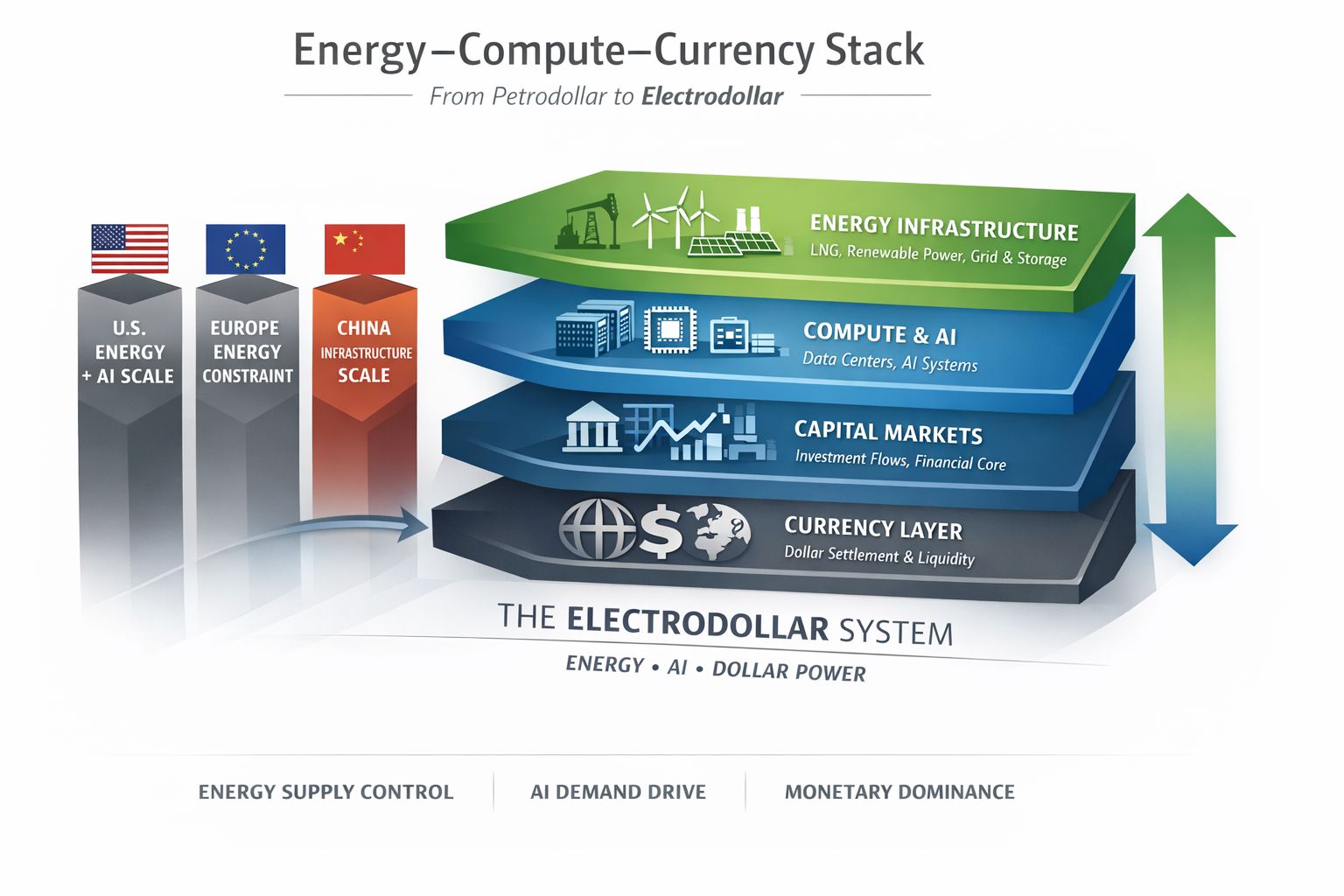
Doctrine — Infrastructure Currency
Monetary power in an energy-bound system is not anchored in energy pricing alone.
It is anchored in the ability to build, control, and scale the infrastructure systems through which energy is converted into economic and technological power.
- Energy-Bound System
- Energy as Operating System of Power
- Global Paradigm Shift
- Global Energy System Shift
- Energy Geopolitics and the Global Paradigm Shift- Why Decarbonisation Has Become a Competitiveness Strategy
- AI–Energy–Cost Chasm
- Monetary Ceiling
- Energy Constraint and the Monetary Ceiling (EU)
- Monetary Sovereignty in an Energy-Bound System - Currency, Capital, and Control Under Structural Constraint
- Monetary Power - Energy, industry, infrastructure, geopolitics
- Infrastructure Currency Doctrine (this article) - Monetary power emerges from control of energy infrastructure systems ## Keynote
For half a century, the global monetary system has been anchored in a simple loop.
Energy exported in dollars.
Surpluses recycled into dollar assets.
Liquidity returned to the system that priced the energy.
This was the petrodollar system.
Today, that system is not disappearing.
But it is no longer sufficient to describe how monetary power
operates.
A new layer is emerging.
Energy flows are now interacting with:
- compute infrastructure
- digital payment rails
- sovereign capital
- electrification systems
- and geopolitical fragmentation
The result is not a replacement of the old order.
It is a recomposition.
I. The Petrodollar System (Recap)
The original architecture functioned as a reinforcing loop:
oil exports (USD)
↓
current account surpluses (Gulf)
↓
recycling into US Treasuries and assets
↓
low-cost US financing
↓
global dollar liquidity
This system linked:
energy → capital → currency
Its strength was not only pricing.
It was systemic absorption capacity.
The United States could:
- consume energy
- absorb global surpluses
- issue reserve assets
- and recycle liquidity globally
II. What Has Changed
Three structural shifts have altered this equilibrium.
1. Energy Geography Has Shifted
The rise of US shale reduced dependence on imported oil.
This did not end the dollar system.
But it changed its internal balance:
- less direct oil import dependence
- more domestic energy production
- altered trade flows
- different capital recycling dynamics
The system did not collapse.
It became less linear.
2. The System Has Become Infrastructure-Dependent
Energy is no longer the only strategic layer.
Power now flows through:
- data centres
- semiconductor supply chains
- cloud infrastructure
- electricity grids
- digital payment systems
Energy still anchors the system.
But infrastructure now determines how energy becomes power.
3. Geopolitics Has Re-entered the Core
The Middle East war has revealed something critical:
Energy, transport, compute, and finance are no longer separable.
They are co-located.
Chokepoints, pipelines, LNG routes, data centres, and financial flows now sit inside the same risk geography.
This changes the nature of the system.
III. War as a System Transmission Event
The war does not only affect supply.
It affects the architecture of the system.
Energy disruption
↓
shipping and insurance repricing
↓
price volatility
↓
industrial margin compression
↓
inflation and rate sensitivity
↓
capital reallocation toward stability
↓
reinforcement of monetary hierarchy
This is the same transmission mechanism described in:
→ Energy Constraint and the Monetary Ceiling
The difference is scale.
The transmission is now global and immediate.
IV. The Emergence of “Infrastructure Currency”
A new question is becoming central:
Who builds the systems through which energy is produced, transmitted, computed, and settled?
Because increasingly:
- grids
- energy systems
- compute infrastructure
- digital payment rails
are not neutral.
They embed:
- standards
- financing structures
- software dependencies
- and often currency preferences
This gives rise to what can be called:
Infrastructure Currency
Not a single currency.
But a system in which:
monetary influence follows infrastructure deployment
V. Two Emerging Pathways
The global system is beginning to show two different models.
1. The Dollar System (Extended)
The United States is adapting its existing architecture.
It combines:
- deep capital markets
- Treasury-backed liquidity
- stablecoins and digital rails
- hyperscale compute infrastructure
- global platform ecosystems
This is not a break from the past.
It is an extension of the petrodollar logic into digital infrastructure.
Energy → Capital → Currency
↘
Compute
2. The Electro-Industrial System (China)
China is building a different structure.
It exports:
- energy infrastructure (solar, batteries, grids)
- industrial systems
- manufacturing ecosystems
- digital coordination layers
This creates:
Energy → Industry → Infrastructure
↓
Payment integration
Settlement may not be immediate.
But influence accumulates through:
- standards
- dependency
- and system integration
VI. What Has Not Changed
Despite these shifts:
- global trade is still largely invoiced in dollars
- US Treasuries remain the deepest reserve asset
- crisis dynamics still push capital toward dollar systems
The old architecture is not gone.
It is being layered and stressed, not replaced.
VII. The Strategic Shift
The key transformation is this:
Monetary power is no longer only a function of financial markets.
It is increasingly a function of:
- energy systems
- infrastructure control
- compute architecture
- and geopolitical stability
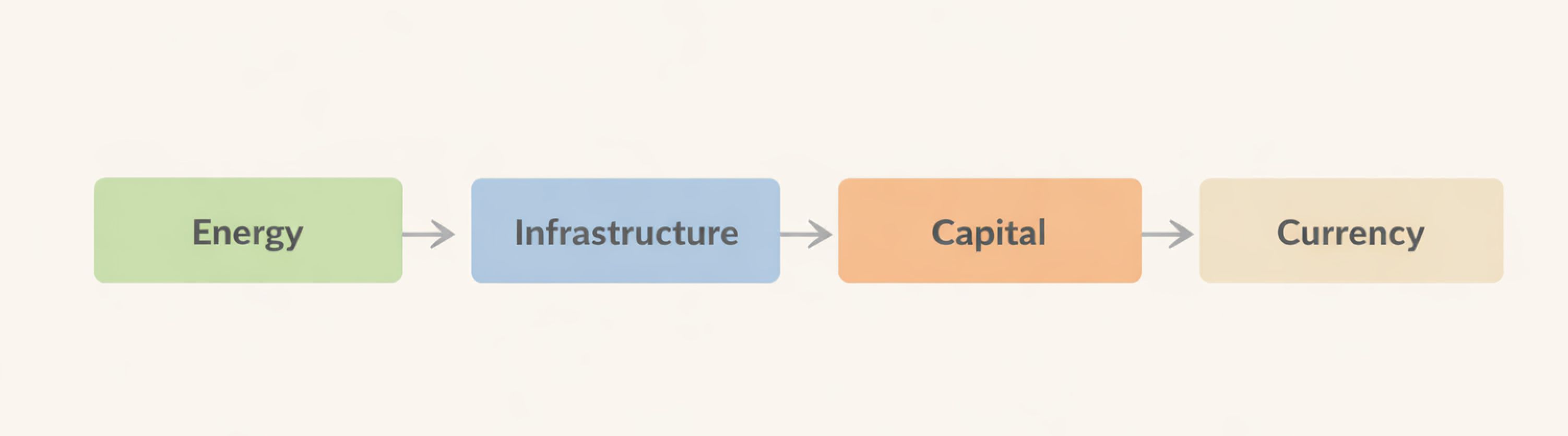
Which leads to a new hierarchy:
Energy → Infrastructure → Capital → Currency
VIII. Why This Matters for Europe
Europe sits inside this transition without controlling its key layers.
It:
- imports energy
- depends on external compute platforms
- lacks deep capital markets
- operates within a shared currency
Which means external shocks transmit directly into:
- industrial cost structures
- investment capacity
- and monetary stability
This is the logic of:
IX. The Core Insight
The global system is not moving from one currency to another.
It is moving from:
currency anchored in energy trade
to
currency embedded in infrastructure systems
One Line Doctrine
The next phase of monetary power will be determined less by who prices energy, and more by who builds the systems through which energy becomes infrastructure, computation, and economic activity.
Position in the Framework
This article sits in:
GLOBAL → System Power in an Energy-Bound World
It connects directly to:
- Energy Geopolitics
- Chokepoints Under Compression
- Energy Constraint and the Monetary Ceiling
- Energy–Industry–Compute Stack
- Agency Under Constraint
- Execution Under Compression
- Monetary Ceiling(Europe)
Related — Monetary Foundations
- Energy
Constraint and the Monetary Ceiling
- Energy,
Financialisation, and Capital Hierarchy
- Infrastructure Currency Doctrine
System Power Link
System Transition
The Energy J-Curve — AI, War, and Europe’s Point of No Return
Physical Constraint ## Transmission Mechanism
European Constraint Layer
Europe’s Challenge — Structural Compression ## Compute and Infrastructure Layer
→ See also:
- Energy
Constraint and the Monetary Ceiling
- US
Energy and Monetary Power
- Energy–Industry–Compute Convergence