EU Sovereignty
European Agency Under Constraint in an Energy-Bound System
Research Programme
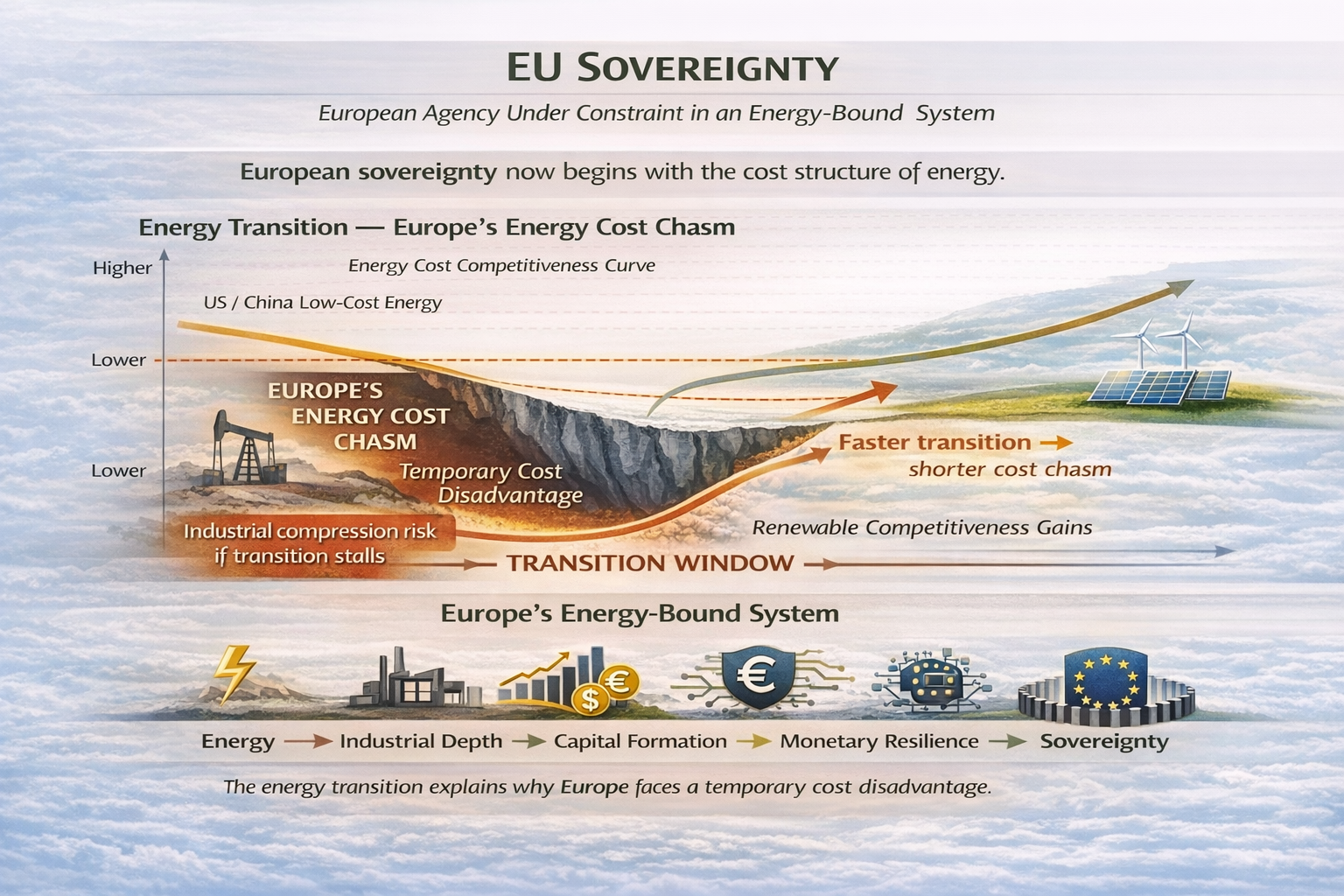
GLOBAL — Energy Paradigm Shift
TECHWAR — Energy–AI–Compute Competition
EU SOVEREIGNTY — European Agency Under Constraint
Doctrine Statement — European Sovereignty
In the emerging global order, energy availability and cost
function as the operating system of economic power.
In an energy-bound global system, sovereignty is determined less by
institutional ambition than by structural capacity.
Energy cost shapes industrial competitiveness, industrial
competitiveness shapes capital formation, and capital formation
ultimately determines technological and monetary power.
Summary
European sovereignty is increasingly shaped by the alignment between energy cost, industrial capability, and system control
As the global energy system transitions, structural differences in energy cost propagate through industry, capital formation, and monetary resilience.
Europe’s strategic challenge is therefore whether it can rebuild agency within an energy-bound global system.
The Energy–Power Framework
The global system is entering a structural transition in which energy cost and availability increasingly determine industrial capacity, capital formation, and technological capability.
This project examines that transformation across three analytical layers:
GLOBAL — Energy system transformation and the emerging energy-bound
world economy
↓
TECHWAR — Energy, AI, and industrial competition within that
system
↓
EU SOVEREIGNTY — Europe’s capacity to sustain agency under energy
constraint
This structure can be understood through three interacting system layers: ## System Architecture — Cost, Capability, and Control

European sovereignty is shaped by the alignment of three system layers:
- Cost → energy systems and compute economics
- Capability → industrial ecosystems and infrastructure
- Control → platforms, standards, and value capture
→ Constraint emerges when these layers are misaligned.
→ Agency emerges when they are coordinated→ Europe’s constraint is concentrated in cost and control, while capability remains unevenly >distributed.
→ Energy–Compute–AI
Stack (Cost Layer) → Industrial
Ecosystems — Cross-Panel Index
→ Digital
Sovereignty — Control, Compute, and Economic Power
The Energy–Sovereignty Framework
1. Energy Transition — The Cost Structure of the System
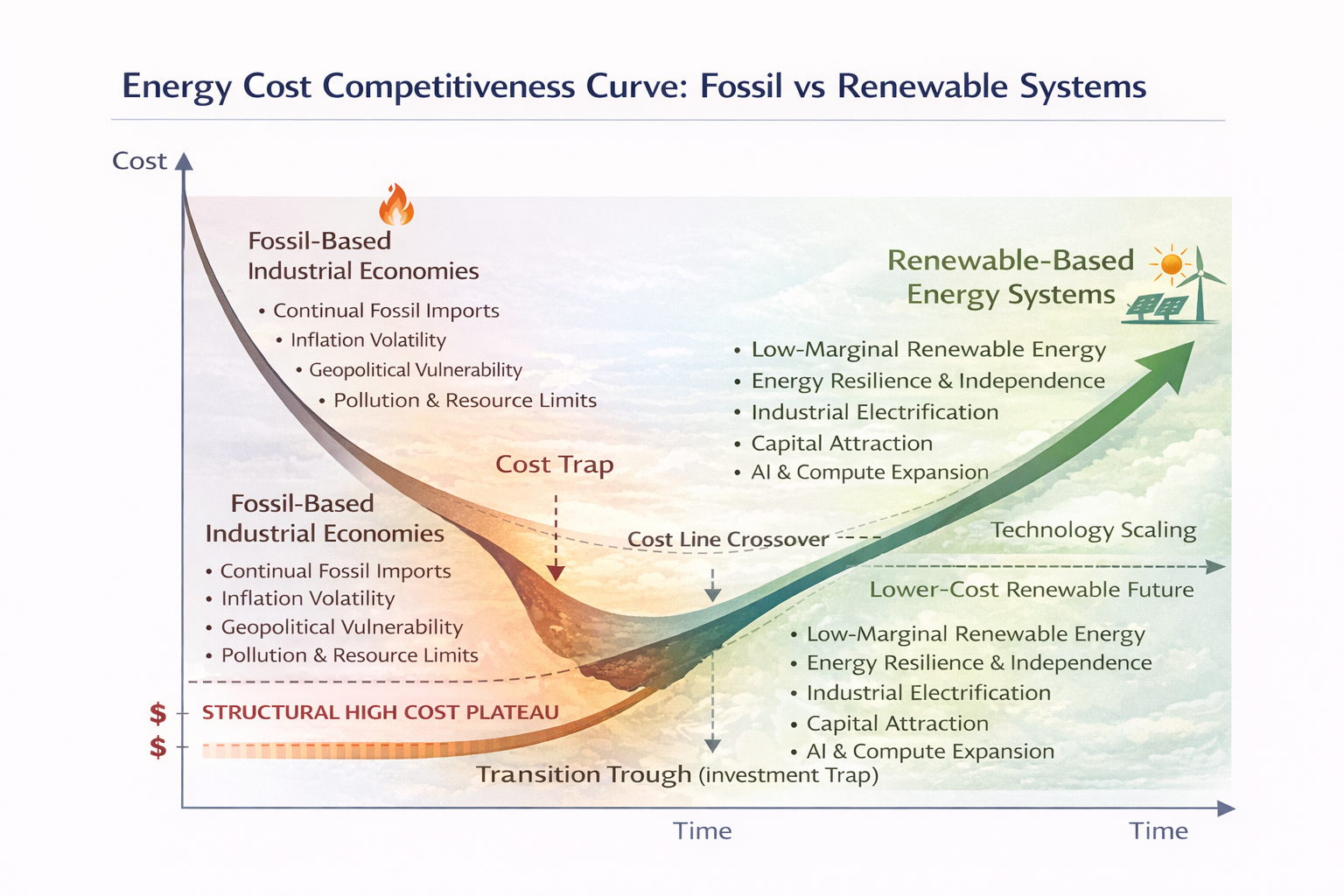
Energy Cost Competitiveness Curve — The Transition
Chasm
The global energy system is undergoing a structural transition from fossil-fuel-based industrial systems toward electrified and renewable architectures.
During this transition, economies experience a temporary phase of
elevated energy costs — the transition trough or energy
chasm.
Economies that move slowly risk remaining trapped in this high-cost
zone, characterised by compressed industrial margins, fiscal strain, and
rising debt pressure.
Accelerating renewable deployment, electrification, grid
infrastructure, and storage shortens this phase. Once scaled,
renewable systems offer structurally lower marginal costs and stronger
competitiveness.
The implications for sovereignty are direct:
energy cost becomes the upstream variable shaping industrial competitiveness, capital formation, and monetary resilience.
System Transmission Map
Energy constraint does not remain confined to the energy
system.
It propagates through the entire economic structure, shaping industrial
capacity, capital formation, monetary resilience, and ultimately
sovereignty.
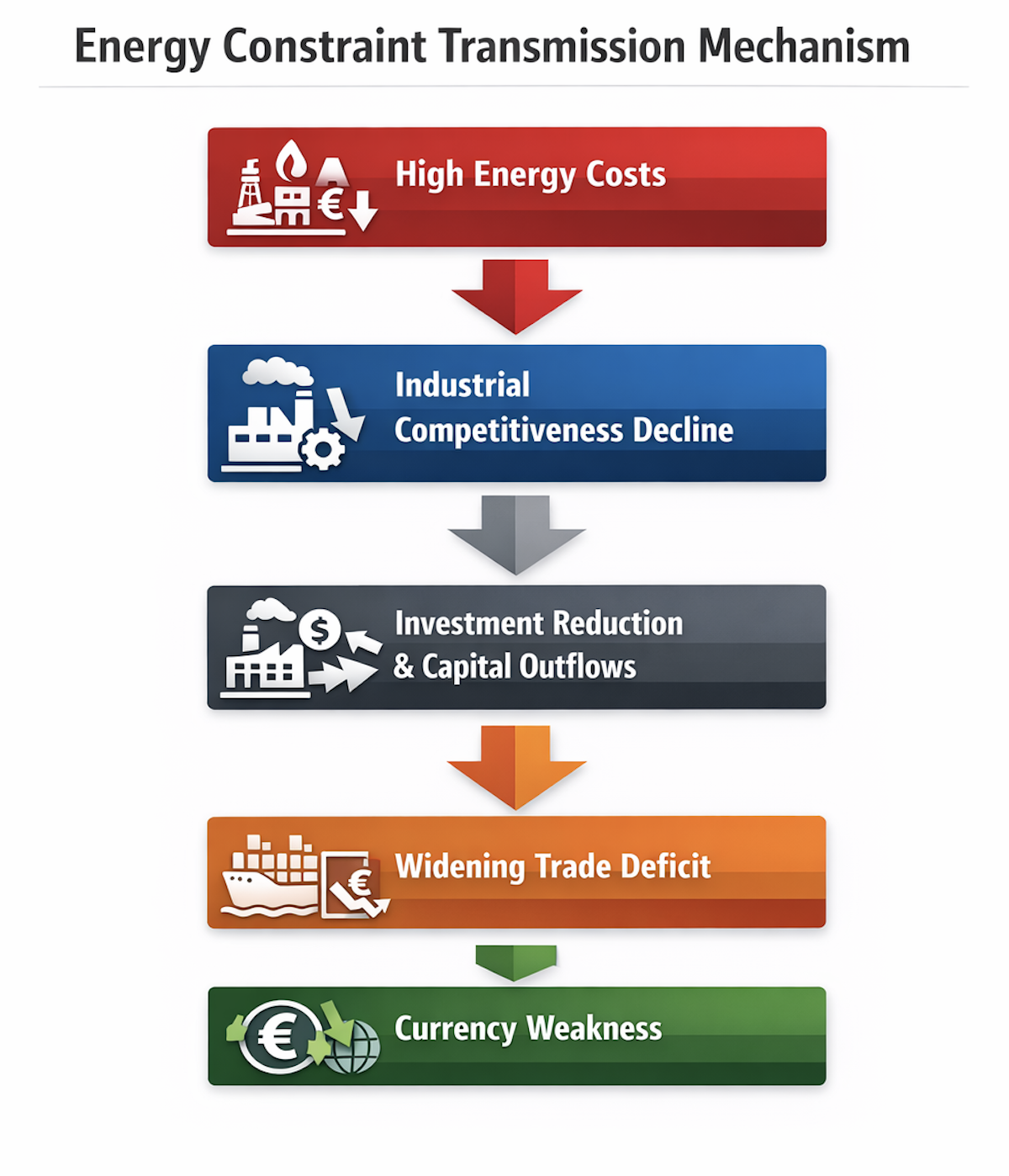
Energy Constraint — System Transmission Mechanism
Energy cost divergence
→ industrial margin compression
→ reduced reinvestment and relocation
→ capital reallocation
→ fiscal and monetary pressure
→ sovereign spread sensitivity
→ currency constraint
→ sovereignty ceiling
This transmission mechanism explains how energy becomes a monetary and geopolitical variable, linking physical systems to financial outcomes.
2. Energy Constraint — System Transmission
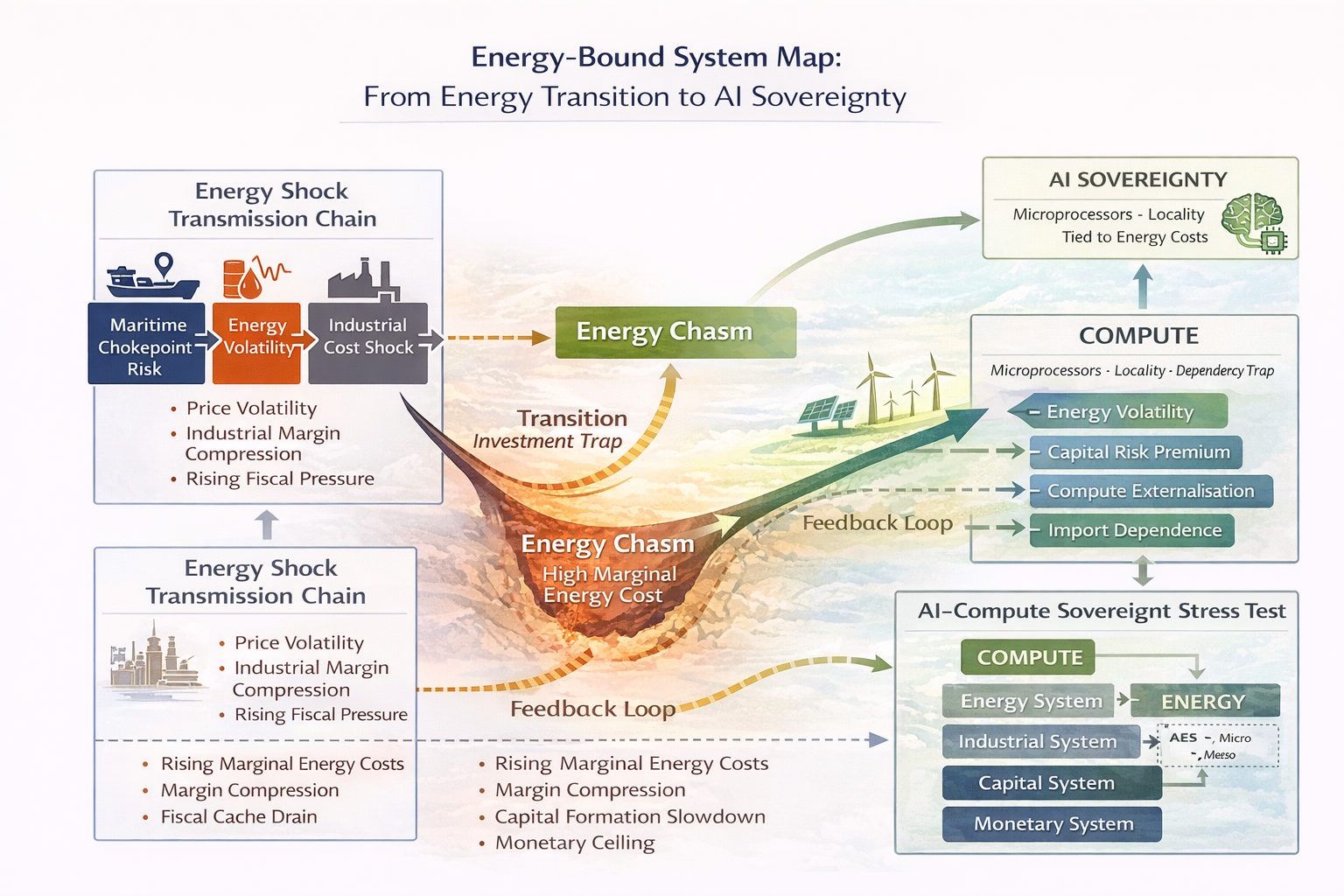
Energy-Bound System Map
In an energy-bound global order, energy availability and cost shape industrial competitiveness, capital formation, monetary resilience, and technological capability.
Sovereignty therefore becomes a question of agency within
structural constraint.
3. Structural Outcomes — Industrial Power and Sovereignty

Energy
↓
Industrial depth
↓
Capital formation
↓
Monetary resilience
↓
AI capability
↓
Sovereignty ceiling
Energy precedes capital.
Capital precedes currency.
AI accelerates both.
Method & Scope
This project examines sovereignty through structural economic analysis rather than political positioning.
It focuses on:
- energy systems and marginal energy cost
- industrial competitiveness and capital formation
- monetary resilience and technological capability
The objective is to evaluate feasible strategic outcomes under constraint, not normative policy preferences.
Panel Roadmap
I. Energy
II. Systems
III. Monetary Systems
IV. AI & Energy
V. Digital Sovereignty
VI. Doctrine
VII. Architecture
VIII. Execution Under Constraint
IX. Boundaries
X. Diagnostics
XI. Evidence
XII. Investor Layer
XIII. Public Annex
I. Energy — The Binding Variable
- Strategic
Constraint
- Energy as
Europe’s Strategic Constraint
- EU
Energy Paradigm Shift — Part I
- EU Energy Paradigm Shift — Part II
II. Systems — Structural Compression
- Europe’s
Challenge
- EU Systemic
Asymmetry
- EU Asymmetry
Under Stress
- EU in the G2
Order
- Chokepoints
Under Compression
- Energy Systems and the Tech War
III. Monetary Systems — Transmission
- Monetary
Sovereignty Under Constraint
- Energy
Constraint and the Monetary Ceiling
- Monetary Ceiling — Core Transmission
IV. AI & Energy — Acceleration Layer
- AI Compute
Ecosystems
- Energy
Systems and AI Infrastructure
- Compute
Locality
- AI–Energy–Sovereignty Framework
V. Digital Sovereignty — Control Layer
VI. Doctrine — Structural Conditions
VII. Architecture — Rebuilding Agency
European Constraint Chain
Structural constraint does not end at monetary transmission.
It continues through execution capacity and ultimately defines the
limits of sovereignty.
Even when structural conditions are understood and architectural responses are defined, constraint continues to propagate through execution capacity and political legitimacy.

European Constraint Chain — From Energy to Sovereignty
Limits
Energy constraint
→ monetary transmission
→ execution under compression
→ legitimacy boundary
→ sovereignty ceiling
This chain explains why European constraints are not only economic, but systemic.
Even when structural conditions are understood, execution capacity is compressed, and political legitimacy becomes the binding constraint.