The Legitimacy Boundary
Labour Markets and the Social Limits of Strategic Autonomy
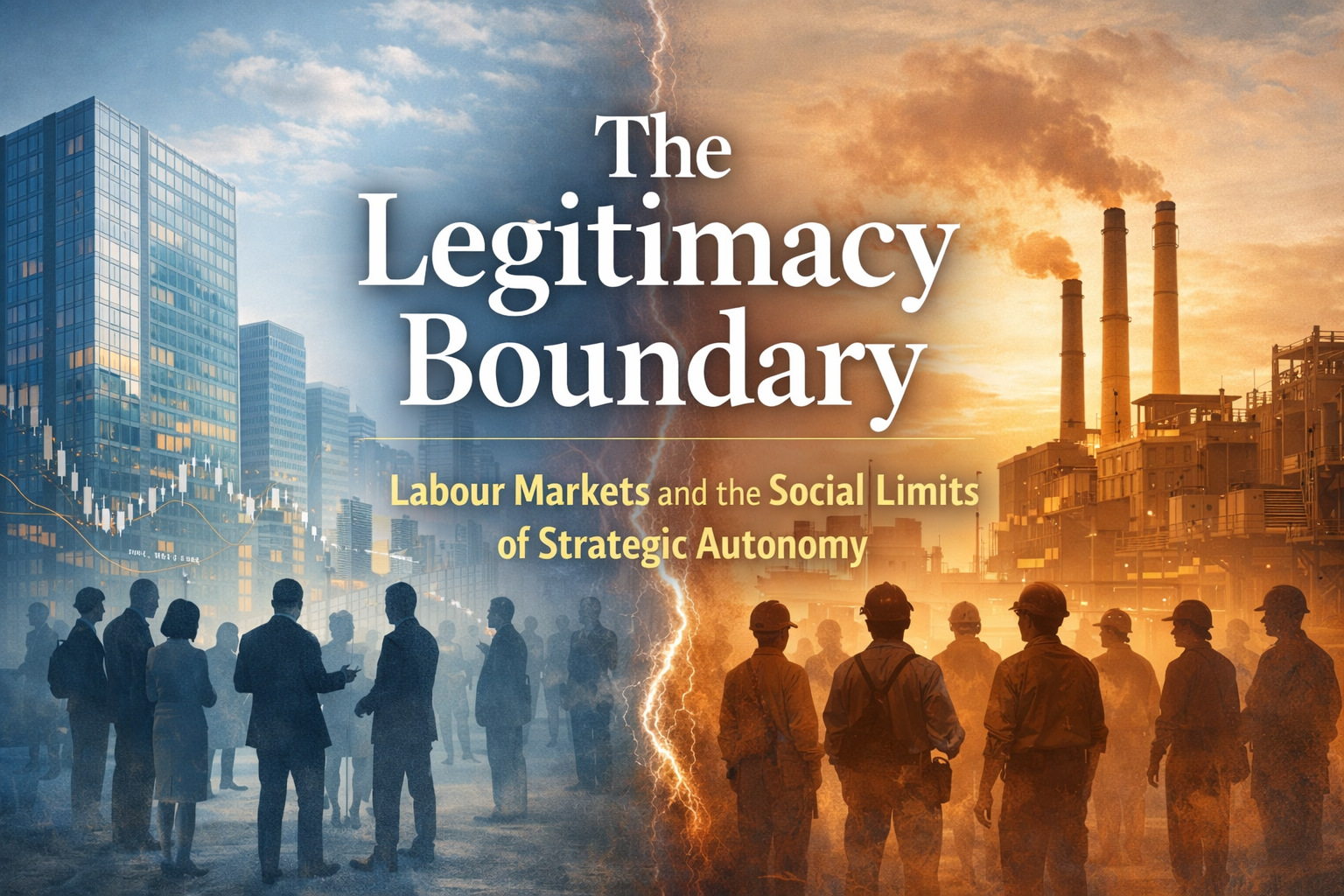
Strategic autonomy cannot endure without legitimacy.
In an Energy-Bound System, sovereignty is constrained not only by physics, capital, compute architecture, and institutional coordination, but by the willingness of societies to sustain collective direction under stress. Democratic consent therefore functions as a structural boundary condition — not a rhetorical or secondary political variable.
Energy sets the physical constraint.
Monetary capacity sets the financial constraint.
Compute architecture sets the distribution of capability.
Institutional coordination sets the execution constraint.
Legitimacy sets the durability constraint.
When the legitimacy boundary is breached, strategy fragments. Legitimacy index
1. Energy Transition as a Structural Labour Shock
The European energy transition is often framed as technological or environmental. Structurally, it is a labour market event.
Electrification, digital coordination, and AI integration reorganise production. Reliable and affordable electricity now conditions:
Industrial viability
SME competitiveness
Wage stability
Fiscal capacity
Regional cohesion
As established in Energy as Europe’s Strategic Constraint, energy affordability is no longer a sectoral issue. It shapes macroeconomic performance.
When electricity prices are structurally high or volatile:
Investment slows
Margins compress
Energy-intensive sectors relocate
Public budgets tighten
These pressures manifest locally — in employment stability, wage growth, and regional resilience.
–> As digital systems scale, energy costs increasingly translate into compute costs.
This affects not only large firms, but access to artificial intelligence, automation, and digital infrastructure across the economy.
When compute remains expensive or externally controlled:
SMEs face barriers to adoption
productivity gains concentrate in larger actors
technological capability becomes unevenly distributed
Labour market outcomes are therefore shaped not only by energy prices, but by who can access and deploy computation.
Under constraint, labour markets become transmission channels of energy and compute instability.
If unmanaged, this erodes consent.
2. Capability and Participation
In earlier industrial eras, legitimacy was anchored in territorially embedded production systems. Employment was visible. Value creation was geographically legible.
In a digitally coordinated, electrified economy, system control migrates upstream — into grids, standards, capital allocation, compute architecture, and integration layers, as outlined in Energy Sovereignty as System Control.
This upstream shift is increasingly mediated through platform ecosystems and integrated hardware–software systems, where control over operating systems, devices, and cloud infrastructure determines access to digital capability.
When these layers are externally controlled, participation becomes conditional rather than embedded — and economic agency is constrained by system design.
If the transition concentrates ownership of infrastructure while distributing cost broadly, democratic systems experience internal strain.
In an Energy-Bound System, redistribution alone cannot sustain legitimacy.
Legitimacy increasingly depends on participation in capability.
This includes:
Regional industrial regeneration
SME energy resilience
Distributed production models
Local integration of generation and storage
–> Compute locality provides an alternative model.
By embedding computation closer to industrial systems, energy infrastructure, and local economies, it enables:
broader participation in digital capability
reduced dependence on external platforms
more even distribution of productivity gains
In this sense, compute architecture is not only a technical
choice.
It is a determinant of economic inclusion and democratic
stability.
As argued in the Distributed Sovereignty Systems and Mediterranean Decentralised Energy Doctrine, decentralised architectures are not merely technical configurations. They diffuse both economic and political agency.
Shared capability stabilises consent.
3. Human Capital as Execution Capacity
System redesign is not self-executing.
Electrification and digital coordination generate demand for:
Grid integration specialists
Storage and battery technicians
Power electronics engineers
Building retrofitting professionals
AI-energy systems integrators
Distributed maintenance operators
Human capital formation determines whether system redesign remains internally executable.
If skills formation lags system transformation, Europe faces two risks:
External technical dependency
Internal labour bifurcation
Both weaken sovereignty.
As demonstrated in AI and Energy — The Sovereignty Stress Test, technological scaling amplifies energy constraint.
See also: Legitimacy, Labour, and System Durability Index
Without embedded technical capacity, strategic autonomy becomes declarative rather than operational.
Skills policy is therefore not a social supplement to strategy.
It is an execution variable.
4. Regional Asymmetry and Political Stability
Constraint does not affect all regions symmetrically.
Regions with:
Renewable resource endowment
Industrial clusters adaptable to electrification
Dense SME ecosystems
may experience regeneration.
Others may face transition shock.
Unmanaged divergence transforms economic asymmetry into political asymmetry.
In the Systems Under Constraint framework, instability accumulates when pressure cannot be transmitted outward. It converts into internal volatility.
Democratic systems under prolonged economic stress lose coordination capacity.
The legitimacy boundary is crossed not through rhetoric, but through persistent lived instability.
5. From Constraint to Collective Agency
Europe operates within structural ceilings:
External energy exposure
Geopolitical fragmentation
Technological competition
Fiscal limitation
Constraint does not inherently undermine democracy.
But unmanaged constraint does.
If the energy transition is experienced primarily as:
Cost escalation
Industrial exit
Employment instability
Regulatory burden
consent fragments.
–> In an energy-bound and compute-intensive economy, the cost of living is increasingly shaped by:
energy affordability
housing electrification costs
access to digital and AI-enabled services
These are not separate domains.
They form a unified system cost structure experienced
directly by households and firms.
If the transition instead produces:
Reduced long-term energy volatility
Regional investment
Skill renewal
SME resilience
Industrial upgrading
consent stabilises.
The difference lies in institutional design and capability distribution.
Sovereignty, as defined in this panel, is built capacity.
Legitimacy is sustained capacity shared.
6. The Durability Condition
Strategic autonomy requires long time horizons.
Time horizons require social patience.
Social patience requires perceived fairness and opportunity.
Perceived fairness depends on participation in value creation.
In an electrified, AI-driven economy, energy functions as the operating layer of economic life, as outlined in Energy as the Operating System of Power.
If that layer remains volatile and externally dependent, democratic systems absorb instability.
If it becomes resilient, affordable, and socially anchored, democratic systems gain endurance.
The legitimacy boundary therefore defines the durability of European sovereignty.
When energy transition strengthens labour stability and capability distribution, autonomy deepens.
When it concentrates gains and diffuses cost, autonomy weakens.
Boundary Condition
In an Energy-Bound System]:
Physics defines feasibility.
Capital defines scale.
Compute architecture defines distribution.
Institutions define coordination.
Legitimacy defines duration.
Strategic autonomy without democratic consent is fragile.
Democratic consent without economic capability is unsustainable.
The task of European sovereignty is to align them.
This is the social limit of strategy.
Further Reading — Democratic Legitimacy Under Constraint
The following works deepen the theoretical foundations of the legitimacy boundary.
Strategic autonomy cannot endure without democratic consent.
These articles consolidate the labour, skills, and democratic durability
dimension of the EU Sovereignty framework.
Further reading on this site:
Legitimacy & Labour Reference
Index
Fritz W. Scharpf
Input vs Output Legitimacy (EU Governance
Theory)
Introduces the distinction between participatory legitimacy (“government
by the people”) and performance legitimacy (“government for the
people”). Under energy constraint, output performance becomes
structurally decisive.
Dani Rodrik
The Globalisation Trilemma
Explains the tension between economic integration, sovereignty, and
democratic politics. Energy constraint compresses this triangle and
forces trade-offs to become visible in labour markets.
Wolfgang Streeck
Democratic Capitalism Under Strain
Examines how slow growth and fiscal pressure destabilise democratic
systems. Relevant to understanding how prolonged energy volatility
transmits into political fragmentation.
Jürgen Habermas
Post-National Democracy and Legitimacy
Argues that European governance requires sustained public justification
across borders. Energy system redesign increasingly functions as
constitutional architecture.
European Commission
European Skills Agenda & Green Transition
Frameworks
Provides institutional perspective on workforce adaptation to
electrification and digital transformation. Demonstrates how skills
formation intersects with sovereignty execution capacity.