Gulf Petrodollar Architecture
Energy Surplus, Capital Recycling, and the Reconfiguration of Monetary Power
Keynote
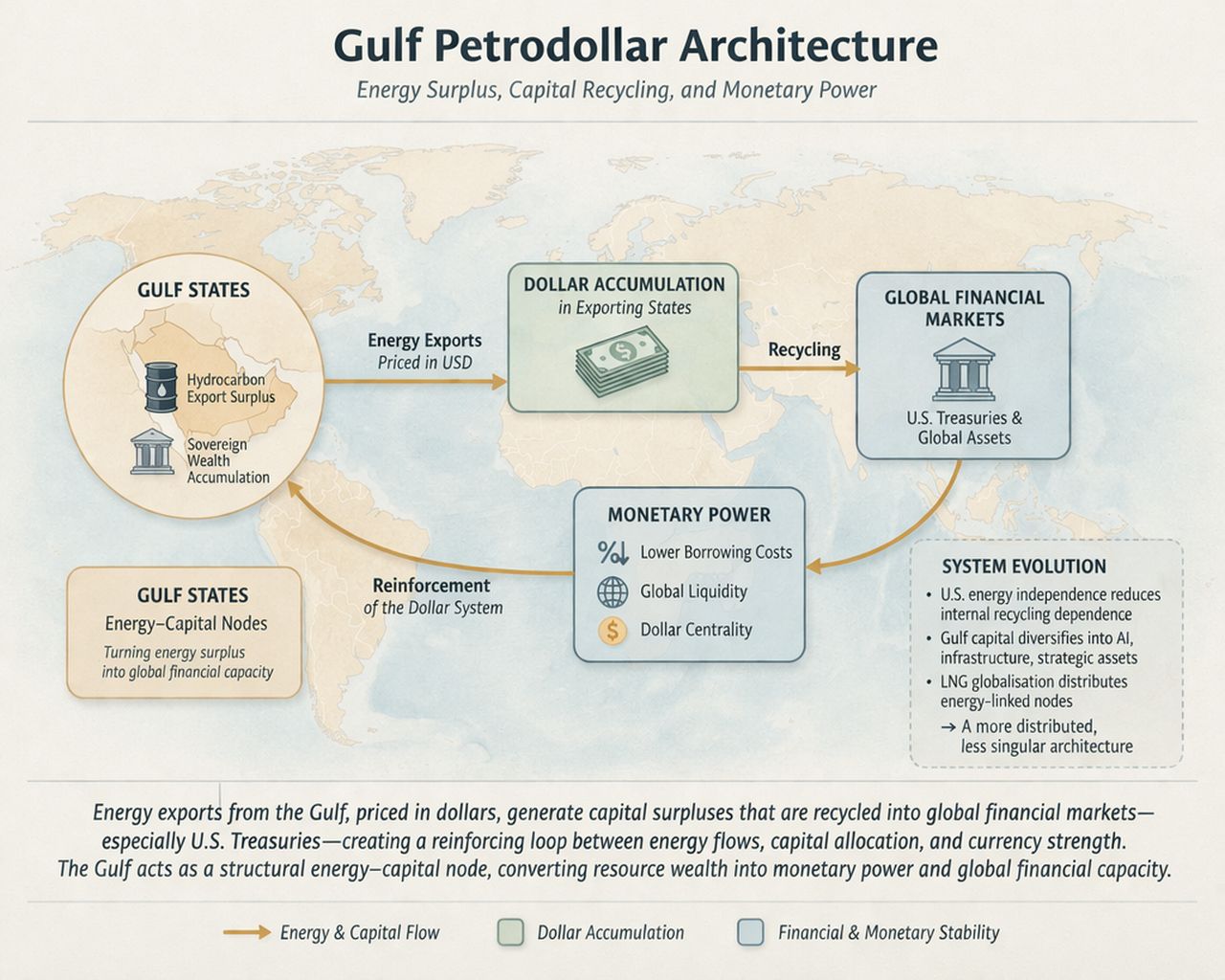
The modern global monetary system has been shaped by a structural linkage between energy production, capital flows, and currency dominance. Hydrocarbon exports priced in U.S. dollars generated persistent surpluses in Gulf economies, which were recycled into global financial markets—particularly U.S. Treasuries—reinforcing liquidity, lowering borrowing costs, and sustaining dollar centrality.
This system is now evolving under conditions of energy transition, rising demand, and geopolitical contestation.
Energy surplus is increasingly deployed not only into financial assets but into infrastructure, technology, and compute capacity. At the same time, the underlying monetary architecture is not dissolving—it is being actively defended and reconfigured.
The relationship between energy, capital, and power is therefore not weakening.
It is intensifying and becoming more strategic.
System Position
This case sits within GLOBAL → Energy Geopolitics → Monetary and Financial Systems. It complements Energy Constraint and the Monetary Ceiling (structural constraint), Energy Shock Transmission Chain (mechanism), and Peripheral Nodes in an Energy-Bound System (structure). It represents the surplus-side counterpart to the constraint dynamics observed in energy-importing systems, and links directly to the Energy Transition J-Curve (cost–demand interaction under transition).
I. The Original Petrodollar System
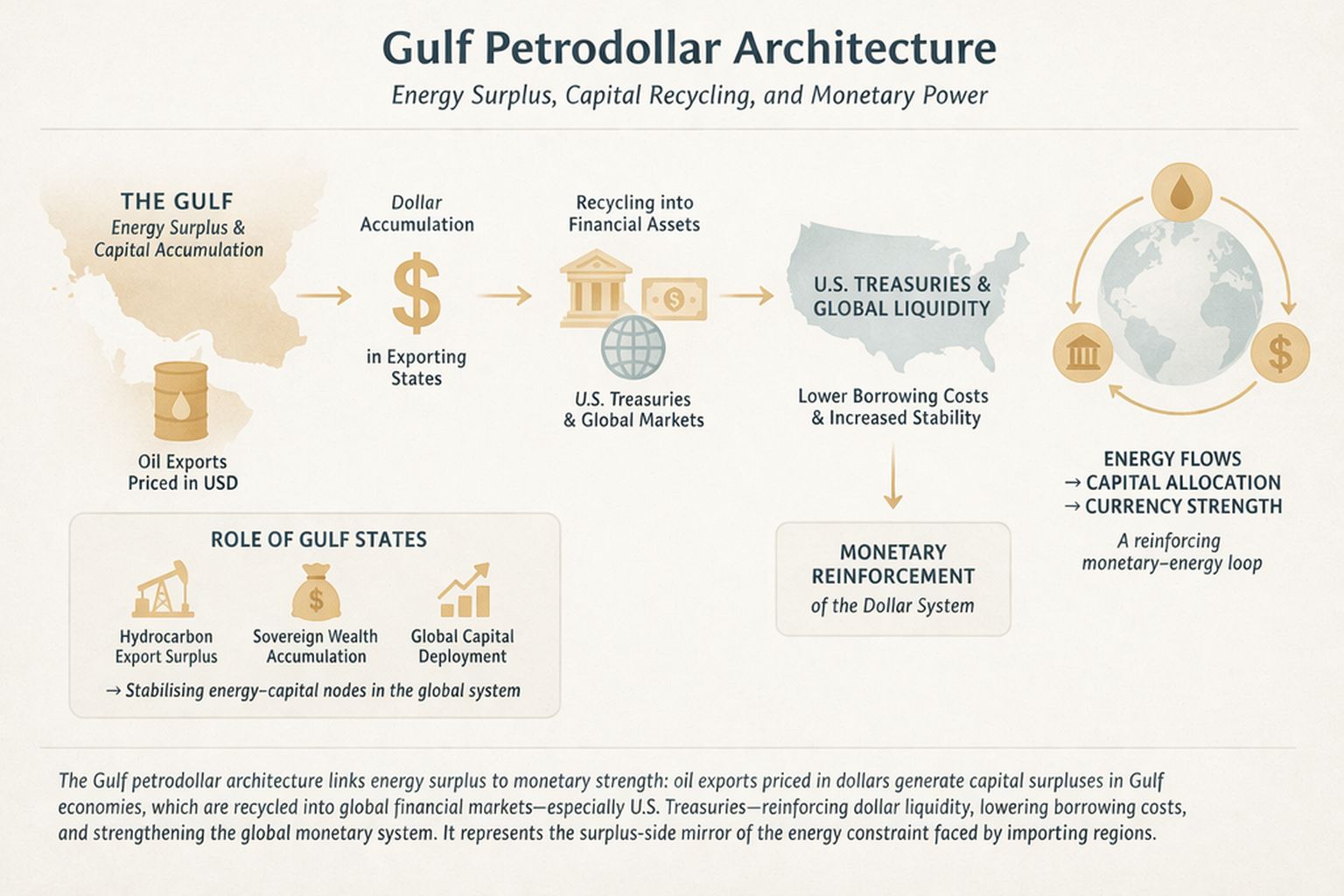
Energy exports priced in USD → dollar accumulation in exporting states → recycling into U.S. Treasuries and global assets → expansion of global liquidity → reinforcement of dollar reserve status.
This created a self-reinforcing loop:
energy demand → dollar demand → capital recycling → financial stability → renewed demand for dollar-denominated energy.
Energy flows became monetary infrastructure.
II. Capital Recycling and System Stability
Petrodollar recycling financed U.S. deficits, supported global bond market depth, anchored liquidity conditions, and reduced volatility. It enabled the U.S. to act as absorber of surplus capital while the dollar functioned simultaneously as reserve, settlement, and investment currency.
The system linked energy production directly to global financial stability.
III. Gulf States as Energy–Capital Nodes
Gulf economies combine large-scale hydrocarbon export capacity, limited domestic absorption, sovereign wealth accumulation, and centralised capital allocation.
This produces persistent surpluses that must be externalised.
They function as energy–capital nodes, converting resource flows into global financial capacity through strategic allocation, geopolitical positioning, and long-term investment.
Increasingly, this allocation is shifting toward infrastructure, technology, and compute systems, linking energy surplus directly to future industrial capacity.
IV. Structural Limits of the Original Model
The classical system depended on:
- stable oil demand
- dollar pricing dominance
- deep U.S. financial markets
- limited systemic alternatives
These conditions are now under pressure.
Energy transition reduces structural reliance on hydrocarbons.
At the same time, the transition itself introduces cost instability, demand acceleration, and geopolitical constraint.
The system is not simply weakening.
It is entering a phase of contested adaptation.
V. System Transition
Several changes are reshaping the system:
- energy transition reduces reliance on hydrocarbons alone
- AI and digital infrastructure increase electricity demand
- LNG globalisation shifts energy into maritime networks
- U.S. energy independence alters internal recycling dynamics
- sanctions and geopolitical risk increase incentives for diversification
At the same time, these dynamics interact with the energy transition J-curve:
dual systems
+
rising demand
+
volatile pricing
+
geopolitical constraint
The result is a system under stress—but not collapse.
It is being restructured under pressure.
VI. China–Gulf Integration
The Gulf is increasingly integrated into Asia-facing systems through energy trade, infrastructure investment, logistics, and industrial cooperation.
China’s role as a major trade partner links Gulf energy flows to Asian industrial demand.
This introduces multi-axis system integration:
U.S. financial system
+
Asian industrial demand
+
Gulf energy surplus
The Gulf is no longer tied to a single axis but operates within overlapping systems.
VII. Payments and Monetary Optionality
The shift is not a sudden move away from the dollar.
It is an expansion of optional pathways:
- diversified trade invoicing
- bilateral settlement systems
- alternative financial channels
The dollar remains dominant.
But the architecture beneath it becomes more layered and flexible.
VIII. From Petrodollars to Compute Capital
A major transformation is the redeployment of surplus capital into:
- AI infrastructure
- data centres
- semiconductors
- cloud systems
- digital platforms
Energy surplus is no longer only recycled into financial assets.
It is increasingly converted into compute capacity and technological control.
This links directly to the emerging architecture:
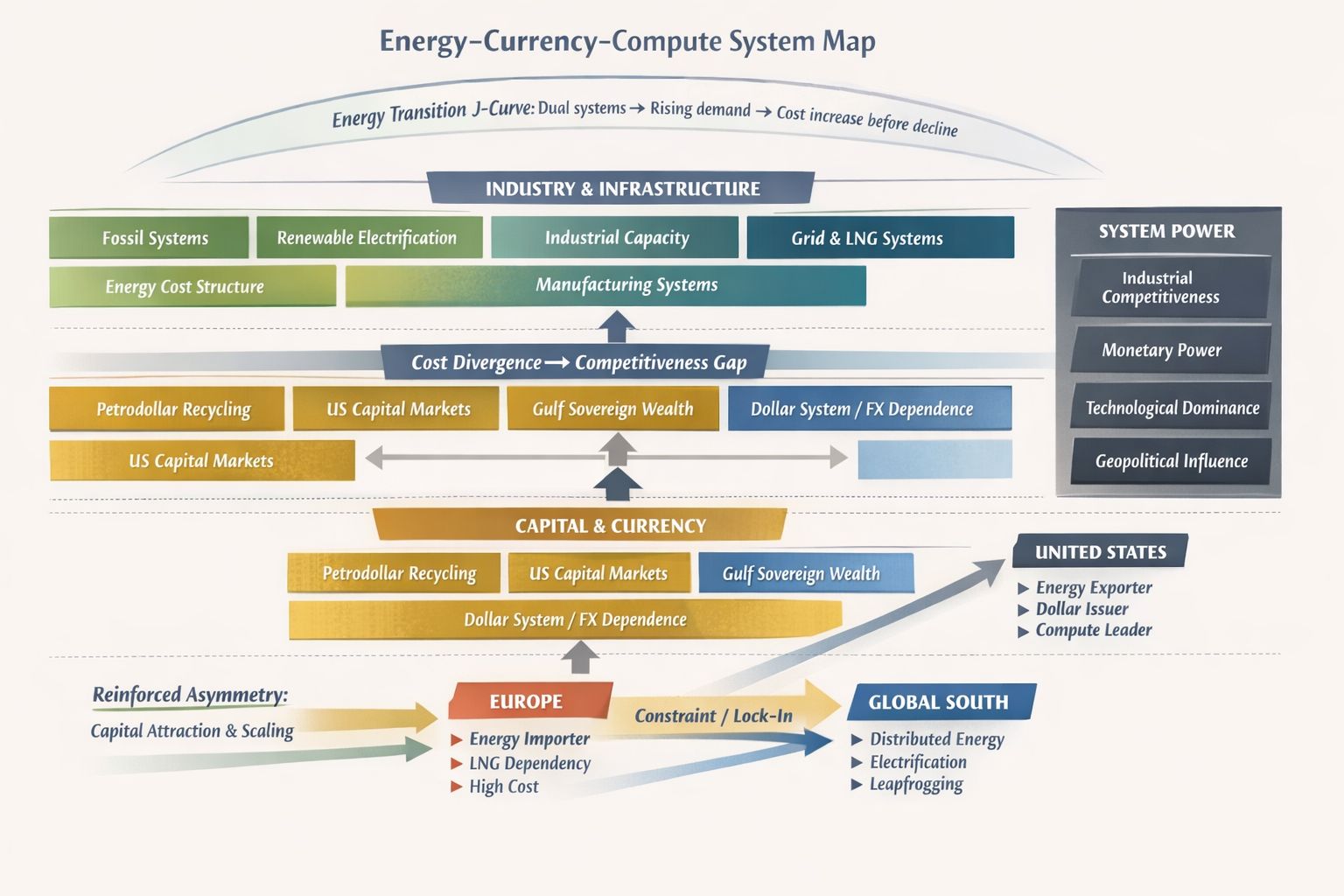
Energy → Capital → Compute → Power
IX. Link to LNG and Maritime Systems
LNG introduces:
- maritime dependence
- chokepoint exposure
- global pricing
- distributed entry nodes
But it also reinforces existing structures.
Long-term LNG contracts are:
- dollar-denominated
- infrastructure-intensive
- long-duration
They create energy–currency lock-in, particularly for importing regions.
The system becomes:
flows → corridors → nodes → transmission
but remains tied to financial architecture.
X. Integration with Peripheral Nodes
The system operates across node types:
- surplus nodes (Gulf) generate capital and reinforce monetary systems
- constraint nodes (e.g. Greece) absorb shocks and transmit volatility
Together they form a chain:
energy surplus → capital export → infrastructure nodes → cost transmission → monetary outcomes
XI. War and System Contestation
Current geopolitical tensions intersect directly with this architecture.
The issue is not simply currency dominance.
It is control over:
- energy corridors
- maritime chokepoints
- infrastructure systems
- capital flows
- technological layers
Sanctions regimes increasingly link energy access to financial alignment.
Energy
↓
currency
↓
system participation
What is being contested is not just trade.
It is the architecture through which energy is converted into power.
XII. Europe and Structural Lock-In
This dynamic is most visible in Europe.
- dependence on imported LNG
- dollar-denominated energy exposure
- long-term infrastructure commitments
- security alignment through NATO
combine to create structural lock-in at the peak of the transition cost curve.
At the same time:
- energy costs remain structurally higher than in the U.S.
- industrial margins compress
- capital reallocates
Europe is therefore exposed to the transition under maximum constraint.
XIII. System Implication
Energy systems are globalising.
Capital flows are diversifying.
Monetary systems are layering.
Technology is integrating into the energy–capital loop.
But this does not produce symmetry.
It produces reinforced asymmetry:
- the U.S. consolidates advantage
- Europe absorbs cost and dependency
- parts of the Global South leapfrog toward electrified systems
The new configuration is:
Energy → Capital → Infrastructure → Compute → Power
XIV. Doctrinal Integration
Energy Geopolitics and the Global Energy Paradigm Shift; Energy Transition J-Curve; Energy Constraint and the Monetary Ceiling; Peripheral Nodes in an Energy-Bound System; Energy Sovereignty as System Control.
System Logic
Energy exports → capital accumulation → financial and strategic allocation → infrastructure and compute investment → monetary reinforcement.
Conceptual Summary
The original petrodollar system linked oil to financial power.
The emerging system links energy surplus to capital, infrastructure, and compute within a contested global architecture.
Final Insight
What is changing is not simply the currency used in trade.
It is the structure through which energy is converted into power.
The petrodollar system is not disappearing.
It is being stressed, defended, and transformed.
The emerging system is not post-dollar.
It is a reconfigured energy–capital–compute architecture operating under strategic competition.
Further Reading
System Architecture, Transition Dynamics, and Strategic Application
Core Doctrine
System Dynamics
Monetary and Financial Systems
- Energy Constraint and the Monetary Ceiling
- Gulf Petrodollar Architecture
Transmission Mechanism
System Structure
Tech War — Energy, Compute, and Control
- Energy Systems and the Tech War
- Energy–Compute–AI Stack
- Hyperscalers and Centralised Compute Power
- Digital Sovereignty Reading Map
Applied Layer — Europe and System Constraint
Core System Foundations
IMF — COFER (global reserve currency composition)
https://data.imf.org/en/datasets/IMF.STA%3ACOFERFederal Reserve — The International Role of the U.S. Dollar
https://www.federalreserve.gov/econres/notes/feds-notes/the-international-role-of-the-u-s-dollar.htmBIS — Global liquidity and FX turnover
https://www.bis.org/statistics/rpfx25.htm
Energy and Petrodollar Structure
U.S. Energy Information Administration — Global oil trade & pricing
https://www.eia.gov/international/IEA — World Energy Outlook
https://www.iea.org/reports/world-energy-outlook
Gulf Capital and Sovereign Wealth
Public Investment Fund (Saudi Arabia)
https://www.pif.gov.sa/en/Abu Dhabi Investment Authority
https://www.adia.ae/Mubadala Investment Company
https://www.mubadala.com/
China–Gulf Integration
Ministry of Foreign Affairs of China — Middle East relations
https://www.fmprc.gov.cn/eng/gjhdq_665435/2675_665437/2878_663746/Reuters — China–Gulf trade and investment coverage
https://www.reuters.com/
AI, Capital Reallocation, and Infrastructure
Amazon Web Services — regional cloud investment
https://aws.amazon.com/Microsoft — AI infrastructure expansion
https://www.microsoft.com/Reuters — Gulf AI investment reporting
https://www.reuters.com/