Europe’s Energy Paradigm Shift
Part I: Democracy, Regeneration, and Strategic Opportunity in a Decentralised Age

Energy Transition J-Curve and the European Energy Chasm
Energy transitions temporarily increase marginal energy costs as legacy systems are dismantled before renewable infrastructure fully scales. Economies that move slowly risk remaining trapped in the transition trough — the energy chasm — characterised by high energy prices, compressed industrial margins, fiscal subsidies, and rising debt pressure. Accelerating renewable deployment shortens this phase and restores long-term energy cost advantage.
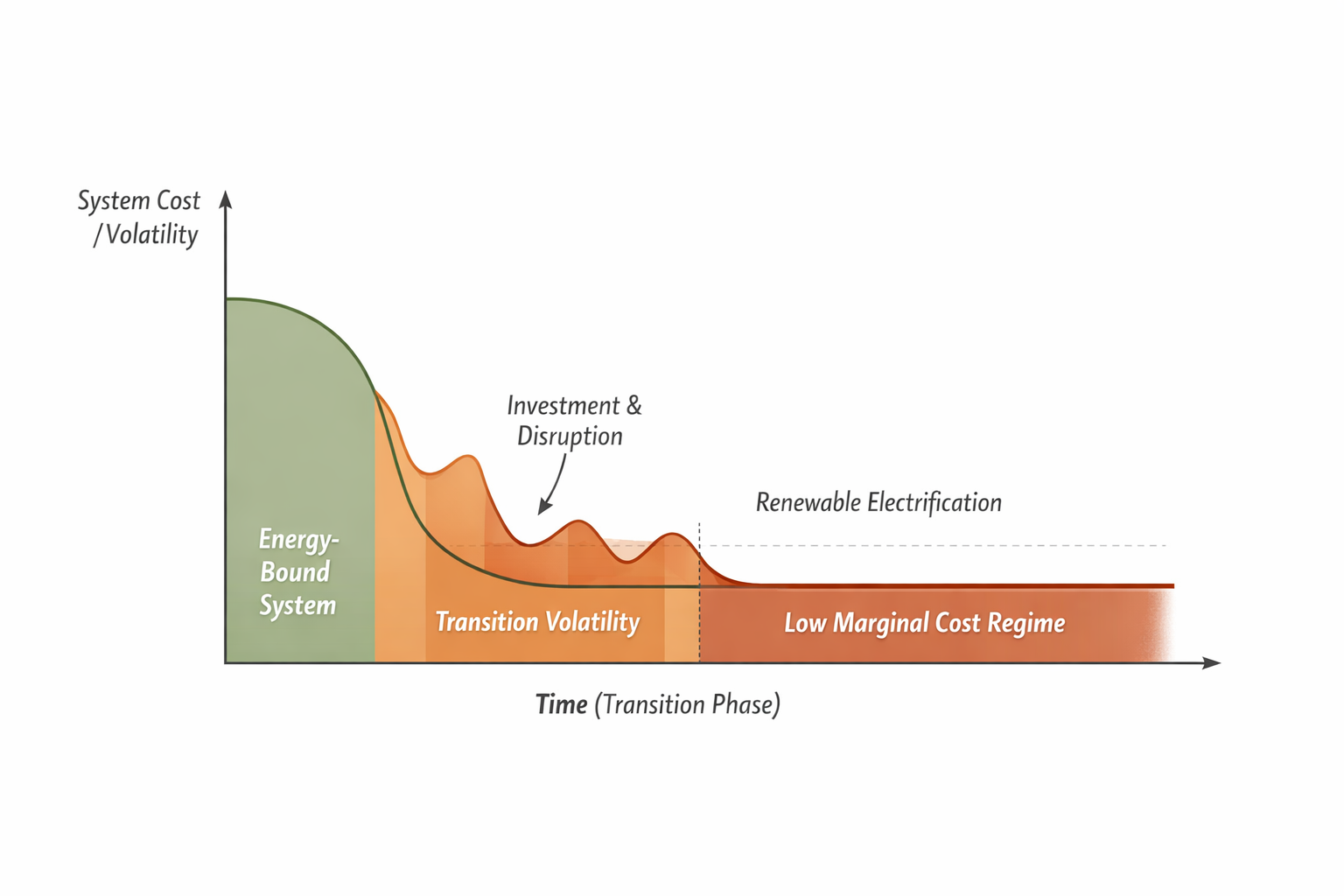
Europe’s position within the energy transition — as illustrated by the initial cost curve — is therefore structurally exposed: costs rise before the benefits of electrification are realised. In practical terms, Europe is currently positioned within the most exposed segment of this curve.
Energy costs remain structurally elevated, while the stabilising effects of electrification — lower marginal costs, localised generation, and system optimisation — have not yet fully materialised.
See: EU_Energy_Exposure_Sov_Data_Companion and Strategic Tipping Point
Keynote
Europe’s energy paradigm shift is not a climate adjustment.
It is a reorganisation of power under constraint.
In an energy-bound global system, sovereignty is no longer secured by fuel ownership or market access alone. It is secured by system design — the integration of generation, grids, storage, digital coordination, and industrial demand.
Decentralisation is not ideological.
It is architectural.
This creates a transitional asymmetry: competing systems with cheaper
energy consolidate industrial advantage, while Europe absorbs prolonged
cost pressure.
The strategic imperative is therefore not gradual transition,
but compression of the transition phase itself.
Executive Summary
The global energy paradigm has changed.
Power is no longer organised primarily around fossil fuel extraction, commodity flows, or marginal price efficiency. It is organised around:
System integration
Electrification capacity
Grid resilience
Digital coordination
Industrial coupling
In this environment, centralised energy architectures favour scale powers with vast domestic resource bases and integrated industrial ecosystems. The emerging U.S.–China structural asymmetry reflects precisely this reality.
Europe enters this system with structural constraints:
High import dependence
Fragmented grids
Ageing infrastructure
Slower capital coordination
Industrial erosion
Yet Europe also possesses a structural advantage:
Its political economy — decentralised, SME-dense, regionally diverse, and democratically embedded — is more compatible with distributed energy architectures than with fossil-fuel centralisation.
If designed strategically, decentralised energy can:
Reduce systemic vulnerability
Lower long-term industrial cost exposure
Re-embed production within regional ecosystems
Strengthen democratic legitimacy through local participation
Increase resilience against geopolitical energy leverage
Europe’s energy shift is therefore not a burden to manage.
It is a strategic redesign opportunity.
The question is not whether Europe can afford decentralisation.
The question is whether it can afford to remain structurally dependent in a system that is hardening around energy control.
I. The Structural Shift: From Commodity Power to System Power
The fossil era organised power around extraction and transport. Control flowed through pipelines, shipping routes, and resource ownership.
The electrified era organises power around system coordination.
Electricity is not stored or traded like oil. It must be generated, transmitted, balanced, and stabilised in real time. This requires:
Grid intelligence
Storage integration
Demand management
Digital control layers
In this architecture, sovereignty shifts from commodity possession to system capability.
States that control integrated energy systems possess:
Industrial cost stability
Crisis absorption capacity
Strategic autonomy in production
Reduced exposure to external leverage
States that do not become price-takers in both energy and industry.
II. Europe’s Structural Constraint
Europe’s energy vulnerability is not temporary. It is systemic.
Unlike continental-scale resource powers, Europe:
Imports significant energy inputs
Operates across fragmented regulatory jurisdictions
Faces higher average industrial energy costs
Lacks unified grid-scale integration
The Ukraine shock did not create this vulnerability.
It revealed it.
In an energy-bound system, persistent cost differentials compound into:
Industrial relocation
Capital flight
Strategic dependency
Political fragmentation
Energy is upstream of competitiveness.
Without structural redesign, Europe’s industrial base erodes faster than its political institutions can respond.
III. Why Decentralisation Aligns with Europe’s Political Economy
Europe is not structured like a petro-state or a continental superpower. Its strength lies in:
Dense regional economies
SME industrial clusters
Municipal governance capacity
Social partnership models
Advanced engineering ecosystems
These characteristics are poorly aligned with fossil centralisation but well aligned with distributed energy systems.
Decentralised architectures:
Reduce transmission losses
Lower exposure to external chokepoints
Enable local storage integration
Support regional industrial ecosystems
Diffuse risk across nodes rather than concentrate it
In geopolitical terms, decentralisation reduces the scale advantage gap between Europe and larger system powers.
It does not eliminate asymmetry.
But it narrows structural vulnerability.
IV. Democracy and System Design
Energy architecture shapes political stability.
Highly centralised energy systems concentrate:
Infrastructure risk
Capital ownership
Pricing power
Strategic leverage
Distributed systems diffuse control across:
Municipal actors
Regional cooperatives
Industrial clusters
Private-public hybrid models
For Europe, whose legitimacy depends on plural governance, decentralised energy is institutionally compatible.
It strengthens democratic embeddedness rather than straining it.
This matters in a period of geopolitical pressure and internal fragmentation.
System design and political cohesion are linked.
V. Industrial Regeneration Through Electrified Coupling
The next industrial cycle is energy-intensive and compute-intensive.
AI, advanced manufacturing, green materials, and digital infrastructure all increase electricity demand.
Regions with:
Stable low-cost electricity
Smart grid capacity
Storage integration
Industrial-energy coupling
will attract capital and production.
Europe cannot compete on resource scale.
It can compete on system intelligence.
Decentralised electrification — properly financed and digitally integrated — allows:
Re-industrialisation at regional level
Shorter value chains
Reduced import exposure
Increased economic resilience
Energy is no longer a background input.
It is the organising layer of industrial power.
VI. Strategic Opportunity Under Constraint
Constraint does not eliminate agency.
It forces redesign.
Europe’s energy paradigm shift is best understood as:
A move from fossil dependency
to distributed system control.
This requires:
Grid-scale investment
Storage acceleration
Digital energy coordination
Regulatory simplification
Capital market alignment
Industrial policy integration
The cost of inaction is cumulative structural erosion.
The reward for redesign is renewed sovereignty.
Conclusion
Europe’s energy paradigm shift is not primarily about decarbonisation.
It is about whether Europe can exercise agency inside an energy-bound global system increasingly structured by scale powers.
In a G2 environment defined by industrial concentration and energy scale, Europe’s path is neither imitation nor retreat.
It is architectural differentiation.
Decentralised energy is not a moral preference.
It is a structural strategy.
If executed coherently, it can regenerate Europe’s industrial base, stabilise its political systems, and preserve its strategic autonomy in a world where energy once again defines power.