Energy Leverage: U.S. Power Under System Constraint
Energy, power, and strategic autonomy — a system analysis
This article is part of the “New G2 Global Order” series, which examines how energy, finance, technology, and governance are restructuring global power.

Key Thesis
The United States’ transition from energy dependence to energy abundance has reshaped global power, but abundance alone does not guarantee strategic insulation.
Energy leverage now interacts with financial dominance, industrial capacity, and electricity infrastructure, creating new vulnerabilities alongside new strengths.
Without sustained alignment across grids, manufacturing, and supply chains, energy autonomy risks producing:
→ leverage without resilience
Power that appears decisive — but can decay over time.
Preface
The United States has undergone a profound structural transformation, shifting from the world’s largest energy importer to one of its dominant producers and exporters.
This transition has altered not only domestic economic dynamics, but the structure of global power itself.
Energy abundance now underpins:
- trade positioning
- alliance structures
- monetary reinforcement
- technological scaling
Unlike earlier financial-hegemonic phases, the United States now combines:
→ reserve currency dominance with energy surplus
This creates a hybrid system:
→ energy + capital + currency + compute
But this position is not frictionless.
Although the energy sector represents a modest share of GDP, its systemic impact is disproportionate. Capital inflows, dollar strength, and export revenues reinforce financial dominance — while simultaneously introducing structural pressures:
- manufacturing competitiveness erosion
- regional imbalances
- capital concentration
At the same time, the internal structure of the economy is changing.
Artificial intelligence, data centres, electrification, and advanced manufacturing are increasing the system’s dependence on continuous, high-load electricity.
This exposes a critical tension:
→ energy abundance at the resource level
→ constraint at the infrastructure level
The U.S. grid remains fragmented, aging, and partially dependent on foreign supply chains.
Energy autonomy therefore coexists with infrastructural vulnerability.
This mirrors a broader systemic pattern:
- Europe → dependence without leverage
- Russia → leverage without industrial depth
- United States → leverage with incomplete structural alignment
In all cases:
→ power exists, but its durability depends on material foundations
I. The Structural Shift: From Dependence to Leverage
For much of the post-war period, the United States depended on external energy supply.
Energy security required:
- maritime control
- geopolitical engagement
- stable global markets
The shale revolution reversed this structure.
The U.S. is now:
- the world’s largest combined oil and gas producer
- a major LNG exporter
- capable of scaling supply under demand shock
Energy has shifted from vulnerability to:
→ system-level leverage
But leverage increases systemic exposure.
It embeds the U.S. more deeply within global flows of:
- pricing
- capital
- demand
Energy power is therefore not insulation.
It is participation at a higher level of influence.

Global Maritime Oil Chokepoints and Shipping
Routes
_Chokepoints function as systemic leverage nodes, where
disruption transmits globally across energy markets._
II. Energy Power and Monetary Reinforcement
Energy exports are not only physical flows.
They are monetary flows.
Dollar-denominated energy trade:
- reinforces global dollar demand
- generates capital inflows
- deepens financial liquidity
This strengthens U.S. monetary dominance.
But it also introduces structural tension.
Sustained capital inflows and a strong dollar can:
- erode industrial competitiveness
- compress tradable sectors
- concentrate capital
This dynamic resembles Dutch disease, but within a more complex system buffered by:
- technological leadership
- domestic market scale
- capital depth
Energy leverage therefore reinforces:
→ currency strength
while simultaneously creating pressure on:
→ industrial balance
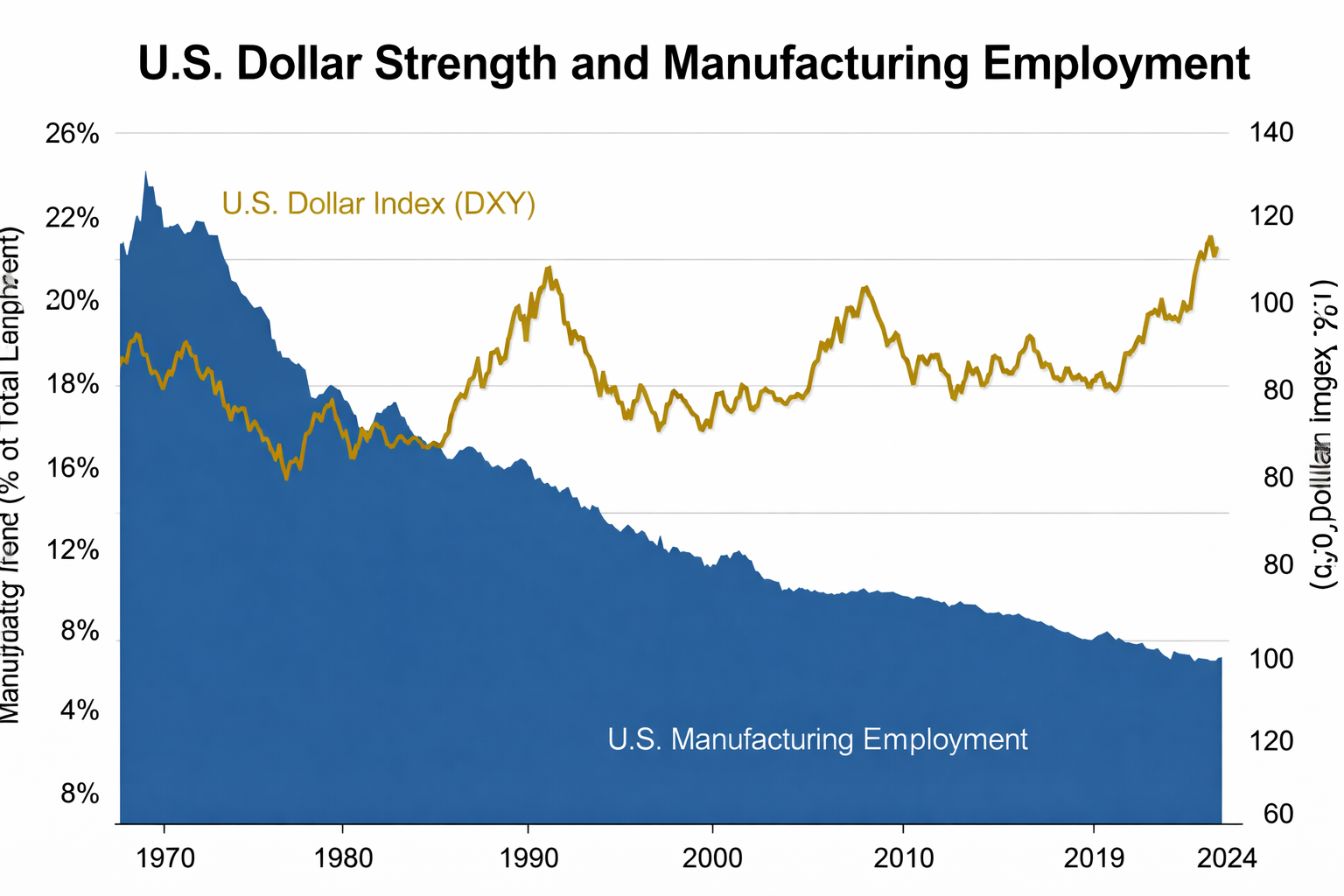
U.S. Dollar Strength and Manufacturing
Employment
Dollar strength has historically coincided with manufacturing
decline, reflecting structural currency pressures.
III. Energy Meets Compute — A System Convergence
A second transformation is now underway.
Energy is no longer linked only to industry.
It is linked to compute.
AI, cloud infrastructure, and digital systems require:
- continuous electricity supply
- grid stability
- capital-intensive deployment
This creates a new system architecture:
→ Energy–Industry–Compute Convergence
The emerging stack becomes:
Energy → Compute → Capital → Currency
This is not a sectoral shift.
It is:
→ system convergence
IV. The Real Constraint — Electricity Infrastructure
The critical constraint is no longer resource availability.
It is:
→ electricity capacity
Key dynamics:
- data centre demand accelerating rapidly
- AI clusters requiring 100–500 MW per site
- electrification expanding across sectors
- grid expansion lagging demand
Electricity has become:
→ the binding constraint on scale
Energy abundance without electrical capacity is not power.
It is constrained potential.
V. Grid Fragility and Infrastructure Limits
The U.S. electricity system reveals a structural weakness:
- aging transmission infrastructure
- slow permitting processes
- fragmented regulatory systems
- dependence on foreign grid components
Investment has increased, but not where most needed.
The result is a mismatch:
- rising demand
- insufficient transmission capacity
- limited system flexibility
Electricity — not fuel — is now the limiting layer of:
- industrial expansion
- AI scaling
- economic growth
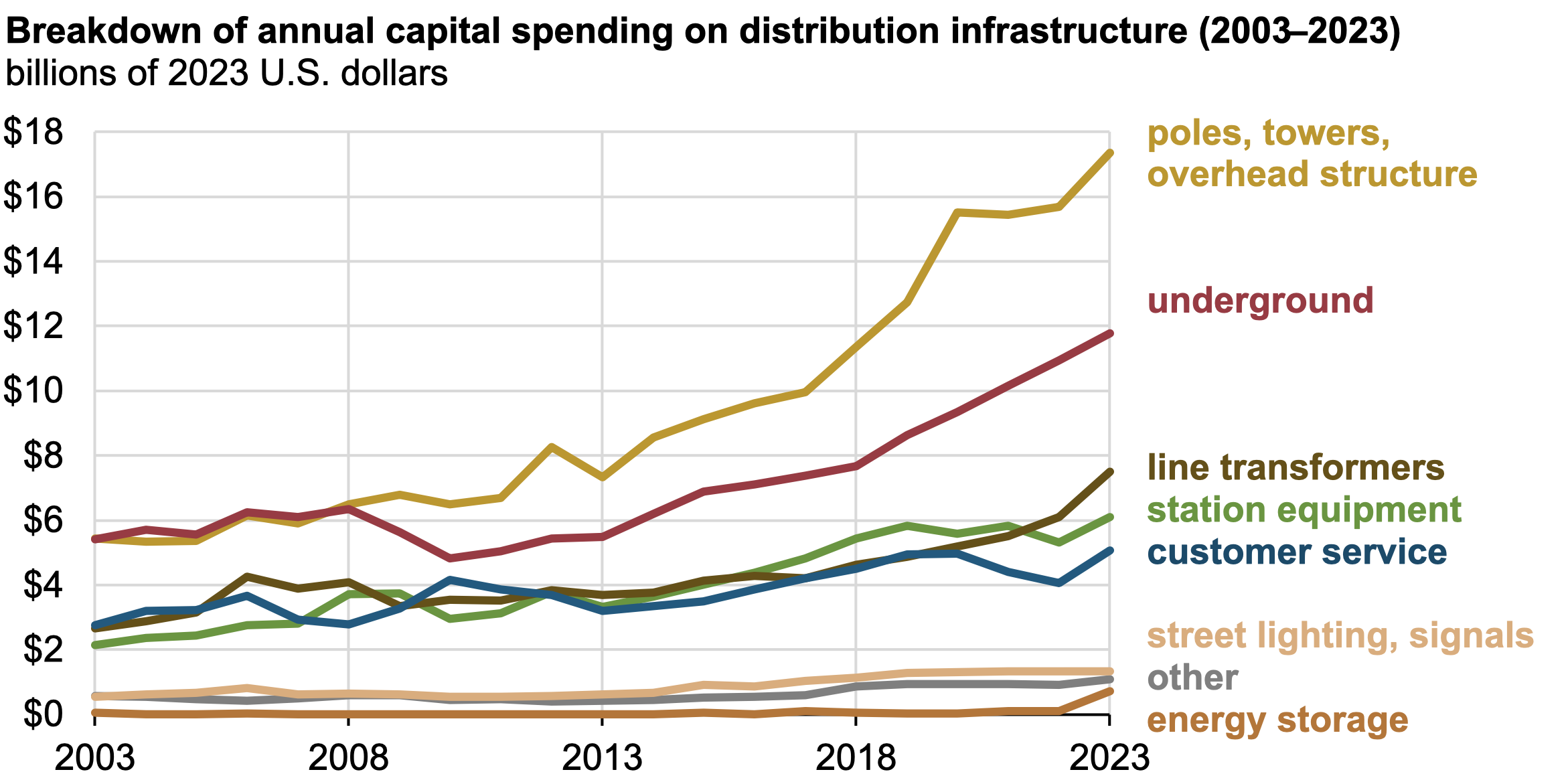
U.S. Electricity Distribution Infrastructure Capital Spending
(2003–2023)
Investment has been uneven, with underinvestment in critical system
components.
VI. Energy Autonomy Does Not Mean Insulation
Energy independence does not eliminate exposure.
Global pricing mechanisms remain dominant.
As both exporter and producer, the United States is exposed to:
- global price volatility
- geopolitical disruption
- demand fluctuations
Energy power therefore creates:
→ cyclical exposure, not stability
Autonomy changes the form of vulnerability.
It does not remove it.
VII. Strategic Geography and System Reorientation
Energy abundance has reshaped U.S. strategic focus:
- reduced reliance on the Middle East
- increased attention to:
- Western Hemisphere
- Indo-Pacific
- Arctic routes
At the same time, critical minerals, infrastructure, and supply chains have become central to geopolitical competition.
Energy is no longer a sector.
It is:
→ the organising layer of global strategy
VIII. Comparative System Positions
Three structural positions define the system:
United States
Energy + capital + compute
→ system-level leverage
China
Industrial scale + electrification + coordination
→ system expansion
Europe
Energy constraint + cost divergence
→ system compression
These positions are structural.
Not cyclical.
IX. The Core Constraint
The decisive constraint is now:
→ infrastructure scaling capacity
The key question:
Can electricity infrastructure scale faster than AI and electrification demand?
If not:
- industrial relocation accelerates
- monetary pressure increases
- strategic autonomy narrows
If yes:
- system capacity expands
- competitiveness stabilises
- sovereignty strengthens
Infrastructure speed becomes:
→ geopolitical power
Conclusion — Leverage Without Alignment
The United States has transformed energy dependence into energy leverage.
But leverage is not equilibrium.
It is a dynamic position within a constrained system.
Energy abundance supports:
- monetary dominance
- industrial potential
- technological leadership
But without:
- grid modernisation
- industrial alignment
- supply-chain depth
this advantage can erode.
The broader lesson extends beyond the U.S.:
Power is not defined by resources alone.
It is defined by:
→ the ability to convert energy into sustained system capacity
Energy creates leverage.
Infrastructure determines whether that leverage endures.
References
Reading Tree — System Navigation
This article forms part of the Global System Architecture framework.
I. Core Doctrine — How the System Works
Start here:
- Energy-Bound System
- Energy Geopolitics and the Global Paradigm Shift
- Energy as the Operating System of Power
These establish the foundational principle:
→ energy defines the structure, limits, and distribution of power
II. Comparative Systems — How Power Is Expressed
This shows how different systems organise power under the same constraint:
- United States → integrated dominance
- China → scale and coordination
- Europe → constraint and fragmentation
III. Transformation Layer — How the System Is Changing
These explain:
→ why the transition creates divergence, not convergence
IV. Monetary Layer — From Energy to Currency
These formalise:
→ how energy cost structures shape monetary power
V. System Convergence — Energy, Industry, Compute
This shows:
→ how energy and AI become a single system
VI. Structural Asymmetry — Winners and Constraints
This explains:
→ why divergence becomes persistent and self-reinforcing
VII. Applied Layer — System in Practice
These apply the framework to:
- energy exporters
- capital flows
- system nodes
VIII. European Constraint Layer
These show:
→ how constraint materialises within Europe
IX. System Transmission
These explain:
→ how energy shocks propagate through the system
X. Suggested Reading Path (Mobile-Friendly)
- Energy-Bound System
- Energy as the Operating System of Power
- G2 Comparative
- Petrostate vs Electrostate
- Energy Constraint and the Monetary Ceiling
- Europe’s Energy Paradigm Shift
- Investor Framework
US’s Petrostate versus China’s Electrostate
How China Is Outperforming the United States in Critical Technologies
Embracing the Future: How Smart Technology and AI are Transforming Our World
Understanding the Difference Between AI and Smart Tech
Our Shared Technological Future: Smart Cities in the U.S. and China
China’s government-led industrial policy .
Understanding the Difference Between AI and Smart Tech
What drives the divide in transatlantic AI strategy?
Advances and challenges in energy and climate alignment of AI infrastructure expansion
China’s Evolving Industrial Policy for AI
Huawei Cloud. (2023–2024). Cloud–edge synergy and intelligent connectivity white papers.
AI and Computing Horizons: Cloud and Edge in the Modern Era
Edge AI versus cloud AI: What’s the difference?
The Rise of Edge Computing in the Cloud Era
Edge AI vs. Cloud AI: What Is the Difference?
Is the AI Cloud Era Ending? Why Edge Computing is Changing How AI Works
The Rise of the Platform Breznitz, D., & Zysman, J. (2022)
Data Sovereignty and the GAIA-X Initiative: Europe’s Push for Independent Cloud Infrastructure
The Fourth Industrial Revolution, by Klaus Schwab
AI Superpowers: China, Silicon Valley, and the New World Order
#TransiciónEnergética #Electrificación #Descarbonización #EnergíasRenovables #GeopolíticaDeLaEnergía #OrdenGlobal #EstrategiaIndustrial #IA #Nube #SoberaníaDigital #ÉticaIA #TecnologíasInteligentes #GobernanzaDeDatos #SoberaníaUE #GeopolíticaTecnológica #4RI #FuturoDeLaIndustria #SeguridadEnergética #CeroEmisiones #CompetitividadUE
https://www.climateandcapitalmedia.com/petrostate-versus-electrostate
US’s Petrostate versus China’s Electrostate
The Future of the Northern Sea Route - A “Golden Waterway” or a Niche Trade route
The Economic Benefits of Unleashing American Energy
Why US Energy Independence Won’t Mean Greater US Energy Autonomy