SME Innovation Networks and the European Scaling Constraint
Distributed Energy, Local Compute, Cost, Control, and Industrial Learning

Keynote
Europe’s economic structure is often described as fragmented and difficult to scale.
This interpretation is incomplete.
As energy systems become electrified and distributed, and as computation becomes central to production, Europe’s structure begins to align with a different model of industrial organisation.
This model is not based on concentration.
It is based on coordination across distributed systems.
These systems include:
local energy availability
digitally coordinated production
ecosystem-based innovation
The strategic question is no longer whether Europe can scale like the United States or China.
The strategic question is whether Europe can scale through a different system architecture.
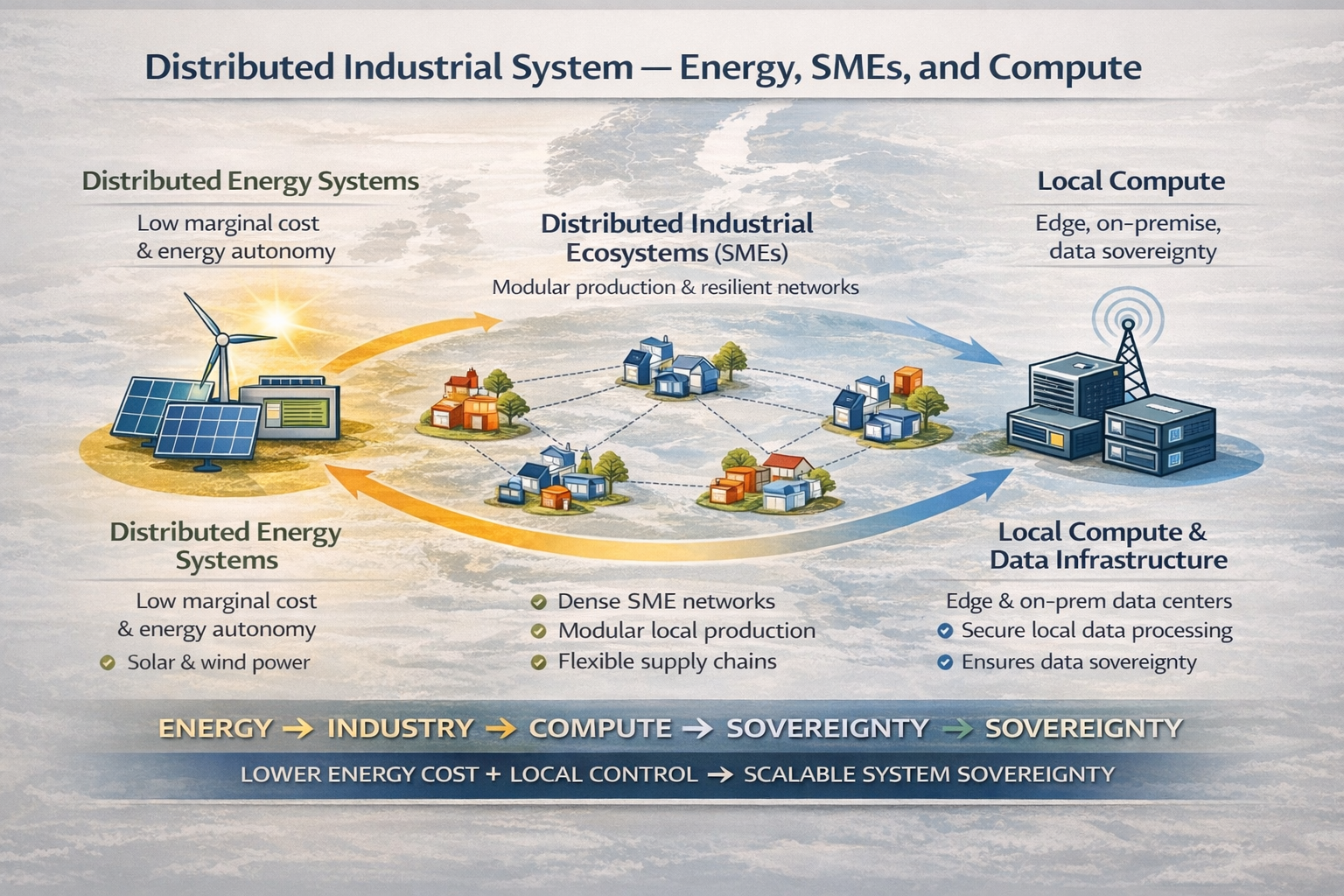
This alternative architecture would convert:
distributed energy into a cost advantage
localised computation into a control advantage
SME networks into coordinated industrial ecosystems
SMEs are central to this transition.
I. The Structure Europe Already Has
Europe’s economic system is built around SMEs.
These firms are:
regionally distributed
highly specialised
embedded in local economies
This structure has traditionally been interpreted as a limitation.
Scaling requires coordination across many firms.
Markets and regulatory systems remain fragmented.
Access to capital is uneven.
As a result, Europe often generates innovation but struggles to industrialise that innovation at scale.
This interpretation reflects an industrial model based on centralisation.
Under conditions of structural transformation, this same structure may represent a latent system advantage.
II. Industrial Ecosystems and Learning Dynamics

European SMEs do not operate as isolated units.
They operate within industrial ecosystems.
Within these ecosystems, innovation emerges through continuous interaction between design, suppliers, manufacturing, and engineering feedback.
This interaction can be understood as a learning loop.
Design decisions influence production processes.
Suppliers specialise and improve their capabilities.
Manufacturing generates process knowledge.
Engineering feedback improves products and systems.
System capability accumulates over time.
This process creates distributed industrial intelligence.
Innovation is not concentrated within a single firm.
It is embedded within the ecosystem.
This mechanism explains how industrial capability scales in practice.
III. Global Value Chains as Learning Systems
During the globalisation period, this learning process operated at a global scale.
Global value chains were not only systems of cost optimisation.
They were also systems of capability diffusion and industrial learning.
Production networks linking firms across regions enabled:
supplier upgrading
engineering knowledge transfer
process innovation through scale
rapid iteration cycles
Over time, these dynamics transformed manufacturing regions into dense innovation ecosystems.
Industrial systems evolved through a sequence:
assembly
→ capability accumulation
→ integrated technological ecosystems
This process explains the development of industrial capacity in sectors such as:
electronics
batteries
electric vehicles
renewable energy technologies
IV. Europe’s Structural Gap: Loss of Ecosystem Density
Europe did not lose only manufacturing volume.
Europe also lost ecosystem density.
The weakening of industrial feedback loops reduced the ability of SMEs to:
scale innovation
coordinate production
accumulate system-level capability
This condition produces a structural imbalance.
Innovation exists, but scaling fails.
This is not primarily a technological constraint.
It is a system coordination constraint.
V. Distributed Energy as a Cost Foundation
The energy transition changes the structure of production costs.
Traditional energy systems are based on:
imported fuels
continuous variable costs
exposure to global price volatility
Renewable energy systems are characterised by:
high initial capital investment
very low marginal cost after deployment
This creates a structural shift.
When energy can be produced locally at low marginal cost, production can also become more local and cost-competitive.
For SMEs, this shift is significant.
Energy is a primary input cost.
Lower marginal energy costs improve long-term viability.
Local energy generation reduces exposure to external shocks.
However, the transition remains incomplete.
Infrastructure is uneven.
Upfront costs are high.
Short-term price volatility persists.
The cost advantage exists, but it is not yet fully realised at the system level.
VI. Localised Compute as a Control Layer
Production processes are increasingly dependent on computation.
These processes include:
automation
AI-assisted production
digital coordination across firms
At present, much of this computation is:
centralised
externally controlled
dependent on global platforms
This creates structural vulnerabilities for SMEs.
First, SMEs face a control constraint.
They depend on infrastructure that they do not control.
Second, SMEs face a data constraint.
Industrial data is transferred outside local systems, reducing value
capture.
Localised or regionally embedded compute changes this dynamic.
Data can remain within European systems.
Coordination can occur without external dependency.
SMEs can participate without surrendering control.
If energy defines cost, compute location defines control.
VII. The Missing Link: System Coordination
Distributed energy and localised compute do not automatically generate scale.
They require system coordination.
SMEs already operate within networks.
However, these networks are not fully integrated at the system level.
What is required includes:
interoperable digital infrastructure
shared compute systems
integrated energy networks
coordinated industrial platforms
Without coordination:
energy advantages remain localised
compute remains externally controlled
scaling remains limited
With coordination:
distributed production becomes a system
SMEs operate as coordinated ecosystems
scale emerges from connection rather than concentration
VIII. Strategic and Geopolitical Implications
Technological competition is not defined only by innovation.
It is defined by system architecture.
Different system configurations are emerging.
The United States is characterised by:
hyperscale compute infrastructure
capital concentration
platform dominance
China is characterised by:
dense industrial ecosystems
integrated supply chains
coordinated industrial scaling
Europe is characterised by:
distributed SME networks
emerging distributed energy systems
potential for localised compute
Europe’s position is not structurally weak.
It is structurally incomplete.
If these elements are aligned, Europe could develop a distinct system architecture.
This architecture would consist of:
distributed industrial ecosystems
local energy-based cost structures
sovereign or regional compute systems
This would represent a third model of system power.
Without alignment, Europe risks:
persistent fragmentation
capital outflows
technological dependency
declining industrial relevance
IX. Preconditions for European System Formation
For this system to function, several conditions must be met.
Energy system alignment
accelerated renewable deployment
expansion and integration of grids
development of storage systems
reform of energy pricing structures
Compute system alignment
development of local and regional compute infrastructure
establishment of interoperability standards
implementation of data governance frameworks
Ecosystem coordination
development of SME coordination platforms
strengthening of supplier networks
support for industrial clustering
Capital alignment
alignment of investment with system architecture
development of long-term infrastructure financing
reduction of fragmentation in capital markets
Without alignment across these layers, system formation cannot occur.
X. Implication
Europe does not need to replicate centralised industrial models.
Its structure already corresponds to a different configuration.
This configuration includes:
distributed firms
emerging distributed energy systems
potential for localised computation
The constraint is not the absence of capability.
The constraint is the absence of system alignment under conditions of energy constraint.
Strategic Insight
Industrial power is not determined by individual firms alone.
Industrial power is determined by the density and coordination of ecosystems through which learning, production, and innovation occur.
Global value chains demonstrated this principle at a global scale.
The European challenge is to reconstruct this dynamic at a regional and system level.
The European challenge is not only to rebuild industrial capacity, but to align ecosystems, energy systems, and technological stacks into a coherent system architecture capable of scaling under constraint.
System Logic and Constraint
Beyond Ideology
This article explains why ideological frameworks delay structural adjustment under conditions of structural constraint.The Legitimacy Boundary
This article defines the limits within which economic and social systems remain politically and economically sustainable.Legitimacy, Labour, and System Durability
This article examines how labour structures and income distribution shape long-term system stability.
Industrial Ecosystems and Capability Formation
Global Value Chains as Innovation Systems
This article explains how global production networks function as systems of industrial learning and capability diffusion.Global Value Chains in an Energy-Bound World
This article situates global value chains within the constraints of energy systems and evolving cost structures.SME Innovation Networks and the European Scaling Constraint
This article explains how SME-based industrial ecosystems can function as distributed systems of production and innovation.
Technology Stacks and System Architecture
Energy–Industry–Compute Stack
This article defines the structural hierarchy through which energy systems propagate into industrial capability, compute infrastructure, and economic power.System Stack Architecture
This article explains how technological systems are organised across layers from infrastructure to applications.Stacks, Systems, and Sovereignty
This article examines how control over technological stacks determines sovereignty and strategic autonomy.
Control Layers — Compute, Standards, and Platforms
Operating Systems and System Control
This article explains how operating systems function as control layers between hardware, software, and users.Standards, Protocols, and System Control
This article analyses how rules of interaction shape technological ecosystems and determine control over systems.Developer Ecosystems and Scaling
This article explains how coordination at the software and developer level enables scaling across distributed systems.
Digital and Compute Infrastructure
AI, Energy, and the Future of Sovereignty
This article explains how compute infrastructure is constrained by energy systems and shapes geopolitical power.AI–Energy–Cost Chasm
This article examines the structural gap between rising compute demand and constrained energy supply.Cloud and Edge AI
This article analyses the distribution of computation between centralised and decentralised systems.
Technology, IP, and Geopolitical Competition
- Intellectual
Property and Future Technologies
This article analyses how intellectual property regimes interact with technological competition and capability formation.