Decarbonisation as a Tech War Instrument
Why the energy transition has become a site of strategic contest, not climate choice
Keynote
Decarbonisation is no longer primarily a climate objective. In an energy-bound world, it has become a strategic instrument through which states restructure cost bases, relocate industry, and impose constraints on competitors. This article examines how electrification and energy transition function as tools of power rather than expressions of ideology.
Executive Summary — Decarbonisation as a Tech War Instrument
Decarbonisation has ceased to be a primarily environmental policy. In an energy-bound world defined by electrification, automation, and artificial intelligence, it has become a systemic determinant of industrial competitiveness and strategic power. As energy systems shift from fuel-based to electricity-based architectures, control no longer flows from extraction or capacity alone, but from the ability to coordinate energy intelligently under constraint. This transforms decarbonisation from a matter of alignment or ambition into a competitive filter: systems that can stabilise costs and allocate electricity reliably attract industry and technology, while those that cannot experience volatility, backlash, and decline.
Europe’s current predicament illustrates this shift. High electrification ambition combined with fragmented grids, volatile prices, and decentralised industrial structures has turned decarbonisation into a politically contested process. The fault line runs through small and medium-sized enterprises, which lack the scale to hedge energy risk and depend on predictability to invest. Where energy systems are poorly coordinated, decarbonisation raises costs without reducing risk, triggering resistance that is often misread as opposition to climate policy. In reality, it reflects exposure to unmanaged system volatility.
The decisive variable is grid intelligence. Where electricity systems are governed through real-time coordination—integrating generation, storage, demand response, and industrial load—decarbonisation becomes a growth and resilience strategy. Where such coordination is absent, it becomes a vector of instability. The tech war is therefore not won by declarations, subsidies, or regulation alone, but by building energy systems that work under pressure. In this context, decarbonisation does not reward intention. It rewards architecture.
Preface — From system condition to instrument of power
Decarbonisation is often framed as a climate policy choice: a question of ambition, regulation, or political will. That framing is increasingly misleading.
In an energy-bound world, decarbonisation is not primarily about emissions targets. It is about system control. As energy systems electrify, decentralise, and integrate with digital infrastructure, decarbonisation becomes inseparable from industrial competitiveness, technological sovereignty, and geopolitical leverage.
This analysis builds on the doctrine that grid intelligence is a condition of industrial sovereignty, and examines how decarbonisation becomes a tech war instrument when that condition is unevenly distributed. Where coordination capacity exists, the transition strengthens economies. Where it does not, decarbonisation becomes a source of volatility, backlash, and strategic vulnerability.
Decarbonisation beyond the climate debate
At a system level, decarbonisation means replacing combustion-based energy systems with electricity-based ones. This shift has three structural consequences:
- energy costs move from fuel volatility to infrastructure design
- control shifts from extraction and transport to coordination and timing
- power concentrates in systems that can integrate energy, industry, and compute
These dynamics persist regardless of political ideology. They are observable across competing models in the United States, China, and Europe.
The result is that decarbonisation increasingly functions as a competitive filter: it rewards systems that can coordinate energy intelligently, and penalises those that cannot.
Why decarbonisation becomes a tech war vector
In the tech war, advantage is no longer determined solely by innovation or regulation, but by the ability to sustain energy-intensive systems under constraint.
Electrified industry, data centres, automation, and AI all demand:
- continuous electricity
- predictable costs
- low latency
- resilience to shocks
Decarbonisation accelerates these demands. Where grids are poorly coordinated, the transition exposes structural weakness. Where grids are intelligently managed, it compounds advantage.
As a result, decarbonisation becomes an instrument of power in three ways:
- Cost discipline — systems with intelligent coordination lower marginal energy costs over time
- Resilience — coordinated systems absorb volatility without cascading failure
- Location control — industry and compute migrate toward energy systems that work
This is not moral pressure. It is system selection.
Europe’s specific exposure
Europe illustrates this dynamic with unusual clarity.
The continent combines:
- high electrification ambition
- rapid renewable deployment
- fragmented grids
- high electricity prices
- decentralised industrial structures
- limited tolerance for volatility
Without grid intelligence, these conditions reinforce one another negatively. Energy costs spike, curtailment rises, and investment decisions shift elsewhere. Decarbonisation, under these circumstances, is experienced not as opportunity but as economic stress.
This is why decarbonisation has become politically contested across Europe — not because climate goals are rejected, but because system design has lagged ambition.
SMEs, cost volatility, and political backlash
The political fault line of the transition runs through small and medium-sized enterprises.
Unlike large firms, SMEs:
- cannot hedge energy prices
- lack long-term power contracts
- operate on thin margins
- depend on predictable operating conditions
In poorly coordinated energy systems, decarbonisation increases:
- price volatility
- planning uncertainty
- capital risk
This translates directly into:
- delayed investment
- reduced productivity
- regional decline
- political resistance
Protests by farmers, transport operators, and regional SMEs are often framed as resistance to environmental regulation. In reality, they reflect exposure to unmanaged system volatility.
Decarbonisation becomes politically toxic when it raises costs without reducing risk.
Operational expression
Grid intelligence manifests not as a single technology, but as a coordination capability that reshapes how firms interact with energy systems. Its effects differ structurally by firm size.
Large firms stabilise production through scale and buffers.
SMEs depend on timing, coordination, and local intelligence to remain
viable under energy constraint.
The impact of energy volatility differs structurally by firm size, as illustrated below.

In an energy-constrained system, large firms stabilise production through scale and buffers, while SMEs depend on coordination, timing, and grid intelligence to survive.
Grid intelligence as the dividing line
The difference between decarbonisation as regeneration and decarbonisation as backlash is grid intelligence.
Where energy systems are intelligently coordinated:
- SMEs can shift loads
- production can adapt to energy availability
- just-in-time manufacturing becomes viable
- inventories and capital lock-up fall
- operating costs stabilise
Where they are not:
- electrification amplifies volatility
- decentralisation fragments responsibility
- renewable deployment faces diminishing returns
- political legitimacy erodes
This is why decarbonisation cannot be separated from control architecture. It is not the presence of renewables that determines outcomes, but how energy is allocated under constraint.
In an energy-constrained system, large firms stabilise production through scale and buffers, while SMEs depend on coordination, timing, and grid intelligence to survive.
At the operational level, grid intelligence enables real-time coordination between energy availability and industrial production.

Distributed sensing and control allow production schedules to adapt to real-time energy conditions, converting installed capacity into reliable industrial power.
Just-in-time manufacturing becomes viable under energy constraint when production schedules respond to real-time energy availability rather than assuming constant surplus.

Energy-aware production sequencing reduces inventory, peak load, and
operating costs in an energy-constrained system. 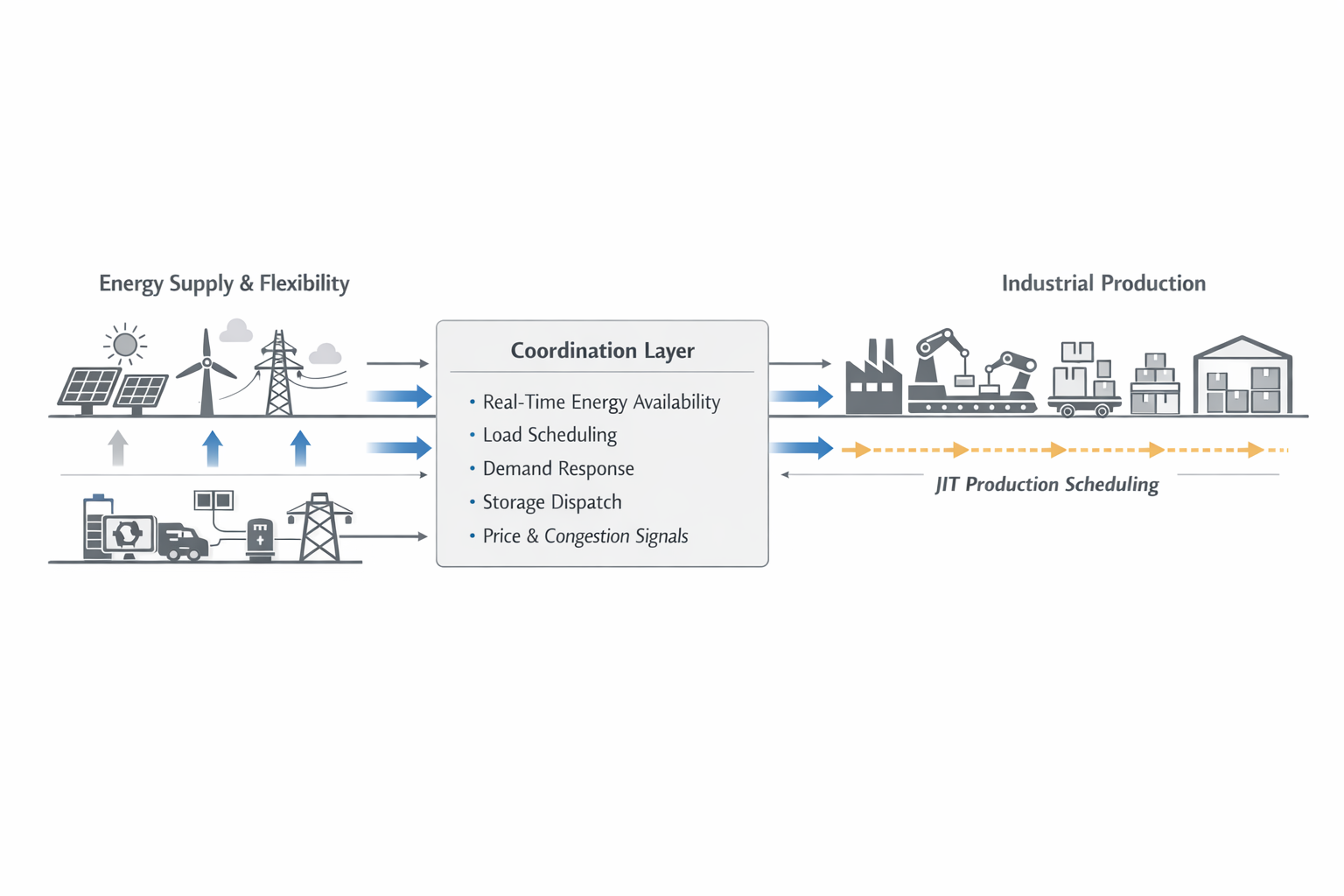
Decarbonisation as leverage, not alignment
In the emerging tech war, decarbonisation increasingly functions as a strategic lever rather than a shared objective.
States and regions that can:
- offer stable, coordinated electricity
- integrate storage and demand response
- align energy systems with industrial needs
…attract industry, compute, and capital.
Those that cannot:
- subsidise endlessly
- regulate more tightly
- or align rhetorically
…but still lose competitiveness.
Decarbonisation thus becomes a mechanism through which advantage accumulates quietly and persistently — without confrontation.
Implications for European strategy
For Europe, the strategic mistake is not ambition. It is sequencing.
Pursuing electrification and decarbonisation without first ensuring grid intelligence:
- shifts risk onto firms least able to bear it
- concentrates political costs
- accelerates deindustrialisation
- undermines public consent
Conversely, treating grid intelligence as industrial infrastructure:
- stabilises costs
- restores SME agency
- rebuilds regional legitimacy
- turns decarbonisation into a competitiveness strategy
The tech war is not won by declaring transitions. It is won by making systems work under constraint.
Conclusion — From climate narrative to system contest
Decarbonisation is no longer a neutral transition pathway. In an energy-bound world, it has become a site of strategic contest.
Where system coordination exists, decarbonisation strengthens industry, technology, and sovereignty. Where it does not, it becomes a vector of instability, backlash, and decline.
The decisive variable is not emissions targets, investment volume, or regulatory alignment. It is whether energy systems can be governed intelligently under pressure.
In the tech war, decarbonisation does not reward intention.
It rewards architecture.
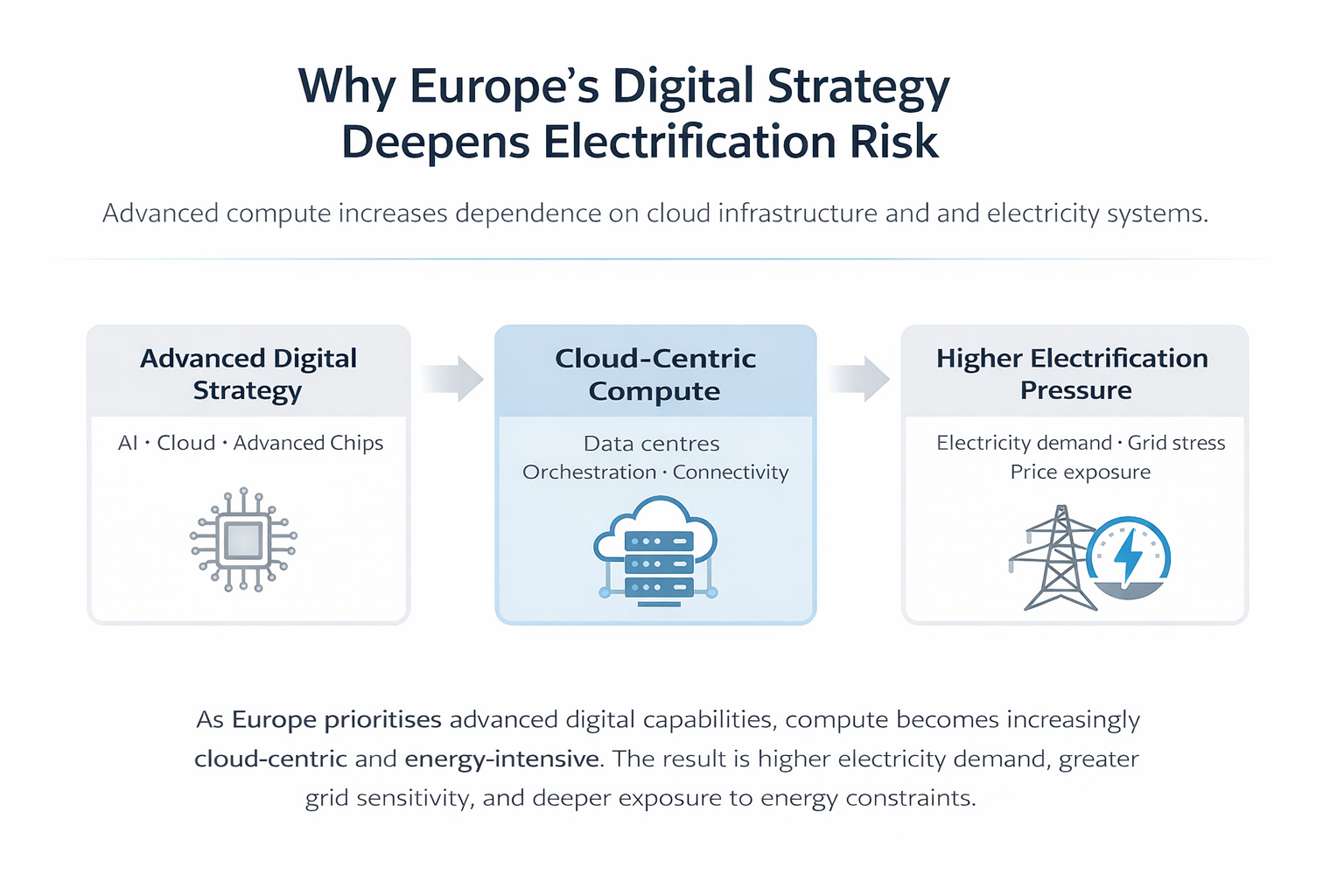
For a detailed examination of how modern compute architectures amplify energy dependency, see Why Europe’s Digital Strategy Deepens Electrification Risk (Techwar/technology)
Suggested Reading
- Decarbonisation as Industrial System Transformation
- Global Energy Paradigm Shift— structural driver
- Industrial Power Post-Globalisation
- EU Industrial Policy Under Constraint (EU Sovereignty Newsletter)