Finance, Sanctions and Upper Layers of System Control
This article is part of the “European Sovereignty & System Constraint Series” series examining how stacked pressures reshape sovereignty and strategic choice.
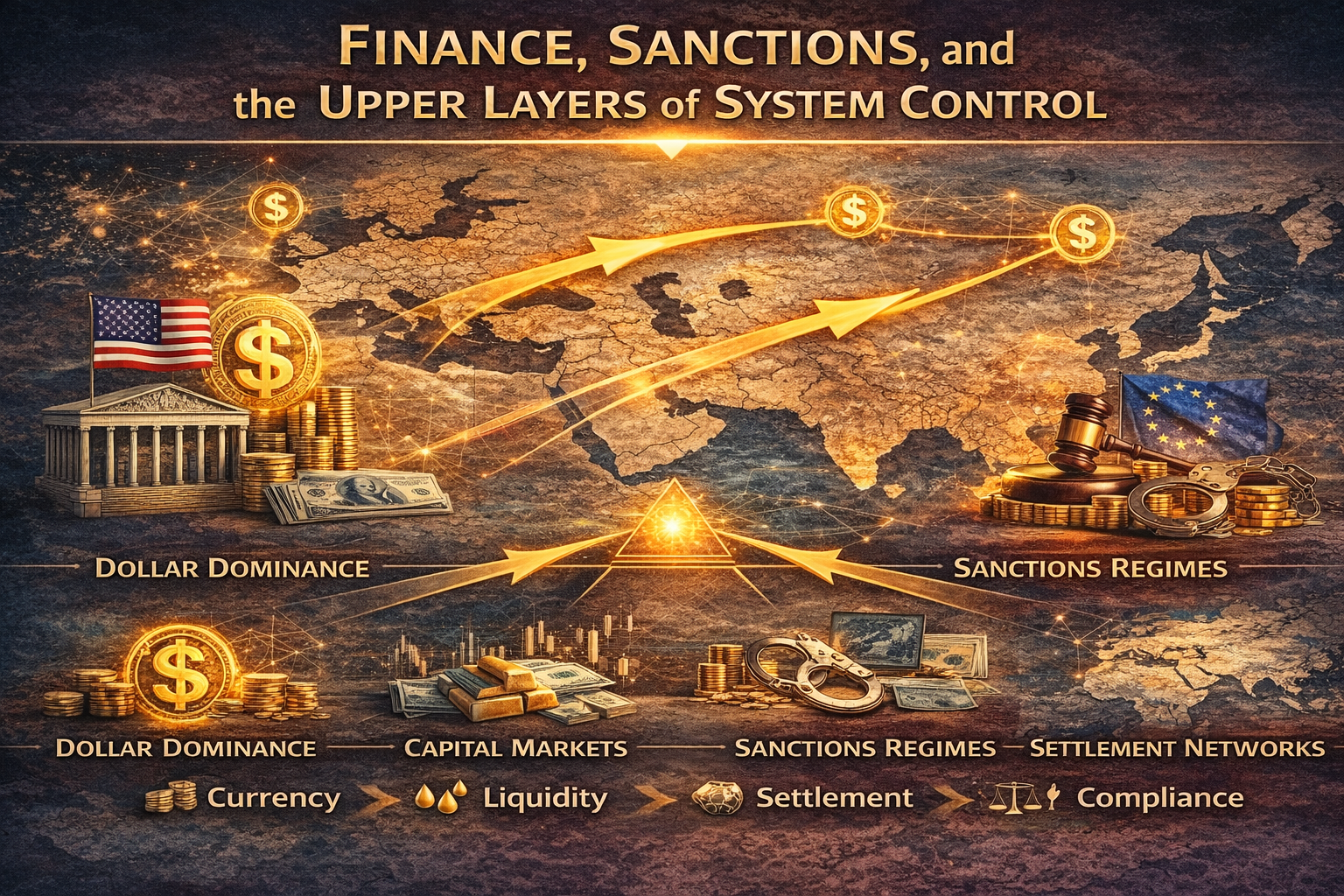
Keynote
From neutral infrastructure to strategic instrument
For much of the globalisation era, financial infrastructure was treated as neutral plumbing. Capital markets, payment systems, insurance, and settlement networks were assumed to be technocratic and rules-based. Politics operated around them, not through them.
That separation no longer exists.
Today, financial systems are increasingly securitised. Access to capital, currencies, clearing systems, and insurance is conditioned by geopolitical alignment and system trust. The result is a shift from finance as facilitator to finance as gatekeeper.
This is not an aberration. It is a structural adaptation to system competition.
Sanctions as system design, not punishment
Sanctions are often framed as punitive tools aimed at changing behaviour. In practice, they increasingly function as architecture-shaping mechanisms.
Modern sanctions rarely rely on total exclusion. Instead, they:
- raise transaction costs,
- introduce legal and compliance risk,
- fragment financial networks,
- and deter participation through uncertainty.
Their power lies less in enforcement than in anticipation. Banks de-risk. Insurers withdraw. Investors pause. Entire categories of economic activity become marginal — without formal prohibition.
Sanctions, in this sense, reprogram system incentives rather than impose outcomes.
The dollar system and asymmetric control
At the centre of this architecture sits the US-anchored financial system. Dollar liquidity, clearing, and settlement remain foundational to global finance. This position grants the United States unique leverage in the upper layers of the stack.
This leverage is not absolute, but it is asymmetric.
It operates through:
- currency dominance,
- capital market depth,
- regulatory reach,
- and network effects that are difficult to replicate quickly.
The consequence is not that alternatives cannot exist, but that exit is costly and slow. Fragmentation in finance lags fragmentation elsewhere — and when it occurs, it carries systemic risk.
Fragmentation without decoupling
Financial fragmentation does not resemble clean decoupling. Instead, it produces partial insulation and selective exposure.
Actors seek to:
- reduce sanction vulnerability,
- diversify settlement mechanisms,
- localise financing where possible,
- and build redundancy into payment and insurance systems.
But because finance sits at the top of the stack, insulation is never complete. Energy, trade, and logistics remain downstream of financial permission structures. Upper-layer constraints propagate downward.
This is why finance remains such a powerful system control layer: it shapes what is feasible elsewhere.
Europe’s financial paradox
Europe’s position within this architecture is paradoxical.
On one hand, Europe is deeply embedded in US-centred financial and regulatory systems. Its banks, firms, and insurers operate within the same compliance and settlement frameworks that underpin transatlantic financial integration.
On the other hand, Europe bears disproportionate exposure to the downstream effects of financial leverage:
- energy price volatility,
- industrial cost inflation,
- corridor disruption,
- and capital sensitivity in strategic sectors.
Europe exercises limited control over the upper layers, yet absorbs much of the systemic spillover.
This constrains strategic autonomy more effectively than overt political pressure.
Finance as amplifier of constraint
In a world of stacked systems, finance acts as an amplifier.
Energy volatility becomes inflation through financial transmission. Corridor risk becomes investment delay through insurance and credit. Sanctions reshape supply chains not by decree, but by altering financing conditions.
This amplification explains why policy responses often feel ineffective. Measures taken at the industrial or trade level are overridden by constraints imposed higher up the stack.
Sovereignty debates that ignore this hierarchy misdiagnose the problem.
Multilateralism and financial geometry
Financial multilateralism struggles under these conditions. Institutions designed to manage shared rules in an integrated system are ill-suited to an order defined by selective access and leverage over nodes.
As financial power becomes more concentrated and conditional, governance follows geometry rather than consensus. Control over hubs matters more than formal representation.
For Europe, whose influence has traditionally rested on rule-making rather than hub control, this represents a structural challenge.
System control without escalation
Like chokepoints, financial leverage rarely requires confrontation. It operates through:
- compliance risk,
- market anticipation,
- and asymmetric exposure.
Pressure can be applied without visibility, attribution, or escalation. This makes finance one of the most effective — and least visible — layers of system control.
The upper bound of autonomy
Taken together, the preceding parts of this series outline a constrained architecture:
- Energy sets the base layer of volatility
- Value chains fragment as systems securitise
- Corridors transmit pressure geographically
- Finance and sanctions shape feasibility from above
Europe operates within this structure, not outside it.
Strategic autonomy, in this context, cannot mean insulation from constraint. It can only mean managing position within the stack — reducing exposure where possible, building resilience where feasible, and recognising where leverage lies beyond reach.
This article forms part of the Systems under Constraint research series examining how layered systems now shape the global order. The conclusion is increasingly difficult to avoid: power today is exercised less through decisions than through design.
Understanding that design is the first step toward operating within it.
Further Reading
[Energy and the Base Layer of Constraint(../1_New_Energy_Power_Equation/eng.md) On how energy volatility sets the foundational limits within which financial leverage operates.
Corridors, Chokepoints, and the Geography of Leverage On how logistics and trade interfaces transmit pressure through the stack.
System Fragmentation: Europe, Eurasia, and the Future of Global Value Chains On how securitised systems reorganise trade and industrial capacity.
EU Asymmetry Under Stress(EU Sovereignty)
On how financial transmission and energy volatility materialise as inflation and capital pressure in Europe.Monetary & Financial Sovereignty Under Constraint(EU Sovereignty)
Capital Duration as System Power (Tech War / Dynamics)
(Monetary Sovereignty in the Tech War(Tech War / Money)
System Foundations of the Energy–AI–Industrial Economy On why energy, industry, compute, and finance now operate as a single system.
Energy Sovereignty as System Control Global / Doctrines)
On why control over energy systems underpins all downstream sovereignty.Global Value Chains in an Energy-Bound World(Global / Energy)
On how energy costs and infrastructure shape production geography.Europe’s Energy Paradigm Shift(EU Sovereignty)
On Europe’s specific exposure to energy cost and infrastructure constraint. ### Energy as Power ArchitectureEnergy as the Operating System of Power The foundational thesis: energy as the organising substrate of modern economic and geopolitical power.
AI Energy Stress Test (Eu Sovereignty) ### Foundational Context
Energy and the Base Layer of Constraint*(Systems under Constraint) Why energy re-emerged as the first binding constraint in the electrified economy.
Asymmetry Under Stress How constraint reveals differences in resilience, coordination capacity, and shock absorption. ### Transmission and Dependence
Decarbonisation as a Tech War Instrument (Tech War / Dynamics)
Downstream Implications
II. TECHWAR — Stack Fractures Under Constraint
These pieces show how energy constraint propagates upward into technology stacks and compute concentration.
Stack-Level Fractures in the Tech War How system dependencies fracture under pressure — and why energy stress cascades across layers.
Compute Locality in an Energy-Bound AI System Why AI infrastructure gravitates toward power stability and low marginal electricity cost.
III. EU SOVEREIGNTY — Constraint as Political Condition
These essays apply the Energy-Bound framework specifically to Europe’s structural position.
Energy as Europe’s Strategic Constraint Why energy marginal cost structure now defines Europe’s competitive ceiling.
Energy Sovereignty as System Control (EU) From fuel ownership to integration control: sovereignty as system design.
Europe’s Microprocessor and Energy Dependency Trap How compute dependency and energy cost structure interact as a failure mode.
Beyond Ideology — Foundational Doctrine
How Europe’s Political Lens Obscures Structural Realities in a Multipolar World
Sequencing, Deregulation, and the Political Economy of Exposure
IV. Boundaries — Social and Temporal Limits
Energy constraint is not only technical or geopolitical. It is social and institutional.
**The Legitimacy Boundary— Labour Markets and the Social Limits of Strategic Autonomy**
Democratic durability under transition stress.Legitimacy, Labour, and System Durability — Reference Index Consolidated essays on consent, affordability, and social absorption capacity.
EU Decisive Decade Time as constraint: irreversibility and strategic narrowing windows.
V. Doctrinal Extensions
These doctrine cards operationalise the Energy-Bound condition into actionable architectural principles.
- Mediterranean Decentralised Energy Doctrine Why fragmented geography and climate stress make decentralised electrification structurally optimal.