TECHWAR Panel
Energy, Compute, Industry, and Control in an Energy-Bound System
GLOBAL — Energy Paradigm Shift
TECHWAR — Energy–AI–Compute Competition
EU SOVEREIGNTY — European Agency Under Constraint

Doctrine Statement — TECHWAR
Technological competition no longer unfolds primarily through isolated innovation.
It unfolds through the interaction between energy systems, semiconductor efficiency, compute infrastructure, industrial ecosystems, platform control, and state capacity.In an energy-bound system, technological power depends not only on who invents, but on who can power, manufacture, deploy, scale, and govern computation at system level.
Keynote — Technology Becomes Physical
Technology is no longer abstract.
It is no longer primarily software.
It is no longer independent from energy.
AI systems do not simply process data.
They convert energy into intelligence.
This transformation depends on:
electricity availability and cost
semiconductor efficiency
compute infrastructure
industrial ecosystems
and system-level coordination
→ Technology is now a physical system embedded in energy, industry, and infrastructure.
This marks a structural shift from an intangible, software-driven paradigm to a capital-intensive, infrastructure-based technological system.
System Architecture — Cost, Capability, and Control

Technological power emerges from the alignment of:
Cost → energy and compute
Capability → industrial ecosystems
Control → platforms and standards
TECHWAR is the competition over this architecture.
- Energy–Compute–AI Stack (Cost Layer)
- Industrial Ecosystems — Cross-Panel Index
- Digital Sovereignty — Control, Compute, and Economic Power
System Map — The TECHWAR Layer
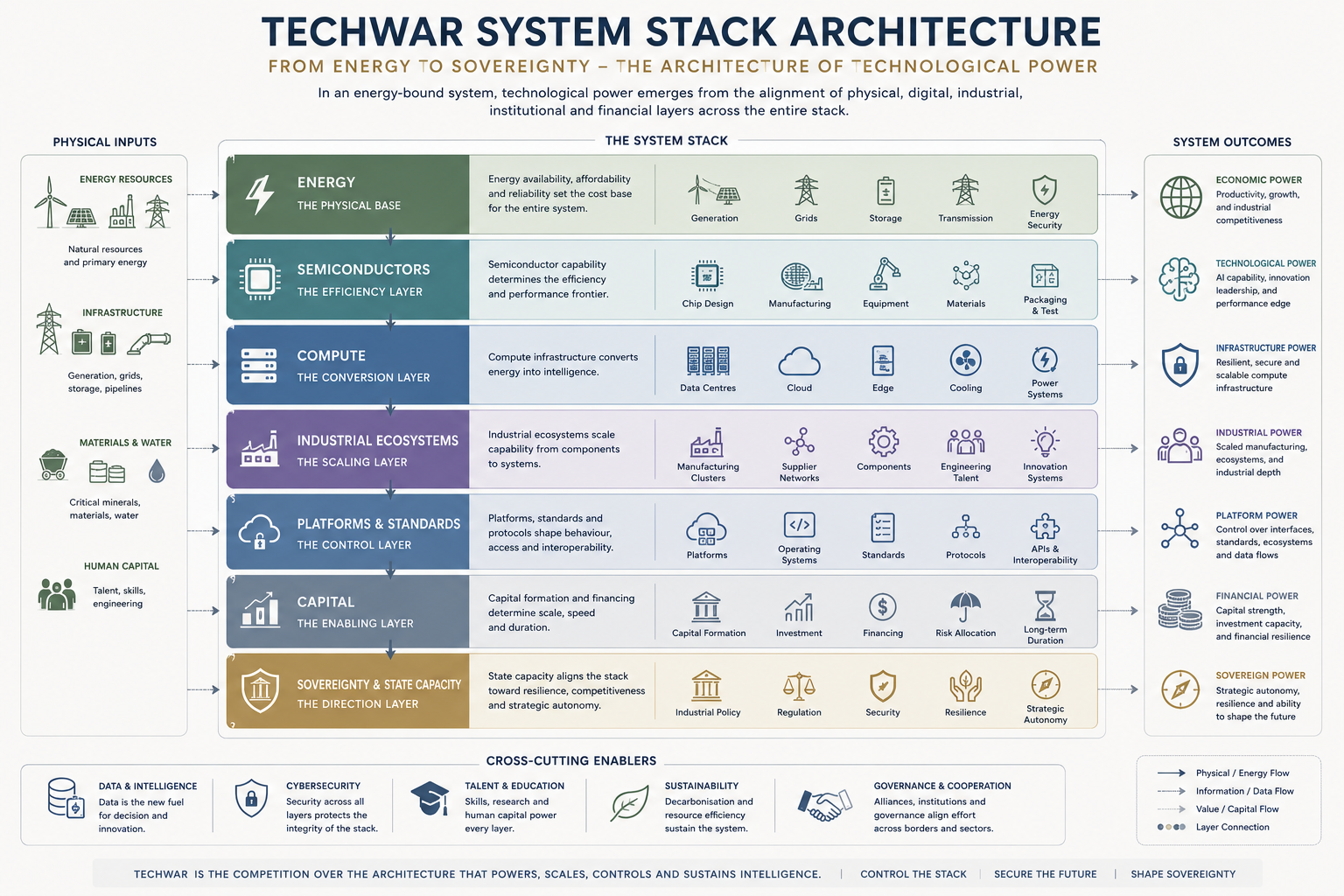
System Stack — TECHWAR Expression Layer
Energy → Compute → Industrial Ecosystems → Control
Energy sets the cost base
Compute transforms energy into intelligence
Industrial ecosystems scale capability
Platforms and standards consolidate control
Why TECHWAR Exists
The traditional view of technology focuses on:
firms
products
innovation cycles
This is no longer sufficient.
Technological competition now unfolds at the level of systems.
It depends on:
who controls energy inputs
who manufactures semiconductors
who hosts compute infrastructure
who scales industrial ecosystems
and who governs platforms and standards
→ The question is no longer who innovates
→ It is who controls the system through which innovation is
powered, scaled, and deployed
This requires moving beyond ideological interpretations toward system-level analysis.
See:
Beyond
Ideology


Core Doctrine — Technology as a Physical System
Technology as a Physical System
Architecture of Power — From Energy to Control
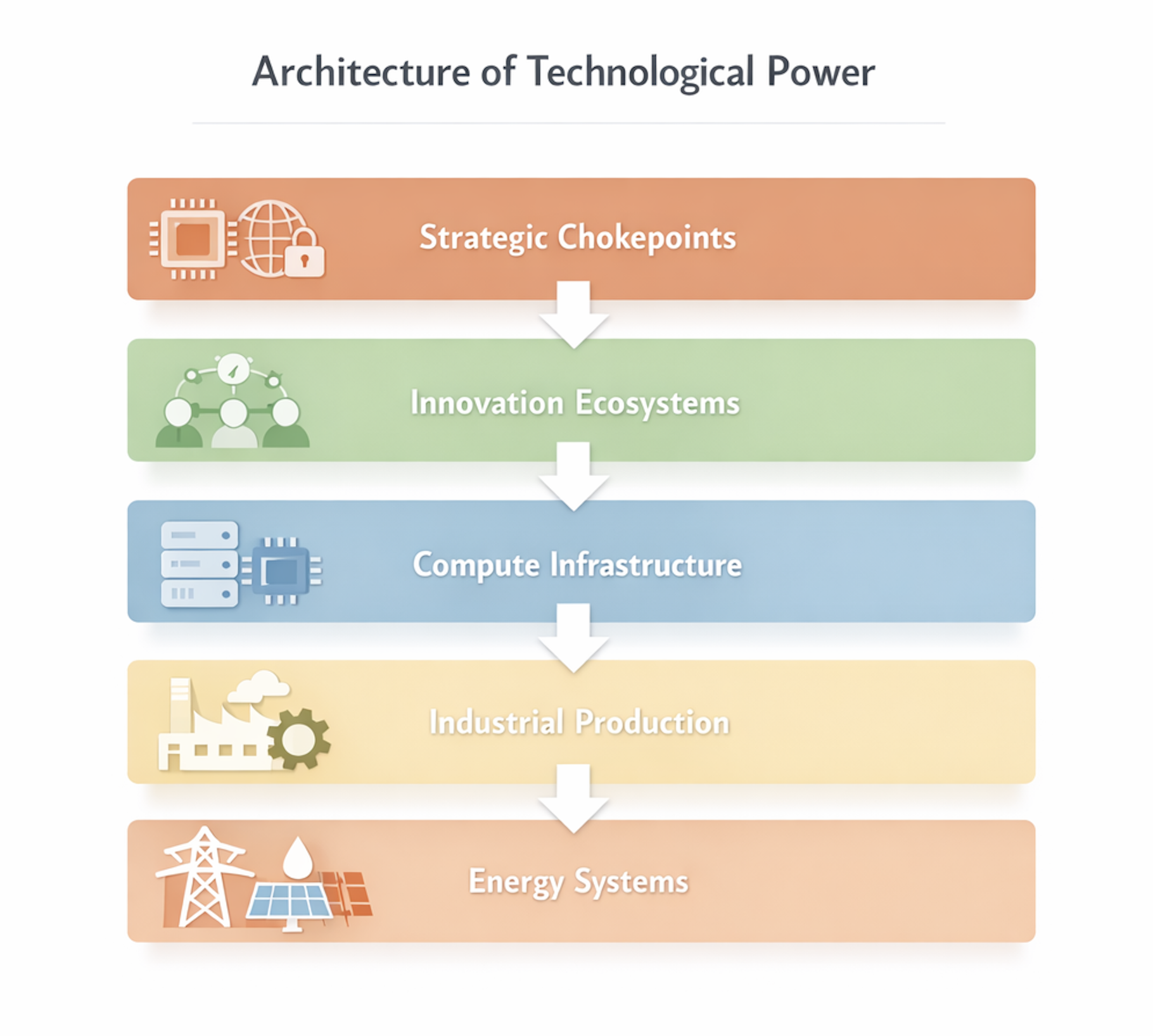
Technological power follows a structured chain:
Energy
→ determines cost and scalability
Semiconductors
→ determine efficiency of energy conversion
Compute infrastructure
→ determines where intelligence is produced
Industrial ecosystems
→ determine how capability scales
Platforms and standards
→ determine control and value capture
State capacity
→ determines sovereignty or dependence
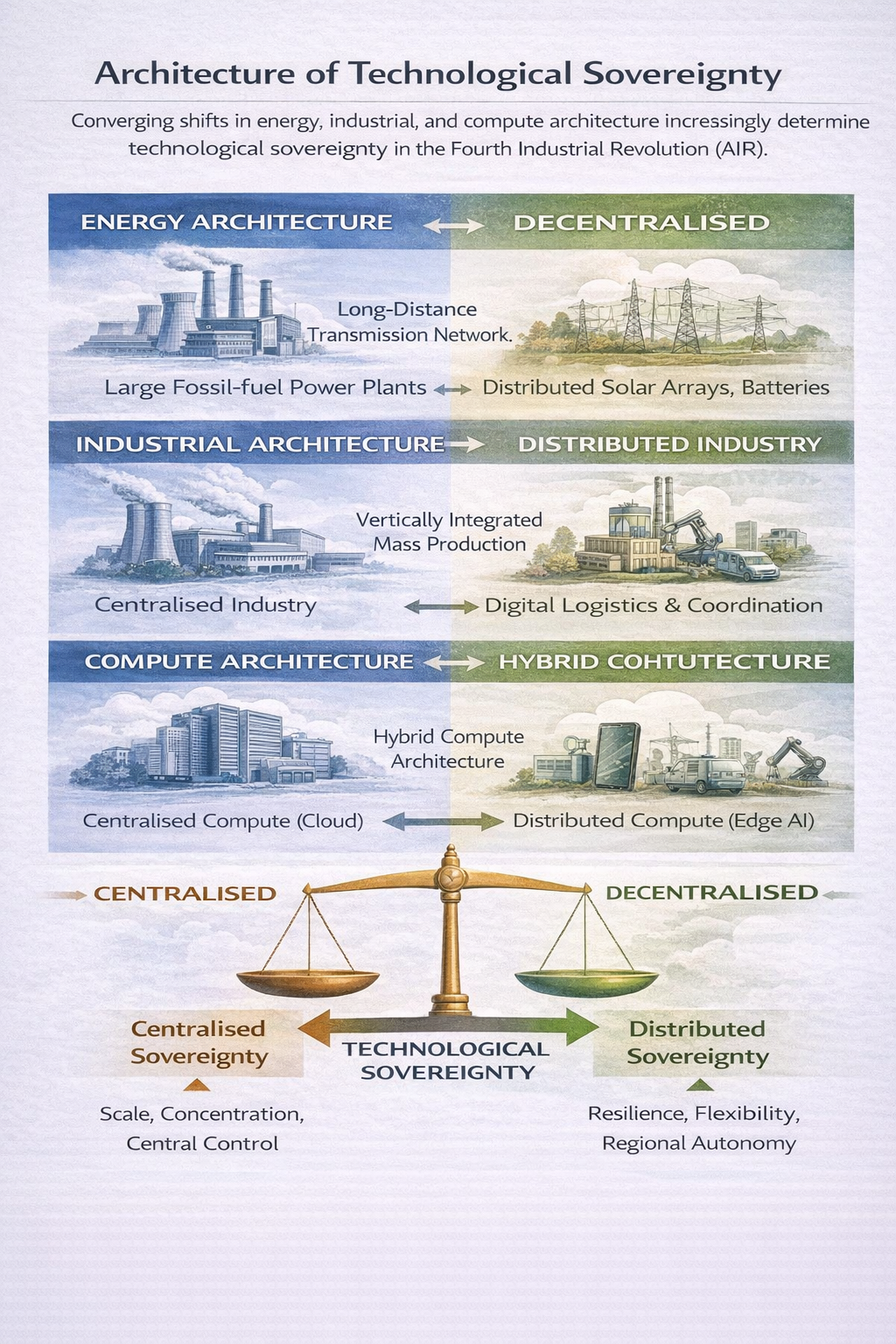
Centralised vs Distributed Systems


A critical architectural divide is emerging:
Centralised systems
hyperscale data centres
concentrated energy demand
platform dominance
external dependency
Distributed systems
edge and local compute
distributed energy integration
reduced grid stress
improved resilience
→ This is not an optimisation.
It is a system-level architectural choice.
Energy Architecture and Compute Architecture
Energy systems and compute systems co-evolve.
They follow the same structural logic.
Centralised energy systems
large-scale generation (fossil, nuclear, hydro)
long-distance transmission
concentrated grid nodes
→ These systems favour:
hyperscale data centres
cloud concentration
centralised compute infrastructure
Energy is transported to compute.
Distributed energy systems
solar, wind, local generation
storage integration
decentralised grid architecture
→ These systems favour:
edge and local compute
distributed processing
proximity to data generation
Compute moves closer to energy.
System Implication
The shift toward decentralised energy is not only an energy transition.
It is a compute architecture transition.
It changes:
where intelligence is produced
how infrastructure is designed
how grids are stressed
how data is governed
and how systems scale
Sovereignty Implication
Centralised compute:
concentrates control
increases dependency
exposes data
Distributed compute:
reduces systemic vulnerability
improves resilience
strengthens privacy
enables local autonomy
→ Cloud and edge are not competing technologies.
They are manifestations of underlying energy
architecture.
This shift accelerates as AI is embedded into 4IR systems across the physical economy, transforming compute demand from a digital function into a system-wide infrastructure requirement.
See:
The Fourth Industrial
Revolution as a Systems Revolution
Microprocessors, Compute Locality, and Sovereignty
At the deepest level, technological power is shaped by:
microprocessors → efficiency
compute locality → placement
Together, they determine:
energy consumption patterns
infrastructure requirements
latency and performance
privacy exposure
and operational autonomy
→ Sovereignty begins below the cloud layer.

I. Foundational Architecture — Technology as a System
AI Compute
Ecosystems
Industrial
Ecosystems and Technological Power
Global Value Chains
and Innovation Systems
II. Energy and Compute — The Strategic Core
Energy–Industry–Compute Stack AI is an energy-conversion system.
III. Industrial Ecosystems — Scaling Capability
Industrial Ecosystems and Technological Power Global Value Chains and Innovation Systems
IV. Digital Sovereignty — Control of the Stack
V. Strategic Competition — The System Level
Technological rivalry now unfolds across:
semiconductors
energy systems
compute infrastructure
industrial ecosystems
platforms and standards
logistics
and state coordination
VI. Core Reading Path
AI Compute
Ecosystems
Energy–Industry–Compute
Stack
Industrial
Ecosystems and Technological Power
Global Value Chains
and Innovation Systems
Digital
Sovereignty Stack
VII. Cross-Panel Position
From GLOBAL
energy as the operating system of power
industrial systems as energy transformation
technological rivalry as system rivalry
Toward EU SOVEREIGNTY
compute locality under constraint
distributed vs centralised infrastructure
digital sovereignty as system control
energy–AI–industrial coupling
VIII. Related Indexes
Digital
Sovereignty Stack
Energy
Systems — Cross-Panel Index
Closing Perspective
Technology is no longer a sector.
It is the mechanism through which energy becomes power.
In an energy-bound system, technological power is determined by the ability to coordinate:
energy
semiconductors
compute infrastructure
industrial ecosystems
platforms
and institutions
TECHWAR is the study of that coordination.