ENERGY CONSTRAINT AND THE MONETARY CEILING
How Energy Marginal Cost Shapes Currency Power

System Position
This article defines the monetary transmission layer of the Energy–Infrastructure–Compute system.
It explains how:
energy cost structures → industrial competitiveness → capital formation → monetary durability
shape long-term currency hierarchy and strategic economic resilience.
It should be read alongside:
System Navigation
The system unfolds across three structural layers:
Foundations → Dynamics → Outcomes
Foundations
Dynamics
Outcomes
Executive Summary
In an energy-bound system, monetary outcomes are not independent of physical conditions.
They emerge from the interaction between:
energy cost structures
infrastructure depth
industrial competitiveness
compute capacity
capital concentration
Persistent structural energy disadvantage propagates through the system:
energy cost → industrial margins → capital formation → productivity → monetary durability
When structural energy cost remains elevated:
industrial profitability compresses
reinvestment weakens
productivity growth slows
capital allocation migrates externally
monetary resilience deteriorates
This process rarely produces immediate crisis.
Instead, it gradually narrows the economic altitude at which a currency can operate without strain.
This is the:
Monetary Ceiling
In the digital era, where AI infrastructure, compute concentration, and capital formation increasingly follow electricity cost and grid stability, the ceiling emerges faster and with greater persistence.
Keynote — The Ceiling Is Structural
Currencies do not weaken only because of policy error.
They weaken when the systems beneath them lose structural depth.
In an energy-bound world, marginal energy cost conditions:
industrial viability
infrastructure scalability
capital formation
long-duration productivity
When structural energy cost remains persistently elevated, monetary space narrows even when institutional credibility remains intact.
This narrowing is cumulative.
It compounds across cycles.
The monetary ceiling is therefore not a crisis event.
It is a:
structural altitude limit imposed by energy architecture
Digital infrastructure now accelerates its emergence.

Energy Transition J-Curve and the Energy Chasm
Transition initially raises system cost before lowering it.Systems that successfully cross the trough regain structural advantage.
Systems that stall remain trapped within the:
AI–Energy–Cost Chasm
I. From Energy Cost to Monetary Constraint
The monetary ceiling operates through a material transmission sequence:
Persistent structural energy cost disadvantage
→ industrial margin compression
→ reduced retained earnings
→ weaker reinvestment
→ slower productivity growth
→ declining competitiveness
→ current-account sensitivity
→ capital allocation asymmetry
→ monetary fragility
This process rarely produces immediate dislocation.
Instead, it generates:
long-duration structural pressure
The ceiling emerges slowly.
But it accumulates persistently.
Doctrine — Energy–Capital–Currency Hierarchy
In an energy-bound system:
Energy → Industry → Capital → Currency
Energy cost shapes industrial margins.
Industrial margins shape capital formation.
Capital formation conditions monetary durability.
Monetary resilience therefore rests on the physical cost structure of the underlying economy.
II. The Euro Under Structural Compression
The euro operates within a structurally constrained configuration.
Europe combines:
energy import dependence
exposure to gas-linked marginal pricing
fragmented fiscal architecture
uneven infrastructure execution
rising security expenditure
accelerated transition investment requirements
Individually, these pressures do not destabilise a currency.
Together, they compress:
policy flexibility
growth capacity
industrial competitiveness
capital formation space
The euro therefore does not necessarily collapse.
It risks:
plateauing under structural constraint
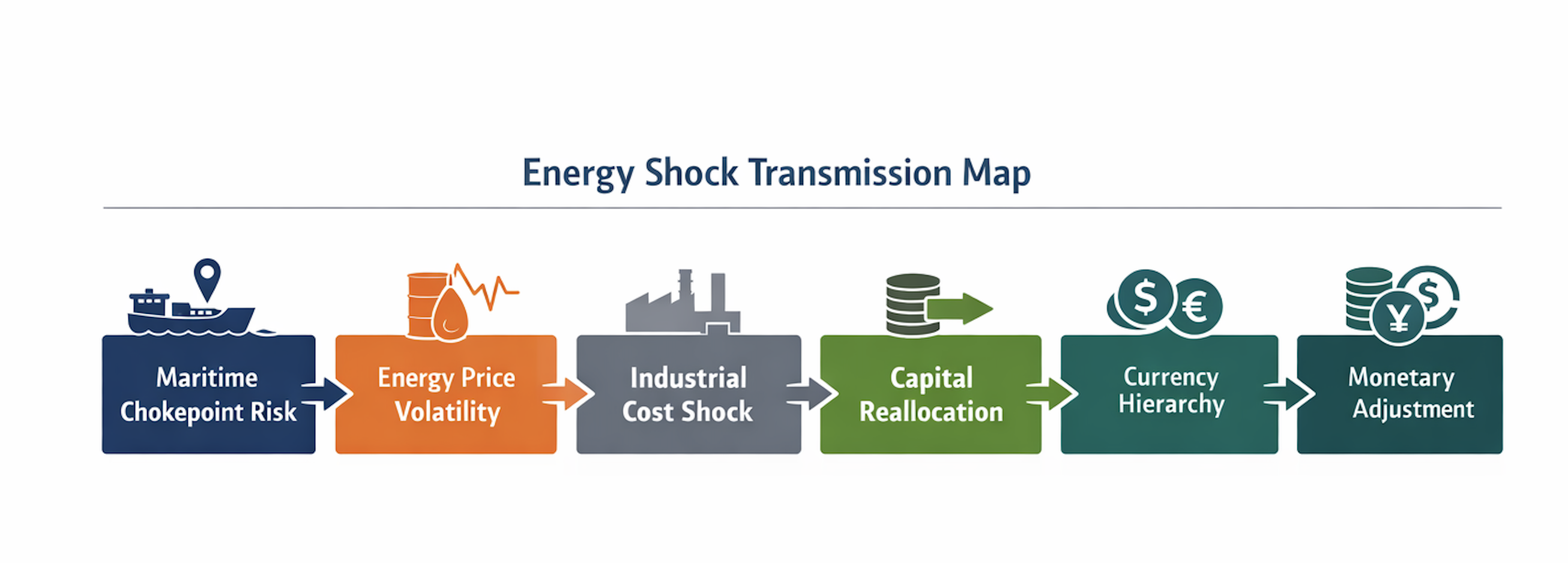
Energy Shock Transmission Map
Energy volatility propagates through:industrial margins → capital allocation → monetary durability
The euro’s long-term trajectory depends less on monetary policy alone than on:
energy system redesign
III. Digital Amplification — The Acceleration Layer
In previous industrial cycles, energy disadvantage transmitted gradually.
In the digital system, transmission accelerates.
AI infrastructure increasingly clusters where:
electricity is abundant
grids are stable
permitting scales rapidly
infrastructure expansion remains executable
As a result:
compute capacity follows energy
capital follows compute concentration
platforms follow capital
monetary influence follows infrastructure
This creates a reinforcing system stack:
Energy → Compute → Capital → Currency

Energy–Compute–Capital–Currency Stack
Energy cost shapes compute geography.Compute concentration shapes capital concentration.
Capital concentration reinforces monetary power.
Where structural energy cost remains elevated:
compute investment migrates externally
platform expansion concentrates elsewhere
long-duration capital accumulates abroad
monetary influence becomes increasingly conditional
Digital systems therefore amplify the monetary ceiling.
Stablecoins and Embedded Monetary Drift
Dollar-denominated digital infrastructure increasingly circulates through:
cross-border payments
platform ecosystems
cloud infrastructure
corporate treasury systems
This embeds monetary preference without formal currency substitution.
Monetary sovereignty therefore becomes layered:
legal issuance
infrastructure control
transactional dominance
platform integration
Without system-level coherence across the stack, these layers diverge.
The ceiling lowers through dependency rather than crisis.
IV. Why Markets Misprice the Ceiling
Markets structurally overweight:
liquidity conditions
earnings momentum
cyclical growth
short-duration signals
They structurally underweight:
energy architecture
infrastructure constraints
industrial erosion
long-duration productivity compression
This creates persistent structural mispricing.
The United States currently combines:
lower energy cost
infrastructure scale
compute leadership
capital depth
currency dominance
This coherence attracts long-duration capital.
By contrast, systems operating below the monetary ceiling experience gradual capital drift.
V. Monetary Power Is Energy-Conditioned
This analysis extends:
If energy is the base layer of economic stability:
monetary sovereignty becomes structurally derivative of energy architecture
Currency power is not abstract.
It is materially conditioned by:
energy cost
infrastructure depth
industrial density
compute concentration
capital formation
Even energy corridors, chokepoints, grid systems, and infrastructure alignment become monetary variables.

Divergence Path — Cost → Capital → Currency
VI. Policy Implication — Lifting the Ceiling
The ceiling cannot be addressed through monetary policy alone.
It requires transformation at the system base.
This includes:
lower structural electricity cost
accelerated grid integration
storage deployment
stable pricing architecture
energy–industry coordination
faster electrification
compute–energy alignment
infrastructure execution capacity
The LNG–Security Trade-Off
Short-term stabilisation mechanisms — particularly:
LNG expansion
long-term import contracts
externally secured energy systems
can reduce immediate volatility.
But they also risk:
anchoring pricing to imported fossil systems
delaying electrification convergence
extending the high-cost phase of the transition
reinforcing external dependency
This creates a structural tension:
systems often stabilise short-term volatility by extending the pricing architecture that reproduces long-term monetary constraint
VII. System Competition and Monetary Hierarchy
In an energy-bound world, currencies do not compete in isolation.
They compete within:
integrated system architectures
Monetary competition therefore becomes:
system competition
Where monetary position is increasingly determined by:
energy cost
infrastructure scalability
compute concentration
industrial depth
capital-market gravity
Systems with structurally lower energy cost do not merely operate above the ceiling.
They increasingly attract:
capital
compute
industrial clustering
monetary influence
from systems operating below it.
Final Insight
The monetary system is not detached from the physical world.
It is anchored in it.
Energy cost defines the outer limits of monetary power.
In this environment, the monetary ceiling is not only a domestic constraint.
It is also a mechanism through which:
capital reallocates
compute relocates
industrial ecosystems diverge
monetary influence concentrates
across competing systems.
The Monetary Cold War is not fought through currencies alone.
It is determined by the energy systems that sustain them.
Evidence Companion — Extract
Validation Layer (Energy Constraint → Monetary Outcomes)
System Mapping
Energy → Infrastructure → Compute → Industry → Capital → Currency
This article focuses on the transmission:
Energy Cost → Industrial Margin → Capital Allocation → Monetary Constraint
I. Energy Constraint and Cost Structures
System Claim
Energy availability, cost, and infrastructure define the limits of industrial competitiveness, AI scaling, and monetary resilience.
Transmission Mechanism
Energy cost → industrial margins → investment capacity → compute deployment → competitiveness
Evidence Anchors
International Energy Agency — industrial electricity pricing and energy outlooks
European Central Bank — energy cost transmission into inflation and industrial margins
International Monetary Fund — external balance pressures from energy imports
II. Transition Dynamics and the J-Curve
System Claim
The energy transition produces a non-linear cost structure in which transition costs rise before long-duration advantages emerge.
Transmission Mechanism
Infrastructure lag → supply constraint → elevated cost → delayed competitiveness gains
Evidence Anchors
International Energy Agency — transition investment requirements
BloombergNEF — renewable learning curves
World Bank — infrastructure financing gaps
III. AI–Energy–Cost Chasm
System Claim
AI-driven electricity demand accelerates during a period of constrained energy-system expansion.
Transmission Mechanism
Compute demand ↑ → electricity demand ↑ → grid stress ↑ → cost divergence
Evidence Anchors
International Energy Agency — data-centre electricity demand
U.S. Department of Energy — grid capacity and AI load
Microsoft and Google infrastructure disclosures
IV. External Dependence and Monetary Exposure
System Claim
Energy-importing systems remain structurally exposed to external financing and pricing volatility.
Transmission Mechanism
Energy imports → external payments → fiscal support → debt accumulation → monetary pressure
Evidence Anchors
European Commission — energy import dependency
International Monetary Fund — current-account pressures
Bank for International Settlements — sovereign financial transmission
V. Control Layers and Capital Capture
System Claim
Control over AI and digital infrastructure determines capital concentration and monetary leverage.
Transmission Mechanism
Platform control → value capture → capital concentration → monetary reinforcement
Evidence Anchors
Amazon Web Services and Microsoft Azure — cloud concentration
World Economic Forum — digital platform dominance
European Commission — digital sovereignty assessments
VI. Sovereignty and System Integration
System Claim
Sovereignty emerges from integrated control across the system stack.
Transmission Mechanism
Energy → Infrastructure → Compute → Capital → Currency → Sovereignty
Evidence Anchors
International Monetary Fund — macroeconomic resilience
Bank for International Settlements — financial system stability
European Commission — strategic autonomy frameworks
System Validation Insight
Taken together, these mechanisms validate a single structural pathway:
Energy cost is not an isolated economic variable.
It is a:
system constraint
that propagates through:
industrial margins → capital allocation → monetary durability
This is the mechanism through which the monetary ceiling emerges in energy-constrained systems.
Investor Data Annex
Energy Constraint and Long-Duration Monetary Risk
1. Industrial Power Cost → Margin Compression
Persistent EU–US electricity cost differentials reduce retained earnings and reinvestment capacity.
2. Energy Import Exposure → External Vulnerability
Energy dependence embeds structural current-account sensitivity and external financing exposure.
3. Energy Volatility → Currency Beta
Energy shocks amplify euro volatility beyond cyclical dynamics.
4. Cost Structure → Capital Allocation
Capital systematically concentrates inside lower-cost energy systems.
5. Energy Stability → Cost of Capital
Stable energy systems reduce discount rates and improve long-duration valuation durability.
Structural Transmission Model
Energy cost disadvantage
↓
margin compression
↓
lower reinvestment
↓
weaker productivity
↓
external sensitivity
↓
currency fragility
↓
capital reallocation
↓
valuation divergence