Decarbonisation, Electrification, and Cost — Cross-Panel Index
Why Energy Transition Reshapes Cost, Sovereignty, and Economic Structure
Keynote
Decarbonisation is often presented as a climate policy.
In reality, it is a system transformation of how energy is produced, priced, and distributed.
At its core, it involves a shift:
from fuel-based energy systems
→ to electricity-based energy systems
This shift has profound implications for:
- cost structures
- industrial competitiveness
- economic sovereignty
- and political autonomy
In an energy-bound system, decarbonisation is not optional.
It is the primary pathway through which economies can regain control over cost, stability, and strategic direction.
- Energy System Transformation — The Transition Layer # System Role — Direction of the Transition
This page represents the directional layer of the system.
It explains how energy systems are being restructured, and should be read alongside:
- Energy Systems → system input
- Energy, AI, and Infrastructure → system constraint
- Dynamics → system evolution
Decarbonisation defines where the system is going.
Dynamics explain how it gets there.
I. From Fuel to Electricity
Traditional energy systems are based on fuel extraction and combustion:
- oil
- gas
- coal
These systems are characterised by:
- ongoing fuel costs
- exposure to global price volatility
- dependence on imports
- sensitivity to currency fluctuations
Electric systems, by contrast, are based on:
- solar
- wind
- hydro
- electrified infrastructure
Their defining characteristics are different:
- high upfront capital cost
- low marginal cost of production
- domestic energy generation
- reduced exposure to global fuel markets
II. The Cost Structure Shift
The key transformation is not environmental — it is economic.
Fuel-based systems:
- low initial infrastructure cost
- high and continuous operating costs
- price volatility driven by global markets
Electrified systems:
- high initial investment
- declining marginal cost over time
- increasing price stability
This creates a structural shift:
from variable, externally determined costs
→ to stable, internally controlled costs
III. Why This Matters for Sovereignty
Energy cost is not just an input.
It is a system-wide price anchor.
It determines:
- industrial competitiveness
- cost of living
- inflation dynamics
- fiscal pressure
- and monetary stability
In fuel-dependent systems:
- costs are imported
- volatility is external
- control is limited
In electrified systems:
- costs are increasingly domestic
- volatility declines over time
- control shifts inward
This is not only an energy transition.
It is a shift in economic control.
IV. Electrification and Domestic Capacity
Electrification links energy more closely to:
- domestic infrastructure
- local production
- regional grids
- digital coordination systems
This creates new forms of capability:
- decentralised energy production
- localised compute infrastructure
- integration with industry and services
As a result:
economic activity becomes more domestically anchored
and less dependent on:
- imported fuels
- external price shocks
- and foreign currency exposure
V. Implications for the Global South
For many economies in the Global South, this shift is particularly significant.
Fuel-based systems often create:
- import dependency
- currency pressure
- exposure to external shocks
- constrained industrialisation
Electrification offers a different pathway:
- utilisation of domestic renewable resources
- reduced reliance on imported fuels
- improved balance-of-payments stability
- greater control over development trajectories
This creates the potential for:
greater economic self-determination
and, over time, greater political autonomy
However, this transition is not automatic.
It requires:
- infrastructure investment
- grid development
- financing capacity
- and institutional coordination
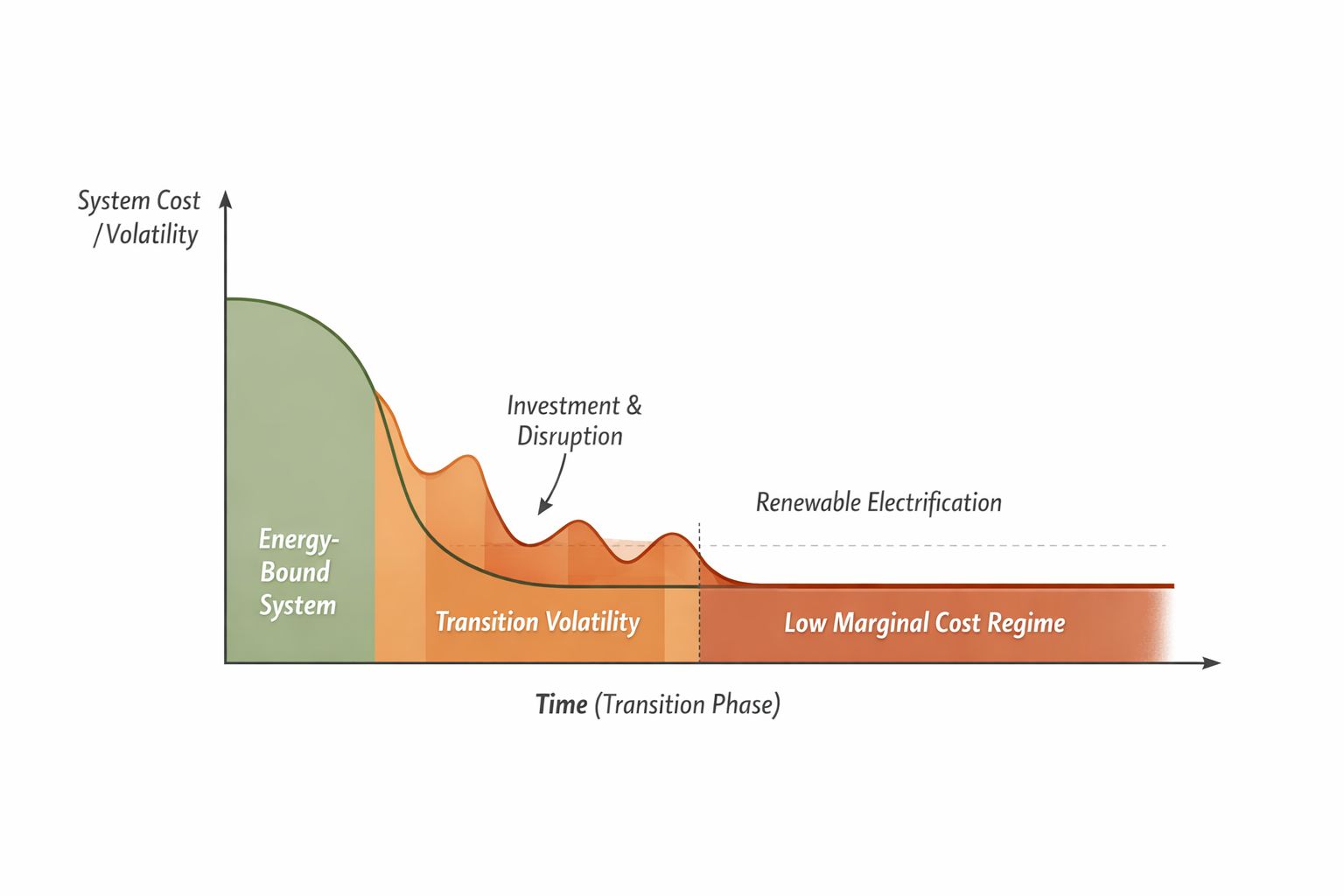
VI. The Transition Challenge
Decarbonisation introduces a temporal tension:
Short term:
- high investment costs
- infrastructure build-out
- potential price pressure
Long term:
- lower marginal energy costs
- improved stability
- enhanced competitiveness
This creates a structural dynamic:
initial cost pressure → long-term cost decline
The ability to manage this transition determines:
whether economies experience compression
or achieve regeneration
VII. Energy, Computation, and the Next System Layer
As economies electrify, energy becomes increasingly linked to:
- computation
- digital infrastructure
- artificial intelligence
This reinforces a new dynamic:
energy → computation → productivity → cost structure
Electrified systems therefore do not only power industry.
They power compute ecosystems.
This makes the design of energy systems central to:
technological capability
digital sovereignty
and economic organisation
VIII. The Political Economy of Transition
Decarbonisation and electrification are often framed as technological or market-driven processes.
In reality, they are state-dependent transformations.
They require:
- large-scale infrastructure investment
- long-term capital allocation
- grid expansion and coordination
- regulatory alignment
- and sustained fiscal capacity
Electrified systems depend on front-loaded system construction, making the transition inherently political.
It involves:
- taxation and redistribution
- public investment and guarantees
- industrial policy coordination
- institutional capacity to execute at scale
Historically, transformations of this magnitude have required:
coordinated state action and long-term investment frameworks
In fragmented or fiscally constrained systems:
- infrastructure remains incomplete
- cost advantages fail to materialise
- dependency can deepen
Decarbonisation is therefore not only technological or economic —
it is a governance and coordination challenge
Decarbonisation as a Tech War Instrument Decarbonisation and Economic Regeneration AI Energy Sovereignty - A Structural Framework for Europe
AI and Energy — The Sovereignty Stress Test Energy, AI, and Infrastructure — Cross-Panel Index
Dynamics — Index Reference - System Evolution — From Transition to Contest Mediterranean Guide to the System