The New G2 Global Order: Power, Systems, and the End of Illusions
This article is part of the “New G2 Global Order” series, which examines how energy, finance, technology, and governance are restructuring global power.
Executive Summary
The global order is no longer organised around universal rules, nor is it collapsing into chaos. It is being reorganised around systems of power. Energy, finance, technology, industrial capacity, and security — once treated as separate domains — have fused into interdependent architectures that determine which states can act, which must adapt, and which become structurally dependent.
This transformation marks the end of a long-held illusion: that global order can be sustained through rules alone. Power today is exercised less through formal authority than through control of dependencies — embedded in supply chains, energy systems, financial infrastructure, technological platforms, and security arrangements.
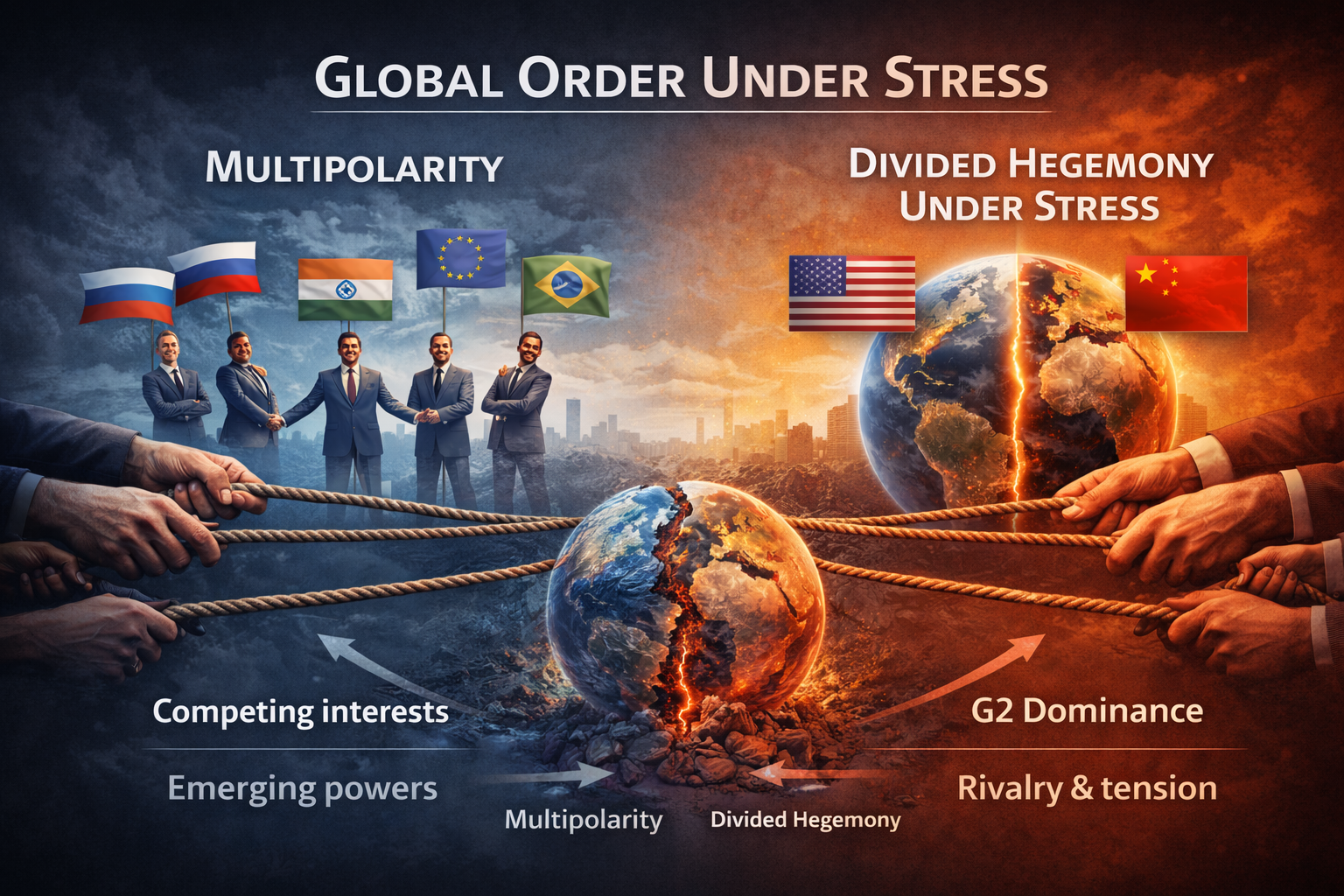
At the centre of this reconfiguration stands a new gravitational reality. The world is increasingly shaped by the interaction between the United States and China. This is not a return to Cold War bipolarity, nor a simple rivalry of ideology or military power. It is a systemic contest over how modern economies are organised: how technology is scaled, how energy is secured, how money circulates, and how rules are enforced when institutions no longer command universal legitimacy.
Yet the emergence of a G2 dynamic does not render the rest of the world irrelevant. On the contrary, it is precisely the absence of credible global governance that forces other actors — particularly Europe, Russia, and the Global South— into increasingly constrained strategic choices. In this environment, power is exercised not through domination, but through the ability to shape — or withstand — dependency.
From Rules to Systems
For three decades after the Cold War, globalisation was framed as a rules-based order: open markets, integrated supply chains, liberal finance, and shared institutions. In practice, it evolved into a system of asymmetric interdependence. Production was offshored in the name of efficiency, finance was centralised in the name of liquidity, energy was commodified, and technology platforms consolidated control over data, standards, and infrastructure.
This model delivered efficiency, but it hollowed out resilience. When shocks arrived — financial crises, pandemics, wars, and energy disruptions — states discovered that sovereignty had quietly migrated into supply chains, grids, payment systems, and platforms they did not control.
The response was not deglobalisation, but re-systemisation:
- the United States leveraging energy abundance, dollar dominance, and platform power
- China building integrated industrial ecosystems, electrification capacity, and regional integration
- Europe caught between economic weight and political fragmentation
The result is not a single global order, but a patchwork of overlapping systems, each enforcing its own logic of access, alignment, and exclusion.
Why Europe Is the Pivot, Not the Prize
Europe is often described as weak or declining. This diagnosis misses the point. Europe is not weak — it is misframed. Treated primarily as an economic union, the European Union remains systematically excluded from many of the decision-making arenas that determine its own security, energy access, and geopolitical environment. This is not accidental; it is the result of institutional design lagging behind material reality.
The war in Ukraine exposed this contradiction with unusual clarity. Europe bears the economic, energy, and security costs of the conflict, yet key negotiations occur through NATO, bilateral channels, or great-power frameworks where the EU has no unified political voice.
Sovereignty, in this context, is not about flags or armies alone. It is about representation within systems of decision-making — the ability to shape the infrastructures, standards, and enforcement mechanisms through which power is exercised.
If Europe remains an economic space governed by others, it will continue to absorb shocks rather than shape outcomes. If it consolidates politically, it becomes the only actor capable of bridging and constraining the emerging G2 dynamic rather than being trapped by it.
Energy, Technology, and Money as Instruments of Order
What distinguishes the current transition from previous geopolitical shifts is the materiality of power. Technology is constrained by electricity and compute. Finance is embedded in platforms and payment systems. Energy abundance or scarcity shapes industrial possibility. Monetary dominance increasingly substitutes for governance when institutions fail.
This volume does not argue that any single model will prevail. Instead, it shows that power now lies in alignment:
- energy with industry
- finance with production
- technology with infrastructure
- sovereignty with representation
Where these align, states gain leverage. Where they do not, dependency deepens — regardless of wealth, innovation, or formal authority.
The Question That Frames This Volume
The central question of this book is not whether the world will be led by Washington or Beijing. It is whether the emerging order will be governed through institutions capable of mediating power, or through coercive systems of dependency that bypass democratic control.
For Europe, for the Global South, and ultimately for the stability of the international system, the answer depends on whether governance structures adapt to material reality — or whether power continues to migrate into markets, platforms, alliances, and currencies beyond public accountability.
This is not the end of global order.
It is the end of pretending that rules alone are
enough.
The chapters that follow trace how power moved, where it now resides, and what it demands of states that wish to act rather than react