Energy-Bound System
Constraint as the Operating Condition of 21st Century Power
Keynote
The defining structural condition of the twenty-first century is not ideology, technology, finance, or geopolitics considered independently.
It is energy constraint.
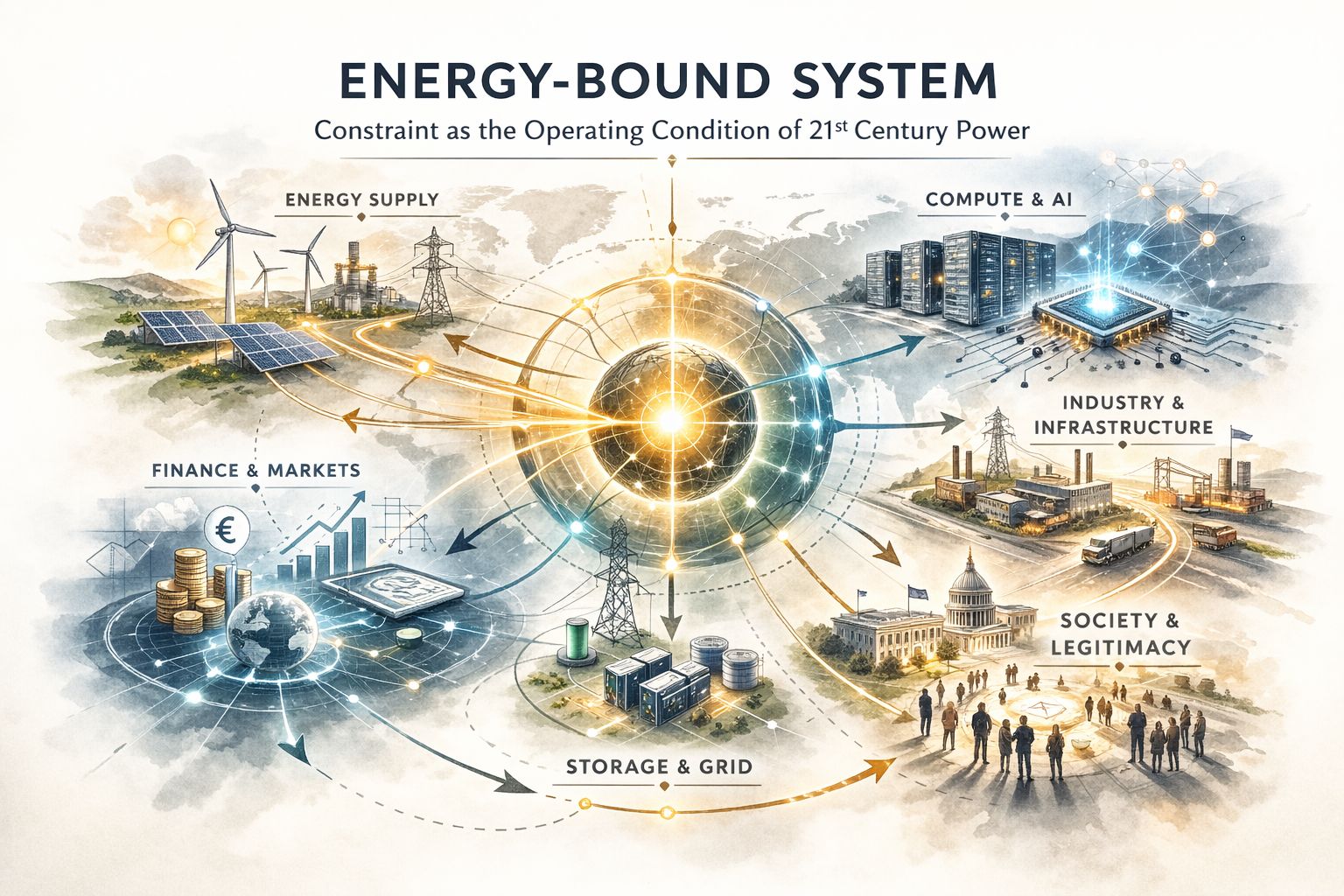
The global system has entered an Energy-Bound System: a structural condition in which energy availability, electricity stability, infrastructure coordination, industrial throughput, and energy marginal cost increasingly determine the limits of economic scale, technological capability, monetary flexibility, military resilience, and geopolitical leverage.
Energy no longer functions merely as a background economic input operating beneath industrial civilisation.
It increasingly functions as the foundational operating condition beneath all higher-order systems.
This transformation changes the structure of power itself.
During the late industrial era, energy primarily powered manufacturing, transportation, and heavy industry.
Under emerging AI-energy conditions, energy simultaneously powers industrial production, semiconductor fabrication, cloud infrastructure, artificial intelligence systems, logistics coordination, digital platforms, communications systems, financial architecture, military infrastructure, and sovereign administrative capacity.
As a result, economic systems can no longer be understood independently from electricity systems.
Technological capability can no longer be understood independently from infrastructure architecture.
Monetary flexibility can no longer be understood independently from physical throughput.
The strategic question of the century is therefore no longer simply:
Who possesses capital?
Who possesses technology?
Who possesses military scale?
The decisive question increasingly becomes:
which systems can sustain affordable energy, scalable compute, industrial coordination, infrastructure resilience, and political legitimacy simultaneously under conditions of structural stress
The emerging global order is therefore increasingly organised through a systemic sequence:
Energy → Infrastructure → Compute → Industry → Capital → Sovereignty
This sequence increasingly defines the architecture of geopolitical power itself.
System Navigation
Foundational System Logic
AI, Compute, and Infrastructure
Sovereignty, Capital, and Structural Constraint
Geopolitical and Mediterranean Architecture
I. From Relative Energy Abundance to Structural Constraint
For much of the late twentieth century, advanced economies operated under assumptions of relative energy elasticity.
Fossil-fuel systems appeared sufficiently abundant, scalable, and globally tradable that energy itself rarely appeared to impose a meaningful structural ceiling upon economic expansion, industrial growth, financial leverage, or technological development.
Energy volatility existed, but energy constraint did not yet organise the global system.
This condition gradually changed through the interaction of several structural transformations.
The first transformation emerged through the increasing difficulty of expanding fossil-fuel systems at low marginal cost. Geopolitical instability, depletion dynamics, environmental pressure, infrastructure complexity, and rising extraction costs progressively weakened the assumption that hydrocarbon expansion could continue indefinitely without systemic consequence.
The second transformation emerged through electrification itself.
As economies became increasingly dependent upon electricity-intensive systems, industrial stability became progressively more dependent upon grid architecture, transmission infrastructure, storage capacity, balancing systems, and long-duration infrastructure coordination.
The third transformation emerged through artificial intelligence, digital infrastructure, and compute-intensive industrial systems.
Artificial intelligence systems, cloud architectures, semiconductor ecosystems, hyperscale data centres, automated logistics, and machine-coordination systems do not reduce dependence upon physical infrastructure.
They intensify it.
The digital economy therefore did not dematerialise industrial civilisation.
It deepened civilisation’s dependence upon electricity stability, compute infrastructure, cooling systems, industrial ecosystems, mineral supply chains, and high-density energy throughput.
This marks a historic transformation in the structure of power itself.
During the industrial era, energy primarily powered production.
Under AI-energy conditions, energy simultaneously powers production, coordination, computation, logistics, communications, industrial automation, financial systems, and sovereign administration.
Energy therefore ceased to function merely as one sector among many.
It became the foundational substrate beneath the entire system.
The resulting condition is not absolute energy scarcity.
The defining condition is instead the return of energy as a structural organising constraint.
In an Energy-Bound System, energy cost, electricity reliability, infrastructure quality, industrial coordination, and system resilience increasingly determine what can scale, where it can scale, and at what political, financial, technological, and geopolitical cost.
II. What an Energy-Bound System Actually Means
An Energy-Bound System is not defined by permanent collapse, civilisational breakdown, or universal shortage.
It is defined by structural sensitivity.
In such a system, energy conditions increasingly shape the behaviour of all higher-order systems because modern industrial civilisation depends upon continuous electricity throughput operating across increasingly integrated infrastructures.
Electricity marginal cost therefore no longer influences only utilities or manufacturing.
It increasingly shapes industrial competitiveness, inflation stability, fiscal flexibility, AI scalability, technological sovereignty, monetary resilience, and geopolitical durability simultaneously.
Because advanced industrial systems depend upon continuous and affordable electricity throughput, persistent energy-cost differentials increasingly determine where industrial production remains viable.
Because artificial intelligence systems require enormous concentrations of compute infrastructure operating continuously at high power density, energy availability increasingly determines where technological ecosystems concentrate.
Because inflation increasingly propagates simultaneously through electricity pricing, fuel costs, logistics systems, industrial supply chains, transportation networks, and food systems, monetary policy itself becomes structurally energy-exposed.
Because sovereign systems increasingly depend upon digitally coordinated infrastructure, energy stability increasingly influences political legitimacy, institutional durability, and state execution capacity.
The result is a structural inversion.
Energy no longer merely supports economic systems.
Economic systems increasingly operate downstream of energy architecture.
This transformation changes the meaning of strategic autonomy itself.
Industrial policy increasingly becomes electricity policy.
Artificial intelligence strategy increasingly becomes infrastructure strategy.
Fiscal flexibility increasingly depends upon energy-cost structure.
Monetary stability increasingly depends upon physical system efficiency.
Digital sovereignty increasingly depends not merely upon software control, but upon physical control over energy systems, semiconductor ecosystems, compute infrastructure, transmission capacity, cooling systems, industrial supply chains, and strategic minerals.
Under Energy-Bound conditions, sovereignty increasingly ceases to operate primarily through formal political authority alone.
It increasingly operates through system capacity.
The ability to maintain affordable electricity, stable infrastructure, industrial coordination, compute scalability, logistical continuity, and institutional execution increasingly determines whether states retain meaningful strategic agency under pressure.
Sovereignty therefore becomes increasingly systemic rather than merely territorial or legal.
This transition marks the emergence of systems sovereignty as the defining operational form of power under AI-energy conditions.
The decisive strategic question is therefore no longer whether states possess abstract technological capability alone.
The decisive question is whether states possess the energy systems, infrastructure coordination, industrial ecosystems, compute architectures, and institutional execution capacity required to sustain technological scale under conditions of structural stress.
Finance does not transcend physical constraint.
Finance increasingly operates within physical constraint.
III. Energy as the Base Layer of System Architecture
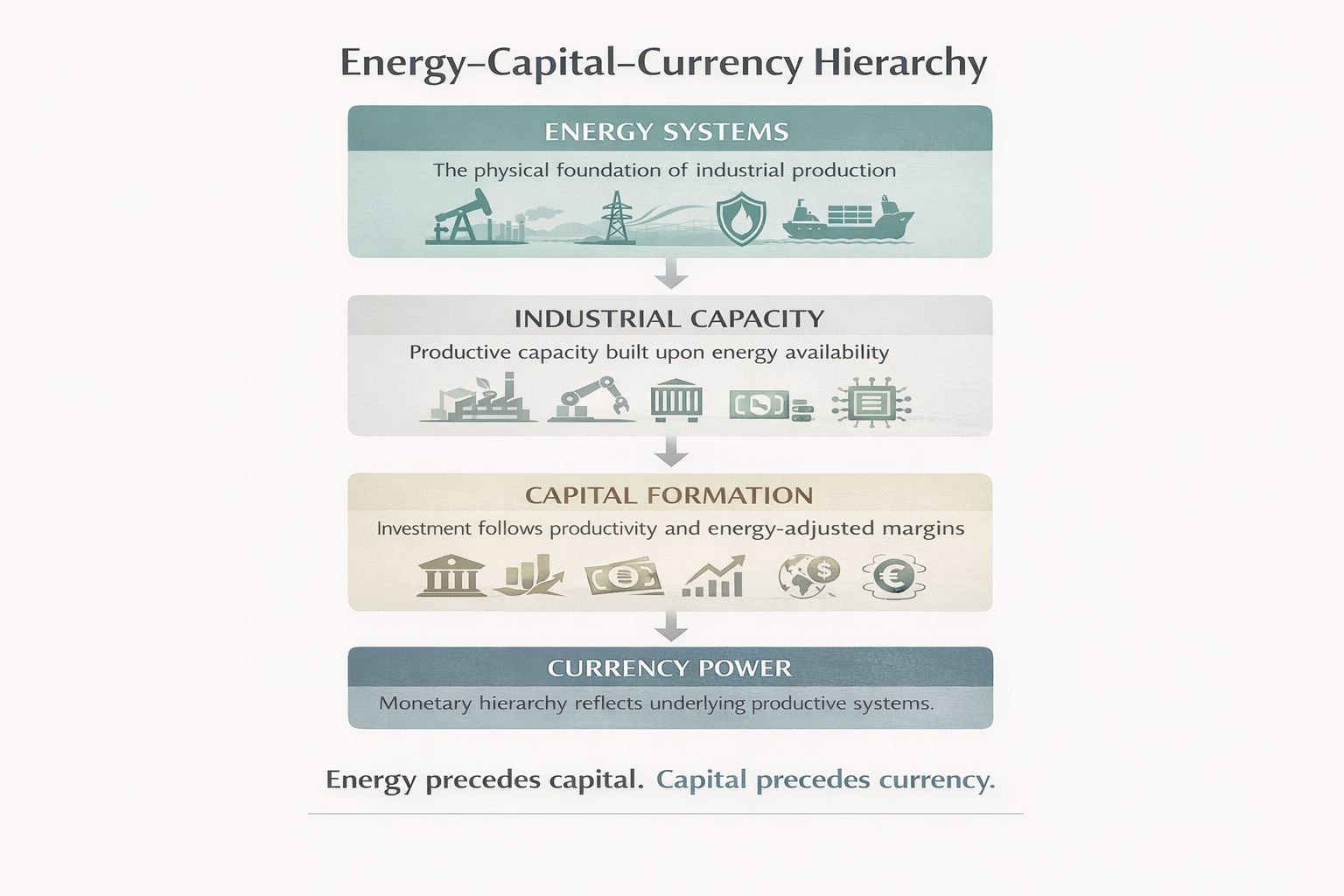
Modern economies increasingly function as layered system architectures.
At the base of these architectures sit energy systems.
Above them emerge industrial systems, logistics networks, compute infrastructure, cloud coordination layers, financial systems, political institutions, military capacity, and sovereign administrative structures.
This hierarchy matters because stress propagates upward throughout the entire stack.
When energy remains cheap, stable, abundant, and expandable, upper layers can absorb volatility relatively effectively. Industrial systems remain competitive, digital systems scale affordably, inflation pressures remain manageable, and political legitimacy remains comparatively stable.
But when electricity systems become structurally expensive, fragmented, volatile, or physically constrained, stress propagates throughout the entire architecture.
Industrial profitability weakens.
Supply-chain resilience deteriorates.
Compute infrastructure becomes geographically concentrated.
Capital allocation shifts toward energy-secure jurisdictions.
Political backlash intensifies through affordability pressure and industrial insecurity.
This explains why persistent inflation volatility, industrial relocation, AI cluster concentration, infrastructure nationalism, energy corridor competition, and political fragmentation increasingly emerge simultaneously.
These developments are not isolated phenomena.
They increasingly emerge from the same underlying structural condition:
the return of energy as the organising constraint beneath industrial civilisation.
Energy constraint therefore does not replace geopolitics.
It reorganises geopolitics around infrastructure, throughput, system integration, industrial coordination, and electricity architecture.
The strategic significance of this transformation extends beyond energy systems narrowly understood.
As energy increasingly determines the viability of industrial ecosystems, compute scaling, logistics coordination, and sovereign resilience, the distinction between economic infrastructure, technological infrastructure, and geopolitical infrastructure progressively collapses.
Energy systems increasingly become civilisational operating systems.
This transformation also explains why technological competition increasingly converges with industrial competition, infrastructure competition, and geopolitical competition simultaneously.
Artificial intelligence systems cannot scale independently from electricity systems.
Compute ecosystems cannot scale independently from semiconductor fabrication, cooling architecture, transmission infrastructure, and mineral processing systems.
Digital systems therefore increasingly operate within the same physical constraints governing energy systems, industrial systems, and logistics systems.
The emerging technological order is therefore increasingly physical rather than abstract.
Technological leadership increasingly depends not merely upon software innovation, but upon the integration of energy systems, industrial ecosystems, compute infrastructure, capital capacity, logistics coordination, and sovereign execution.
This is why the AI-energy transition increasingly reorganises the entire hierarchy of global power.
IV. The Electrification Transition and the J-Curve of Constraint
The energy transition is frequently described primarily as an environmental transition.
Structurally, it is something far larger.
It represents the reconstruction of the operating architecture of industrial civilisation itself.
Electrification offers major long-term advantages. Electrified systems can reduce marginal energy costs, improve industrial efficiency, strengthen domestic generation capacity, reduce hydrocarbon dependence, and improve long-term strategic resilience.
But these advantages emerge only after extremely demanding transition phases.
Electrification simultaneously increases dependence upon transmission infrastructure, grid coordination, storage systems, balancing mechanisms, semiconductor supply chains, digital coordination layers, industrial ecosystems, and institutional execution capacity.
This creates a structural paradox.
The transition required to reduce long-term energy constraint initially intensifies short-term system stress.
Capital requirements increase sharply.
Infrastructure duplication becomes necessary.
Legacy systems and emerging systems must operate simultaneously during transition phases.
Industrial systems must reorganise while simultaneously continuing to sustain existing production systems.
Political backlash intensifies through affordability pressure, industrial dislocation, and uneven regional adjustment.
This is why transition follows a structural J-curve.
The destabilising phase is not evidence that electrification is inherently failing.
It reflects the cost of rebuilding the foundational infrastructure of industrial civilisation while simultaneously continuing to operate the existing system.
The decisive issue is therefore not whether economies pursue decarbonisation or fossil-fuel continuity in abstraction.
The decisive issue is whether transition architecture reduces future structural constraint or amplifies it.
Poorly coordinated transition deepens instability.
Well-coordinated transition lowers long-term marginal energy costs, strengthens sovereign resilience, improves industrial competitiveness, expands future monetary flexibility, and increases long-duration strategic autonomy.
This increasingly transforms electrification from an environmental policy framework into a competitiveness architecture framework.
Under AI-energy conditions, electrification increasingly determines:
compute scalability,
industrial competitiveness,
monetary flexibility,
infrastructure resilience,
and geopolitical durability simultaneously.
The transition therefore increasingly becomes geopolitical rather than merely environmental.
At the same time, prolonged conditions of energy constraint increasingly expose the vulnerabilities of excessively centralised infrastructure architectures.
Extreme infrastructure concentration amplifies transmission dependency, cooling stress, energy exposure, single-node vulnerability, and systemic fragility.
As a result, distributed infrastructure architectures increasingly emerge not merely as redundancy mechanisms, but as strategic resilience architectures capable of supporting energy balancing, compute distribution, infrastructure durability, and sovereign flexibility under AI-energy conditions.
This transformation increasingly alters the strategic meaning of geography itself.
Distributed energy systems, edge compute systems, maritime infrastructure systems, and interconnected regional electricity architectures increasingly become components of sovereign resilience.
Under these conditions, infrastructure topology itself becomes geopolitical.

V. Artificial Intelligence, Compute, and the Return of Physical Geography
Artificial intelligence intensifies the logic of the Energy-Bound System because computation itself has become physically infrastructure-dependent at civilisational scale.
Large-scale AI systems require continuous high-density electricity supply, advanced semiconductor ecosystems, cooling systems, stable transmission infrastructure, hyperscale cloud coordination, and massive long-duration capital deployment.
This transforms the geography of technological power.
For several decades, digital systems were often imagined as increasingly detached from physical geography. The digital economy appeared to imply dematerialisation, mobility, and abstraction from industrial constraint.
The AI era reverses that assumption.
Computation increasingly concentrates where electrical systems are abundant, stable, scalable, politically secure, and economically viable at marginal scale.
Artificial intelligence therefore does not weaken the importance of geography.
It rematerialises geography through infrastructure.
The emerging competition surrounding artificial intelligence is therefore not simply a competition over software models, algorithms, or abstract innovation.
It increasingly operates through competition over electrical systems, semiconductor fabrication, transmission capacity, industrial ecosystems, cooling architecture, mineral processing, cloud infrastructure, and sovereign execution capability.
This transformation fundamentally alters the meaning of technological sovereignty.
Technological power no longer rests primarily upon software abstraction alone.
It increasingly rests upon the integration of energy systems, industrial infrastructure, compute architecture, logistics coordination, and long-duration capital capacity.
Artificial intelligence therefore increasingly reconnects computation to the underlying physical systems upon which industrial civilisation depends.
Semiconductor fabrication, transmission systems, cooling infrastructure, robotics, battery systems, cloud architecture, and hyperscale compute all depend upon increasingly concentrated ecosystems of energy, industrial infrastructure, strategic minerals, advanced manufacturing capacity, and geopolitical coordination.
Under AI-energy conditions, rare earth elements and strategic minerals no longer function merely as commodities operating within industrial supply chains.
They increasingly function as foundational infrastructure inputs into computational civilisation itself.
The strategic importance of minerals therefore cannot be evaluated exclusively through traditional commodity logic.
These materials increasingly operate as system-critical components embedded within the wider architecture of energy systems, compute scaling, industrial ecosystems, technological sovereignty, digital infrastructure, and geopolitical resilience.
Artificial intelligence therefore does not transcend physical constraint.
It deepens the strategic importance of infrastructure quality, industrial depth, mineral processing capacity, energy stability, and sovereign coordination.
This broader transformation is explored further in:
→ Strategic Minerals in the AI–Energy System
VI. Energy, Capital, and Monetary Sovereignty
In an Energy-Bound System, monetary systems can no longer be understood independently from physical throughput.
For much of the late twentieth century, advanced economies operated under the assumption that monetary flexibility could partially offset physical constraint. Financial expansion, credit creation, asset inflation, and global capital circulation often appeared capable of compensating for underlying industrial and energetic weakness.
That assumption weakens significantly once energy itself becomes structurally constrained.
Energy shocks now propagate directly into inflation, industrial production costs, logistics systems, transportation systems, food systems, sovereign borrowing conditions, and trade balances simultaneously.
Because modern economies depend upon continuous energy throughput operating across deeply interconnected infrastructures, energy volatility increasingly transmits throughout the entire monetary system.
This alters the relationship between finance and production.
Central banks retain the capacity to suppress demand through interest-rate policy.
They do not possess the capacity to generate electricity, expand transmission systems, increase semiconductor fabrication, stabilise supply chains, or construct industrial ecosystems through monetary expansion alone.
The result is the emergence of a structural monetary ceiling.
When energy systems remain structurally expensive, fragmented, volatile, or import-dependent, economic growth becomes inflationary more rapidly because physical throughput cannot expand efficiently enough to support higher systemic demand.
Under such conditions, industrial competitiveness weakens, fiscal flexibility narrows, sovereign borrowing costs rise, external vulnerability increases, and monetary stability deteriorates simultaneously.
Conversely, systems possessing structurally cheap, stable, and scalable energy infrastructures acquire wider monetary flexibility because their industrial systems can absorb expansion more efficiently without generating equivalent inflationary pressure.
Energy surplus increasingly becomes industrial advantage, monetary resilience, capital attraction, technological scalability, compute advantage, and geopolitical durability simultaneously.
This is why energy and monetary sovereignty are becoming progressively inseparable.
The monetary order ultimately rests upon physical system efficiency.
This increasingly alters the relationship between capital markets and physical infrastructure.
Under prolonged conditions of structural constraint, financial systems increasingly cannot remain permanently detached from energy systems, industrial systems, and compute systems.
Capital increasingly flows toward infrastructure durability, energy resilience, compute scalability, industrial coordination, and strategic resource security.
This transformation increasingly shifts global capital allocation away from purely abstract financial expansion and toward physical system capacity.
The AI-energy transition therefore increasingly reorganises not only industrial geography, but also capital geography.
Systems capable of combining energy abundance, infrastructure resilience, compute scalability, industrial depth, and sovereign coordination increasingly attract disproportionate concentrations of investment, compute infrastructure, industrial ecosystems, and technological capability.
This increasingly produces structural divergence across the global system.
VII. Geopolitical Reconfiguration Under Constraint
Energy constraint reorganises geopolitical leverage.
During the late globalisation era, interdependence often diffused power across highly integrated trade and financial systems. Globalisation appeared to reduce the importance of geography because supply chains, digital systems, and capital markets expanded across increasingly interconnected networks.
The Energy-Bound System reverses part of this logic.
As energy systems, compute infrastructure, industrial capacity, logistics resilience, technological ecosystems, and mineral-processing capability become strategically decisive simultaneously, control over physical systems regains central geopolitical importance.
Power increasingly concentrates within systems capable of controlling energy corridors, maritime chokepoints, LNG infrastructure, transmission systems, storage capacity, semiconductor supply chains, critical mineral processing, cloud infrastructure, and digital coordination layers.
This does not imply the end of globalisation.
It implies the restructuring of globalisation around infrastructure resilience, energy security, strategic redundancy, industrial depth, and system control.
Under conditions of structural constraint, asymmetry becomes increasingly important.
Systems capable of externalising pressure preserve greater internal stability.
Systems forced to absorb pressure internally experience stronger inflationary exposure, industrial erosion, political fragmentation, sovereign vulnerability, and institutional instability.
Stress therefore increasingly reveals underlying structural hierarchy.
Energy consequently becomes simultaneously:
a source of resilience,
a strategic weapon,
a technological foundation,
a monetary anchor,
an industrial advantage,
and a geopolitical transmission mechanism.
The emerging global order therefore increasingly operates through infrastructure systems rather than abstraction alone.
Power increasingly depends upon the capacity to sustain integrated systems under conditions of pressure.
This transformation also explains why technological competition, industrial competition, infrastructure competition, energy competition, and geopolitical competition increasingly converge into a single systemic struggle over control of scalable physical architectures.
The so-called “tech war” increasingly operates as:
an energy war,
an infrastructure war,
a semiconductor war,
a logistics war,
a minerals war,
and ultimately a systems-capacity war simultaneously.
Under AI-energy conditions, the distinction between technological competition and geopolitical competition progressively collapses.
The competition increasingly concerns which systems possess the physical, industrial, financial, and institutional capacity to sustain complexity at scale under conditions of prolonged stress.
VIII. Europe Inside an Energy-Bound System
Europe illustrates the structural logic of the Energy-Bound System with particular clarity because it combines advanced industrial capability with structural energy vulnerability.
Europe possesses advanced manufacturing capacity, sophisticated institutional systems, major technological ecosystems, highly developed financial markets, and ambitious electrification strategies.
At the same time, Europe also faces imported fossil-fuel dependence, fragmented infrastructure governance, uneven industrial coordination, divergent national energy structures, rising geopolitical exposure, and intensifying AI and compute competition.
This combination makes electricity-cost structure strategically decisive for Europe’s future position.
Energy marginal cost increasingly shapes industrial competitiveness, AI scalability, compute localisation, fiscal flexibility, technological sovereignty, political legitimacy, and geopolitical resilience simultaneously.
The European sovereignty question is therefore no longer primarily ideological.
It increasingly becomes architectural.
The decisive issue is whether Europe can construct an integrated energy–infrastructure–compute architecture capable of sustaining industrial scale under conditions of geopolitical fragmentation, technological concentration, and infrastructure competition.
This challenge increasingly extends far beyond energy policy in the narrow sense.
It increasingly involves:
grid integration,
industrial policy,
semiconductor ecosystems,
compute infrastructure,
capital allocation,
digital coordination systems,
logistics resilience,
infrastructure financing,
and sovereign execution capacity simultaneously.
Under Energy-Bound conditions, Europe’s strategic position increasingly depends upon whether it can successfully convert electrification, infrastructure investment, industrial coordination, and compute scaling into durable sovereign capability.
This increasingly transforms the European question from:
a monetary and regulatory question
into:
a systems architecture question.
The Mediterranean consequently acquires growing strategic importance within Europe’s future architecture.
The Mediterranean is not merely Europe’s southern periphery.
It increasingly functions as:
a strategic interface connecting energy systems, maritime corridors, industrial logistics, digital infrastructure, compute geography, and sovereign capacity.
Under AI-energy conditions, the Mediterranean increasingly emerges as one of the critical interface geographies connecting energy systems, maritime infrastructure, subsea cables, logistics corridors, electrification systems, industrial ecosystems, and distributed compute architectures.
Its strategic importance derives not simply from geography itself, but from its growing role within the wider European conversion architecture linking energy access, industrial coordination, compute scaling, infrastructure resilience, and sovereign capacity.
This transformation increasingly repositions Southern Europe not as peripheral to European power, but as structurally connected to the future infrastructure geography of the European system itself.
This shift increasingly alters the strategic significance of countries such as Greece, Italy, and Spain.
Under older industrial and financial frameworks, Southern Europe often appeared structurally peripheral relative to the core industrial systems of Northern Europe.
Under AI-energy conditions, however, infrastructure geography itself increasingly changes strategic hierarchy.
Distributed energy systems, maritime infrastructure, interconnector systems, subsea cable networks, logistics corridors, and regional compute architectures increasingly become components of sovereign resilience and continental system durability.
The Mediterranean therefore increasingly functions not merely as a transport space or tourism geography.
It increasingly functions as part of the wider infrastructure-operating layer through which Europe connects energy systems, compute systems, industrial ecosystems, and sovereign capacity.
This transition increasingly explains why infrastructure investment, energy coordination, compute localisation, and industrial conversion now operate together as components of a broader European sovereignty architecture.
IX. Legitimacy, Labour, and Social Durability
Energy affordability is not merely an economic variable.
It is a political and civilisational condition.
In an Energy-Bound System, households experience structural pressure directly through electricity prices, transportation costs, housing affordability, industrial restructuring, labour-market instability, and declining purchasing power.
The energy transition therefore cannot be understood purely as a technological transition.
It simultaneously constitutes a social, political, and institutional transition.
When transition costs distribute unevenly across regions, sectors, and social groups, political fragmentation intensifies.
When affordability deteriorates persistently, institutional legitimacy weakens.
When industrial erosion accelerates faster than system adaptation, democratic stability comes under pressure.
This creates a fundamental strategic constraint.
No sovereignty architecture can remain durable without social legitimacy.
No long-term electrification strategy can remain politically viable if large parts of the population experience transition primarily through declining affordability, industrial insecurity, and growing structural instability.
Constraint is physical.
But durability is social, institutional, and political.
The strategic challenge of the century therefore increasingly operates simultaneously across multiple dimensions:
maintaining physical system resilience,
maintaining industrial competitiveness,
maintaining technological scalability,
maintaining democratic legitimacy,
and maintaining sovereign execution capacity simultaneously.
Systems that fail in any of these dimensions increasingly become unstable.
This increasingly explains why legitimacy itself becomes infrastructural under Energy-Bound conditions.
States capable of maintaining affordable electricity, resilient infrastructure, industrial continuity, and institutional coordination retain greater political durability under pressure.
States unable to stabilise these systems increasingly experience fragmentation, distrust, institutional erosion, and declining sovereign flexibility.
Under AI-energy conditions, democratic durability therefore increasingly depends upon system durability.
X. The Structural Condition of the Century
The Energy-Bound System does not imply inevitable decline.
It implies a transformation in the operating logic of industrial civilisation.
Growth remains possible.
Technological innovation remains possible.
Industrial renewal remains possible.
Strategic autonomy remains possible.
But all increasingly depend upon infrastructure quality, electricity stability, industrial coordination, compute scalability, logistical resilience, and long-term physical efficiency.
The twentieth century was shaped primarily by hydrocarbon abundance, industrial expansion, globalised supply chains, and financial expansion operating under conditions of relative energy elasticity.
The twenty-first century is increasingly shaped by electrification, AI-energy convergence, compute concentration, infrastructure competition, industrial ecosystem resilience, strategic system integration, and sovereign execution capacity operating under conditions of structural constraint.
This transformation changes the structure of geopolitical competition itself.
The central strategic question of the century is therefore no longer simply:
Who possesses finance?
Who possesses software?
Who possesses ideology?
The decisive question increasingly becomes:
which systems have constructed the energy, infrastructure, compute, industrial, and institutional architectures capable of sustaining scale under conditions of prolonged stress
Energy is no longer one policy domain among many.
It increasingly defines the operational boundary within which higher-order systems compete, coordinate, scale, and sustain complexity.
Industrial power, technological leadership, monetary flexibility, military resilience, digital sovereignty, and geopolitical influence increasingly operate downstream of energy architecture.
The emerging global order is therefore increasingly determined not by abstraction alone, but by the physical capacity of systems to sustain complexity under constraint.
This is why the AI-energy transition increasingly reorganises:
technological hierarchy,
industrial geography,
capital allocation,
infrastructure investment,
geopolitical leverage,
and sovereign capability simultaneously.
The emerging era is therefore not simply an energy transition.
It is a civilisation-scale systems transition.
Artificial intelligence, compute infrastructure, electrification systems, industrial ecosystems, cloud architectures, semiconductor supply chains, logistics coordination systems, and sovereign administrative capacity increasingly converge into a single integrated operating environment.
Under these conditions, the distinction between:
energy systems,
industrial systems,
technological systems,
infrastructure systems,
and geopolitical systems
progressively weakens.
The global system increasingly operates as an interconnected sovereignty architecture organised around physical throughput, infrastructure resilience, compute scalability, industrial coordination, and strategic execution capacity.
This is why the Energy-Bound System increasingly functions not merely as an energy doctrine.
It increasingly functions as a general theory of power under conditions of physical constraint.
The decisive systems of the twenty-first century will therefore not simply be the systems possessing the largest financial markets, the most advanced software, or the greatest military inventories in isolation.
The decisive systems will increasingly be those capable of integrating:
energy systems,
infrastructure systems,
compute architectures,
industrial ecosystems,
logistics coordination,
capital formation,
and institutional execution
into coherent sovereign operating architectures capable of sustaining complexity under prolonged conditions of stress.