System Default: Energy, Anarchy, and the G2 Order
Keynote
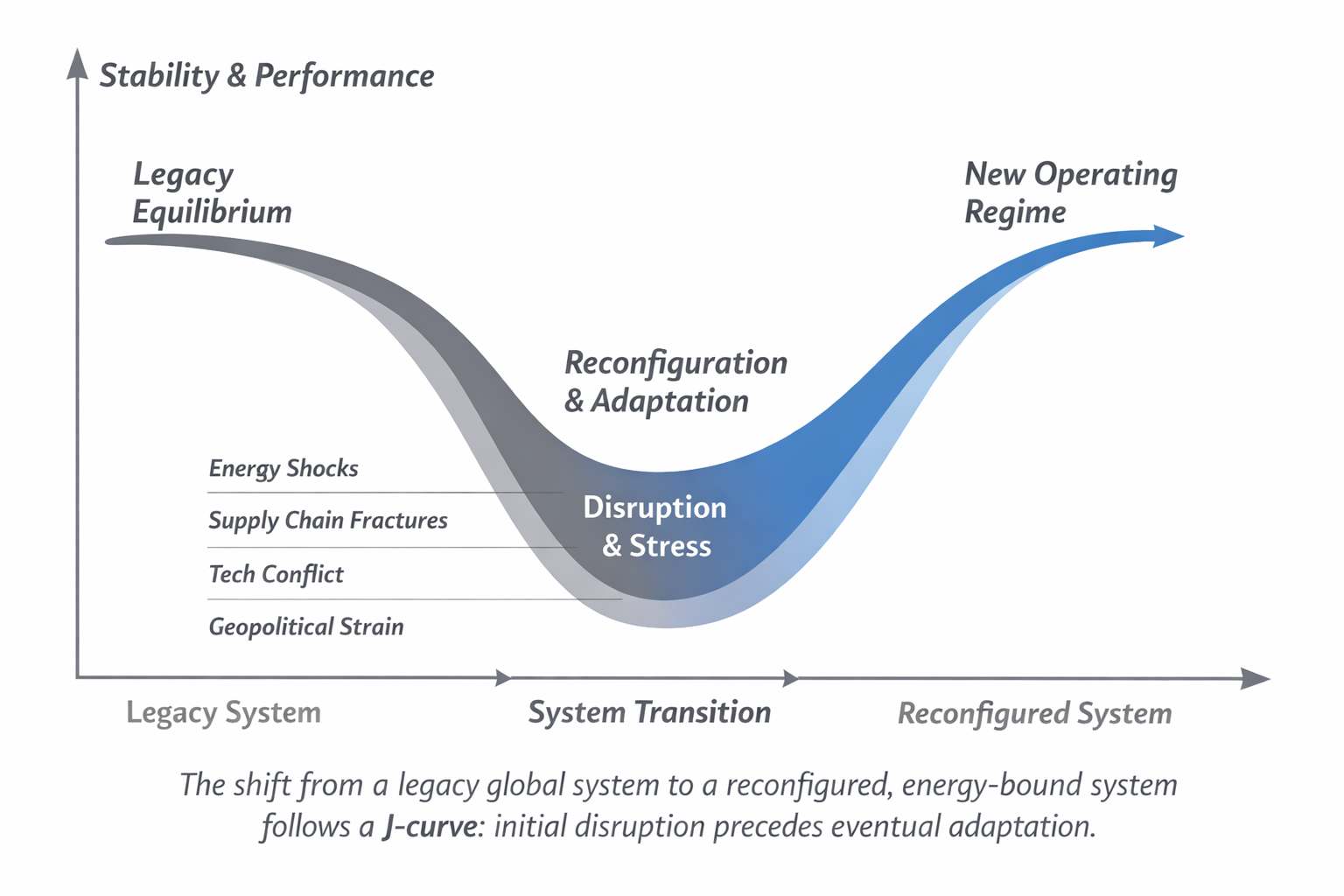
The defining feature of the contemporary global order is not crisis, but constraint. Energy, capital, technology, and logistics no longer expand freely or adjust smoothly through markets alone. Instead, they interact as bounded systems in which shocks propagate, choices narrow, and optimisation gives way to survival logic. This article establishes constraint—not growth, innovation, or ideology—as the default condition shaping the world economy.
System Navigation This article defines the structural logic of asymmetry under constraint:
Preface — When Constraint Becomes the Default
This article follows Energy and the Base Layer of Constraint, which established energy as the foundational condition shaping all higher layers of the modern economy.
Energy alone, however, does not explain the behaviour of the system now taking shape.
As energy constraints propagate upward, they interact with finance, logistics, technology, and governance in ways that fundamentally alter how economies adjust. Shocks no longer clear cleanly. Bottlenecks persist. Trade-offs harden. Optimisation gives way to prioritisation, and choice gives way to constraint.
This article introduces the concept of system default: the condition in which constraint is no longer episodic or external, but endogenous and persistent. In such a system, volatility is not absorbed and dissipated; it accumulates and redistributes. Policy does not restore equilibrium; it reallocates stress.
Understanding this shift is essential. Many contemporary policy failures stem not from poor execution, but from operating with assumptions inherited from an earlier era — one in which markets expanded capacity, capital flowed freely, and energy remained background infrastructure rather than a binding limit.
System default marks the point at which those assumptions break.
The articles that follow examine how this condition expresses itself across corridors and chokepoints, financial systems, standards and platforms, industrial policy, and finally strategic agency. Each operates downstream of the system default described here.
This article therefore does not argue for a particular policy response. It establishes the operating environment within which all responses now occur.
This document describes the operating conditions of the international system under sustained stress. It is intended to be read as a system assessment, not a policy proposal.
It is written for policymakers operating under conditions of sustained systemic stress. It proceeds from the assumption—established in the Energy Paradigm Shift—that energy has re-emerged as the binding constraint of economic, technological, and military power. It now determines the limits within which technology, industry, finance, and security can operate.
The post–Cold War order was built on material conditions that no longer apply reliably: abundant and expandable energy, widening industrial margins, stable supply chains, and a credible systemic guarantor. As these conditions erode, the international system does not gradually rebalance. It reverts.
The current operating environment is best described as a system default to anarchy—not disorder or institutional collapse, but a condition in which no actor reliably guarantees stability under stress, and where outcomes are shaped primarily by operational capability rather than formal rules or declared alignment.
In this environment:
- Energy availability, cost, and scalability determine economic resilience, industrial viability, and defence readiness.
- Interdependence increasingly functions as leverage rather than assurance.
- Alliances remain necessary but are no longer sufficient to offset material constraints.
- Strategic agency depends on the capacity to sustain energy, industry, and finance through shocks.
This paper examines the geopolitical consequences of the energy paradigm shift under conditions of stress. It explains why the system increasingly produces a G2 structure by default, and why Europe—despite its central geography—faces constrained agency unless it rebuilds material depth.
1. Energy as the First Principle of Power
Energy is no longer a background input into growth or security. It is the first principle of contemporary power.
Across advanced economies, energy now directly conditions:
- Industrial competitiveness and re-industrialisation,
- Artificial intelligence and digital infrastructure,
- Military readiness, mobilisation, and sustainment,
- Fiscal resilience and macroeconomic stability.
Electrification, automation, and compute-intensive systems all convert energy throughput into capability. Where energy supply is abundant, scalable, and reliable, states retain freedom of action. Where it is constrained, sovereignty becomes conditional.
This marks a structural break with the previous era. Energy scarcity no longer merely slows growth; it sets the outer boundary of strategic autonomy.
This is the material foundation of the current system.
2. Systemic Stress and the Emergence of a G2 Structure
In periods of low stress, the international system can accommodate a wide range of power expressions: regulatory influence, financial reach, institutional leadership, and normative authority.
Under sustained stress, these forms of influence degrade. Power consolidates around actors capable of acting as system-builders.
A system-builder is defined not by ideology or intent, but by the ability to integrate:
- Energy production and transmission,
- Industrial capacity and surge manufacturing,
- Financial plumbing and liquidity provision,
- Compute infrastructure and data systems,
- Defence mobilisation and logistics,
into a coherent operational stack.
At present, only two actors can do this at scale.
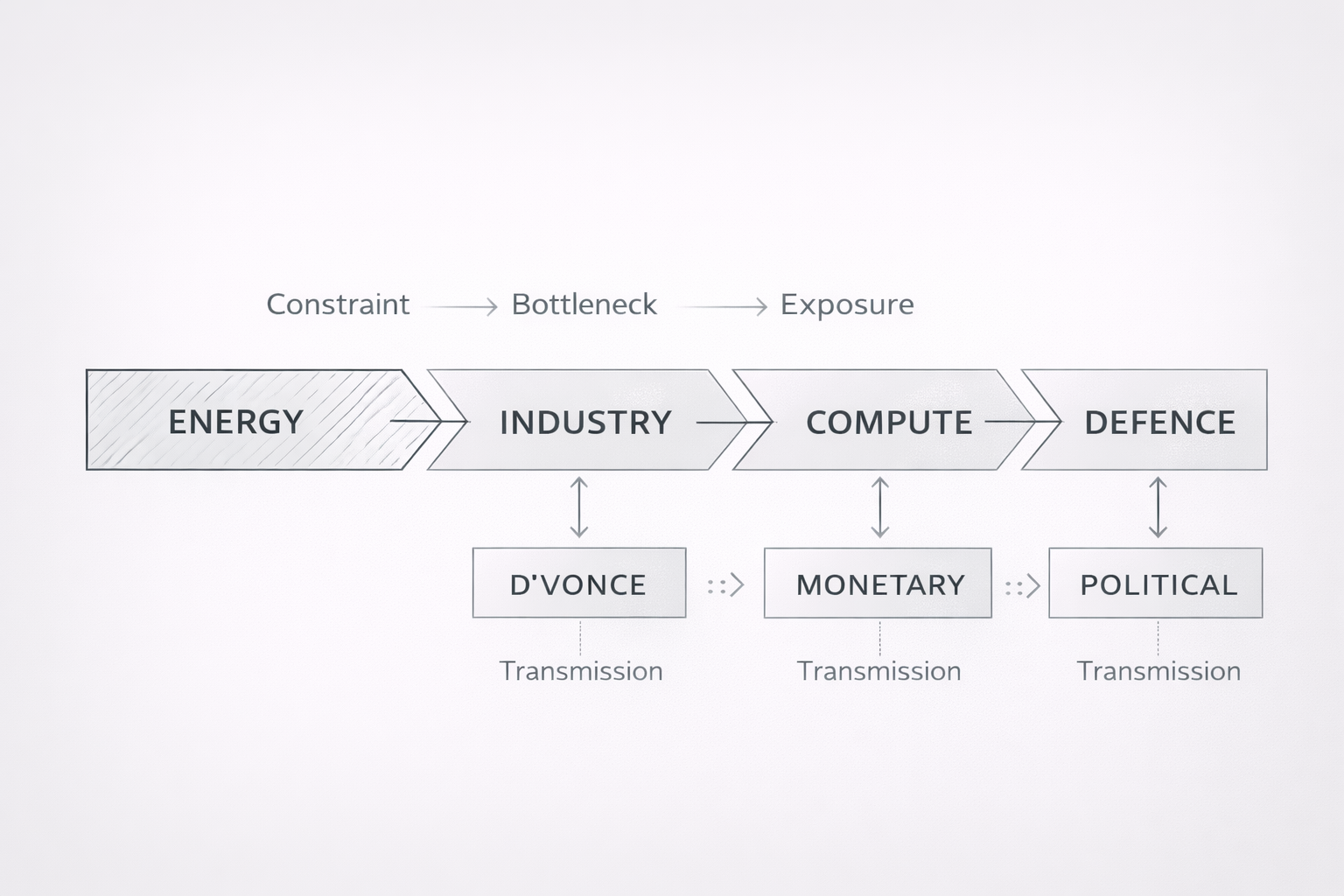
The emergence of a G2 structure is therefore structural, not strategic. It is not the result of coordination, preference, or design. It is the predictable outcome of energy-bounded systems under stress, where margins narrow and shocks propagate quickly.
In such an environment, capacity dominates posture.
3. Technology as an Energy-Conversion Layer
A central analytical error of the past decade was the belief that technology could substitute for material constraints. In practice, technology amplifies underlying energy advantages.
Artificial intelligence, semiconductor manufacturing, automation, and advanced military systems all function as energy-conversion layers:
- Electricity is converted into compute,
- Compute into productivity and decision advantage,
- Industrial energy into scale and resilience,
- Military energy into readiness and sustainment.
Technology does not dematerialise power. It concentrates it.
As a result:
- Actors with abundant, expandable energy experience accelerating returns.
- Actors with constrained energy face rising costs, slower deployment, and structural dependency.
This is why the contemporary Tech War cannot be understood as a contest over innovation alone. It is a competition over who can afford to operate advanced systems continuously and at scale.
4. Anarchy as the System’s Functional Default
Anarchy, in this context, does not imply chaos, lawlessness, or the absence of institutions. It describes a system in which no actor reliably underwrites stability once stress exceeds tolerance thresholds.
Under these conditions:
- Interdependence becomes a mechanism of leverage,
- Supply chains become strategic terrain,
- Trade, finance, and infrastructure are politicised by default,
- Alliances function as conditional arrangements rather than absolute shelters.
This shift does not require malign intent. It arises automatically when energy, industrial capacity, and fiscal space tighten simultaneously.
States prioritise continuity of their own systems first. Cooperation becomes selective, transactional, and contingent.
This is the operating logic of the current environment.
5. Europe’s Position: Central Geography, Constrained Agency
Europe occupies a structurally central position in the emerging order.
Geographically, Europe sits at the intersection of:
- Eurasian land corridors,
- African energy and resource flows,
- Maritime routes linking the Atlantic, Mediterranean, and Indo-Pacific.
Economically, Europe remains a major industrial, technological, and regulatory actor. It is well positioned to act as a connector of global value chains across Eurasia and Africa.
However, Europe’s strategic agency is constrained by material factors:
- High marginal energy costs,
- Slow grid expansion and infrastructure deployment,
- Fragmented industrial mobilisation,
- Dependence on external energy-to-compute systems.
In a low-stress system, these constraints were manageable through trade, regulation, and institutional coordination. In a system that defaults to anarchy, they translate directly into reduced freedom of action.
Europe’s challenge is therefore not marginalisation, but the inability to convert centrality into operational capability.
6. Sovereignty Re-defined: From Legal Status to Operational Capacity
In the current system, sovereignty is no longer primarily a legal or institutional condition. It is operational.
A sovereign actor can:
- Sustain energy supply through shocks,
- Maintain industrial output under constraint,
- Operate core digital infrastructure independently,
- Finance stress without external veto,
- Mobilise defence capabilities without critical bottlenecks.
Energy is the common prerequisite across all five dimensions.
Where this foundation is absent, sovereignty becomes conditional—regardless of treaty commitments, alliance structures, or political alignment.
7. Strategic Implications for Policymakers
The central implication is unambiguous:
Policy that does not treat energy as a strategic system variable will systematically underestimate risk.
Energy policy is now inseparable from:
- Industrial policy,
- Technology policy,
- Defence policy,
- Macro-financial stability.
Fragmented approaches—treating these domains as separate portfolios—are increasingly misaligned with system realities.
For Europe, strategic agency depends on rebuilding the material foundations of power by:
- Expanding energy capacity at scale,
- Accelerating grid and infrastructure deployment,
- Re-integrating energy and industrial strategy,
- Leveraging Europe’s geographic position to organise Eurasian-African value chains.
Conclusion
The international system has not entered a period of exceptional volatility. It has entered a period of structural clarity.
When energy is abundant, rules dominate.
When energy is constrained, power consolidates.
The G2 structure is not an anomaly. It is the predictable outcome of an energy-bounded world operating without a systemic guarantor.
Europe’s future influence will depend less on rhetorical alignment and more on its ability to translate geographic centrality into sustained operational capability.
Suggested Reading
- System Foundations of the Energy–AI–Industrial Economy
- Energy Sovereignty as System Control (Global / Doctrines)
- Europe’s
Energy Paradigm Shift (EU Sovereignty)System
Default (Systems under Constraint)
On how systems revert to leverage, exclusion, and coercion under strain. - Systemic Asymmetry
European application:
- EU Asymmetry Under Stress(EU Sovereignty)
- Energy and the Base Layer of Constraint On why energy volatility establishes the first binding limit shaping system exposure.
- The Global Energy Paradigm Shift On how the end of fossil-fuel abundance re-materialises inflation and vulnerability.
- Energy and the Base Layer of Constraint On why energy volatility establishes the first binding limit shaping system exposure.
- Global Value Chains in an Energy-Bound World On how fragmentation transmits stress unevenly across regions and systems.
- System Default (Systems under Constraint)
On how systems revert to leverage, exclusion, and coercion under strain. - Industrial Policy Inside Constrained Systems (Systems under Constraint) On why policy ambition collides with constraint when upstream systems misalign.
- Agency Under Constraint (Systems under Constraint) On how strategy is redefined once asymmetry becomes unavoidable.
Further Reading
System Foundations (GLOBAL)
Energy-Bound System
On the structural role of energy as the binding constraint of modern economic systems.Energy as the Operating System of Power
On how energy systems structure industrial capacity, capital formation, and geopolitical power.The Global Energy Paradigm Shift
On the transition from fossil abundance toward electrified infrastructure.
Systems Under Constraint
System Default On how international systems revert to leverage and coercion under sustained stress.
Systemic Asymmetry
On how structural imbalances shape resilience and adjustment capacity.Agency Under Constraint
On how strategy and sovereignty evolve when constraints intensify.
European Application (EU Sovereignty)
EU Asymmetry Under Stress
On the structural constraints shaping Europe’s strategic agency.Europe’s Energy Paradigm Shift
On the transformation of the European energy system.Industrial Policy Inside Constrained Systems
On the limits of industrial policy under energy and financial constraint.