Decarbonisation as Industrial System Transformation
How electrification reshapes industrial systems in the tech war
Introduction: Why These Terms Cause So Much Confusion
Few terms in contemporary debate are as widely used — and as poorly understood — as decarbonisation, decentralisation, and the Fourth Industrial Revolution.
To some audiences, decarbonisation is shorthand for climate
activism.
To others, it is assumed to mean nuclear power.
To many, the Fourth Industrial Revolution sounds like a digital future
detached from physical reality.
All of these interpretations miss the point.
In the context of global technological competition, these concepts are not political preferences. They are derived properties of how modern energy, industry, and computation now work. They describe the shape of the system that is emerging — regardless of ideology.
This article clarifies what these terms actually mean, why they are structurally linked, and why they now define the terrain of the global tech war. It describes the system logic of decarbonisation; its distributional, political, and regional consequences are examined separately
1. What Decarbonisation Actually Means (In Plain Terms)
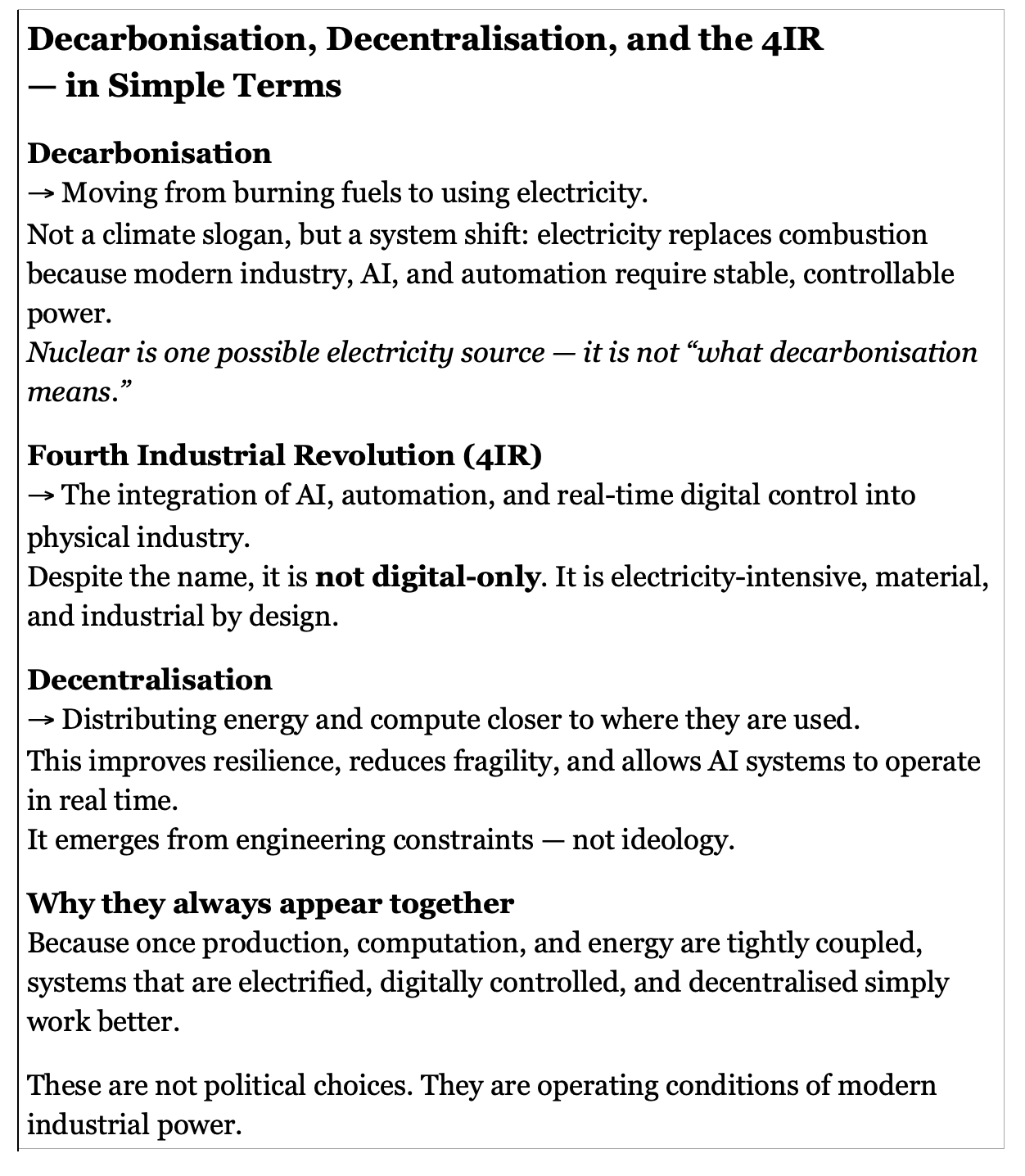
At its core, decarbonisation means replacing energy systems that rely on burning fuels with systems that rely on electricity.
That is all.
Historically, most energy came from combustion:
- coal burned for heat and power
- oil refined into fuels for transport
- gas burned for electricity and industry
Combustion-based systems share three properties:
- they emit carbon
- they rely on continuous fuel supply
- their costs are exposed to extraction, transport, and geopolitics
Decarbonisation replaces this model with one where:
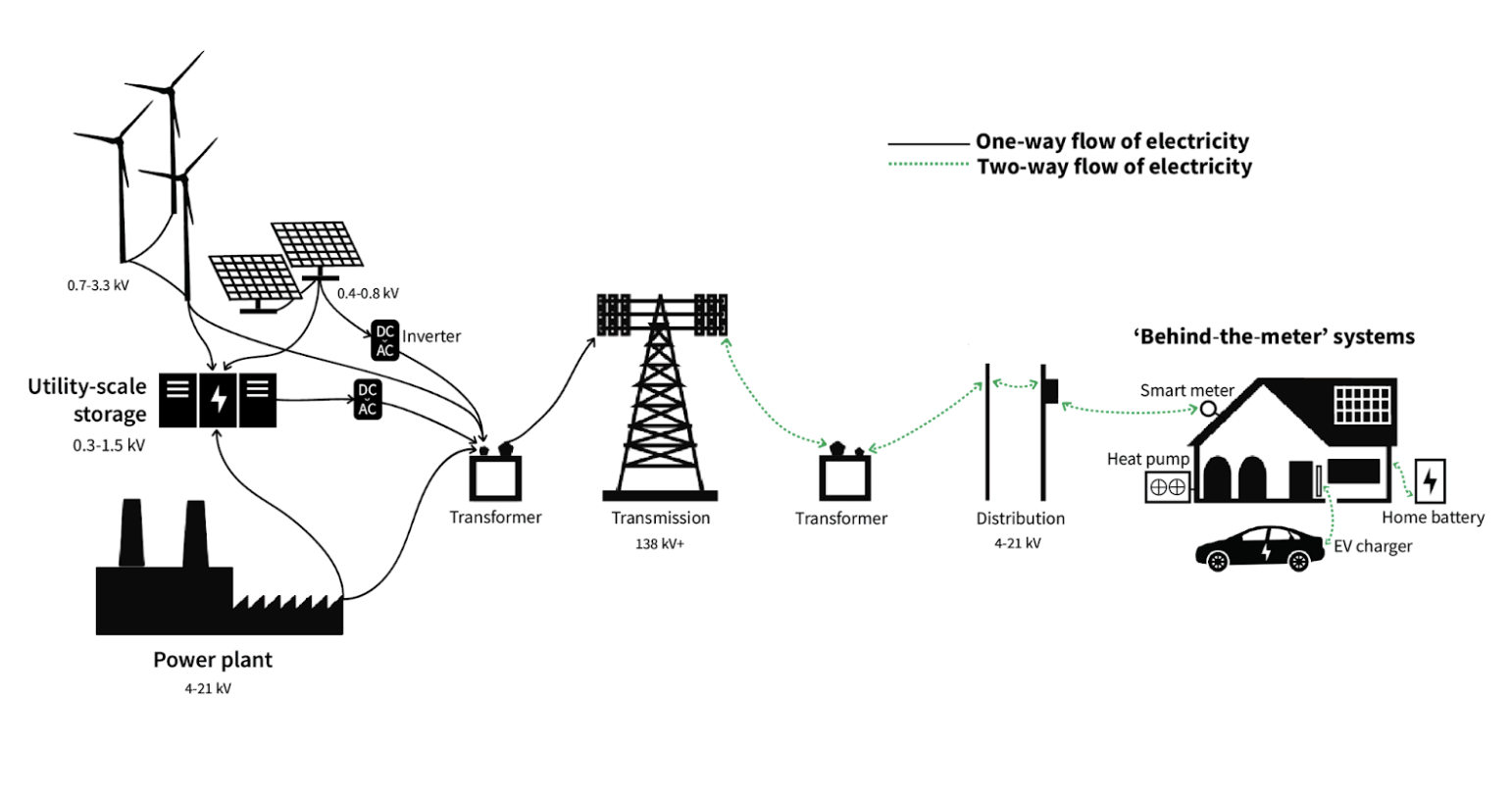
- energy is generated primarily as electricity
- electricity is produced from sources that do not require continuous fuel combustion
- costs are front-loaded in infrastructure rather than ongoing fuel purchases
In practice, this includes:
- renewables (solar, wind, hydro)
- storage (batteries, pumped hydro, thermal)
- electrification of industry, transport, and heating
- and, where countries choose it, nuclear power
Nuclear is not decarbonisation itself.
It is one possible generation technology within a decarbonised,
electrified system.
This distinction matters because decarbonisation is about system structure, not about any single technology.
2. Why Decarbonisation Is a System Property, Not a Climate Policy
In the current tech war, decarbonisation persists even where climate politics differ.
Why?
Because electrified systems:
- are easier to automate
- integrate directly with digital control
- scale with manufacturing rather than fuel extraction
- reduce exposure to external supply shocks
These properties matter for:
- AI deployment
- advanced manufacturing
- data centres
- robotics and automation
- grid-scale optimisation
Once economies move toward electricity-intensive computation and automation, combustion-based energy becomes a bottleneck.
Decarbonisation therefore emerges not because of climate targets, but because the new industrial system requires it.
Climate policy may accelerate the transition — but it did not invent the constraint.
3. The Fourth Industrial Revolution Is Electric, Not Digital
The Fourth Industrial Revolution (4IR) is often described as a digital transformation. In reality, it is a recomposition of energy, computation, and production.
AI, robotics, automation, and real-time optimisation do not float in the cloud. They operate in:
- factories
- logistics hubs
- data centres
- grids
- physical supply chains
All of these systems:
- consume electricity continuously
- require high reliability
- depend on predictable energy costs
Unlike earlier technological waves, the 4IR does not
dematerialise production.
It intensifies material throughput.
Compute substitutes for some labour, but it adds:
- hardware
- cooling
- redundancy
- network infrastructure
- energy demand
This is why the 4IR is inseparable from decarbonisation: only electrified systems can support this level of automation and control at scale.
4. Why Decentralisation Emerges Naturally
Once energy and computation become tightly coupled, centralised architectures become fragile.
Large, distant, fuel-dependent systems struggle with:
- latency
- grid congestion
- cascading failures
- geopolitical exposure
Decentralisation emerges not as ideology, but as engineering logic.
In practice, this means:
- local and regional generation
- distributed storage
- edge computing near machines and users
- digitally managed microgrids
- flexible, modular infrastructure
Decentralised systems:
- recover faster from shocks
- adapt more easily to demand changes
- integrate better with AI-based optimisation
- reduce single points of failure
This is why decentralisation appears simultaneously in:
- energy systems
- digital architecture
- industrial organisation
It is a system response to complexity, not a political choice.
5. Clearing Up the Nuclear Confusion
Many older observers reasonably associate “non-carbon energy” with nuclear power — because historically, nuclear was the only large-scale non-fossil electricity source.
That historical experience shapes perception.
But today:
- renewables are manufactured, not mined
- costs fall through scale and learning curves
- generation can be geographically distributed
- systems integrate directly with digital control
Nuclear remains a valid option for some countries, particularly for:
- baseload stability
- existing industrial ecosystems
- long-term capacity planning
But it is neither synonymous with decarbonisation nor sufficient on its own.
Decarbonisation is about how the system operates, not about which generator dominates.
6. Why This Matters in the Global Tech War
The global tech war is not primarily about apps, platforms, or
standards.
It is about which systems can scale AI, industry, and resilience
simultaneously.
Those that succeed combine:
- electrified, decarbonised energy
- decentralised, resilient infrastructure
- AI-enabled control and optimisation
- industrial capacity at scale
Those that do not remain dependent on:
- fuel imports
- volatile prices
- fragile supply chains
- externally controlled platforms
This is why decarbonisation, decentralisation, and the 4IR appear together across competing models — even when political narratives differ.
They are structural features of the new industrial era.

Conclusion: These Are Not Choices — They Are Conditions
Decarbonisation is not a moral project.
Decentralisation is not a political slogan.
The Fourth Industrial Revolution is not a digital fantasy.
Together, they describe the operating conditions of modern power.
States, firms, and regions that understand this design
accordingly.
Those that argue about the terms while ignoring the structure fall
behind.
The tech war is not being decided by rhetoric.
It is being decided by systems that work.
This article describes the system logic of decarbonisation; its distributional, political, and regional consequences are examined separately.
Suggested Reading
Decarbonisation as a Tech War Instrument (Dynamics)
Industrial Policy Inside Constrained Systems (EU Sovereignty)
SMEs and Transition Stress (EU Challenge)