Energy–Industry–Compute Convergence
The formation of a unified system layer in an energy-bound world
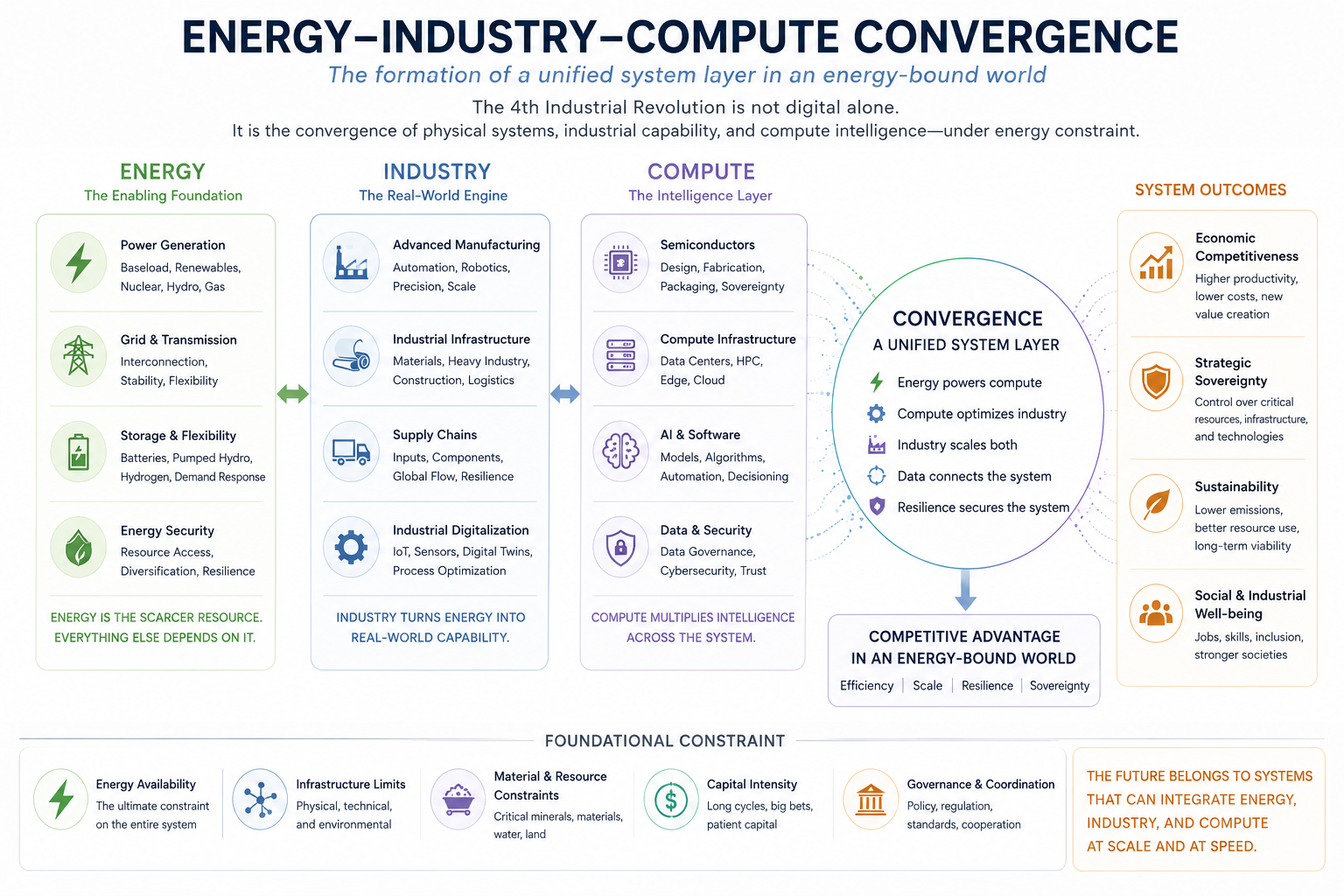
Keynote
Energy, industrial capacity, and computation are no longer separable domains.
They are converging into a single system layer.
In an energy-bound world, power does not emerge from technology alone, nor from industrial scale in isolation. It emerges from the integration of energy systems, industrial ecosystems, and computational infrastructure into a coherent, scalable architecture.
Energy determines the cost base and physical limits of the system. Industry converts that energy into production capacity and material output. Compute optimises, coordinates, and accelerates both.
→ The systems that dominate are not those with the best technology, but those that align energy, industry, and compute into a unified operating layer.
System Position
This article sits within the GLOBAL foundational layer, but bridges directly into TECHWAR and EU SOVEREIGNTY.
It should be read alongside:
- Energy–Capital–Currency Hierarchy
- Infrastructure Currency Doctrine
- Energy–Compute–AI Stack
- Energy–Compute Infrastructure Geography
- Strategic Minerals AI Energy System
→ These define the monetary, infrastructural, and spatial consequences of this convergence.
I. From Separation to Convergence
Historically, energy, industry, and computation could be analysed separately.
- Energy supplied power
- Industry produced goods
- Compute supported coordination and optimisation
This separation no longer holds.
Three structural shifts have collapsed these domains into a single system layer:
- Electrification of industrial processes
- Computational intensification of production
- Energy intensity of digital infrastructure
→ Industry now depends on compute.
→ Compute now depends on energy.
→ Energy systems are increasingly managed through computation.
II. Energy as the Constraint Layer
Energy sets the physical and economic boundary conditions of the system.
- It determines marginal cost
- It shapes industrial location
- It constrains compute scalability
Low-cost, stable energy systems enable:
- large-scale manufacturing
- dense compute infrastructure
- continuous reinvestment
High-cost or unstable energy systems produce:
- industrial fragmentation
- capital flight
- constrained compute deployment
→ Energy is not an input. It is the limiting variable of convergence.
III. Industry as the Transformation Layer
Industrial ecosystems convert energy into material capability.
This includes:
- manufacturing capacity
- supply chain depth
- infrastructure systems
- engineering talent
Industrial ecosystems determine:
- how efficiently energy is transformed into output
- how quickly innovation scales
- how resilient production systems remain under stress
→ Without industrial depth, energy advantage does not translate into power.
IV. Compute as the Acceleration Layer
Computation transforms both energy and industry into adaptive, scalable systems.
Compute enables:
- optimisation of energy grids
- automation of production systems
- coordination of complex supply chains
- training and deployment of AI systems
But compute itself is now:
- energy-intensive
- infrastructure-heavy
- geographically constrained
→ Compute does not float above the system. It is embedded within it.
V. Convergence as System Architecture
The convergence of energy, industry, and compute forms a single operational layer.
This layer determines:
- where production occurs
- where data is processed
- where capital is deployed
- where sovereignty is exercised
It is expressed physically through:
- energy grids and generation systems
- industrial clusters and supply chains
- data centres and compute infrastructure
→ These are no longer separate infrastructures. They form a combined system architecture.
VI. Geopolitical Implications
The global system is reorganising around this convergence.
- The United States combines energy abundance, industrial reshoring, and hyperscale compute
- China integrates energy systems, manufacturing scale, and state-directed technological deployment
- Europe faces fragmentation across all three layers
→ The competition is not technological alone.
It is competition over:
- integrated system architectures
- infrastructure depth
- energy–compute alignment
VII. European Position — Fragmented Convergence
Europe’s challenge is not a lack of technology.
It is a lack of system integration.
- Energy systems are fragmented and costly
- Industrial ecosystems are unevenly distributed
- Compute infrastructure is dependent on external actors
This produces:
- reduced industrial competitiveness
- limited capital formation
- constrained technological scaling
→ Europe does not lack components. It lacks convergence.
VIII. From Convergence to Power
The systems that achieve convergence gain:
- lower system-wide costs
- higher productivity
- faster innovation cycles
- stronger capital accumulation
- greater monetary resilience
This feeds directly into:
- currency strength
- geopolitical leverage
- technological leadership
→ Convergence is not efficiency. It is power formation.
Conceptual Summary
Energy, industry, and compute now operate as a single system.
- Energy sets the constraint
- Industry transforms capacity
- Compute accelerates and coordinates
Together, they form the operating layer of modern power.
In an energy-bound world:
→ sovereignty depends on the ability to integrate these layers into a coherent system architecture.