AI Energy Sovereignty - A Structural Framework for Europe
The AI Illusion: Why Energy, Not Code, Will Decide Europe’s Future.
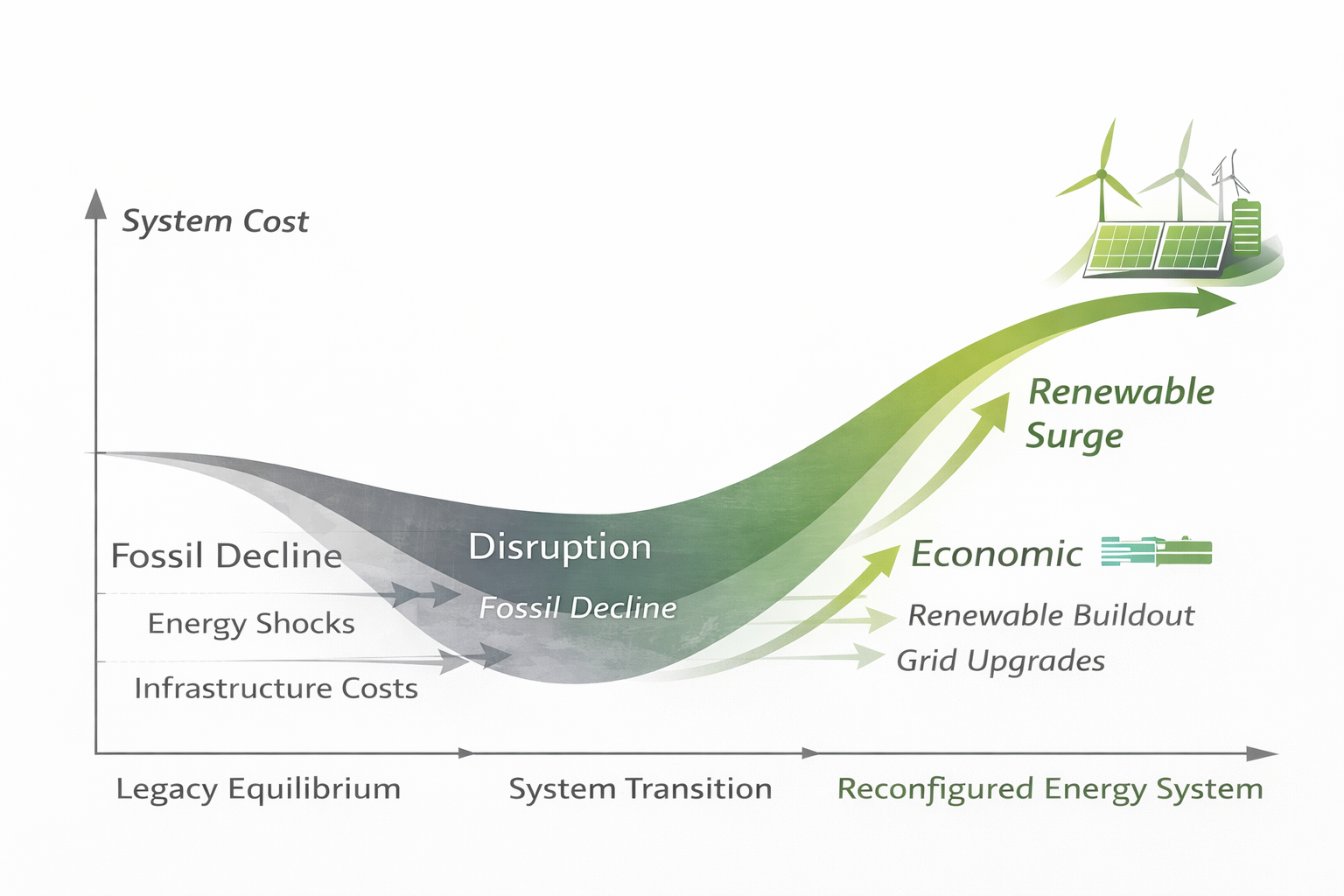
Energy Transition J-Curve and the European Energy
Chasm
Energy transitions temporarily increase marginal energy costs as legacy
systems are dismantled before renewable infrastructure fully scales.
Economies that move slowly risk remaining trapped in the transition
trough — the energy chasm — characterised by high
energy prices, compressed industrial margins, fiscal subsidies, and
rising debt pressure. Accelerating renewable deployment shortens this
phase and restores long-term energy cost advantage.
Keynote
Artificial intelligence is increasingly presented as Europe’s path back to competitiveness — a digital shortcut around demographic decline, industrial erosion, and geopolitical marginalisation.
This is an illusion.
AI is not an escape from material constraint. It intensifies
it.
In an electrifying world, compute scales with power. Infrastructure
determines speed. Grid resilience determines viability. Sovereignty
depends on system control.
Europe’s AI future will not be decided by code alone.
It will be decided by energy.
This essay introduces a three-layer framework — macro, meso, and micro — through which AI and energy must be analysed together. The analyses that follow apply this structure to Europe’s global position, its industrial ecosystems, and its compute architecture.
AI is no longer a technology race.
It is an infrastructure race.
Preface — The Mistake Europe Is About to Repeat
Artificial intelligence is increasingly framed as Europe’s opportunity to regain competitiveness: a way to offset demographic decline, leapfrog decades of underinvestment, and restore strategic relevance without reopening difficult debates about industry, energy, and infrastructure.
This framing is seductive — and incomplete.
Europe has encountered a similar promise before. In the 1990s and 2000s, globalisation, services, finance, and intangible technologies were presented as substitutes for industrial depth and physical capacity. Manufacturing ecosystems were deliberately dismantled under the belief that efficiency, markets, and comparative advantage would compensate for the loss of control.
The result was not renewal, but strategic fragility.
Artificial intelligence now risks becoming the next iteration of that illusion. Not because AI lacks transformative potential, but because it is being treated as a primarily digital phenomenon — detached from the energy systems, infrastructure, and ecosystems on which it materially depends.
AI is not immaterial. It is embedded in grids, data centres, cooling systems, rare earth supply chains, transformers, and power electronics. Its benefits accrue fastest where energy systems are resilient, infrastructure can be mobilised at speed, and ecosystems can absorb prolonged learning phases.
Europe’s AI trajectory will therefore be shaped less by algorithmic brilliance than by its ability to govern complex physical systems under stress.
The Trilogy Structure
This essay establishes a structural framework that unfolds across three analytical levels:
Micro — Why AI initially reduces productivity inside firms before it builds it
Meso — Why productivity no longer diffuses through European industrial ecosystems
Macro — Why energy and infrastructure now determine sovereignty in the global AI order
Together, these layers examine whether Europe can scale AI without deepening dependency in an energy-bound world.
1. Why AI Is Being Misunderstood
Public debate treats AI as a digital phenomenon: software, data, talent, venture capital. This framing privileges visibility over reality.
AI is not merely an algorithmic breakthrough. It is a general-purpose, energy-intensive, infrastructure-dependent technology that embeds itself across production, logistics, energy, defence, and governance. Its economic effects are mediated not by code alone, but by the physical systems that sustain it.
This misunderstanding has consequences:
- Investors chase valuations detached from power availability
- Policymakers regulate models they cannot host
- Firms adopt systems their organisations cannot absorb
The result is a widening gap between narrative and capacity.
2. The Micro Reality — AI Breaks Before It Builds
At the firm level, AI adoption follows a productivity J-curve.
Measured productivity often declines before it improves. AI disrupts workflows, exposes skill mismatches, forces reorganisation, and demands large upfront investment in data, sensors, compute, and integration. During this phase, costs are immediate and benefits latent.
This is not failure. It is learning.
What has changed is the capacity to survive the learning phase. European firms now operate in environments stripped of redundancy, organisational slack, and patient capital — conditions produced by decades of global value chain restructuring and financialisation.
The AI productivity paradox is not primarily technological. It is institutional. Firms struggle not because AI fails, but because ecosystems can no longer absorb transition shock.
3. The Meso Failure — When Productivity Stopped Diffusing
Historically, productivity gains did not diffuse firm by firm. They diffused ecosystem by ecosystem — through SMEs, suppliers, standards, skills pipelines, and shared infrastructure.
Europe dismantled much of this “missing middle” under the global value chain model. Learning was subordinated to liquidity. Manufacturing depth was traded for financial efficiency. Ecosystems were exposed to global competition before capability stabilised.
The result was not convergence, but concentration.
East Asian economies pursued a different logic. They sequenced competition, protected learning time, and treated failure as a collective risk — not a signal for immediate exit. Technology transfer and interoperability were prioritised until domestic value chains matured.
AI now exposes the cost of Europe’s institutional amnesia.

4. Why Energy Is the Binding Constraint
AI, electrification, and the Fourth Industrial Revolution are unfolding simultaneously. Together, they are driving a structural surge in electricity demand.
AI systems require:
- Continuous, high-quality power
- Resilient grids with minimal downtime
- Cooling, redundancy, and storage
- Proximity between compute and demand
At the same time:
- Transport electrifies
- Heating electrifies
- Industry electrifies
- Defence and logistics digitise
These demands stack. They do not substitute for one another.
Energy is no longer a background input into growth. It is becoming the primary constraint on industrial viability and technological scale.
The AI debate is therefore no longer about talent or capital.
It is about power systems.
5. The US Illusion — Cheap Energy, Hidden Fragility
Investor enthusiasm for US AI dominance rests on a narrow reading of advantage: cheap fossil fuels and hyperscale deployment.
This advantage is real — and conditional.
The US grid is ageing, transmission-heavy, and dependent on long-distance infrastructure and globally stretched supply chains. Transformer shortages, deferred maintenance, and interconnection delays complicate scaling.
Cheap energy is not costless. It is purchased through systemic fragility.
Models can scale rapidly. Grids cannot.
The risk is not immediate failure, but cumulative vulnerability as demand compounds.
6. Europe’s Misread Advantage — Decentralisation by Design
Europe often compares itself unfavourably to the US on energy costs. This comparison ignores structural differences.
Europe’s geography and economy are characterised by:
- Shorter distances
- Dense industrial clustering
- High SME integration
- Advanced standards capacity
- Regional governance depth
These are not disadvantages. They are preconditions for decentralised energy systems.
Decentralised generation, storage, microgrids, and demand response:
- Deploy faster than centralised megaprojects
- Reduce transmission losses
- Improve resilience
- Integrate naturally with SMEs
- Align with real-time optimisation under 4IR
Europe is not poorly positioned for the transition.
It is structurally suited to it — if policy aligns with geometry rather
than ideology.
7. Sovereignty Reframed
In the AI–energy era, sovereignty means:
The capacity to function under stress.
That capacity depends on:
- Energy availability
- Grid resilience
- Infrastructure speed
- Ecosystem depth
- Coordination across borders
Control over transformers, power electronics, rare earths, and refining capacity now matters as much as control over code.
Power has become infrastructural again.
8. The Strategic Choice
Europe faces a choice.
It can:
- Treat AI as an intangible sector
- Treat energy as a commodity
- Accept infrastructure delay
- Drift into managed dependence
Or it can:
- Recognise AI as a physical system
- Treat energy as strategic infrastructure
- Mobilise at continental scale
- Rebuild the ecosystems through which productivity diffuses
Without energy, none of the digital ambitions matter.
Conclusion — From Illusion to Infrastructure
The AI era forces a return to first principles.
Electrical, industrial, and political power are once again decisive. Europe’s future will not be determined by who writes the most elegant code, but by who can power, integrate, and govern the systems that code requires.
The illusion that AI can substitute for energy and infrastructure is comforting. It is false.
Europe still has a window — narrowing, but open — to align its strengths: density, decentralisation, coordination, and institutional depth.
Failing to do so would repeat the central error of deindustrialisation: mistaking abstraction for power.
The trilogy concludes where it must:
Not with ideology.
Not with hype.
But with infrastructure.
For the full framework
Next Micro
AI Energy Sovereignty Stress Test
AI Energy System Architecture Index
EU_Energy_Exposure_Sov_Data_Companion
Most Important Reading
Energy Foundations
- Global Energy Paradigm Shift
- Energy as the Operating System of Power
- EU Energy Paradigm Shift — Part I
- Operating Systems and System Control
European System Constraints
AI and Infrastructure Architecture
- Compute Locality in an Energy-Bound AI System
- EU Compute Locality Doctrine (AI & Energy)
- Microprocessors, AI, and Energy Sovereignty