ENERGY CONSTRAINT AND THE MONETARY CEILING (EU)
European Monetary Constraint in an Energy-Bound System

System Position
This article describes the European manifestation of the broader structural framework developed in:
→ Energy Constraint and the Monetary Ceiling (Global)
It examines how:
energy import dependence
industrial electricity pricing
infrastructure fragmentation
fiscal asymmetry
external security exposure
compute divergence
condition Europe’s monetary and economic position inside an energy-bound global system.
System Navigation
Foundational System Logic
European Constraint Layer
Executive Summary
The euro does not operate inside a neutral economic environment.
It operates within a structurally constrained energy and infrastructure system.
Europe combines:
high energy import exposure
gas-linked electricity pricing
fragmented fiscal architecture
uneven infrastructure execution
rising security expenditure
accelerating transition investment requirements
These pressures do not necessarily produce monetary instability in isolation.
Together, however, they compress:
industrial competitiveness
reinvestment capacity
capital formation
long-duration productivity growth
The result is not necessarily monetary crisis.
It is a gradual narrowing of monetary flexibility and strategic economic space.
This is the European manifestation of the:
Monetary Ceiling
I. The European Expression of the Monetary Ceiling
The broader doctrine developed in:
→ Energy Constraint and the Monetary Ceiling (Global)
argues that monetary durability is conditioned by:
energy architecture
Europe illustrates this mechanism clearly.
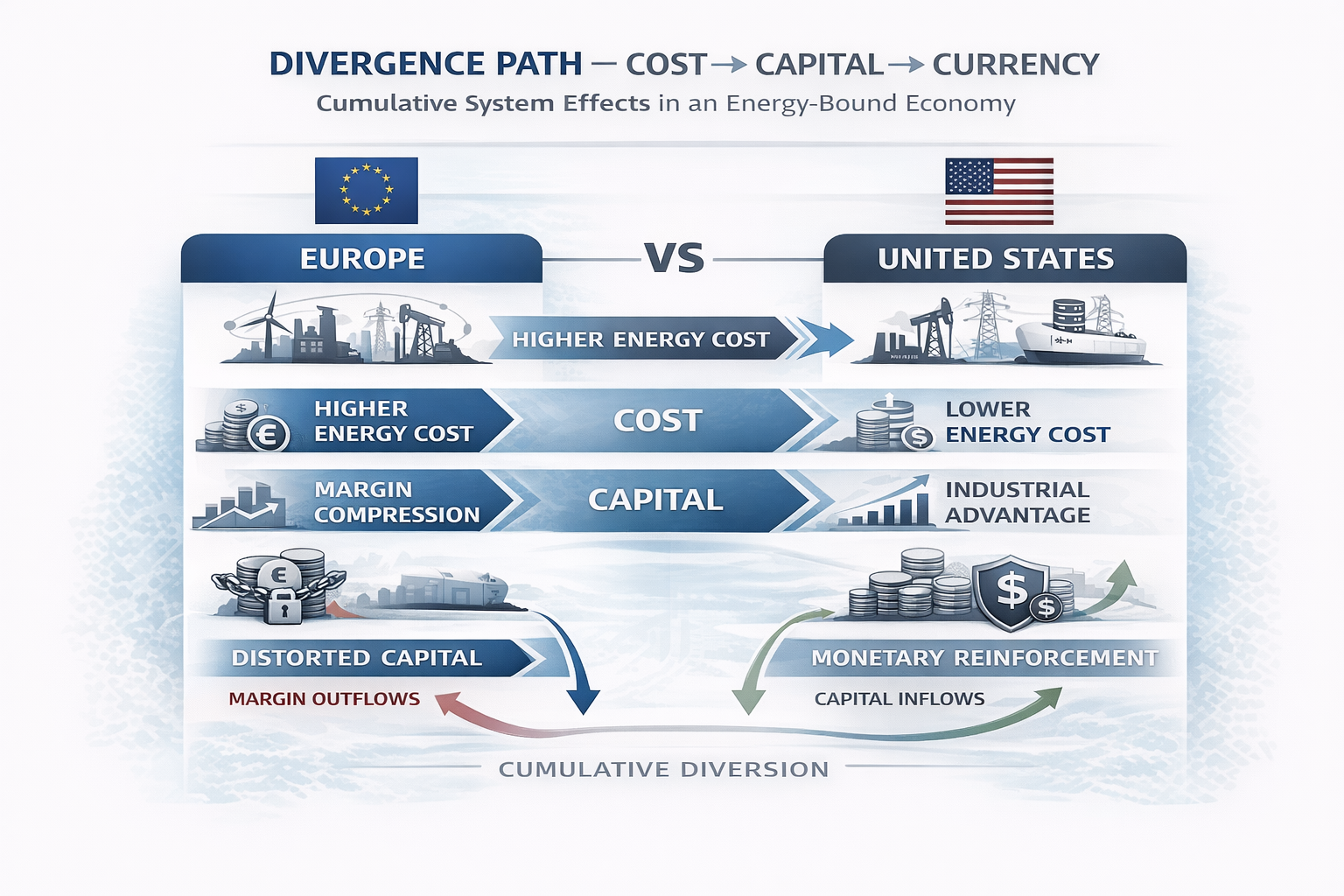
Persistent structural energy disadvantage transmits through:
energy cost
→ industrial margin compression
→ weaker reinvestment
→ slower productivity growth
→ external sensitivity
→ monetary constraint
This transmission is gradual rather than abrupt.
The euro therefore faces:
structural compression rather than sudden collapse
II. Europe’s Structural Constraint Configuration
Europe’s monetary environment is shaped by several overlapping pressures.
Energy Import Dependence
The European system remains structurally exposed to imported energy.
This creates vulnerability to:
external pricing shocks
geopolitical supply disruptions
current-account deterioration
industrial cost volatility
Gas-Linked Marginal Pricing
European electricity pricing remains highly sensitive to gas-market volatility.
As a result:
industrial electricity prices remain elevated
competitiveness weakens relative to lower-cost systems
investment horizons shorten
capital expenditure becomes more cautious
Fragmented Fiscal Architecture
Unlike fully integrated monetary systems, Europe combines:
shared monetary policy
fragmented fiscal capacity
uneven industrial structures
divergent national energy exposure
This limits coordinated strategic response capacity during periods of system stress.
Infrastructure Execution Asymmetry
Europe often possesses:
technological capability
financial depth
industrial sophistication
but struggles with:
execution speed
permitting scalability
grid expansion
integrated infrastructure deployment
This delays convergence toward lower-cost energy structures.
 ## III. AI, Compute, and
Monetary Divergence
## III. AI, Compute, and
Monetary Divergence
The AI transition amplifies these pressures.
AI systems increasingly cluster where:
electricity is abundant
infrastructure scales rapidly
permitting is fast
capital concentration is already deep
This creates a reinforcing sequence:
Energy → Compute → Capital → Currency
Where energy cost remains structurally elevated:
compute investment migrates
platform scaling concentrates externally
capital duration accumulates elsewhere
monetary leverage weakens
Europe therefore risks becoming:
a consumer of externally scaled compute systems rather than a primary infrastructure node
IV. Why This Is Often Mispriced
Financial markets typically overweight:
liquidity conditions
monetary policy
short-term earnings
cyclical growth
They often underweight:
infrastructure constraints
energy pricing architecture
industrial erosion
long-duration productivity compression
As a result, monetary constraint can accumulate gradually beneath periods of apparent financial stability.
The ceiling emerges slowly.
But structurally.
V. The LNG–Security Trade-Off
Europe’s post-crisis stabilisation strategy has relied heavily on:
LNG expansion
external supply contracts
security-aligned energy systems
These mechanisms reduce short-term volatility.
However, they may also:
anchor pricing to imported fossil systems
delay electrification convergence
extend structurally elevated industrial energy costs
reinforce external dependency
This creates a strategic tension:
what stabilises the system in the short term can reinforce structural monetary constraint in the long term
VI. Lifting the Ceiling
The monetary ceiling cannot be resolved through monetary policy alone.
It requires structural transformation at the system base.
This includes:
lower structural electricity cost
accelerated grid integration
storage deployment
faster electrification
energy–industry coordination
compute infrastructure scaling
execution capacity expansion
The issue is therefore not simply monetary.
It is infrastructural.
VII. Europe and the Global Monetary Transition
The euro’s long-term position increasingly depends on whether Europe can successfully transition from:
fragmented energy dependence
toward:
integrated low-cost electrified infrastructure
This determines not only:
industrial competitiveness
productivity growth
investment attraction
but increasingly:
compute concentration
capital depth
monetary durability
The monetary system is therefore becoming progressively tied to:
infrastructure scalability and energy-system design
Final Insight
The European monetary ceiling is not an isolated monetary phenomenon.
It is the regional manifestation of a wider structural transformation:
Energy → Infrastructure → Compute → Capital → Currency
Europe’s challenge is therefore not simply defending monetary credibility.
It is rebuilding the material system conditions that sustain monetary power.
The full structural framework is developed in:
→ Energy Constraint and the Monetary Ceiling (Global)