Mediterranean System Navigation
This navigation page provides the operational map for the Mediterranean system layer.
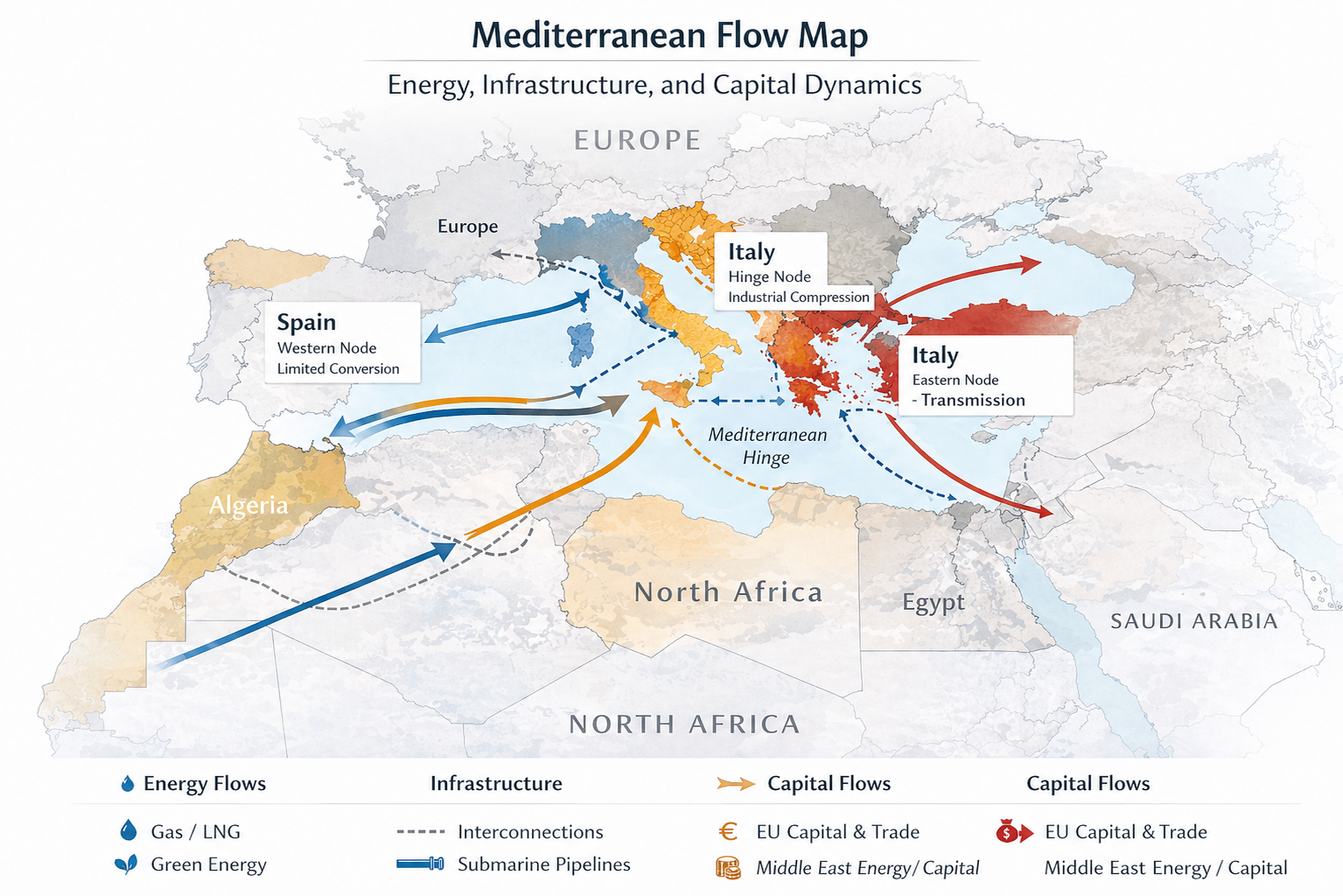
The Mediterranean should not be understood as a peripheral region within Europe. It should be understood as a strategic system interface connecting energy, infrastructure, industry, compute, ecosystems, capital, and sovereignty under conditions of European constraint.
This navigation structure connects the Mediterranean layer across GLOBAL, TECHWAR, and EU SOVEREIGNTY, and is designed for cross-panel use throughout the system.
System Foundations
→ AI, Energy, and the Future of Sovereignty
This article defines the core system logic across:
Energy → Compute → Capital → Sovereignty
It functions as the primary conceptual anchor for the Mediterranean system layer.
→ Systemic Sovereignty Architecture
This article explains how sovereignty increasingly derives from the capacity to govern integrated technological, infrastructural, industrial, computational, and monetary systems.
It establishes the systems sovereignty framework underlying the Mediterranean conversion layer.
This doctrine defines the structural constraint environment shaping energy systems, industrial competitiveness, compute scalability, ecosystem density, capital formation, and sovereignty outcomes.
→ Hybrid Infrastructure Sovereignty
This doctrine defines the emerging infrastructure architecture required for sovereignty in an Energy-Bound System, integrating centralized and distributed energy, compute, industrial, and digital systems into resilient hybrid architectures.
Mediterranean Entry Layer
These articles introduce the Mediterranean as a strategic conversion layer operating within an Energy-Bound Europe.
The Mediterranean should not be understood purely as geography. It should be understood as an interface through which energy systems, infrastructure, compute capacity, industrial ecosystems, logistics corridors, and capital structures interact under conditions of systemic transition.
National System Entry Layers
These country-level guides provide operational entry points into the Mediterranean system architecture.
They explain how energy systems, infrastructure, industrial capacity, compute scaling, capital allocation, and sovereignty pressures resolve differently across national systems.
The Mediterranean should not be understood as a uniform regional bloc.
It is a differentiated system architecture composed of industrial nodes, infrastructure corridors, logistics interfaces, energy gateways, and conversion layers operating under different structural conditions.
GLOBAL — System Logic
These articles define the structural logic of the Energy-Bound System and explain how energy cost, infrastructure capacity, compute scalability, industrial organisation, ecosystem density, and monetary power interact across the global system.
GLOBAL Evidence — Energy, LNG, and Transmission Layers
These evidence and validation layers demonstrate how energy systems propagate through infrastructure, industrial competitiveness, monetary structures, geopolitical positioning, and capital transmission.
Conversion Spine — System Backbone
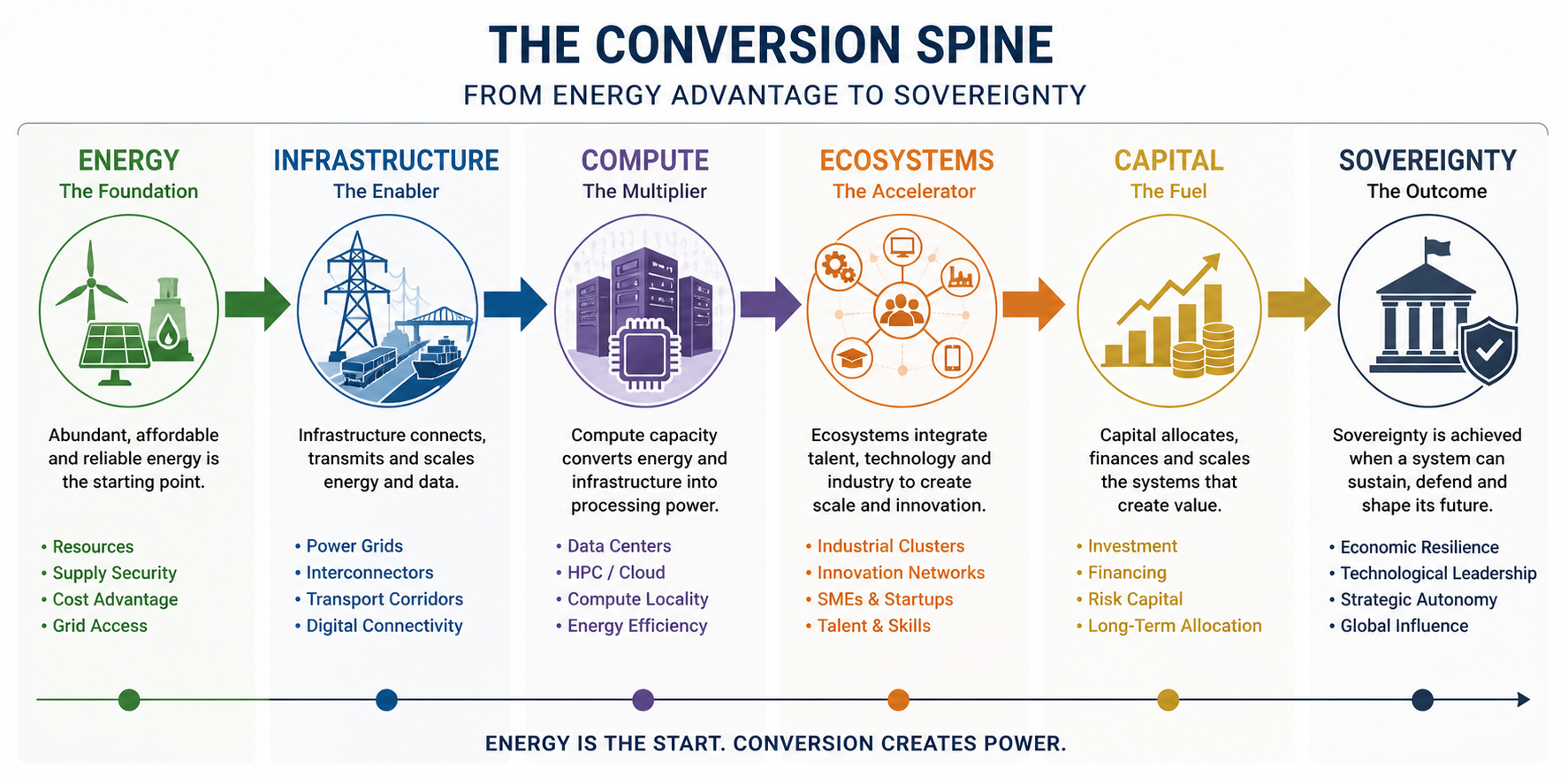
Energy → Infrastructure → Compute → Ecosystems → Capital → Sovereignty
This conversion spine defines the operational logic of the Mediterranean system.
Energy advantage alone does not generate sovereignty or durable system power.
Energy must be converted through:
infrastructure integration
compute capacity
industrial ecosystems
technological coordination
platform leverage
capital retention mechanisms
Where these layers align, system power compounds.
Where they fragment, value flows outward and sovereignty weakens.
Technological Sovereignty Layer — Compute, Ecosystems, and Control Systems
The Mediterranean becomes system power only when energy systems and infrastructure networks are successfully converted into compute capacity, industrial ecosystems, technological coordination, platform leverage, and long-term capital retention.
Technological sovereignty therefore emerges not from isolated innovation alone, but from the successful integration of:
energy systems
infrastructure networks
industrial ecosystems
compute architecture
standards
platforms
capital structures
scaling capacity
This layer explains how technological systems determine whether energy advantage becomes durable strategic capability.
Core Conversion Mechanism
These articles define the relationship between energy systems, industrial organisation, compute infrastructure, ecosystem density, and technological scaling.
AI–Energy Sovereignty Layer
These articles examine how AI infrastructure, electricity systems, compute capacity, industrial coordination, ecosystem integration, and scaling architecture increasingly determine sovereignty within an Energy-Bound System.
Mediterranean Compute Layer
These articles examine how the Mediterranean could evolve into an integrated energy–compute corridor linking electricity systems, infrastructure networks, data infrastructure, industrial coordination, cloud architecture, and AI deployment geography.
Stacks — Control Layers
These articles explain how operating systems, standards, semiconductors, cloud infrastructure, developer ecosystems, and platform architectures function as sovereignty control layers within the technological stack.
Ecosystems — Value Capture Layer
These articles examine how industrial ecosystems, platform structures, semiconductor networks, developer density, innovation coordination, and compute ecosystems determine whether technological value is retained or lost.
Mediterranean Evidence Layer
These articles provide validation, transmission mapping, structural evidence, and comparative system analysis across the Mediterranean layer.
Mediterranean Investor Layer
These articles examine how infrastructure investment, capital allocation, industrial coordination, technological ecosystems, compute scaling, and system conversion determine whether Mediterranean energy advantage becomes durable strategic power.
Executive Brief — Capital Allocation in an Energy-Bound System
Security Architecture and Technological Sovereignty — Executive Brief
System Principle
The Mediterranean is not a peripheral region.
It is a system interface.
Energy enters.
Infrastructure connects.
Industry processes.
Compute scales where electricity systems, industrial ecosystems, cloud architecture, and capital align.
Sovereignty emerges where conversion capacity is retained.
Where these layers fragment, value flows through the region but is not fully captured.