System Stack Architecture
## The Structural Order of Power in an Energy-Bound World

The global system is increasingly structured through a stack of interdependent physical, industrial, and financial layers.
At the base of this stack lie energy systems, which determine the capacity of industrial production. Industrial production supports compute infrastructure, which enables technological development and digital systems. These industrial and technological capabilities in turn generate capital formation, which ultimately shapes currency stability and geopolitical influence.
Understanding this hierarchy is essential for analysing the emerging global order.
Power increasingly depends not only on technological innovation, but on the ability to integrate energy, industry, computation, and capital into a coherent system architecture.
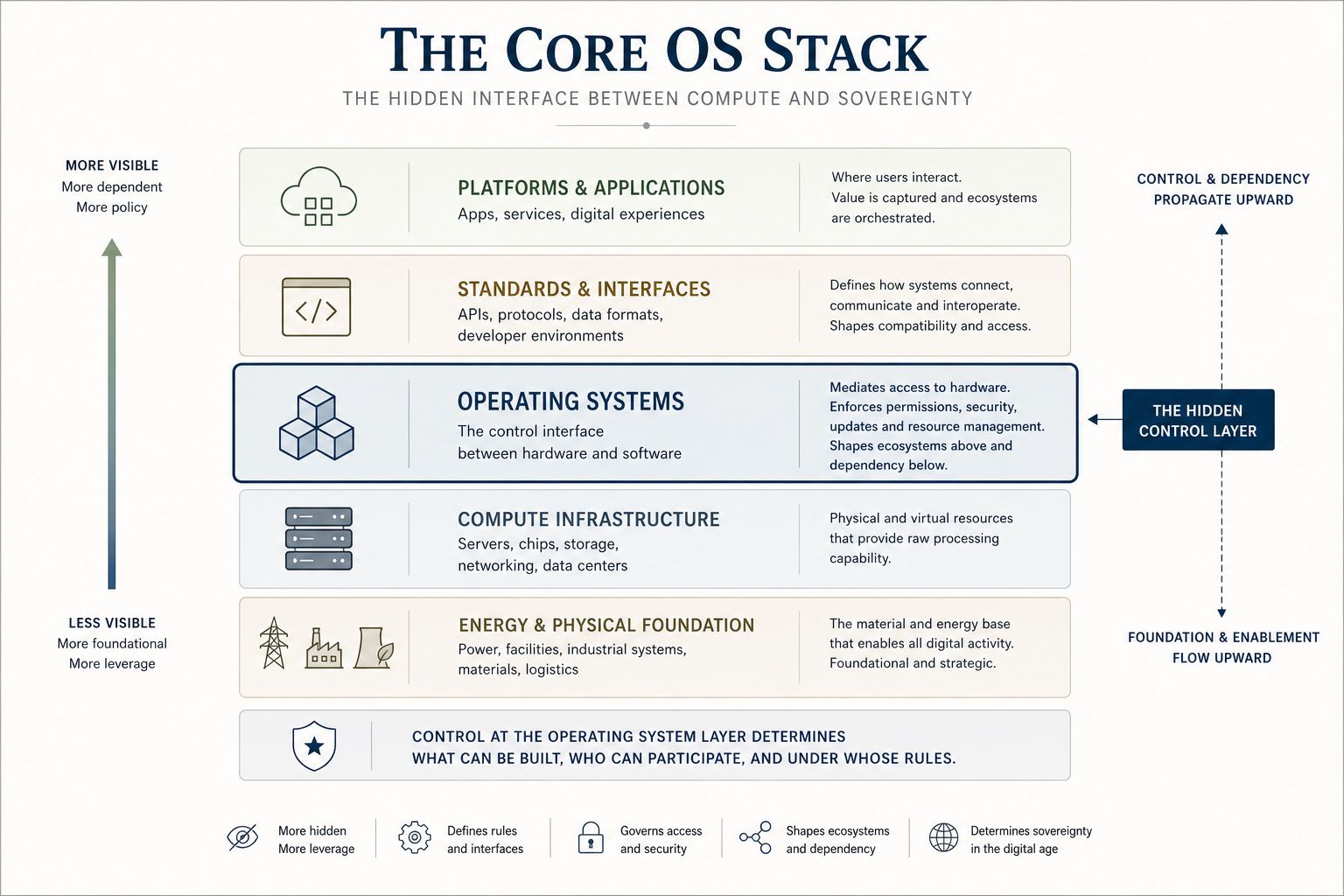
The System Stack
Energy Systems
→ Industrial Production
→ Compute Infrastructure
→ Capital Formation
→ Currency Stability
→ Sovereignty
Each layer both depends on the layers below it and reinforces the layers above it.
This structure forms the material architecture through which technological power and geopolitical influence are generated.
Energy Systems
Energy systems form the foundational layer of the global system stack.
They include:
electricity generation
energy resources
transmission grids
storage systems
energy markets and regulation
Energy systems determine:
industrial location
electricity cost structures
infrastructure resilience
capacity for technological development.
In an energy-bound system, energy availability and cost increasingly constrain the entire stack above it.
Industrial Production
Industrial production translates energy into material economic capacity.
This layer includes:
manufacturing
industrial supply chains
transport and logistics systems
heavy industry and materials production.
Industrial capacity determines whether an economy can:
build infrastructure
produce advanced technologies
maintain strategic supply chains.
Industrial decline therefore represents a structural loss of power, not simply an economic adjustment.
Compute Infrastructure
The digital layer of the system stack depends on physical infrastructure.
Compute infrastructure includes:
semiconductor production
data centres
networking systems
cloud infrastructure
distributed computing systems.
Artificial intelligence, digital platforms, and advanced technological systems all rely on large-scale computing infrastructure, which in turn requires substantial and stable electricity supply.
As AI expands, compute infrastructure increasingly becomes a major driver of energy demand.
Capital Formation
Capital formation reflects the ability of a system to convert productive capacity into financial investment.
Capital flows typically follow:
industrial productivity
technological innovation
infrastructure expansion.
Financial markets therefore tend to concentrate in economies capable of sustaining large-scale industrial and technological systems.
Where industrial capacity erodes, capital formation eventually weakens.
Currency Stability
Currencies derive their long-term stability from the productive strength of the economies that issue them.
Stable currencies typically emerge from systems with:
strong industrial capacity
large capital markets
deep energy infrastructure.
In contrast, economies with declining industrial bases often experience monetary fragility and capital flight.
Currency hierarchy therefore reflects underlying system strength rather than purely financial policy.
Sovereignty
At the top of the system stack lies sovereignty—the ability of a political system to exercise independent strategic choice.
Sovereignty increasingly depends on control of:
energy systems
industrial production
technological infrastructure
capital markets.
Without these structural foundations, formal political autonomy becomes increasingly constrained.
The System Doctrine
The stack can be summarized through the following structural relationship:
Energy determines industrial capacity.
Industrial capacity determines capital formation.
Capital formation determines technological and monetary power.
Energy therefore functions as the operating system of modern economic power.
Technological competition, financial dominance, and geopolitical influence ultimately rest on the ability to sustain the lower layers of the system stack.
Implications for the Emerging Global Order
In the emerging global system:
technological competition increasingly reflects energy system architecture
industrial competitiveness depends on electricity cost and infrastructure
artificial intelligence becomes an energy-intensive strategic technology
monetary power increasingly reflects industrial and energy capacity.
This dynamic is central to understanding the Tech War, the restructuring of global industrial systems, and the strategic challenges facing Europe.
Relationship to the Project Structure
This doctrine underpins the analytical framework used throughout the project.
GLOBAL
→ systemic transformation of energy, capital, and geopolitics
TECHWAR
→ technological competition across the energy–industry–compute stack
EU SOVEREIGNTY
→ Europe’s strategic position within an energy-bound global system.
Related Doctrines
- Energy-Bound System
- Energy–Capital–Currency Hierarchy
- Energy Sovereignty as System Control
- Strategic Minerals in the AI–Energy System