China: Technology Leadership and the Strategic Energy Transition
Industrial Policy, Electrification, and System Reconfiguration
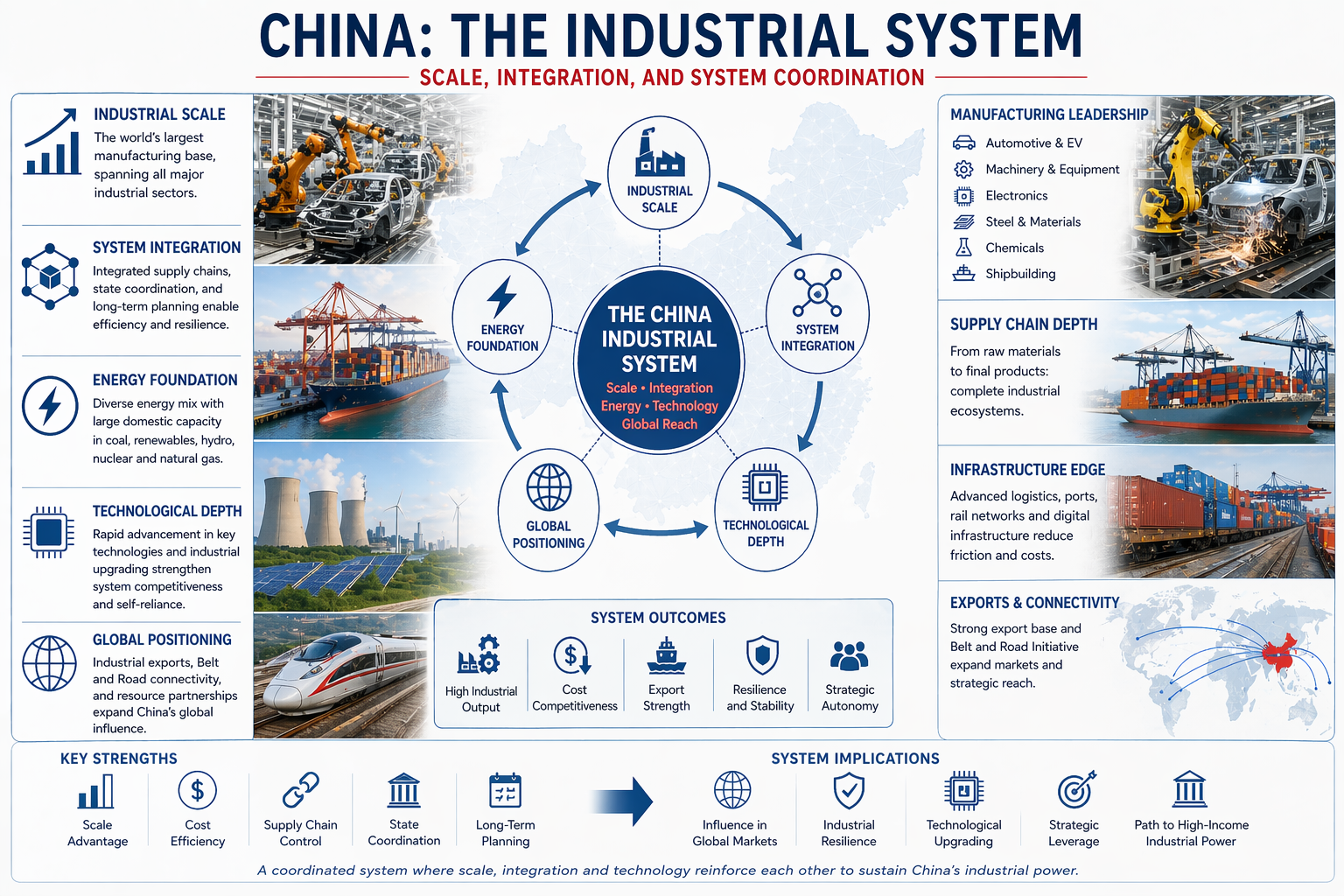
Keynote
China’s technological advancement is frequently interpreted as a shift toward innovation leadership.
In systemic terms, it represents something more specific:
the use of technology to reconfigure the energy–industrial system under conditions of constraint
In an energy-bound system, technological leadership
is not neutral.
It is directed toward:
reducing exposure to external energy dependencies
increasing control over industrial inputs
and restructuring production around electrified systems
China’s approach links technology development, energy transition, and industrial policy into a single system strategy.
System Navigation
This article extends:
- China: Industrial Scale and System
Coordination
- China_Technology_Energy_Transition
- Tech War as Energy
War
- AI–Energy–Cost Chasm
I. Technology as System Instrument
Technological development in China is not primarily oriented toward frontier innovation alone.
It is deployed as a system instrument.
Priority sectors include:
electrification technologies
battery systems
renewable energy infrastructure
grid management and transmission
industrial automation
These technologies are selected based on their capacity to:
reduce system vulnerability
increase production continuity
and improve energy conversion efficiency
Technology is therefore embedded within system-level optimisation, not isolated sectoral advancement.
II. The Strategic Energy Transition
China’s investment in renewable energy and electrification reflects more than environmental policy.
It represents a strategic adjustment to energy constraint.
Key drivers include:
dependence on imported hydrocarbons
exposure to maritime chokepoints
rising domestic energy demand from industry and electrification
The transition toward:
solar
wind
storage
and grid expansion
allows China to:
increase domestic energy supply
stabilise input costs over time
reduce exposure to external supply disruptions
This process is not immediate.
It involves a transition phase characterised by cost, redundancy, and overcapacity.
III. Strategic Tipping Point Dynamics
The energy transition introduces a non-linear dynamic.
During early stages:
capital intensity increases
system costs rise
legacy and new systems coexist
Over time, as deployment scales:
marginal energy costs decline
infrastructure efficiency improves
system dependence on external fuels decreases
This creates a strategic tipping point, where the cost structure and resilience of the system shift.
For China, reaching this point is critical to:
long-term industrial competitiveness
energy security
and global positioning
IV. Electrification and Industrial Reconfiguration
Electrification is not limited to energy production.
It restructures the entire industrial system.
Affected sectors include:
transport
manufacturing
urban infrastructure
digital systems and data centres
Electrification enables tighter integration between:
energy generation
industrial consumption
and technological systems
This integration increases system controllability and efficiency.
V. Localisation and Regionalisation of Value Chains
China’s technological and energy strategy supports the development of:
local and regional value chains
This reduces reliance on:
long-distance supply chains
external inputs
and global logistical systems
Localisation is reinforced through:
domestic manufacturing ecosystems
regional infrastructure development
and integration with neighbouring economies
The result is a system that is:
less exposed to global disruption
more internally coherent
and more resilient under constraint
VI. Global Implications
China’s approach contributes to a broader global paradigm shift.
Energy systems move toward electrification and decentralisation
Industrial production becomes more regionally anchored
Technological competition aligns with energy systems
Global interdependence is reconfigured, not eliminated
This process does not eliminate global trade.
It changes its structure.
VII. Position within the G2 System
Within the G2 framework:
The United States leads in energy abundance and technological systems integration
China leads in industrial scale and system-directed technological deployment
China’s technological strategy strengthens its position by:
reinforcing industrial capacity
reducing energy vulnerability
and supporting system autonomy
Conclusion
China’s technological leadership is not an isolated development.
It is embedded within a broader strategy to:
transition the energy system
restructure industrial production
and reduce external dependency
This integration transforms technology from a sectoral advantage into a system-level capability.
Closing Statement
In an energy-bound system, technological leadership is most consequential when it reshapes the underlying structure of production and energy use.
China’s strategy demonstrates how technology can be deployed to:
alter the balance between dependency and autonomy at system level
I. SYSTEM POSITION
#update ### How China fits into the global comparative architecture
→ Global System Power — Comparative Architecture (G2
Framework)
How the United States, China, and Europe occupy different positions
within the emerging system hierarchy
→ The
United States: Energy Abundance and System Power
Why U.S. system power rests on energy abundance, capital depth, and
technological infrastructure
→ Europe &
Russia
How energy dependence and geopolitical exposure reshape Europe’s
strategic position
II. CHINA’S INDUSTRIAL LOGIC
How scale becomes system power
→ China Industrial System
How industrial scale, coordination, infrastructure, and supply-chain
depth generate structural power
→ China Technology
& Energy Transition
How electrification, clean technology, and industrial upgrading
reinforce China’s long-term system position
→ Energy Leverage: U.S.
Energy Autonomy and the Global Order
How energy autonomy and energy dependence shape strategic
optionality across major powers
III. ENERGY, ELECTRIFICATION, AND COST ADVANTAGE
Why industrial competition is increasingly determined by energy systems
→ Energy-Bound
System
Why energy availability, cost, and infrastructure define the
operating conditions of power
→ The Energy J-Curve
Why transition initially raises instability and cost before
producing strategic advantage
→ AI–Energy–Cost Chasm
How electrification and compute expansion create divergence between
high-cost and system-coherent economies
→ Decarbonisation, Electrification, and Cost — Cross-Panel
Index
How the energy transition restructures industrial cost and
competitiveness
IV. INDUSTRY, COMPUTE, AND TECHNOLOGICAL CONTROL
Why industrial depth now converges with compute and platform power
→ Energy
Systems and the Tech War
How energy and compute increasingly define technological
competition
→ The Energy–Industry–Compute Stack
How industrial capability, electricity systems, and compute
infrastructure now operate as one strategic stack
→ Chokepoints
Under Compression
How bottlenecks in semiconductors, infrastructure, and inputs shape
system rivalry
→ System Re-Concentration
Why power is concentrating around energy, infrastructure, capital,
and compute rather than dispersing
V. CAPITAL, COORDINATION, AND SYSTEM COMPETITION
Why scale alone is insufficient without financing and coordination
→ Global
Cycles and Dollar Strategy
How monetary power and capital cycles shape the wider competitive
field
→ Energy–Capital–Currency Hierarchy
Why monetary position is downstream of energy, capital formation,
and structural control
→ Security Architecture as System Enforcement
How industrial and technological systems are reinforced through
security alignment and strategic dependency
VI. SYSTEM CONSEQUENCE
What China’s rise means for the wider order
→ [The System Is Not Fragmenting — It Is Re-Concentrating How the global order is being reorganised around concentrated system architectures
→ From
Constraint to Sovereignty — A European Architecture
How Europe must respond to a world shaped by integrated U.S. and
Chinese system power
System Reading Path
This sequence follows the competitive logic of the emerging order:
Energy Base → Industrial Scale → Technological Upgrading → Capital Coordination → System Power
It is designed to move from China’s industrial structure to the wider logic of global rivalry in an energy-bound system.