SYSTEM STACK ANALYSIS

Propagation pf power in an energy-bound system


System Architecture
Power propagates through a structured chain:

Energy → Industry → Compute → Ecosystems → Platforms → Standards → Capital → Currency → Sovereignty


Control of lower layers determines the structure and limits of higher layers.

I. Energy Systems — Physical Input Layer


→ defines cost, availability, and the structural ceiling of the system

• Energy Systems — Cross-Panel Index

• Decarbonisation, Electrification, and Cost

II. Industrial & Ecosystem Systems — Transformation Layer


→ converts energy into production, capability, and scaling capacity

• Industrial Ecosystems — Cross-Panel Index

III. Compute & AI Systems — Acceleration Layer


→ converts energy and industry into computation, intelligence, and infrastructure

• Energy–AI Infrastructure — Cross-Panel Index

IV. Digital Sovereignty — Control Layer


→ determines access, governance, and system-level control of computation

• Digital Sovereignty — Index

V. Capital & Monetary Systems — Outcome Layer


→ reflects how system control translates into capital formation, pricing power, and monetary stability

• Energy Capital Currency Index

• Energy Constraint Index

VI. Geopolitics of Systems — External Constraint Layer


→ shapes system interaction through competition, chokepoints, and external dependencies

• Energy Geopolitics — Index

VII. System Interface — Strategic Interpretation Layer


→ where system structure becomes geographically and operationally visible

• Mediterranean Guide to the System


GLOBAL — System Power in an Energy-Bound World

I. Foundational System Logic


Doctrines

• Doctrine Index

• The Energy-Bound System

• Energy As Operating System Of Power

•  Energy System Transformation

• Energy–Capital–Currency Hierarchy

• Infrastructure Currency Doctrine

• Energy Sovereignty As System Control

• Energy Constraint and the Monetary Ceiling

• Energy, Financialisation, and Capital Hierarchy

• US Energy and Monetary Power

• Energy Os G2 Comparative

• Energy Geopolitics Global Shift

• Global Energy Paradigm Shiftglobal

• Global Energy System Transition

• Physical Constraint

•  Financial–Physical Asymmetry in an Energy-Bound System

• System Architecture

• System Stack Architecture

Foundational Laws

• Energy Systems Index

• Decarbonisation, Electrification, and Cost

• Centralised Vs Distributed Systems

• The Global Compute Shift

• The Architecture of Energy, Capital, and Compute

• Energy, Industry, and Compute Convergence

• System Foundations of the Energy–AI Industrial Economy

•  System Re-Concentration


II. Systemic Asymmetry


• System Default

• Systemic Asymmetry

• Asymmetry under Stress

• Peripheral Nodes in an Energy-Bound System

• The AI–Energy–Cost Chasm

• Gvc In Energy Bound World

• Tech War as Energy War


III. System Guides — Strategic Interpretation Layer


• Mediterranean Guide to the System


IV. Monetary Systems — Control Layer


• Energy Capital Currency Index

• Monetary Power

• Monetary Sovereignty Energy Bound System


V. Global Order Under Stress


• Global Order Under Stress — Index

• Executive Summary

• Europe and Russia

• Energy Leverage

• 2B Energy As Os G2 Comparative White Paper

• Global Cycles and Dollar Strategy

• Tech War as Energy War

• Digital Economy, Platforms, and Currencies

• The Petro-Electrostate

• Global Value Chains

• Intellectual Property and Technology

• Military Buildup

• Demographics and Technology

• The UN Security Council

• Global Energy Flows and Dependencies

• ..

•  US Energy Abundance and System Power

•  China’s Industrial System

•  System Re-Concentration

•  Global System Power — Comparative Architecture

•  China’s Industrial System


VI. Systems Under Constraint

*Execution under structural limits*


• Systems Under Constraint — Index

• Executive Summary

• Energy as the Base Layer of Constraint

• System fragmentation in Eurasia

• Corridors, Chokepoints, and the Geography of Leverage

• Finance and Sanctions

• Tech Standards and Digital Control Layers

• Industrial Policy Inside Constrained Systems

• Agency Under Constraint

• Energy System Data Companion


VII. Evidence — System Validation Layer


• Evidence — Index

• Energy–Capital–Currency Map

• Energy System Data Companion

• Global LNG Routes

• Global Energy Flows Dependencies

• Gulf Petrodollar Architecture — Case Study

• Greece Energy Capital Currency Transmission

• Mediterranean Energy System Global


•  Electrostate Deployment and Industrial Scale

•  China’s Technology–Energy Transition

•  Electrostate Deployment and Industrial Scale


•  US Energy Abundance and System Power


•  Global South Electrification Leapfrog


[AI, Energy Constraint, and Compute Infrastructure]

•  LNG, NATO, and the Enforcement of System Power


•  Global System Power — Comparative Architecture

•  Security Architecture and Technological Sovereignty


•  Global System Power — Comparative Architecture


•  Electrostate Deployment and Industrial Scale


•  China’s Technology–Energy Transition


•  US Energy Abundance and System Power


•  Global South Electrification Leapfrog


•  LNG, NATO, and the Enforcement of System Power


•  Security Architecture and Technological Sovereignty


•  US Energy Abundance and System Power


•  China’s Industrial System


•  System Re-Concentration


•  Global System Power — Comparative Architecture


•  Security as System Enforcement


•  System Re-Concentration


• Mediterranean Guide to the System


Physical Constraint Doctrine

Why Energy Systems Ultimately Anchor Economic Power


Doctrine Statement

Digital and financial systems can expand exponentially.
Civilisation remains constrained by physical energy systems.

Energy infrastructure, industrial capacity, and material systems expand slowly and require time, resources, and coordination. Financial markets, digital technologies, and monetary systems can scale rapidly and often exponentially.

When abstract systems expand faster than the physical base that supports them, structural instability emerges.

In the long run, the physical system reasserts the constraint.
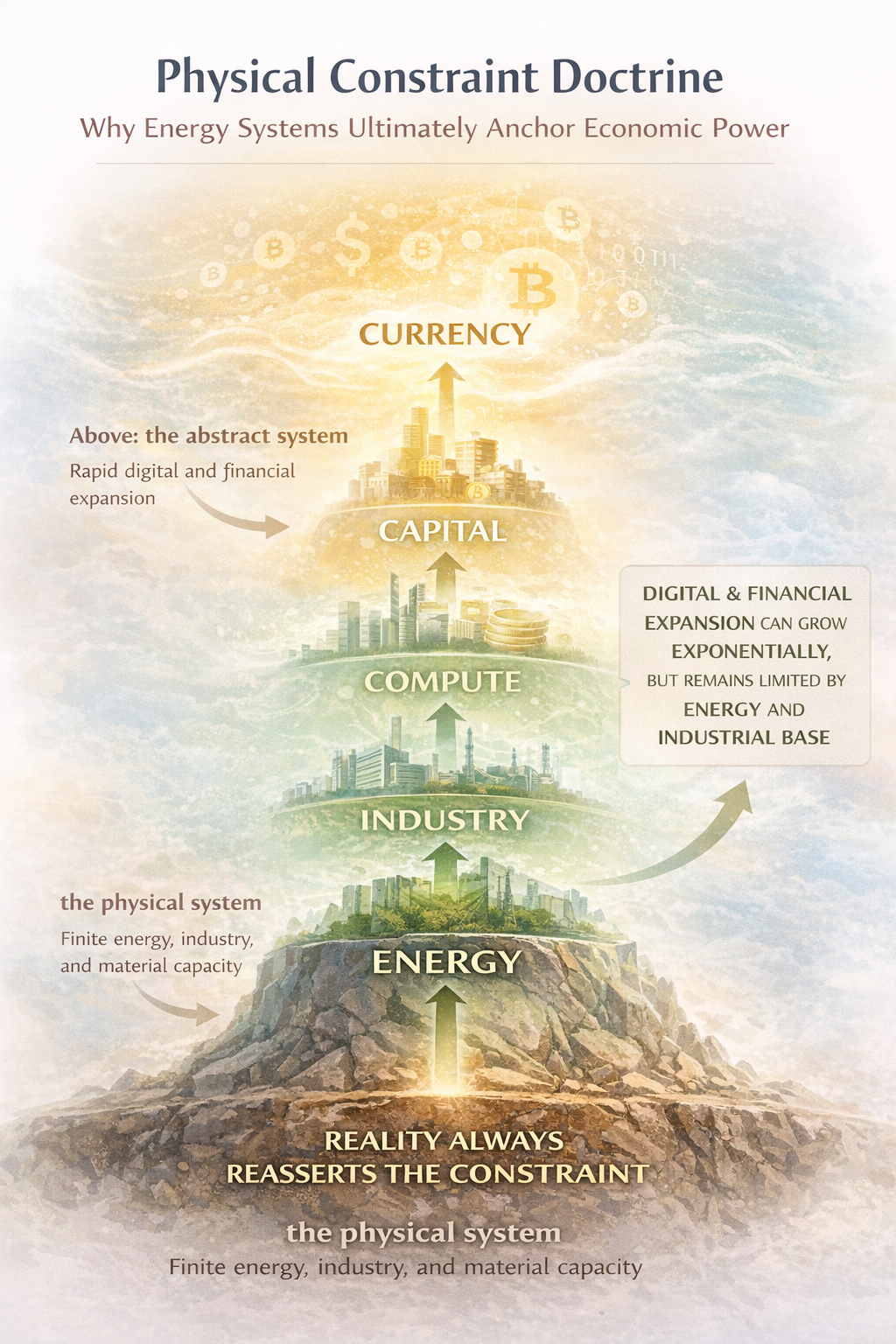

System Hierarchy

Modern economies operate as layered systems.

Energy

Industry

Compute

Capital

Currency

The lower layers anchor the system.
The upper layers move faster but remain dependent on the base.

When this hierarchy reverses — when capital or technology expands faster than energy and industry — systems experience volatility, speculative bubbles, or geopolitical stress.


Application: The AI Expansion

Artificial intelligence appears infinitely scalable as software.

In reality, AI depends on physical systems:

AI therefore follows the same hierarchy:

Energy → Compute → Capital.

If AI investment expands faster than electricity infrastructure, financial markets may temporarily overestimate the speed of technological transformation.

Eventually, the constraint appears through energy bottlenecks, infrastructure limits, or capital reallocation.


Strategic Implication

Technological leadership ultimately depends on the ability to align:

Systems that secure abundant, stable, and affordable energy gain structural advantages in technological development and economic power.


Investor Implication

Financial markets frequently price technological and financial expansion without fully accounting for physical constraints.

Examples include:

In each case, markets eventually rediscover the same reality:

the physical economy sets the ceiling.


Philosophical Lineage

This principle echoes a long intellectual tradition.

The distinction between real economic production and abstract financial accumulation appears already in the work of Aristotle.

Modern ecological economists such as Nicholas Georgescu-Roegen emphasised that economic systems ultimately operate within physical and thermodynamic limits.

Contemporary systems theory similarly describes economies as layered structures in which physical infrastructure anchors financial and informational systems.


One-Line Summary

Markets can expand faster than physics — but physics eventually sets the limit.


Further Reading Legitimacy Index Beyond Ideology Europe’s Challenge

System Transition

Transmission Mechanism

European Constraint Layer

→ See also: