Systemic Sovereignty Architecture
Technology, Infrastructure, and Power in the Fourth Industrial Revolution
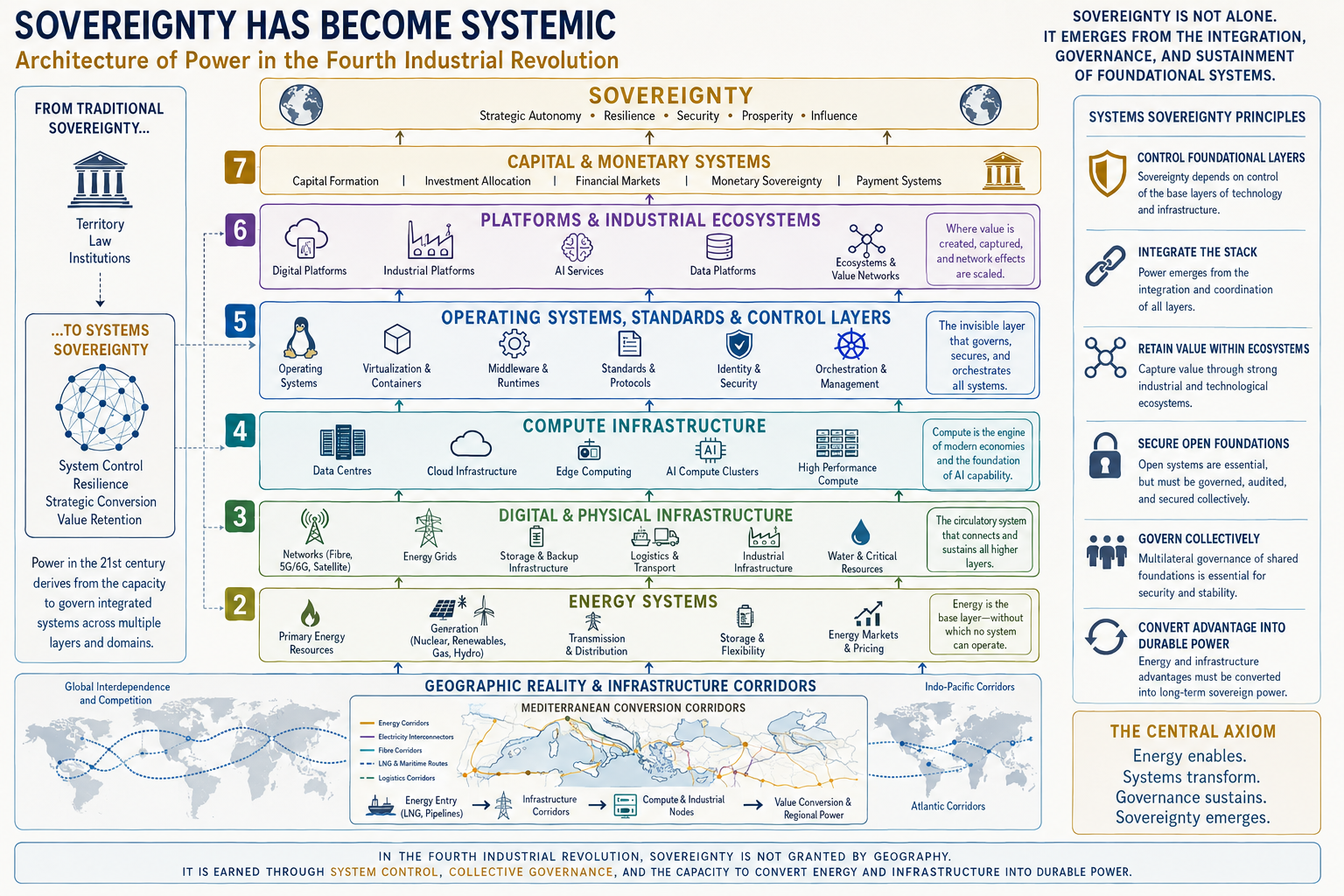
Executive Summary
Sovereignty is no longer exercised primarily through territory, law, or institutional authority alone.
In the Fourth Industrial Revolution, power increasingly derives from the capacity to govern integrated systems across energy, infrastructure, computation, industrial production, finance, logistics, and digital coordination.
Sovereignty has become systemic.
As energy systems, compute infrastructure, operating systems, AI architectures, industrial ecosystems, logistics corridors, semiconductor supply chains, cloud platforms, and financial systems converge into interconnected technological stacks, strategic power increasingly depends on the ability to:
sustain infrastructure under stress
coordinate systems across multiple layers
retain technological and industrial value
govern foundational digital architectures
scale computation efficiently
and convert energy and infrastructure advantage into durable system capability
The emerging geopolitical order is therefore increasingly shaped not by isolated technologies, but by the capacity to govern integrated systems operating across:
Energy → Infrastructure → Compute → Operating Systems → Ecosystems → Capital → Sovereignty
At the same time, the global technological system is built upon deeply shared foundations, particularly Unix- and Linux-derived operating systems, open-source infrastructure, internet protocols, semiconductor standards, and globally interconnected compute architectures.
This creates a structural tension.
Modern sovereignty increasingly requires system-level control, yet the stability of the global economy depends on multilateral coordination across common technological foundations.
For Europe, this challenge is especially acute.
Europe possesses advanced industrial capabilities, scientific depth, sophisticated infrastructure networks, regulatory capacity, and globally significant engineering ecosystems. Yet it struggles to convert these strengths into durable sovereignty across energy systems, AI infrastructure, cloud architecture, semiconductor ecosystems, digital platforms, and capital formation.
The challenge is not simply technological.
It is structural.
This article establishes the conceptual foundation for the broader architecture developed throughout this project across:
energy systems
infrastructure systems
AI infrastructure
operating systems and control layers
technological stacks
industrial ecosystems
digital sovereignty
Mediterranean conversion systems
monetary structures
and geopolitical power formation
System Navigation
This article establishes the systems sovereignty framework underlying the emerging Energy-Bound technological order:
GLOBAL
TECHWAR
EU SOVEREIGNTY
From Territorial Sovereignty to Systems Sovereignty
For most of modern history, sovereignty was understood primarily through territory, borders, jurisdiction, and legal authority.
States exercised power through institutions capable of governing defined geographic space.
That model is no longer sufficient.
In the Fourth Industrial Revolution, economic, industrial, and social activity increasingly operates through continuously interconnected technological systems:
electricity grids coordinated through software
cloud infrastructure governing computation
operating systems managing industrial infrastructure
logistics systems orchestrated digitally
financial systems embedded within platforms and code
AI systems integrated into industrial and administrative processes
These systems cut across borders, operate continuously, and increasingly function beyond the direct visibility of traditional governance structures.
As a result, sovereignty increasingly derives not only from the authority to legislate, but from the capacity to govern how systems function operationally.
The central geopolitical question is no longer simply:
Who controls territory?
It is increasingly:
Who governs the systems upon which modern societies depend?
Fourth Industrial Revolution Reading Path
The Fourth Industrial Revolution is treated here not as a narrow technology cycle, but as a systems transformation in which energy, computation, industrial capacity, automation, AI, and digital coordination converge into a new architecture of power.
This wider transformation is developed further in:
- 4IR as System Revolution
- Decarbonisation as Industrial Systems Transformation
- Decarbonisation as Techwar Instrument
- AI Smart Tech Sovereignty
The Integrated Stack of Power
Technology no longer functions as a collection of isolated sectors or discrete tools.
It increasingly operates as an integrated stack linking energy systems, infrastructure, software, computation, industrial production, ecosystems, logistics systems, and capital formation into a single operational architecture.
The emerging system increasingly resolves through the following chain:
Energy → Infrastructure → Compute → Operating Systems → Standards → Platforms → Ecosystems → Capital → Sovereignty
Each layer depends upon the stability, scalability, and governability of the layers beneath it.
Disruption at foundational layers propagates upward across the entire system.
Control at lower layers amplifies strategic influence across higher layers.
This transformation changes the nature of geopolitical competition.
Competition increasingly revolves around:
infrastructure rather than applications
ecosystems rather than isolated firms
standards rather than features
orchestration layers rather than visible services
compute scalability rather than software alone
energy access rather than digital abstraction
The relevant unit of power is no longer the isolated technology or corporation.
It is the system.
System Expansion — Stack Architecture
The integrated stack architecture developed here expands throughout the broader systems framework:
Energy as the Foundational Layer of Sovereignty
At the base of every modern technological system lies energy.
Artificial intelligence, cloud infrastructure, industrial automation, semiconductor fabrication, logistics systems, telecommunications, and digital finance all ultimately depend on electricity availability, grid stability, and energy cost structures.
In the emerging technological order, energy systems are no longer passive utilities.
They are increasingly:
digitally orchestrated
software-managed
infrastructure-intensive
compute-dependent
and strategically integrated with industrial systems
Electricity increasingly conditions:
AI training and inference
hyperscale data-centre deployment
advanced manufacturing
industrial electrification
cloud scalability
military infrastructure
and financial system resilience
This is why energy increasingly functions as the foundational layer of sovereignty itself.
Without stable, scalable, and competitively priced energy systems, higher-level ambitions in AI, industry, digital sovereignty, or financial autonomy become structurally constrained.
The Fourth Industrial Revolution is therefore not simply digital.
It is simultaneously computational, infrastructural, industrial, and energetic.
AI–Energy Sovereignty Layer
The relationship between energy systems and AI infrastructure increasingly defines the geography of technological sovereignty.
As AI systems scale, compute infrastructure becomes progressively conditioned by:
electricity pricing
grid resilience
cooling infrastructure
interconnection capacity
compute locality
and industrial coordination
This emerging AI-energy architecture is developed further in:
Infrastructure and the Geography of Sovereignty
Sovereignty increasingly depends not only on technological capability, but on infrastructure geography.
Infrastructure determines where energy flows, where computation scales, where industrial ecosystems cluster, and where capital accumulates.
Ports, grids, LNG terminals, fibre corridors, interconnectors, data centres, semiconductor supply chains, logistics hubs, and compute infrastructure increasingly form part of a single strategic architecture.
This transformation elevates geography once again into a central dimension of geopolitical power.
Within Europe, the Mediterranean increasingly functions as a strategic system interface connecting:
global energy flows
infrastructure corridors
maritime logistics
electricity interconnection
compute locality
industrial conversion
and capital transmission
The Mediterranean is therefore not simply a regional category.
It is increasingly a sovereignty conversion layer.
Energy advantage alone is insufficient.
Infrastructure must be converted into:
compute capacity
industrial ecosystems
technological coordination
platform leverage
and long-term capital retention
Where this conversion fails, value flows through systems without being retained.
Mediterranean Conversion Layer
The Mediterranean increasingly functions as Europe’s sovereignty conversion interface, linking energy systems, infrastructure corridors, compute locality, industrial ecosystems, logistics systems, and capital formation.
Further system expansion:
Digital Sovereignty and the Stack Architecture of Power
Digital sovereignty does not primarily emerge from applications, regulation, or data ownership alone.
It increasingly derives from control over:
compute infrastructure
operating systems
cloud orchestration
standards and protocols
developer ecosystems
semiconductor access
data infrastructure
AI deployment systems
and platform coordination layers
Modern digital systems increasingly operate through vertically integrated technological stacks linking:
semiconductors
compute infrastructure
operating systems
cloud platforms
AI systems
developer ecosystems
and financial architecture
As a result, digital sovereignty increasingly depends on whether states and institutions possess the capacity to:
govern orchestration layers
shape standards
sustain infrastructure
coordinate ecosystems
and retain value across the stack
This is why technological competition increasingly revolves around:
hyperscale cloud infrastructure
semiconductor ecosystems
AI compute concentration
platform coordination
standards governance
and operating system control
rather than software applications alone.
Digital Sovereignty Reading Path
The Operating System Layer: Infrastructure Becomes Governable
Between physical infrastructure and visible digital platforms lies a layer frequently absent from geopolitical analysis:
the operating system and orchestration layer
Across energy grids, cloud infrastructure, industrial automation systems, telecom networks, AI infrastructure, financial systems, and logistics architecture, this layer is overwhelmingly built on Unix-derived and Linux-based systems.
These operating systems define:
security architecture
permissions and access control
update authority
interoperability
orchestration logic
resilience under stress
and system continuity
Operating systems translate physical infrastructure into governable systems.
Without them, modern industrial and computational systems cannot coordinate at scale.
Linux in particular now functions as a form of civilisational infrastructure underpinning:
hyperscale cloud systems
AI compute infrastructure
internet architecture
telecom systems
industrial embedded systems
Android ecosystems
semiconductor toolchains
edge computing
container orchestration
and critical infrastructure globally
This creates a profound strategic paradox.
Open infrastructure does not eliminate power concentration.
It often relocates power upward into:
orchestration layers
cloud integration
ecosystem governance
standards influence
developer concentration
deployment scale
and platform coordination
Access to source code alone does not create sovereignty.
The strategic question is whether states and institutions possess the capacity to:
sustain systems
govern infrastructure
maintain ecosystems
shape standards
audit dependencies
and coordinate technological development over time
Dependence at this layer cannot be offset through regulation alone.
Operating Systems and Control Layers
These control-layer dynamics are developed further in:
Open Technology and Multilateral System Governance
Open technologies increasingly form the shared substrate of the global economy.
Internet protocols, Linux infrastructure, semiconductor standards, cloud-native architectures, and open-source software ecosystems underpin the functioning of modern industrial and computational systems across the world.
These shared foundations enable:
interoperability
scalability
resilience
modular innovation
and cross-border coordination
Europe has historically favoured openness, interoperability, and standards-based governance.
In the emerging technological order, this is no longer merely ideological.
It is structurally necessary.
However, shared technological foundations also generate shared systemic risk.
Because energy systems, industrial infrastructure, cloud architectures, AI systems, and financial platforms increasingly depend on globally integrated technological layers, fragmentation can itself become destabilising.
Europe therefore faces a dual challenge.
It must simultaneously:
reduce strategic dependency
while preserving interoperability across shared systems
This is why strategic autonomy and multilateral coordination are not opposites.
Under conditions of systemic technological interdependence, they increasingly become inseparable.
Sovereignty increasingly depends not on isolation from shared systems, but on meaningful participation in governing them.
Ecosystems, Platforms, and System Power
Technological power no longer derives primarily from isolated products.
It increasingly derives from ecosystem density and system integration.
Industrial ecosystems, developer communities, semiconductor supply chains, cloud architectures, logistics systems, research institutions, infrastructure networks, and capital formation mechanisms increasingly operate as interconnected sovereignty multipliers.
This helps explain why some systems scale more effectively than others.
The United States exercises power primarily through:
hyperscaler dominance
platform ecosystems
financial depth
cloud infrastructure
and technological orchestration layers
China increasingly pursues sovereignty through:
infrastructure coordination
industrial policy
domestic ecosystem scaling
semiconductor localisation
platform integration
and state-supported system control
Europe possesses substantial capabilities across:
advanced industry
infrastructure
scientific research
regulation
engineering
and energy transition systems
Yet Europe often struggles to retain value across the full stack.
Its challenge is not simply technological weakness.
It is fragmented ecosystem density across energy systems, industrial coordination, digital infrastructure, compute scaling, and capital formation.
This fragmentation weakens Europe’s capacity to convert technological capability into durable system power.
Ecosystem Sovereignty Layer
AI, Compute, and the Return of Material Sovereignty
Artificial intelligence is frequently described as a software revolution.
In practice, AI increasingly behaves as an infrastructure system.
AI scaling depends simultaneously on:
electricity systems
semiconductor efficiency
cooling infrastructure
compute locality
fibre networks
industrial coordination
cloud architecture
and capital intensity
As AI systems scale, sovereignty increasingly returns to material constraints.
Compute becomes geographically concentrated around:
energy availability
infrastructure density
industrial ecosystems
and capital depth
This transformation increasingly links AI sovereignty directly to:
energy sovereignty
infrastructure sovereignty
semiconductor sovereignty
ecosystem sovereignty
and digital sovereignty
The digital system is therefore becoming increasingly physical.
The emerging technological order is not reducing the importance of geography, infrastructure, industry, or energy.
It is reintroducing them as foundational layers of geopolitical power.
Europe’s Structural Challenge
Europe is not technologically irrelevant.
It possesses:
advanced industrial capacity
world-class research institutions
large integrated markets
sophisticated infrastructure
regulatory influence
and significant engineering depth
However, Europe struggles to convert these strengths into integrated sovereignty across the technological stack.
The problem is structural.
Unlike state-centric systems, the European Union operates across multiple sovereign states, regulatory systems, energy architectures, industrial models, fiscal regimes, and political priorities.
As a result, sovereignty must be coordinated across fragmented systems rather than imposed through centralised authority.
Europe’s challenge is therefore not simply to innovate.
It is to coordinate infrastructure, energy systems, industrial ecosystems, digital architectures, capital formation, and governance across the full stack.
This makes Europe’s path to sovereignty more difficult.
But it may also make it more compatible with a deeply interconnected global system.
The Systems Sovereignty Doctrine
This project advances a Systems Sovereignty Doctrine based on the following premise:
In the Fourth Industrial Revolution, sovereignty increasingly derives from the capacity to govern integrated systems across energy, infrastructure, computation, ecosystems, capital, and digital coordination.
Under conditions of technological convergence and energy constraint:
energy systems become compute systems
compute systems become industrial systems
industrial systems become financial systems
and sovereignty increasingly emerges from the coordination of the entire architecture
The doctrines developed throughout this project examine this transformation across:
GLOBAL
energy systems
monetary systems
infrastructure architectures
sovereignty transformation
TECHWAR
compute stacks
operating systems
semiconductor ecosystems
cloud infrastructure
developer ecosystems
EU SOVEREIGNTY
Mediterranean conversion systems
AI-energy architectures
industrial coordination
capital allocation
digital sovereignty
This article establishes the foundational framework through which these layers should be understood.
Conclusion: Sovereignty in an Interdependent System
Europe cannot secure sovereignty through isolation, fragmentation, or purely regulatory ambition.
Nor can sovereignty be restored simply by replicating state-centric technological models developed elsewhere.
In the Fourth Industrial Revolution, sovereignty increasingly depends on the ability to govern integrated technological systems under conditions of:
energy constraint
infrastructural interdependence
ecosystem concentration
compute intensity
industrial coordination
and digital dependency
Where foundational layers remain externally governed, sovereignty becomes progressively conditional regardless of market size or regulatory ambition.
The emerging geopolitical order is therefore increasingly shaped not by isolated technologies, but by the capacity to sustain and coordinate complete systems across:
Energy → Infrastructure → Compute → Ecosystems → Capital → Sovereignty
Sovereignty has become systemic.