Decarbonisation and Economic Regeneration
SMEs, Energy Costs, and the Political Economy of Transition
Keynote
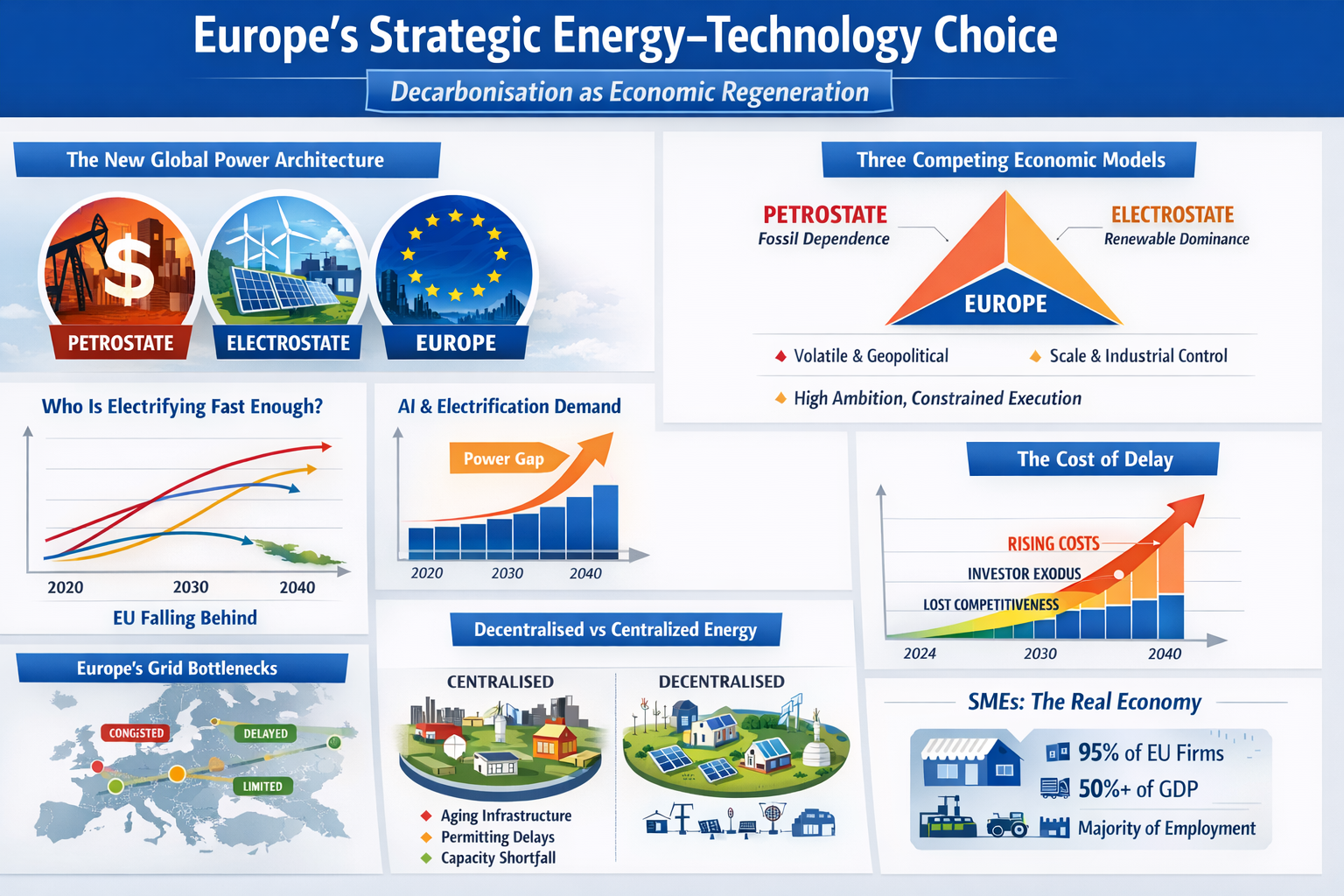
System transitions succeed or fail not at the level of ambition, but at the level of distribution. As energy systems are reconfigured, costs and risks are unevenly borne — particularly by small and medium-sized firms. This analysis examines how decarbonisation reshapes Europe’s political economy, determining legitimacy, resilience, and long-term growth.
Preface — Decarbonisation Beyond the Climate Debate
This analysis builds on the system logic established in “Decarbonisation as Industrial System Transformation,” and examines how the transition is experienced, contested, and governed at the level of firms, regions, and politics.
Decarbonisation is frequently misunderstood as a narrow environmental agenda, rooted in earlier debates about fuel substitution, nuclear power, or emissions targets. This framing obscures the strategic reality.
In the current global context, decarbonisation is best understood as a reconfiguration of energy and industrial systemsunder conditions of electrification, geopolitical fragmentation, and technological competition. It is not primarily about ideology, but about cost structures, resilience, deployment speed, and control over infrastructure.
This article situates decarbonisation within the Fourth Industrial Revolution and the Global Energy Paradigm Shift, showing why the energy transition has become central to industrial competitiveness, technological sovereignty, and the emerging tech war — regardless of political orientation or climate preference.
Europe is approaching a structural inflection point. Across the continent, energy volatility, demographic aging, geopolitical fragmentation, and slowing productivity are converging into a single economic challenge. The recent farmers’ protests, spreading from Western to Central and Southern Europe, are only the most visible expression of a deeper reality: Europe’s productive base—particularly its small and medium-sized enterprises (SMEs)—is under sustained pressure.
These protests are often framed as resistance to environmental policy. That interpretation misses the point. What farmers, transport operators, manufacturers, and service SMEs are responding to is not decarbonisation itself, but an economic model in which cost volatility, external dependency, and regulatory complexity accumulate faster than income stability and investment capacity.
In this context, decarbonisation must be reframed. It is not primarily a climate policy. It is a strategy for economic regeneration, SME competitiveness, and strategic resilience. Properly designed, it addresses some of the most binding constraints on European growth. Poorly designed, it risks deepening regional inequality and political backlash.
SMEs at the Core of the European Economy—and the Crisis
SMEs are not a peripheral feature of Europe’s economy; they are its foundation. They generate over half of EU GDP and account for the majority of private-sector employment. They anchor Europe’s regions, sustain rural economies, and form the backbone of its industrial ecosystems—from family farms and food processors to engineering firms, logistics providers, retailers, and digital services.
Yet SMEs are structurally exposed. Unlike large multinationals, they lack the scale to hedge energy prices, the leverage to negotiate long-term supply contracts, or the balance sheets to absorb repeated shocks. When electricity prices spike, when diesel or fertiliser costs surge, or when supply chains fracture, SMEs feel the impact immediately.
Over the past decade, Europe’s reliance on imported fossil energy has turned this vulnerability into a structural condition. Geopolitical shocks—wars, sanctions, supply disruptions—are transmitted directly into SME balance sheets. Margins shrink, investment is postponed, and risk aversion replaces expansion. This is not a temporary cycle; it is a systemic drag on productivity and growth.
Decarbonisation speaks directly to this problem.
Energy Sovereignty as Economic Sovereignty
At its core, decarbonisation is about who controls energy costs and risks. In a fossil-dependent system, Europe exports capital to import volatility. In an electrified, renewable-based system, more of the energy system becomes domestic, predictable, and investable.
For SMEs, this distinction is decisive. Energy is not an abstract input; it is a core cost driver. Electrification and decentralised renewables—solar and wind, storage, microgrids, demand management, and digitalised grids—offer a pathway to lower, more stable, and more transparent energy costs.
When SMEs can generate part of their own power, participate in local energy communities, or rely on predictable electricity prices, their planning horizons lengthen. Investment becomes feasible again. Productivity-enhancing upgrades—automation, digitalisation, efficiency improvements—become rational rather than risky.
In this sense, energy sovereignty becomes SME sovereignty. It restores agency to firms that have been operating under chronic uncertainty.
Beyond Climate: Decarbonisation as a Growth Strategy
Europe’s growth problem is structural, not cyclical. Productivity growth has slowed, demographics are deteriorating, and industrial activity is increasingly drawn toward regions with cheaper and more abundant energy. Without intervention, Europe risks a gradual hollowing-out of its productive base.
Decarbonisation is one of the few strategies capable of reversing this trend at scale.
First, it reduces Europe’s structural energy disadvantage over time. While fossil fuels are subject to global price cycles and geopolitical risk, renewable electricity benefits from declining marginal costs and domestic production. Over the medium term, this translates into a more competitive cost base for European industry and services.
Second, decarbonisation generates growth directly through investment. Grid expansion, storage deployment, building retrofits, electrified transport, industrial efficiency upgrades, and digital energy management require skilled labour, engineering, construction, manufacturing, and services. These investments are inherently local and difficult to offshore.
Third, decarbonisation underpins the next phase of technological change. Artificial intelligence, automation, data centres, and advanced manufacturing are all electricity-intensive. Regions that cannot supply abundant, reliable, and affordable power will struggle to attract or retain these activities. Clean electricity is becoming a prerequisite for competitiveness.
Rural Economies, Agriculture, and Social Stability
The political flashpoints of the transition have emerged most clearly in rural Europe. Farmers face rising input costs, climate stress, and declining bargaining power in concentrated value chains. Protests reflect not hostility to environmental goals, but resistance to asymmetric adjustment.
A transition that increases costs without reducing risk will fail. A transition that lowers costs and stabilises incomes can rebuild trust.
Decarbonisation offers concrete tools for rural regeneration: electrified irrigation, on-farm renewables and storage, precision agriculture that reduces fertiliser and water intensity, local processing that captures more value, and energy cooperatives that keep revenues in communities.
Across Europe—not only in the south—these measures can stabilise rural incomes, reduce exposure to fossil-fuel volatility, and slow demographic decline. Political legitimacy depends on whether decarbonisation is experienced as investment and resilience, rather than as administrative burden.
A Pan-European Logic with Regional Variations
While the economic logic is pan-European, its expression varies by region.
In Northern and Western Europe, decarbonisation is increasingly about industrial competitiveness and energy de-risking. Manufacturing-oriented SMEs face electricity price exposure and grid constraints that threaten investment and relocation decisions. Clean power and grid modernisation are essential to retaining value chains.
In Central and Eastern Europe, the emphasis is on economic sovereignty and convergence. High fossil dependence and legacy infrastructure expose SMEs to external shocks. Decarbonisation enables domestic energy production, regional resilience, and long-term catch-up growth.
In Southern Europe, decarbonisation intersects with climate stress and long-standing underinvestment, offering a route out of stagnation through renewable abundance and infrastructure-led growth.
Different contexts, same core dynamic: cheaper, more stable energy enables regeneration.
From Regulatory Burden to Economic Architecture
The central policy challenge is not ambition, but design. Europe has often treated decarbonisation as a regulatory overlay rather than as an economic architecture. That approach risks backlash and underperformance.
A regenerative strategy must prioritise:
- rapid permitting for SME-scale renewables and storage,
- affordable finance for electrified equipment and efficiency upgrades,
- grid modernisation that supports decentralised generation,
- simplified rules for energy communities and cooperatives,
- and targeted support for sectors with thin margins and high exposure.
Decarbonisation must be integrated into industrial, agricultural, and regional policy—not siloed as environmental compliance.
Conclusion: Regeneration or Decline
Europe’s choice is no longer between climate ambition and economic growth. It is between strategic adaptation and managed decline. Continued fossil dependence locks Europe into volatility, external dependency, and SME fragility. It erodes competitiveness and fuels social conflict.
Decarbonisation, properly designed, offers a different trajectory: lower and more predictable energy costs, renewed investment, stronger SMEs, resilient rural economies, and a credible foundation for future technologies.
The protests across Europe should be read not as rejection, but as warning. Europe’s economic base is asking for stability, fairness, and a viable future. Decarbonisation can deliver all three—if it is treated not as a constraint, but as Europe’s primary engine of economic regeneration.
Suggested Reading
- Agency Under Constraint (EU Challenge)
- Investor Reframing: System Returns (EU Sovereignty)
- Energy Sovereignty as System Control (EU Sovereignty)
- [Rural & Regional Stability in System Transitions (EU Challenge)]