AI Has Become Physical
Artificial Intelligence, Infrastructure Civilisation, and the Return of Material Power
System Navigation
This article functions as a foundational transition doctrine connecting artificial intelligence, energy systems, infrastructure architecture, industrial ecosystems, compute geography, capital concentration, and sovereignty under emerging AI conditions.
It should be read alongside:
Keynote
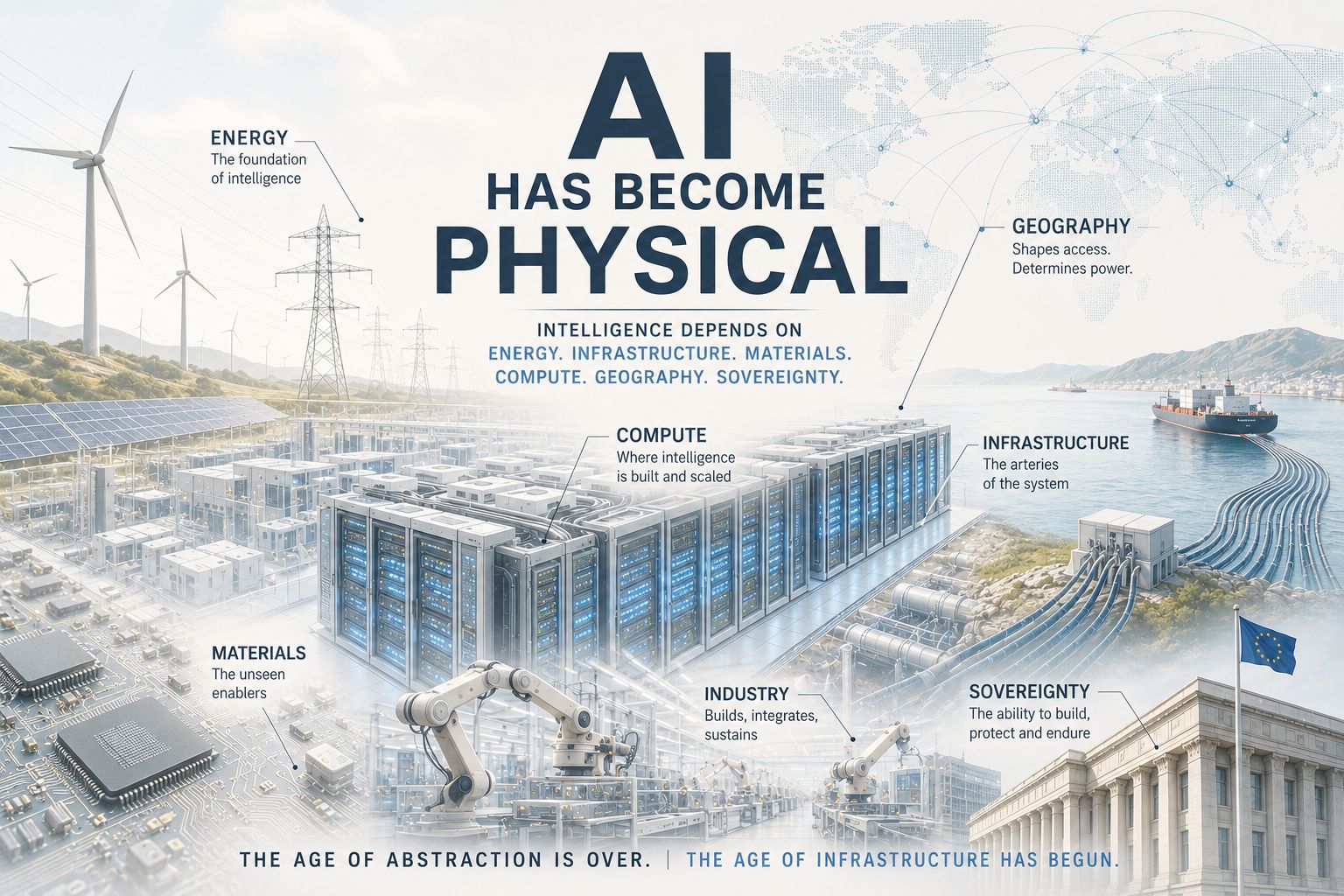
Artificial intelligence is no longer primarily a software phenomenon operating within abstract digital space.
It is increasingly becoming a physical infrastructure system organised around electricity, semiconductor fabrication, compute concentration, transmission architecture, industrial ecosystems, logistics continuity, territorial geography, and capital intensity.
This transition represents far more than the emergence of a new technology sector.
It represents the re-materialisation of digital civilisation itself.
For much of the late digital era, advanced economies increasingly operated under the assumption that software systems could scale independently from geography, industrial infrastructure, and material constraint. Digital expansion appeared increasingly detached from territory. Cloud systems appeared weightless. Platforms appeared globally scalable at near-zero marginal cost. Financial markets increasingly interpreted digital growth through the logic of abstraction, virtualisation, and frictionless scalability.
Artificial intelligence is now reversing these assumptions.
As computational intensity rises, intelligence increasingly becomes constrained by electricity systems, semiconductor fabrication capacity, cooling infrastructure, logistics chains, transmission networks, land availability, industrial supply continuity, and geopolitical stability.
Under these conditions, digital power increasingly returns to physical systems.
Artificial intelligence therefore does not mark the end of industrial civilisation.
It marks the reintegration of intelligence into industrial civilisation.
This transition alters the meaning of technological power, infrastructure, sovereignty, and geopolitics simultaneously.
Constraint: From Software Logic to Infrastructure Logic
The earlier internet era was historically shaped by software logic.
Digital systems appeared capable of expanding independently from physical geography because the dominant perception of the internet economy focused on platforms, applications, interfaces, and network effects rather than the industrial systems operating beneath them.
This perception encouraged the belief that digitality itself reduced the importance of territory, infrastructure, and industrial depth.
Cloud architectures reinforced this abstraction because computation appeared infinitely distributable and globally accessible regardless of underlying geography. Software increasingly appeared detached from energy systems, manufacturing systems, transmission systems, and material scarcity.
Yet this abstraction was always partially illusory.
The physical infrastructure underlying the digital economy never disappeared. It merely became less visible beneath increasingly sophisticated software layers.
Artificial intelligence increasingly dissolves this illusion because AI scaling dramatically intensifies the physical requirements of computation itself.
Large-scale AI systems require extraordinary concentrations of electricity, specialised semiconductors, cooling systems, fibre connectivity, industrial coordination, and long-duration capital deployment. As AI systems diffuse across industrial production, logistics, finance, administration, healthcare, defence, and consumer ecosystems, these requirements increasingly become permanent structural conditions rather than temporary technological inputs.
Under these conditions, the logic of software increasingly gives way to the logic of infrastructure.
Computation becomes physically constrained.
Electricity availability increasingly determines compute scalability. Transmission resilience increasingly shapes data-centre deployment. Cooling capacity increasingly influences infrastructure geography. Semiconductor fabrication increasingly becomes a geopolitical chokepoint. Logistics continuity increasingly becomes necessary for computational continuity.
The abstraction layer therefore begins collapsing downward into the underlying material system.
Artificial intelligence does not dematerialise the economy.
It rematerialises it through computation.
The AI transition does not introduce physical limitation into civilisation for the first time. Rather, it exposes constraints that remained structurally embedded beneath the abstraction layers of the late digital era. Industrial civilisation never escaped dependence upon energy systems, infrastructure continuity, material extraction, territorial stability, and logistical coordination. Artificial intelligence increasingly reveals these dependencies because computational scaling intensifies them.
→ Physical Constraint Doctrine → Physical Limits of Power
Transition: AI Becomes an Energy System
The AI transition fundamentally reorganises the relationship between intelligence and energy.
This shift is historically significant because artificial intelligence increasingly converts electricity directly into strategic capability.
The issue is therefore not merely that AI consumes energy. All industrial systems consume energy.
The deeper transformation is that computational scale increasingly depends directly upon energy scale itself.
Under AI conditions, electricity abundance, grid resilience, transmission continuity, cooling capacity, and generation infrastructure increasingly determine the capacity of states and corporations to scale intelligence systems.
This transition fuses energy systems and compute systems into a single infrastructural architecture.
Training frontier-scale models already requires enormous electricity consumption. More importantly, inference deployment extends this requirement continuously across industrial automation, logistics systems, cloud infrastructure, mobility systems, financial systems, healthcare architectures, administrative systems, and defence ecosystems.
As intelligence diffuses throughout economic systems, electricity demand increasingly becomes structurally tied to computational demand.
This transforms the strategic meaning of energy infrastructure.
Electrical grids no longer function merely as industrial utilities. Increasingly, they become foundational layers of computational sovereignty.
Transmission corridors increasingly shape compute geography. Grid stability increasingly influences industrial competitiveness. Generation capacity increasingly determines ecosystem scalability.
Under these conditions, energy policy increasingly becomes infrastructure policy, industrial policy, compute policy, and sovereignty policy simultaneously.
This is why the AI transition increasingly transforms energy systems into sovereignty systems.
The states capable of integrating stable electricity systems, compute infrastructure, industrial continuity, semiconductor access, and capital concentration acquire disproportionate strategic advantage because they possess the physical architecture required for intelligence scaling.
The emerging hierarchy is therefore not merely digital.
It is infrastructural, energetic, and civilisational.
Architecture: Compute Geography and the Return of Territory
Once intelligence becomes physically constrained, geography returns to the centre of technological power.
This marks a profound reversal from the assumptions of the hyper-globalised digital era, during which computation frequently appeared detached from territorial logic.
Artificial intelligence increasingly reverses this perception because compute infrastructure cannot scale uniformly across all geographies.
Large-scale compute systems require stable electricity networks, transmission resilience, cooling availability, land, fibre density, logistical accessibility, geopolitical stability, and immense concentrations of long-duration capital.
As these requirements intensify, infrastructure-rich geographies increasingly emerge as strategic nodes within the global intelligence system.
A new form of compute geography therefore begins to emerge.
AI infrastructure increasingly clusters around territories capable of integrating energy abundance, industrial continuity, semiconductor access, subsea connectivity, cloud ecosystems, logistics systems, and infrastructure financing into coherent operational architectures.
This transition is already visible across multiple regions.
Nordic states increasingly attract compute concentration because of grid stability, cooling conditions, and electricity availability. Texas increasingly illustrates the convergence of energy systems and hyperscale infrastructure expansion. Gulf states increasingly deploy sovereign capital into AI infrastructure as part of wider geopolitical diversification strategies. Mediterranean infrastructure corridors increasingly gain strategic relevance because they connect energy systems, cable systems, ports, logistics routes, interconnectors, and distributed compute architectures.
Under AI conditions, intelligence increasingly follows infrastructure topology.
This transition fundamentally alters the strategic meaning of infrastructure geography itself.
Subsea cable systems, electrical interconnectors, LNG infrastructure, ports, fibre corridors, logistics systems, and distributed energy systems increasingly form part of the same compute architecture.
The geography of intelligence increasingly becomes inseparable from the geography of infrastructure.
This is why infrastructure sovereignty increasingly becomes central to geopolitical power.
The strategic issue is no longer limited to software innovation alone.
It increasingly concerns the capacity to organise and stabilise the physical architecture upon which intelligence systems depend.
Semiconductors and the Infrastructure of Intelligence
The AI transition also fundamentally transforms the strategic meaning of semiconductors.
Microprocessors are no longer merely technological components operating within consumer electronics or commercial supply chains.
Increasingly, they function as foundational infrastructure layers within the emerging intelligence system.
Artificial intelligence cannot scale independently from semiconductor fabrication, lithography, advanced packaging, precision manufacturing, rare material supply chains, and industrial ecosystem continuity.
Under these conditions, semiconductor ecosystems increasingly become geopolitical chokepoints.
Control over advanced fabrication capacity increasingly shapes compute capability, military capability, industrial competitiveness, cloud scalability, and technological sovereignty simultaneously.
This transition explains why semiconductor production increasingly becomes inseparable from national security, industrial strategy, geopolitical competition, and alliance systems.
The strategic issue is not simply access to chips.
It is access to the industrial ecosystems capable of sustaining advanced computational civilisation itself.
Artificial intelligence therefore accelerates the strategic fragmentation of the global technological system.
Artificial intelligence also increasingly reconnects semiconductor systems to the underlying mineral architectures upon which advanced computation depends.
Semiconductor fabrication, electrical systems, batteries, robotics, transmission infrastructure, renewable energy systems, defence electronics, cooling systems, and hyperscale compute infrastructures all depend upon increasingly concentrated ecosystems of strategic minerals and rare earth processing.
Under AI–energy conditions, these materials no longer function merely as commodities within industrial supply chains.
They increasingly function as foundational inputs into computational civilisation itself.
This transition transforms strategic minerals into sovereignty infrastructure embedded within the wider architecture of energy systems, industrial ecosystems, compute scaling, and geopolitical power.
→ Strategic Minerals in the AI–Energy System
Semiconductor ecosystems increasingly function not merely as commercial industries, but as sovereignty infrastructures embedded within wider geopolitical blocs.
This transition increasingly shapes the emerging technological fragmentation between the United States, China, Europe, and other regional infrastructure systems.
AI Re-Materialises Geopolitics
The AI transition also re-materialises geopolitics itself.
The earlier globalisation era often encouraged the assumption that digital systems reduced the importance of geography, industrial depth, territorial continuity, and material infrastructure.
Artificial intelligence increasingly reverses this logic.
Because AI scaling depends upon electrical grids, semiconductor ecosystems, subsea cable systems, logistics corridors, transmission infrastructure, industrial coordination, financing structures, and security architectures, geopolitical power increasingly recentres around infrastructure continuity.
Under these conditions, infrastructure systems increasingly become strategic assets requiring geopolitical protection.
Energy corridors, cable routes, ports, logistics chains, semiconductor supply systems, and compute infrastructures increasingly converge into the same strategic layer.
This is why energy security, infrastructure security, digital sovereignty, and military strategy increasingly begin merging together.
The protection of subsea cables, LNG systems, transmission corridors, semiconductor supply chains, satellite systems, cloud infrastructure, and maritime logistics increasingly becomes part of the wider sovereignty architecture of the AI era.
This transition also explains the growing convergence between infrastructure systems and alliance systems.
NATO increasingly intersects with energy continuity, infrastructure protection, cable security, logistics resilience, and technological sovereignty because intelligence systems increasingly depend upon these infrastructures remaining operational under conditions of geopolitical competition.
Under AI conditions, geopolitical power increasingly depends not only upon military capability or financial scale, but upon the capacity to maintain stable infrastructure civilisation under computational intensity.
Financialisation and the Infrastructure Reality
The AI transition also introduces a growing tension between financial narratives and infrastructural realities.
Financial markets frequently continue interpreting artificial intelligence through the logic of the earlier software era, where digital systems appeared capable of frictionless scalability, low marginal cost expansion, and rapid platform dominance.
Yet the underlying infrastructure reality increasingly behaves differently.
AI scaling increasingly requires extraordinary capital expenditure, electricity expansion, semiconductor concentration, cooling infrastructure, grid reinforcement, and industrial coordination.
As computational intensity rises, the infrastructure requirements of AI increasingly become more visible across the global economy.
This does not imply that artificial intelligence lacks transformative potential.
Nor does it imply that hyperscale infrastructure systems necessarily fail.
Rather, it suggests that there may be a growing divergence between financial narratives of frictionless digital scaling and the increasingly physical realities of infrastructure-constrained intelligence systems.
This distinction is strategically important.
The AI era may increasingly resemble an infrastructure expansion cycle as much as a software expansion cycle.
Under these conditions, compute concentration, electricity bottlenecks, semiconductor constraints, infrastructure financing intensity, and ecosystem concentration increasingly shape the trajectory of AI development itself.
The physicalisation of intelligence therefore alters not only technological systems, but also the financial assumptions surrounding digital growth.
The financial architecture of the late digital era evolved during a period in which markets increasingly interpreted technological scaling through the logic of abstraction, low marginal cost expansion, software replication, and global liquidity. Artificial intelligence increasingly disrupts these assumptions because intelligence scaling now depends upon materially intensive infrastructure systems requiring enormous electricity consumption, semiconductor concentration, cooling systems, grid reinforcement, logistics continuity, and long-duration capital deployment.
Under these conditions, a structural asymmetry may increasingly emerge between financial valuation systems shaped by software-era assumptions and the physical realities governing infrastructure-constrained AI expansion.
→ Financial-Physical Asymmetry in an Energy-Bound System
Europe and the Conversion Problem
Europe’s strategic challenge under AI conditions is therefore not reducible to innovation alone.
Europe retains advanced industrial capabilities, engineering depth, scientific capacity, electrification ambitions, infrastructure continuity, and major technological talent pools. Yet these capabilities frequently fail to convert into sovereign compute systems, hyperscale ecosystems, semiconductor dominance, or globally integrated digital infrastructure architectures.
The structural issue is therefore increasingly a conversion problem.
The AI transition intensifies this challenge because the emerging intelligence system rewards vertically integrated infrastructures capable of linking energy systems, compute deployment, industrial ecosystems, semiconductor access, capital concentration, logistics continuity, and geopolitical scale into coherent sovereignty architectures.
Europe often possesses these capabilities individually while lacking sufficient systemic integration between them.
This creates a widening strategic vulnerability.
Europe risks interpreting artificial intelligence primarily through regulation, software abstraction, platform imitation, or financial participation while underestimating the infrastructural nature of the transition itself.
This creates increasing strategic risk for both public policy and capital allocation. Financial participation in AI-related sectors does not automatically produce sovereign infrastructure capacity. Under infrastructure-intensive AI conditions, long-term strategic advantage increasingly depends upon the capacity to finance, construct, integrate, and secure the physical systems underlying computational scale itself.
→ Investor Note — Financial Evaluations vs Physical Constraints
Yet AI increasingly behaves not primarily as a software industry, but as an infrastructure civilisation system.
This is precisely why electrification, infrastructure continuity, distributed compute systems, industrial ecosystems, interconnector expansion, and Mediterranean infrastructure geography increasingly become strategically important for Europe.
The Mediterranean increasingly functions as one of Europe’s principal infrastructure interfaces under AI-energy conditions.
Electricity corridors, subsea cable systems, ports, distributed renewable architectures, logistics systems, LNG infrastructure, and regional compute clusters increasingly form part of a wider European conversion architecture linking energy systems to sovereign compute capability.
Under these conditions, Southern Europe increasingly shifts from peripheral geography toward strategic infrastructure geography.
This transition fundamentally alters the strategic meaning of the Mediterranean within the emerging sovereignty architecture of Europe.
Outcome: The Return of Physical Civilisation
The AI transition ultimately marks the end of the post-physical illusion that shaped much of the late globalisation era.
For several decades, advanced economies increasingly behaved as though software systems, financial systems, and digital platforms could permanently transcend material limitation.
Artificial intelligence increasingly reverses this condition.
Civilisational capability once again depends upon electricity systems, industrial depth, semiconductor manufacturing, logistics continuity, infrastructure resilience, compute deployment, territorial organisation, and long-duration capital formation.
This does not represent a return to the industrial age in its earlier form.
It represents the fusion of intelligence systems and industrial systems into a new form of infrastructure civilisation organised around energy, compute, industrial ecosystems, capital concentration, and sovereignty architectures.
Under these conditions, sovereignty increasingly depends upon the capacity to integrate energy systems, compute systems, industrial ecosystems, infrastructure continuity, financial systems, and territorial geography into coherent architectures capable of sustaining intelligence at scale.
The states, regions, and blocs capable of achieving this integration will increasingly shape the geopolitical hierarchy of the AI era.
Artificial intelligence has therefore become physical.
And once intelligence becomes physical, sovereignty becomes infrastructural.