Agency Under Constraint
Strategy in a Partial-Control System
This article is part of the “European Sovereignty & System Constraint Series” series.
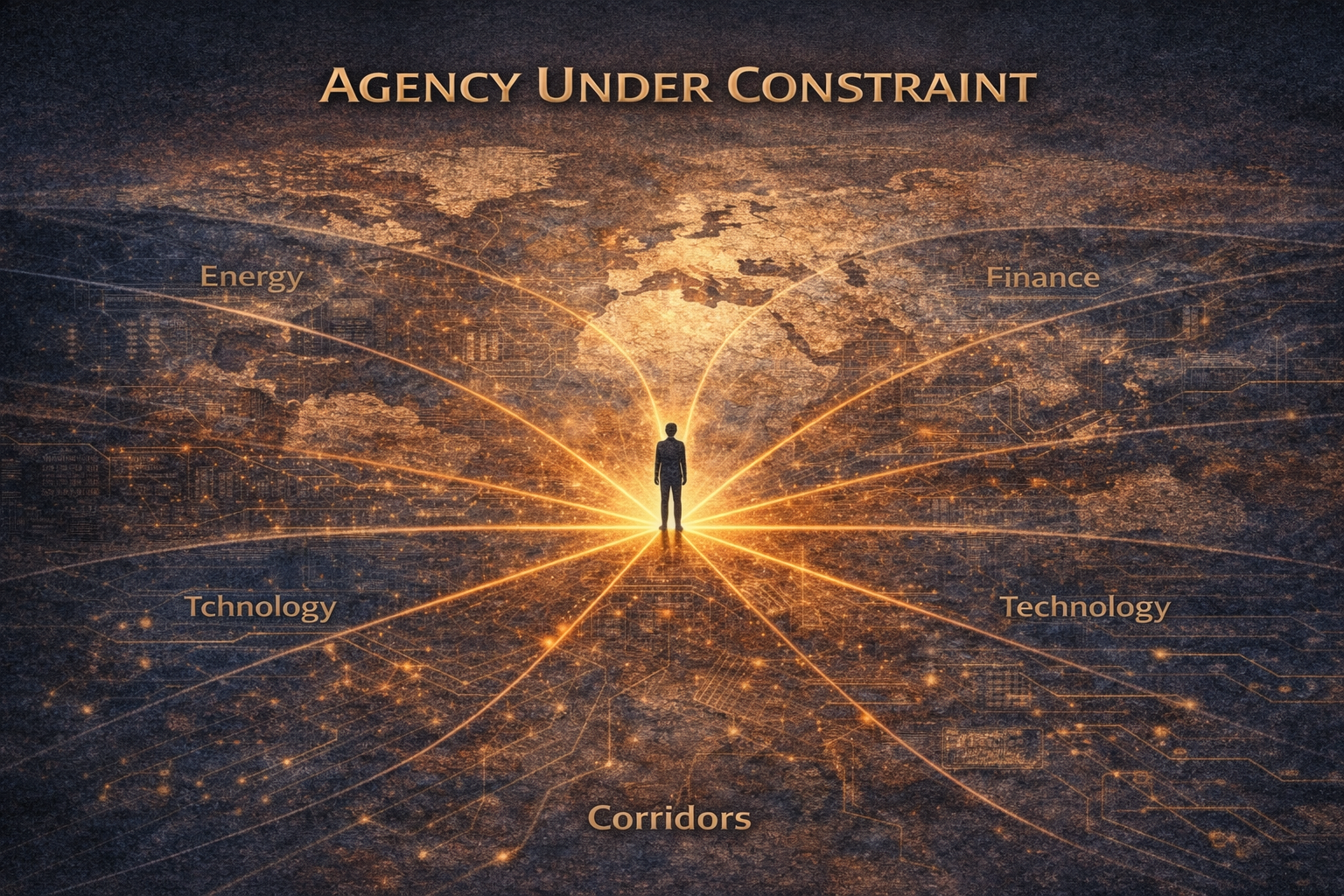
Keynote
The defining feature of the current era is not a lack of ambition, but a contraction of effective agency. As economic, energy, and technological systems become more constrained and interdependent, the space in which strategy can operate narrows. Power flows less through decisions and more through position within systems. Understanding how agency is reshaped under these conditions is a prerequisite for credible strategy.
Preface — When Control Is Partial
This article forms part of the Systems under Constraint series and serves as the anchor analysis for the EU Challengepanel.
The preceding articles in this series have traced the emergence of a global order structured less by choice than by constraint. Energy volatility sets the base layer. Supply chains fragment. Financial systems condition access. Standards and platforms lock in design. Industrial policy operates downstream of these architectures rather than above them.
At this stage, a familiar question arises: what can still be done?
Answering it requires abandoning an older conception of agency. In an era of stacked, interdependent systems, control is partial, uneven, and often exercised elsewhere. Outcomes are shaped as much by position within infrastructures and networks as by formal authority or policy intent.
This does not eliminate agency. It redefines it.
Rather than commanding outcomes, strategy under constraint consists of managing exposure, preserving optionality, and maximising room for manoeuvre within binding limits. Dependence cannot be eliminated, only shaped. Time becomes a strategic variable. Hedging replaces alignment. Autonomy becomes relative and situational rather than absolute.
Europe’s experience brings these dynamics into sharp relief. High energy costs, externalised infrastructures, and compressed adjustment capacity expose the limits of traditional policy tools. Yet Europe’s challenge is not unique. It is simply where the tension between ambition and constraint is most visible.
This article examines how agency functions when control is partial—at the level of states, institutions, and societies—and why recognising these limits is not defeatism, but the starting point for effective strategy.
This article is part of the Systems under Constraint series and serves as the anchor analysis for the EU Challengepanel, examining the human and institutional limits of action in an energy-bound, fragmented global system.
The preceding parts of this series have described a global order increasingly defined by constraint rather than choice. Energy volatility sets the base layer. Economic systems fragment. Corridors and chokepoints transmit pressure. Finance and sanctions shape access. Technology standards lock in design. Industrial policy operates downstream of all of these forces.
At this point, a familiar question emerges: what can still be done?
The answer requires abandoning an older conception of agency.
The End of Unconstrained Agency
For much of the post–Cold War period, agency was implicitly defined as the ability to choose freely among policy options. States were assumed to control their economic environment, shape outcomes through regulation or investment, and adjust course as needed. Constraint was treated as temporary or exogenous.
That assumption no longer holds.
In a system organised around stacked, interdependent architectures, agency is bounded. Outcomes are shaped as much by position within systems as by decisions taken within institutions. Control is partial, uneven, and often exercised elsewhere.
This does not eliminate agency. It redefines it.
Agency as Position, Not Command
In constrained systems, agency is less about issuing commands and more about occupying viable positions.
Position determines:
- exposure to volatility
- sensitivity to leverage
- access to capital and technology
- resilience to disruption
States do not act on the system from above. They act within it, adjusting posture, alignment, and interface management.
Agency becomes comparative rather than absolute. It is measured not by autonomy from systems, but by relative advantage within them. The relevant question is no longer “can we control outcomes?” but “relative to whom, and at what cost?”
Managing Dependency Rather Than Eliminating It
A recurring illusion in sovereignty debates is that dependence can be eliminated. In deeply integrated systems, this is structurally unrealistic.
Agency under constraint therefore shifts from eliminating dependence to managing it:
- identifying which dependencies are most destabilising
- which can be tolerated
- which can be diversified
- and which must be hedged
This is not a failure of ambition. It is a recognition of system reality.
Effective agency prioritises critical vulnerabilities, not symbolic independence.
Time as a Strategic Variable
Constraint also reshapes the role of time.
In unconstrained models, policy is expected to deliver decisive outcomes. In constrained systems, agency often consists in buying time:
- delaying adverse lock-in
- smoothing volatility
- preserving optionality
- preventing irreversible loss of position
This temporal dimension is often misread as indecision. In practice, it is one of the few remaining sources of leverage.
Time management becomes strategy.
Hedging, Not Alignment
In a fragmented global order, binary alignment reduces agency. It hardens exposure to shocks originating elsewhere in the system.
Agency under constraint therefore favours hedging strategies:
- maintaining access across systems
- avoiding irreversible commitments
- preserving interoperability where possible
- limiting single-point dependencies
This does not imply neutrality or indecision. It reflects an understanding that flexibility is a form of power when control is limited.
The Limits of Autonomy
Much of the political discourse around autonomy remains anchored in an earlier era. It assumes that sovereignty can be restored through policy instruments alone — regulation, subsidies, procurement, or institutional reform.
The analysis in this series suggests otherwise.
Autonomy in a constrained system is relative, layered, and incomplete. It varies by domain. It fluctuates over time. It is constantly renegotiated through system interaction.
Recognising these limits is not defeatism. It is the precondition for effective strategy.
Europe’s Specific Challenge (as Case, Not Exception)
Europe’s position illustrates this reality sharply.
It operates within:
- externally priced energy systems
- US-anchored financial and security architectures
- externally defined digital platforms and standards
- increasingly politicised trade corridors
Europe retains agency, but not control.
Its strategic task is therefore not to reclaim a level of autonomy that no longer exists, but to maximise room for manoeuvre within constraint — economically, politically, and institutionally.
This is not a uniquely European problem. Europe is simply where the tension between ambition and constraint is most visible.
From Illusion to Strategy
The danger is not constraint itself. The danger is misrecognising constraint.
When policy assumes control where none exists, outcomes disappoint and credibility erodes. When ambition ignores architecture, dependency deepens. When sovereignty is framed as absolute, agency collapses into frustration.
A more durable approach begins with acceptance:
- acceptance of limits
- acceptance of partial outcomes
- acceptance that strategy is about positioning, not dominance
This is not resignation. It is strategic maturity.
Conclusion: Agency Redefined
The global order now taking shape is not one of free choice, but of structured constraint. Power flows through systems rather than decisions. Leverage is exercised through design rather than declaration.
Agency persists — but only for those who understand the architecture within which they operate.
The constraints described here shape how industrial policy, energy transition, and technological sovereignty unfold in practice across Europe and beyond. Systems under Constraint has argued that sovereignty today is not a binary condition, but a function of system position, interface control, and resilience to pressure.
Understanding that reality does not guarantee success.
Failing to understand it guarantees strategic error.
Agency under constraint is not about restoring the past. It is about operating effectively in the present.
Suggested Reading
Strategic agency operates within structural architecture.
Strategic Constraint defines the binding variable.
Energy Sovereignty as System Control defines the redesign mechanism.
Structural Ceiling describes macroeconomic compression.
Monetary Ceiling explains currency durability under constraint.
Agency Under Constraint addresses the operational question: how sovereignty is exercised within — and through — structural limits.
Constraint is the condition.
Agency is the response.
To place this analysis in context, readers may wish to consult the following:
Energy as Europe’s Strategic Constraint On how physical energy limits underlie digital and industrial scaling.
System Fragmentation: Europe, Eurasia, and the Future of Global Value Chains On how securitised systems reorganise trade and production around partially incompatible stacks.
EU Asymmetry Under Stress (EU Sovereignty)
On how these structural layers materialise in Europe’s cost and inflation dynamics
System Foundations
System Foundations of the Energy–AI–Industrial Economy
On why energy, industry, compute, and finance now operate as a single constrained system.Energy Sovereignty as System Control (Global / Doctrines)
On why control over energy systems underpins all downstream policy capacity.Energy, Financialisation and Capital Hierarchy From Bretton Woods to BRICS, this essay traces how energy regimes and financialisation have reordered global capital — and why that hierarchy may now be shifting again.
Constraint and Agency
- Capital
Duration as System Power
On why long-cycle finance and investment horizons determine what industrial policy can sustain.
Industrial and Trade Context
- Global
Value Chains in an Energy-Bound World
On how energy costs and infrastructure reshape production geography and corridor viability. - Stack-Level
Fractures in the Tech War
On how stress propagates across interdependent systems, narrowing industrial options.
System Foundations
- System
Foundations of the Energy–AI–Industrial Economy
On how constraint has become a structural feature of modern economic and technological systems. - The
Energy–Industry–Compute Stack
On why power and agency now flow through layered infrastructures rather than discrete policy domains.
Constraint, Contest, and Power
- Decarbonisation
as a Tech War Instrument
On how system constraint is actively used as a lever of competition and control. - Stack-Level
Fractures in the Tech War
On how stress propagates through interdependent systems, narrowing room for manoeuvre.
Institutional and Economic Capacity
- Industrial
Policy Inside Constrained Systems
On why industrial policy under constraint prioritises sequencing, capacity, and energy control over scale. - Doctrine_Capital_Duration_as_System_Power
On how time horizons and patient capital determine who can act—and who must react.
European Context
- Decarbonisation,
SMEs, and the Political Economy of Transition
On how constraint is experienced unevenly across firms and regions, shaping legitimacy and compliance. - Why
Europe’s Digital Strategy Deepens Electrification
Risk
On how policy ambition can inadvertently reduce agency when physical systems are misaligned.
How to read this article
This article should be read as a diagnostic, not a prescription. It explains why effective strategy under constraint looks different from strategy under abundance—and why misunderstanding this shift leads to repeated policy failure.