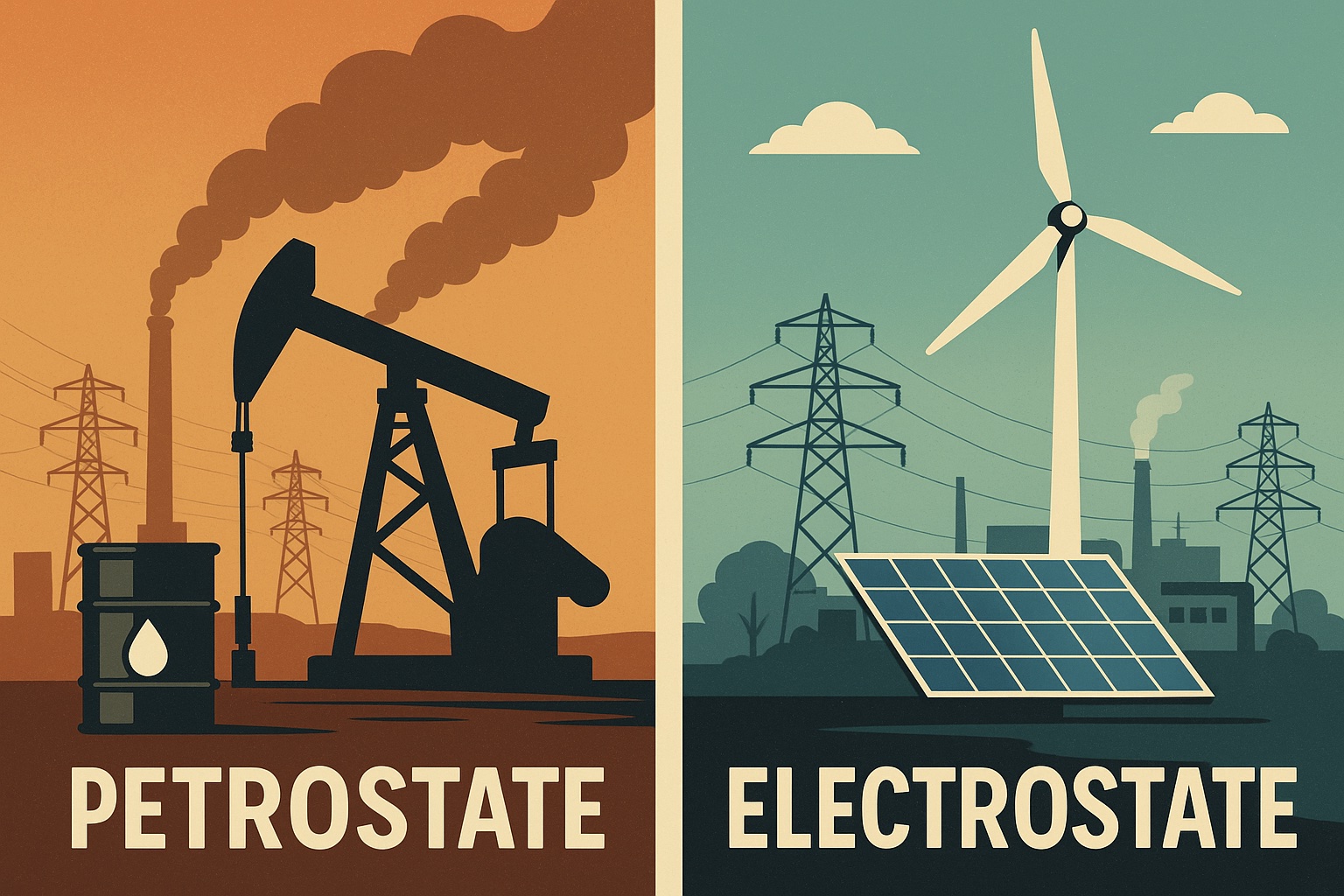
Petrostate vs Electrostate
Fossil-Fuel Incumbency, Electrified Systems, and the Reordering of Power
Keynote
The energy transition does not replace the system.
It reorders who controls it.
It is not a linear shift from fossil fuels to renewables.
It is a restructuring of how energy is produced, priced, and integrated
into industrial and technological systems.
This creates divergence:
→ between systems built on extraction
→ and systems built on electrified infrastructure
The outcome is not convergence.
It is a new hierarchy of power.
Framework Position
Framework → Transformation Layer

This article defines how the global system transitions from fossil-fuel incumbency
to electrified infrastructure systems, and how this process creates divergence
in cost, capability, and geopolitical position.
I. The System Does Not Transition Cleanly
The dominant narrative assumes:
fossil fuels decline
renewables rise
power redistributes
This is incorrect.
Energy systems do not switch.
They layer.
The current phase is defined by:
persistent fossil dependence
accelerating electrification
rising total energy demand
infrastructure lag
capital intensity
This is not a transition.
It is a hybrid system under stress.
II. Two System Architectures
Petrostate — Power Through Extraction
Built on:
hydrocarbons
centralised energy systems
global pricing exposure
export-driven leverage
Delivers:
immediate energy availability
geopolitical influence through flows
But creates:
price volatility
external exposure
long-term cost instability
Petrostates generate energy supply.
They do not control system cost.
Electrostate — Power Through Systems
Built on:
electrified energy infrastructure
renewable generation
grids, storage, and coordination
industrial-scale deployment
Delivers:
falling marginal energy cost
system efficiency
reduced exposure to fuel markets
But requires:
capital intensity
infrastructure depth
execution capacity
Electrostates do not extract advantage.
They engineer it.
III. The Hybrid Phase (Where Power Concentrates)
The transition does not eliminate fossil systems.
It overlays electrification onto them.
This produces a prolonged hybrid phase:
fossil fuels remain essential
renewables scale unevenly
electricity demand accelerates
grids lag behind
This creates:
cost volatility
supply stress
capital concentration
And most importantly:
systems that can operate across both layers dominate
This is the current global asymmetry.
IV. The Real Competition
This is not:
→ fossil vs renewable
It is:
→ cost vs cost
The decisive variables are:
energy cost structure
infrastructure depth
deployment speed
system integration
Power shifts to those who can:
produce electricity cheaply
scale infrastructure quickly
integrate energy with industry and compute
stabilise systems under volatility
This is not an environmental transition.
It is a system architecture race.
V. System Positions
United States — Hybrid Petro-Compute System
energy abundance
capital depth
AI and compute dominance
→ controls both legacy and emerging layers
China — Electro-Industrial System
electrification at scale
industrial coordination
deployment speed
→ compresses cost through integration
Europe — Constrained Transition System
import dependence
fragmented infrastructure
high marginal costs
→ absorbs transition under constraint
These are not policy choices.
They are structural positions.
VI. Divergence Becomes Structural
As the transition unfolds:
Lower energy cost
→ stronger industrial margins
→ reinvestment capacity
→ faster scaling
→ capital attraction
Higher energy cost
→ margin compression
→ capital outflow
→ slower scaling
→ dependency
This is not cyclical.
It is path dependent.
Once divergence emerges, it compounds.
VII. Energy Becomes the System Layer
Electrification connects:
industry
infrastructure
compute
AI
Energy is no longer an input.
It is the enabling layer of all advanced systems.
This convergence is formalised in:
→ Energy–Industry–Compute Convergence
VIII. Strategic Implication
The transition does not distribute power.
It selects.
The key question is not:
Will the system electrify?
It is:
who builds the lowest-cost, most scalable, most integrated system first
Conclusion
The transition is not about fuel.
It is about control.
Petrostates generate leverage through extraction
Electrostates generate power through integration
During the transition:
→ hybrid systems dominate
→ divergence accelerates
→ hierarchy emerges
The result is not a balanced system.
It is a reconcentration of power around those who control:
energy systems
infrastructure
industrial scaling
and the conversion of energy into capability
Reading Tree — System Navigation
I. Core Doctrine
II. Comparative Systems
III. Transformation Layer
Petrostate vs Electrostate (this article)
The Energy J-Curve — AI, War, and Europe’s Point of No Return
IV. Monetary Layer
V. System Convergence
VI. Structural Asymmetry
VII. Applied Layer
VIII. European Layer
IX. Transmission
X. Expansion Layer — System in Practice
The transformation described here unfolds through specific system dynamics examined in the following articles:
Electrostate Deployment and Industrial Scale → how electrification, manufacturing depth, and deployment speed create structural cost advantage
AI, Energy Constraint, and Compute Infrastructure → how electricity availability becomes the limiting factor in AI and digital systems
Europe Electrification Strategy or Decline → how structural energy constraint translates into industrial and geopolitical risk
Global South Electrification Leapfrog (optional) → how emerging economies bypass fossil systems and reshape global energy geography
These articles extend the transformation logic into applied system dynamics across regions and sectors.
References #review/update Petrodollars vs. Electroyuans