Energy and the Base Layer of Constraint
New Energy Power Equation - Europe and the Gulf
This article is part of the “European Sovereignty & System Constraint Series” series.
Keynote
In the emerging global order, energy has ceased to be a background input and has re-emerged as the base layer of constraint. Energy availability, cost, and system design now condition industrial viability, inflation dynamics, technological scale, and geopolitical leverage. This article explains why energy is the first binding constraint in the modern economy — and why all higher-order strategies operate downstream of it.
Preface — Why Energy Comes First
This article opens the Systems under Constraint series.
The analyses that follow examine how economic, technological, and political systems behave once constraint replaces abundance as the dominant condition. But before those dynamics can be understood, the base layer must be established.
Energy is that base layer.
For much of the late twentieth century, energy was treated as a background input: globally traded, price-volatile but ultimately available, and largely separable from questions of monetary stability, industrial capacity, or strategic power. That assumption shaped economic models, policy design, and institutional mandates across the advanced economies.
It no longer holds.
In an electrifying, reindustrialising, and geopolitically fragmented world, energy availability, cost, and system design now condition everything built above them: production viability, inflation dynamics, technological scale, capital allocation, and geopolitical leverage. Where energy is constrained, all higher layers inherit that constraint. Where it is abundant and well-coordinated, strategic options expand.
This article establishes energy as the first binding constraint in the modern global system. It explains why energy volatility is no longer cyclical but structural, why electrification tightens rather than loosens material limits, and why strategies that ignore energy realities systematically fail downstream.
The rest of the series builds on this foundation. Industrial policy, finance, standards, corridors, and agency all operate within the limits set here. Understanding the base layer is therefore not a sectoral exercise, but a prerequisite for understanding the system as a whole.
Escalation in the Middle East is often discussed as a regional security problem or a temporary market disturbance. This framing misses the larger picture. What matters is not the escalation itself, but what it reveals about how power now operates — through energy, finance, and industrial systems rather than formal alliances alone.
At stake is not simply stability in the Middle East, but the boundaries of European sovereignty, the strategic autonomy of the Gulf states, and the evolving structure of global power in a world where economic interdependence is increasingly weaponised.
Energy as Strategic Power
The United States is no longer merely a large energy consumer. It has become an energy power with the capacity to influence global price expectations, supply psychology, and financial conditions. This does not make the US a petrostate in the classical sense, but it does mean that energy now functions as strategic leverage, directed not only at rivals such as Russia and China, but increasingly toward allies.
Energy stability, dollar liquidity, and security guarantees remain deeply intertwined. The signal is rarely explicit, but structurally clear: access to stability still flows through US-anchored financial, technological, and military systems.
The Gulf’s Structural Dilemma
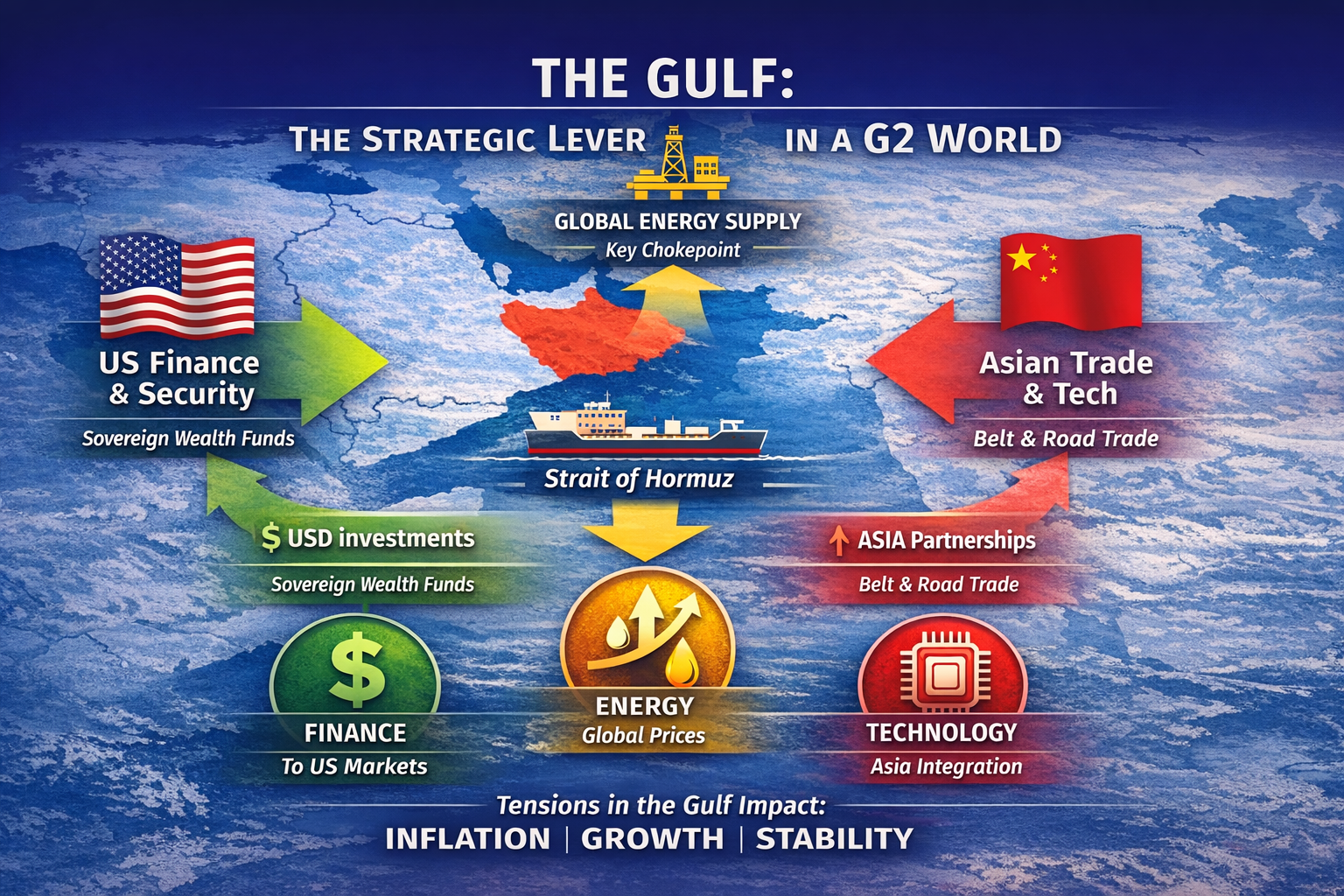
The Gulf states sit at the center of this transformation. Their financial balance sheets are deeply embedded in the US system, with vast holdings of US Treasuries, dollar-denominated assets, and investments routed through American capital markets via sovereign wealth funds. These assets provide liquidity and safety, but they also create exposure to US political and financial leverage.
At the same time, the future growth model of the Gulf increasingly points east. China has become the largest trading partner for most Gulf economies and a critical destination for energy exports. More importantly, Gulf capital is flowing into future-oriented sectors linked to Asian growth — manufacturing, logistics, AI, EV supply chains, and digital infrastructure — often within the framework of long-term Eurasian integration.
This creates a structural dependency trap: financial stability and security are anchored in the US system, while trade revenues and future growth increasingly depend on China and Asia. Escalation tightens this dilemma by raising the cost of hedging between systems that are becoming less compatible.
Iran Escalation as Structural Signal
Escalation involving Iran should therefore be read as more than regional brinkmanship. Persistent tension around Iran — and the implied vulnerability of the Strait of Hormuz — injects a geopolitical risk premium into global energy markets even in the absence of physical disruption.
For the Gulf states, the signal is a reminder that regional stability ultimately depends on US military and financial primacy, regardless of diversification strategies. But the audience for this signal extends well beyond the region.
Europe Is Also Being Addressed
Europe is a critical, often overlooked, recipient of this message.
Despite diversification efforts, the European Union remains structurally dependent on imported energy, a vulnerability that has deepened since the breakdown of its former energy relationship with Russia. In this environment, instability in the Middle East translates rapidly into higher prices, greater volatility, and inflationary pressure.
This matters precisely as Europe debates retaliatory tariffs, industrial subsidies, and regulatory measures aimed at asserting greater economic sovereignty.
Inflation as the Political Choke Point
Industrial policy is energy-intensive by definition. Advanced manufacturing, electrification, data centres, defence production, and digital infrastructure all require stable and affordable power. When energy prices rise, inflation becomes the political choke point through which strategic ambition is constrained.
Escalation around Iran functions as a pressure lever in this system. Higher energy risk premiums feed directly into inflation, eroding household purchasing power and destabilising governing coalitions. At that point, trade confrontation and regulatory divergence cease to be abstract policy tools and become immediate domestic liabilities.
From Inflation to Deindustrialisation
The strategic consequence is not merely inflation, but accelerating deindustrialisation risk.
Energy-intensive sectors in Europe are already under strain: chemicals and petrochemicals, steel and aluminium, fertilisers, cement, glass, paper — and increasingly “strategic industries” such as semiconductors, battery production, EV manufacturing, data centres, and defence supply chains. These sectors cannot absorb sustained energy price instability without losing competitiveness, cutting capacity, or relocating investment.
The implication is stark: an energy-constrained Europe cannot simultaneously pursue aggressive trade policy, ambitious industrial strategy, and domestic political stability. One of the three must give.
Rearmament Without Autonomy
Europe’s response to growing insecurity has increasingly focused on rearmament. Yet much of this effort deepens dependence on US-origin platforms, munitions, software, and sustainment systems. Capability may increase, but autonomy does not.
Rearmament conducted on a weakening industrial and energy base risks becoming an exercise in purchasing security rather than building it. Military power cannot be sustained without industrial depth, and industrial depth cannot survive without affordable and secure energy.
Eurasia, Chokepoints, and Global Value Chains
This dynamic is not confined to the Middle East. It is part of a broader Eurasian reconfiguration of global value chains, trade corridors, and energy flows. As supply chains shorten, securitise, and regionalise, chokepoints such as the Gulf, the Red Sea, and the Suez corridor regain strategic significance.
Energy, logistics, finance, and industrial capacity are no longer separable variables. They are components of a single system. Control over corridors and chokepoints increasingly substitutes for multilateral governance, narrowing the space for rules-based cooperation.
A System Under Strain
What is emerging is a new energy-power paradigm. Energy is no longer merely a commodity or a climate variable; it is a constraint on sovereignty itself. Financial systems, industrial policy, defence capability, and geopolitical alignment are increasingly shaped by exposure to energy volatility.
The Gulf states are responding with cautious diplomacy and strategic hedging — not out of indecision, but out of rational risk management. Europe, however, faces a more uncomfortable reality. Its strategic autonomy is bounded not only by alliances or trade relationships, but by structural energy dependence and industrial fragility.
Conclusion: The Material Foundations of Sovereignty
The question for Europe is therefore not whether it seeks strategic autonomy, but whether it is prepared to build the material foundations required to sustain it. Energy security, industrial capacity, defence credibility, and trade resilience cannot be pursued in isolation. They form a single strategic problem.
Understanding how regions like the Gulf shape this system is not optional. It is the starting point for any serious European strategy in a G2 world — and for any credible discussion of sovereignty in an era where power flows through systems rather than declarations.
Suggested Reading
System Foundations of the Energy–AI–Industrial Economy On why energy, industry, compute, and finance now operate as a single system.
Energy Sovereignty as System Control Global / Doctrines)
On why control over energy systems underpins all downstream sovereignty.Global Value Chains in an Energy-Bound World(Global / Energy)
On how energy costs and infrastructure shape production geography.Europe’s Energy Paradigm Shift(EU Sovereignty)
On Europe’s specific exposure to energy cost and infrastructure constraint. ### Energy as Power ArchitectureEnergy as the Operating System of Power The foundational thesis: energy as the organising substrate of modern economic and geopolitical power.
AI Energy Stress Test (Eu Sovereignty) ### Foundational Context
**Energy and the Base Layer of Constraint*(Systems under Constraint** Why energy re-emerged as the first binding constraint in the electrified economy.
Asymmetry Under Stress How constraint reveals differences in resilience, coordination capacity, and shock absorption. ### Transmission and Dependence
Decarbonisation as a Tech War Instrument (Tech War / Dynamics)
Downstream Implications
II. TECHWAR — Stack Fractures Under Constraint
These pieces show how energy constraint propagates upward into technology stacks and compute concentration.
Stack-Level Fractures in the Tech War How system dependencies fracture under pressure — and why energy stress cascades across layers.
Compute Locality in an Energy-Bound AI System Why AI infrastructure gravitates toward power stability and low marginal electricity cost.
III. EU SOVEREIGNTY — Constraint as Political Condition
These essays apply the Energy-Bound framework specifically to Europe’s structural position.
Energy as Europe’s Strategic Constraint Why energy marginal cost structure now defines Europe’s competitive ceiling.
Energy Sovereignty as System Control (EU) From fuel ownership to integration control: sovereignty as system design.
Europe’s Microprocessor and Energy Dependency Trap How compute dependency and energy cost structure interact as a failure mode.
Beyond Ideology — Foundational Doctrine
How Europe’s Political Lens Obscures Structural Realities in a Multipolar World
Sequencing, Deregulation, and the Political Economy of Exposure
IV. Boundaries — Social and Temporal Limits
Energy constraint is not only technical or geopolitical. It is social and institutional.
**The Legitimacy Boundary— Labour Markets and the Social Limits of Strategic Autonomy**
Democratic durability under transition stress.Legitimacy, Labour, and System Durability — Reference Index Consolidated essays on consent, affordability, and social absorption capacity.
EU Decisive Decade Time as constraint: irreversibility and strategic narrowing windows.
V. Doctrinal Extensions
These doctrine cards operationalise the Energy-Bound condition into actionable architectural principles.
- Mediterranean Decentralised Energy Doctrine Why fragmented geography and climate stress make decentralised electrification structurally optimal.