Europe — The Missing Conversion Layer
Why Europe Does Not Yet Convert Mediterranean Energy, Industry, and Capital into System Power
System Navigation
This article connects the Mediterranean system to Europe’s broader sovereignty problem and should be read alongside:
Keynote — Europe Has Assets, But Not Conversion
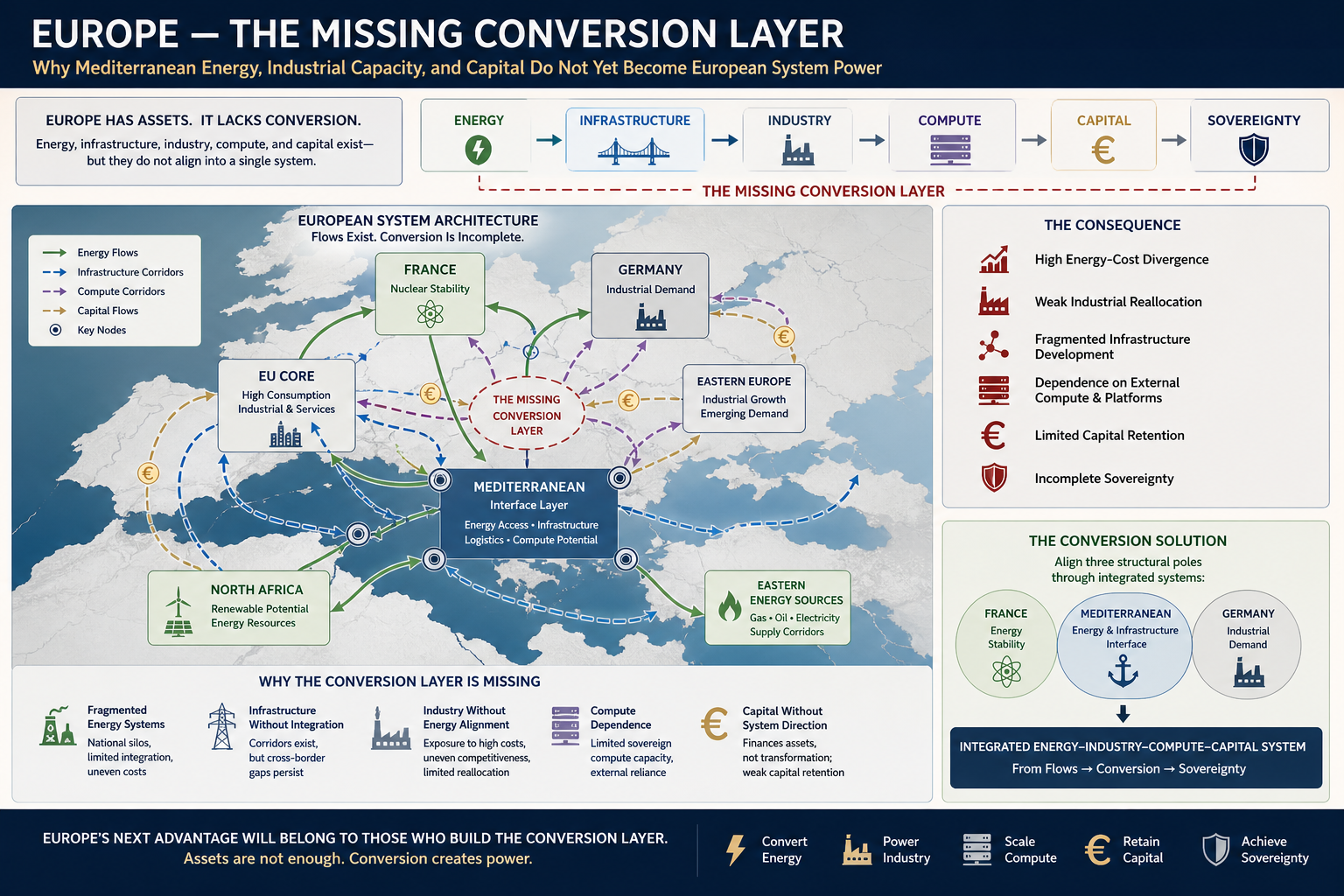
Europe does not lack strategic assets.
On the contrary, it possesses substantial capabilities across energy systems, industrial capacity, infrastructure, technology, and capital markets.
France provides nuclear baseload stability.
Germany retains deep industrial capacity and concentrated demand.
Spain is expanding renewable energy infrastructure at scale.
Italy maintains a diversified manufacturing system.
Greece occupies a critical corridor position within the
Mediterranean.
The Mediterranean itself connects Europe to external energy flows and
emerging infrastructure routes.
These elements exist simultaneously and within the same geographic system.
However, they do not yet operate as a unified continental structure.
Europe’s problem is not the absence of energy, industry, or capital.
It is the absence of a conversion layer capable of systematically connecting them.
Europe possesses components, but it does not yet possess a fully integrated system.
System Position — The Broken Chain
The system can be understood as a sequential chain:
Energy → Infrastructure → Industry → Compute → Capital → Sovereignty
Each stage in this chain converts one form of capacity into another form of power.
This logic is developed further in:
Europe participates in every stage of this process.
However, the transitions between stages remain incomplete, fragmented,
or unstable.
Energy systems remain largely organised at the national level.
Infrastructure integration remains uneven across borders.
Industrial capacity is distributed asymmetrically and exposed to
energy-cost divergence.
Compute infrastructure depends heavily on external platforms and
ecosystems.
Capital allocation is not consistently aligned with long-term
continental transformation.
As a result, Europe exhibits capacity at each layer, but does not achieve full system conversion across layers.
Core Mechanism — Fragmentation Between Layers
Europe’s structural weakness does not arise because the layers of the system are absent.
It arises because the relationships between these layers are not sufficiently coordinated within a coherent continental system.
Each layer functions according to its own institutional, economic, or
political logic.
However, these layers are not fully aligned with one another.
This fragmentation appears precisely at the point where conversion should occur.
This broader structural logic connects directly to:
1. Energy Without Continental Conversion
France contributes nuclear stability to the European energy
system.
Spain contributes large-scale renewable expansion.
The Mediterranean provides access to external energy flows, including
LNG and future renewable imports.
Despite this, Europe has not yet established a fully integrated continental energy system capable of delivering consistently competitive electricity costs across regions.
As a result, energy availability does not translate uniformly into industrial competitiveness.
Energy exists within the system, but it is not fully converted into a shared continental cost advantage.
Related reading:
2. Industry Without Energy Alignment
Germany and Italy retain substantial industrial capacity, including manufacturing depth, export capability, and industrial ecosystems.
However, industrial systems depend upon stable and competitively priced energy inputs.
When energy costs diverge across regions, industrial performance becomes uneven and, in some cases, structurally weakened.
Electrification, which is necessary for the next phase of industrial development, also progresses unevenly across Europe.
Industrial capacity remains present, but its energy foundation is not consistently aligned or stable.
Related reading:
3. Infrastructure Without System Integration
Europe possesses extensive infrastructure networks, including ports, pipelines, electricity interconnectors, transport corridors, and logistics systems.
These networks facilitate movement across the continent and between Europe and external regions.
However, infrastructure can facilitate movement across regions without necessarily producing coordinated industrial or strategic integration.
Without alignment between energy systems, industrial demand, compute infrastructure, and capital allocation, infrastructure remains a conduit rather than a conversion mechanism.
This becomes increasingly important as energy infrastructure, data infrastructure, compute deployment, and industrial systems converge into a single strategic layer.
Infrastructure enables flow, but it does not automatically generate system-level integration.
Related reading:
4. Capital Without System Direction
Europe has access to substantial pools of public and private capital.
However, capital allocation does not automatically align with long-term system transformation.
In the absence of strategic coordination, capital tends to finance isolated projects, fragmented assets, or short-term optimisation rather than integrated continental systems.
This limits the ability of capital to reinforce the full chain from energy to sovereignty.
Capital is present, but it is not consistently directed toward system conversion.
Related reading:
The Mediterranean Role — Europe’s Interface Layer
The Mediterranean should not be understood as a peripheral region within Europe.
It functions as a critical interface between Europe and external energy systems, infrastructure routes, industrial corridors, and emerging compute geography.
Through the Mediterranean, Europe connects to:
external energy inflows, including LNG and pipeline systems
North African renewable potential
maritime logistics and port infrastructure
industrial and infrastructure corridors
future energy–compute integration routes
This interface possesses strategic significance because it is the point at which external flows can potentially be integrated into the wider European system.
However, without a functioning conversion layer, these flows remain only partially utilised.
If conversion does not occur, the Mediterranean remains an interface.
If conversion is achieved, the Mediterranean becomes a platform for European system power.
This Mediterranean logic is developed further in:
France, Germany, and the Mediterranean — The Structural Alignment Problem
Europe’s broader system depends upon the alignment of three major structural poles.
France provides energy stability through nuclear generation.
Germany represents concentrated industrial demand and manufacturing
capacity.
The Mediterranean provides access to energy flows, infrastructure
positioning, and external connectivity.
Each of these poles performs a distinct strategic function.
However, their interaction is not yet fully coordinated within a unified continental architecture.
France’s energy stability is not fully transmitted across the
continent.
Germany’s industrial demand is not consistently matched with stable
low-cost energy.
The Mediterranean’s interface capacity is not fully integrated into
European industrial and capital systems.
System power emerges only when these structural poles operate within a shared conversion architecture.
France — The Continental Stabilisation Layer
France occupies a structural position within the European system that extends beyond conventional national energy capacity.
Its strategic importance does not arise solely from the scale of its nuclear infrastructure, but from its ability to function as a continental stabilisation layer within an increasingly energy-bound Europe.
This distinction is critical.
Europe’s broader structural challenge is not simply the production of
additional energy.
It is the ability to stabilise and coordinate the conversion chain
linking:
energy → infrastructure → industry → compute → capital → sovereignty
Within this chain, France performs a unique systemic function.
French nuclear continuity provides long-duration baseload stability inside a continental system increasingly exposed to energy volatility, fragmented electrification, and divergent regional cost structures.
As Europe electrifies industry, expands compute infrastructure, deploys artificial intelligence systems, and attempts to reduce strategic dependency, the importance of stable sovereign electricity increases substantially.
This is not merely an energy issue.
It is a system continuity issue.
Artificial intelligence infrastructure, advanced compute systems, industrial electrification, strategic manufacturing, transport electrification, and future continental grid integration all depend upon persistent and scalable electricity availability.
Under these conditions, France becomes more than a national energy actor.
It becomes a stabilising conversion core between Mediterranean energy geometry and continental industrial sovereignty.
This role becomes particularly important because the Mediterranean increasingly functions as Europe’s southern energy and infrastructure interface.
The Mediterranean connects Europe to:
external energy inflows
LNG systems
North African renewable potential
subsea infrastructure
maritime logistics
interconnector systems
and future energy–compute corridors
However, these flows do not automatically generate continental sovereignty.
Without stabilisation and conversion capacity inside the continental core, external energy access alone can still produce fragmentation, uneven industrial development, infrastructure asymmetry, and incomplete strategic integration.
France helps reduce this risk.
French nuclear infrastructure contributes not only electricity supply, but systemic continuity.
It provides:
baseload stabilisation
sovereign electrification continuity
long-duration grid reliability
industrial energy predictability
and a foundation for future compute localisation
This increasingly intersects with European AI sovereignty.
Large-scale compute systems cluster where electricity is simultaneously:
stable
scalable
predictable
and politically secure
As compute infrastructure, AI deployment, industrial systems, and energy networks converge into a unified strategic layer, France’s role inside the continental architecture expands accordingly.
This is why France should not be understood merely as another national energy profile within Europe.
Nor should it be understood purely through the framework of traditional industrial policy.
France functions as a continental stabilisation mechanism within the wider European conversion architecture.
Germany provides industrial density and manufacturing depth.
The Mediterranean provides energy interfaces, spatial corridors,
logistics, and external connectivity.
France provides stabilisation capacity across the electrified
continental core.
Only when these layers operate together does Europe begin to approach genuine system conversion.
In this sense, French nuclear continuity is not simply a national infrastructure asset.
It is part of the broader architecture required for European strategic continuity under energy constraint.
Without a functioning stabilisation layer, Mediterranean opportunity risks remaining regionally fragmented.
With such a layer, Mediterranean energy, infrastructure, and compute integration can begin to convert into continental-scale sovereignty.
Germany — Industrial Depth Without Conversion Sovereignty
Germany remains Europe’s central industrial platform, but its systemic position has changed.
Its strength was built on a model in which cheap external energy, dense manufacturing ecosystems, export competitiveness, engineering depth, and euro-area monetary stability reinforced one another. That model no longer operates under the same conditions.
In an energy-bound Europe, Germany still possesses industrial capacity, machinery ecosystems, automotive depth, chemicals, advanced manufacturing, Mittelstand networks, and export infrastructure. However, these assets no longer automatically convert into European system power because the energy-cost base, digital stack, compute layer, and capital-allocation architecture have shifted.
Germany therefore illustrates the central European conversion problem at the continental scale.
It possesses industrial depth, but that depth is increasingly constrained by energy prices, grid transition costs, dependence on external digital platforms, fragmented European capital markets, and insufficient sovereign control over AI compute and technological stacks.
The German problem is therefore not deindustrialisation alone.
It is the weakening of the conversion chain that once translated
industrial capacity into strategic autonomy.
Germany demonstrates that Europe cannot secure sovereignty through regulation alone, nor through industrial legacy alone.
Without an energy–compute–industrial conversion layer, even Europe’s strongest industrial base risks becoming structurally exposed.
This is why Germany must be understood alongside France and the Mediterranean.
France provides nuclear-state capacity and strategic
centralisation.
Germany provides industrial density and manufacturing depth.
The Mediterranean provides energy corridors, spatial capacity,
logistics, ports, grids, and future conversion geography.
None of these layers is sufficient independently.
Europe’s missing conversion layer is the architecture that connects them.
The strategic question is therefore not whether Germany remains
strong.
It does.
The question is whether German industrial capacity can be reconnected to a European system architecture capable of converting energy, infrastructure, compute, ecosystems, and capital into sovereignty.
This aligns with the broader doctrine that sovereignty has become systemic because power increasingly depends upon the capacity to govern interconnected layers of energy, infrastructure, compute, ecosystems, and capital rather than institutions alone.
System Consequence
In the absence of a functioning conversion layer, Europe experiences a series of reinforcing structural outcomes.
Energy-cost divergence persists across regions.
Industrial activity struggles to reallocate efficiently.
Infrastructure development remains fragmented.
Dependence on external compute and platform systems continues.
Capital formation increasingly occurs outside the European system.
Sovereignty remains incomplete.
These outcomes are not isolated problems.
They are interconnected consequences produced by a system that does not fully convert its own capacities into coordinated power.
Europe does not lack strategic objectives.
It lacks the architecture required to translate those objectives into system outcomes.
Global Context — Conversion Under a Shifting System
Europe’s internal structural challenges are unfolding within a rapidly changing global environment.
The energy transition is not occurring in isolation.
It is reshaping the global distribution of industrial capacity,
technological infrastructure, compute systems, and capital
formation.
Some systems continue to derive influence from fossil energy production and pricing power, while others are scaling through electrified infrastructure and low-cost electricity systems.
This divergence is already affecting:
where industrial activity concentrates
where compute infrastructure scales
where artificial intelligence systems cluster
and how global capital is allocated
Within this environment, the ability to convert internal capacity into integrated system power becomes increasingly time-sensitive.
Systems that successfully align energy, infrastructure, industry, compute, and capital gain cumulative advantages over time.
Systems that fail to achieve this alignment do not remain
neutral.
They experience increasing structural compression.
For Europe, this compression manifests through:
persistently higher energy costs relative to competitors
weakening or relocation of industrial activity
concentration of compute infrastructure outside Europe
outward movement of capital formation
rising fiscal pressure as public systems absorb structural gaps
The AI–Energy–Cost Chasm is therefore not only a European internal problem.
It is part of a broader global competitive dynamic that amplifies Europe’s structural vulnerabilities.
Related reading:
Implication — Delay Becomes Structural Loss
Within this global environment, time becomes a decisive strategic variable.
The longer Europe operates without a functioning conversion layer, the more difficult it becomes to reverse existing trajectories.
Industrial systems adapt to prevailing cost structures.
Compute infrastructure clusters where electricity is cheapest, most
abundant, and most stable.
Capital allocation patterns become increasingly entrenched over
time.
As these processes continue, the range of available strategic options narrows.
What appears initially as fragmentation gradually evolves into long-term structural positioning.
For this reason, the absence of a conversion layer should not be understood as a temporary inefficiency.
It is a structural constraint that becomes progressively more difficult to overcome as global systems continue to reorganise.
Strategic Implication
Europe’s next phase of development cannot rely solely upon:
climate targets
fiscal coordination mechanisms
industrial subsidies
or national-level energy strategies
These instruments remain necessary, but they are not sufficient on their own.
A system-level strategy is required.
A continental conversion architecture is required at the level of systems coordination.
Such a strategy must explicitly connect:
energy systems with industrial demand,
infrastructure with compute deployment,
and capital allocation with long-term continental integration.
The Mediterranean represents the most immediate and visible domain in which this alignment can potentially be constructed.
Related reading:
Link to Compute and AI
The next phase of industrial development is increasingly energy-bound.
Artificial intelligence and advanced compute systems require:
stable and scalable electricity supply
integrated infrastructure networks
coordinated capital investment
industrial ecosystem density
and proximity between compute infrastructure and industrial deployment
If Europe does not connect its energy systems to compute infrastructure and industrial ecosystems, these systems will continue to concentrate elsewhere.
In this sense, the missing conversion layer is also the missing layer of European AI sovereignty.
Related reading:
System Insight
Europe’s structural challenge is not fragmentation in a general sense.
It is fragmentation at the precise point where one layer of the system should convert into the next.
Energy does not consistently translate into industrial
advantage.
Industrial capacity does not consistently translate into capital
formation.
Capital does not consistently translate into sovereignty.
As a result, Europe repeatedly generates capacity without fully retaining system power.
Conclusion — Conversion Determines Sovereignty
The emerging global system increasingly rewards integration rather than isolated capability.
Energy alone is insufficient without infrastructure.
Infrastructure alone is insufficient without industrial alignment.
Industrial capacity alone is insufficient without compute
integration.
Capital alone is insufficient without strategic direction.
Sovereignty now depends upon the successful conversion of these layers into a coherent system architecture.
This is the central European challenge.
The Mediterranean represents the most visible interface through which such a conversion architecture could emerge.
The strategic issue is therefore no longer connectivity alone, but whether Europe can construct the conversion architecture necessary to transform connectivity into sovereign system capacity.
If Europe succeeds in aligning energy systems, infrastructure, industrial ecosystems, compute deployment, and capital allocation, the Mediterranean becomes more than a corridor or transit space.
It becomes the southern conversion layer of a sovereign continental system.
If this alignment fails to occur, Europe risks remaining structurally fragmented within an increasingly competitive and energy-bound global order.
The question is therefore no longer whether Europe possesses strategic assets.
The question is whether Europe can convert those assets into coordinated system power before structural divergence becomes permanent.