Stacks, Systems, and Sovereignty
Power, Governance, and Control in the Fourth Industrial Revolution
Executive Summary
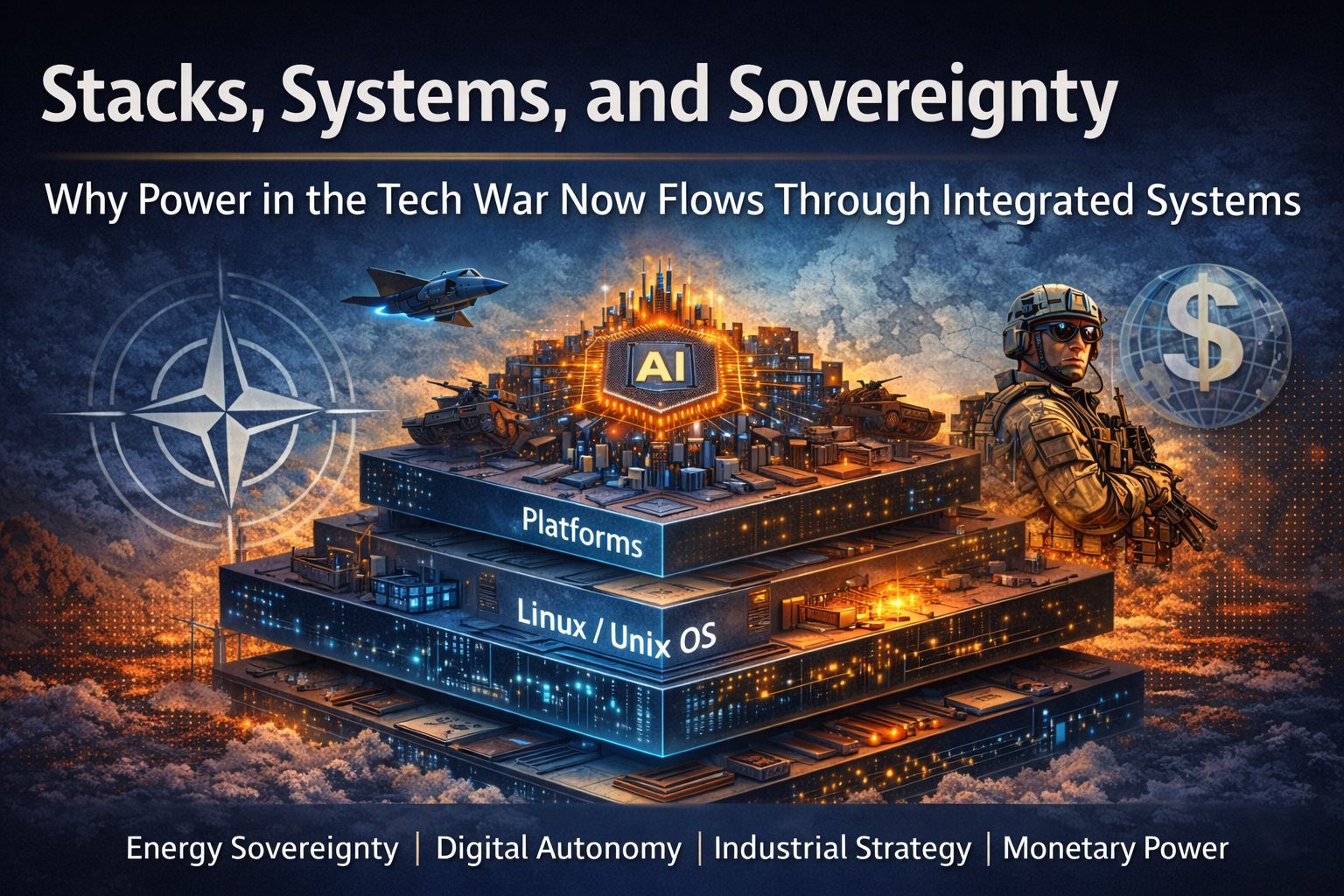
Technological competition in the Fourth Industrial Revolution is increasingly structured around systems rather than individual technologies. As energy, computation, data, platforms, and industrial capacity converge into integrated technology stacks, power now derives from the ability to control, operate, and scale these systems—often through foundational digital and energy infrastructure—under conditions of strategic pressure.
From a European policy perspective, this shift underscores the limits of sector-specific interventions. Strategic autonomy can no longer be achieved through energy, digital, industrial, or monetary policy in isolation, but depends on coordinated governance across the full technology stack, including foundational software, infrastructure standards, and system-level resilience.
At the same time, the global economy increasingly rests on shared technological foundations, particularly Unix- and Linux-based operating environments that underpin energy systems, cloud infrastructure, industrial automation, and digital finance. This creates a structural paradox: sovereignty is exercised at the system level, yet security and stability depend on multilateral governance of common foundations.
This article provides a system-level framework for understanding how sovereignty, power, and governance are being redefined in the Fourth Industrial Revolution—and why energy systems, operating systems, platforms, and monetary infrastructure must now be understood as a single, interdependent architecture.

Introduction: From Neutral Technology to System Power
For much of the modern era, technology was treated as modular, neutral, and separable from questions of sovereignty. States regulated sectors, firms innovated products, and infrastructure was assumed to be politically passive.
That assumption no longer holds.
In the Fourth Industrial Revolution, technology has become systemic. Power no longer flows primarily from invention or ownership, but from the capacity to design, integrate, and govern complex systems over time. As a result, sovereignty itself is being redefined—not as formal jurisdiction alone, but as operational control over the systems that sustain economic, industrial, and social life.
This systemic transformation lies at the core of the contemporary tech war.
From Modular Technologies to Integrated Stacks
Earlier industrial eras were characterised by separability. Energy systems, computing, communications, finance, and industry evolved along parallel but distinct trajectories. Dependence could be managed through trade, diversification, or regulation.
Today, these domains have collapsed into a single interdependent stack:
energy → compute → operating systems → data → platforms → industry → finance
Each layer depends on the integrity and controllability of the layers beneath it. Vulnerabilities propagate upward; control at the base amplifies power across the system.
This is why contemporary competition increasingly targets:
- infrastructure rather than applications
- platforms rather than products
- standards rather than features
- control layers rather than visible services
Technology is no longer a toolbox. It is a system of systems.
The Technology Stack as the New Unit of Power
In this environment, the relevant unit of competition is not the firm, the patent, or even the sector. It is the stack.
A sovereign technology stack exhibits four properties:
- Vertical integration across energy, compute, software, data, platforms, and industry
- Operational control over how systems are run, secured, and modified
- Resilience under stress, including sanctions, crises, and supply disruption
- Governability, meaning the ability to enforce rules, accountability, and public authority within the system
States and regions that lack these properties may remain technologically advanced, yet structurally dependent. They innovate, but within systems governed by others.
Sovereignty Revisited: Control, Not Ownership
This transformation forces a redefinition of sovereignty.
Traditional sovereignty focused on territory, legal authority, and regulation. In system-based economies, these remain necessary but insufficient.
Effective sovereignty now depends on control over operational layers, including:
- the software that governs infrastructure
- the data that informs decision-making
- the platforms that coordinate markets and behaviour
- the monetary and payment systems that underpin exchange
- the energy systems that power everything above
A state may own infrastructure yet lack sovereignty if the rules, updates, standards, or transaction validation mechanisms are externally governed.
This is why digital sovereignty, energy sovereignty, and monetary sovereignty increasingly converge. They are not separate policy domains, but interlocking layers of system control.
Energy as the Base Layer of the Fourth Industrial Revolution
At the foundation of every modern stack lies energy.
In earlier eras, energy was treated as a commodity. In the Fourth Industrial Revolution, energy systems have become digitally managed, software-defined, and data-rich. Electricity now powers data centres, AI training, cloud platforms, industrial automation, and digital finance simultaneously.
As energy systems decentralise and digitise, they become active system components, governed by software and platforms rather than passive inputs. Control over energy therefore means control over when, where, and under what conditions computation and industry can function.
Energy sovereignty is thus not a legacy concern—it is the base layer of technological, economic, and security power.
The Operating System as the Hidden Control Layer
Between energy-powered hardware and visible digital platforms lies a layer often overlooked in policy debates: the operating system and control layer.
Across data centres, telecom networks, energy systems, industrial control environments, cloud platforms, and increasingly financial infrastructure, this layer is overwhelmingly built on Unix-derived and Linux-based operating systems. These systems translate physical capacity into governable, programmable environments.
Operating systems define:
- security models and permissions
- update and patching mechanisms
- interoperability and standards compliance
- resource allocation and isolation
Because they sit beneath applications and platforms, they shape outcomes regardless of who controls the user interface. Technological dependence is therefore often embedded far deeper than visible services, residing in kernels, libraries, and orchestration tools that are extremely difficult to replace once deployed at scale.
Control of the OS layer is not a technical detail; it is an instrument of sovereignty.
[!Note] Compute scales through two architectures: - Centralised systems scale through infrastructure concentration - Decentralised systems scale through device distribution
See also: Decentralised Compute Architecture ### Open Technology and the Paradox of Shared Foundations
Open-source technologies—particularly Unix- and Linux-based systems—form the common substrate of the Fourth Industrial Revolution. They dominate cloud infrastructure, industrial systems, energy management, networking, and AI development worldwide.
Open technologies matter strategically because they:
- reduce single-vendor dependence
- enable auditability and long-term resilience
- allow systems to be adapted under stress
- support interoperability across borders and sectors
However, this creates a structural paradox.
Because critical global infrastructure rests on shared, open, interoperable foundations, no state can secure long-term sovereignty through unilateral control alone without risking fragmentation, instability, or systemic failure.
Global security in the Fourth Industrial Revolution therefore depends on multilateral governance of shared technological foundations—standards, protocols, open software, and core infrastructure—whose disruption would propagate across economies and alliances.
Strategic autonomy and global governance are not opposites. They are co-dependent conditions of system-level security.
Private Networks, Platforms, and the Challenge to the Nation-State
These dynamics extend beyond infrastructure into the monetary and governance domain.
Private digital networks—platform-based payment systems, cryptocurrencies, decentralised finance, and privately governed digital ecosystems—operate increasingly outside traditional state frameworks. While often framed as innovation, they effectively relocate core sovereign functions:
- currency issuance
- transaction validation
- financial oversight
- enforcement of legal and fiscal norms
When these functions migrate into privately governed platforms, accountability weakens and authority fragments. Over time, this risks creating parallel systems of economic coordination that bypass democratic institutions and rule-of-law frameworks, particularly in jurisdictions built on regulatory and legal consistency, such as the European Union.
Monetary sovereignty, like energy and digital sovereignty, is therefore inseparable from control over platform and protocol layers.
Divergent Stack Strategies: China, the United States, and Europe
China: Open Technology as Strategic Control
China has prioritised open technologies not primarily for ideological reasons, but for interoperability, control, and resilience. By anchoring infrastructure on open, Unix-derived systems, China reduces exposure to external chokepoints, enables integration across energy, industry, and data systems, and retains the ability to modify and govern core layers domestically. Open systems provide flexibility without surrendering strategic control.
United States: Platform Power on Open Foundations
The United States relies heavily on open-source foundations, particularly in cloud and digital infrastructure, but exercises power primarily at the platform and market layer. Open technology underpins U.S. dominance, yet governance remains largely private and market-driven rather than framed explicitly as sovereign stack construction.
European Union: Sovereignty Through Governance
Europe’s challenge is structural rather than conceptual. The EU must exercise system-level control across multiple sovereign states, regulatory regimes, and market structures. As a result, European sovereignty cannot be built through national stacks, but through collective governance of shared infrastructure, open standards, and foundational technologies. For Europe, sovereignty is inherently multilateral.
Implications for the Tech War
Viewed through a system lens, the tech war is not primarily about innovation races or product leadership. It is about architecture, governance, and endurance.
- Sanctions target stack chokepoints
- Export controls focus on foundational layers
- Industrial policy prioritises integration and resilience
- Monetary and digital policy increasingly overlap
The decisive question is no longer who innovates fastest, but who can govern systems over time without losing control or legitimacy.
Conclusion: Sovereignty in a World of Shared Systems
The Fourth Industrial Revolution has transformed technology from a neutral input into a strategic system. Power flows through integrated stacks that bind energy, computation, software, data, platforms, industry, and finance into a single operational whole.
In contemporary systems, sovereignty is exercised less through visible applications than through the control layers that govern how energy-powered infrastructure operates.
Yet because these systems rest on shared technological foundations, sovereignty in the Fourth Industrial Revolution cannot be exercised in isolation. It must coexist with multilateral governance capable of protecting the integrity of common substrates on which all states depend.
In this environment, sovereignty is no longer guaranteed by law or
territory alone.
It is earned through system control—and sustained through
collective stewardship.
Suggested Reading
- System Foundations of the Energy–AI–Industrial Economy
- Energy Sovereignty as System Control
- Monetary Sovereignty Under Constraint (EU Sovereignty)
- Capital Duration as System Power](Dynamics)