Apple, Industrial Ecosystems, and the Architecture of the Tech War
System Navigation
This article examines how Apple’s ecosystem architecture reflects the wider transformation of technological power under AI–energy conditions. It should be read alongside:
I. Physical Constraint and the Return of Industrial Power
For several decades, much of the digital economy appeared increasingly detached from the physical systems upon which industrial civilisation historically depended.
Globalisation, financial expansion, software scalability, and platform economics reinforced the perception that technological power could increasingly expand independently from geography, energy systems, industrial concentration, and material infrastructure.
The early internet era strengthened the belief that value creation was progressively migrating away from physical production and toward informational coordination.
Artificial intelligence initially appeared to reinforce this perception further.
AI was frequently presented as an infinitely scalable software phenomenon driven primarily by algorithms, data, and cloud infrastructure.
Yet the rapid expansion of artificial intelligence is increasingly revealing the opposite dynamic.
Under AI–energy conditions, technological power is becoming more physically constrained rather than less.
The scaling of computational systems increasingly depends upon electricity generation, transmission infrastructure, semiconductor fabrication, cooling systems, industrial manufacturing ecosystems, logistics capacity, strategic minerals, and sovereign infrastructure coordination.
This transition is re-materialising technological competition.
As computation becomes increasingly energy-intensive, the physical architecture supporting computational systems becomes strategically decisive.
The technological contest emerging between major powers therefore increasingly concerns the ability to integrate energy systems, industrial ecosystems, compute infrastructure, logistics systems, semiconductor capacity, and capital coordination within coherent sovereign architectures.
Under these conditions, technological systems can no longer be analysed primarily through software abstraction alone.
They must increasingly be analysed as physical stack architectures embedded within wider industrial, infrastructural, and geopolitical systems.
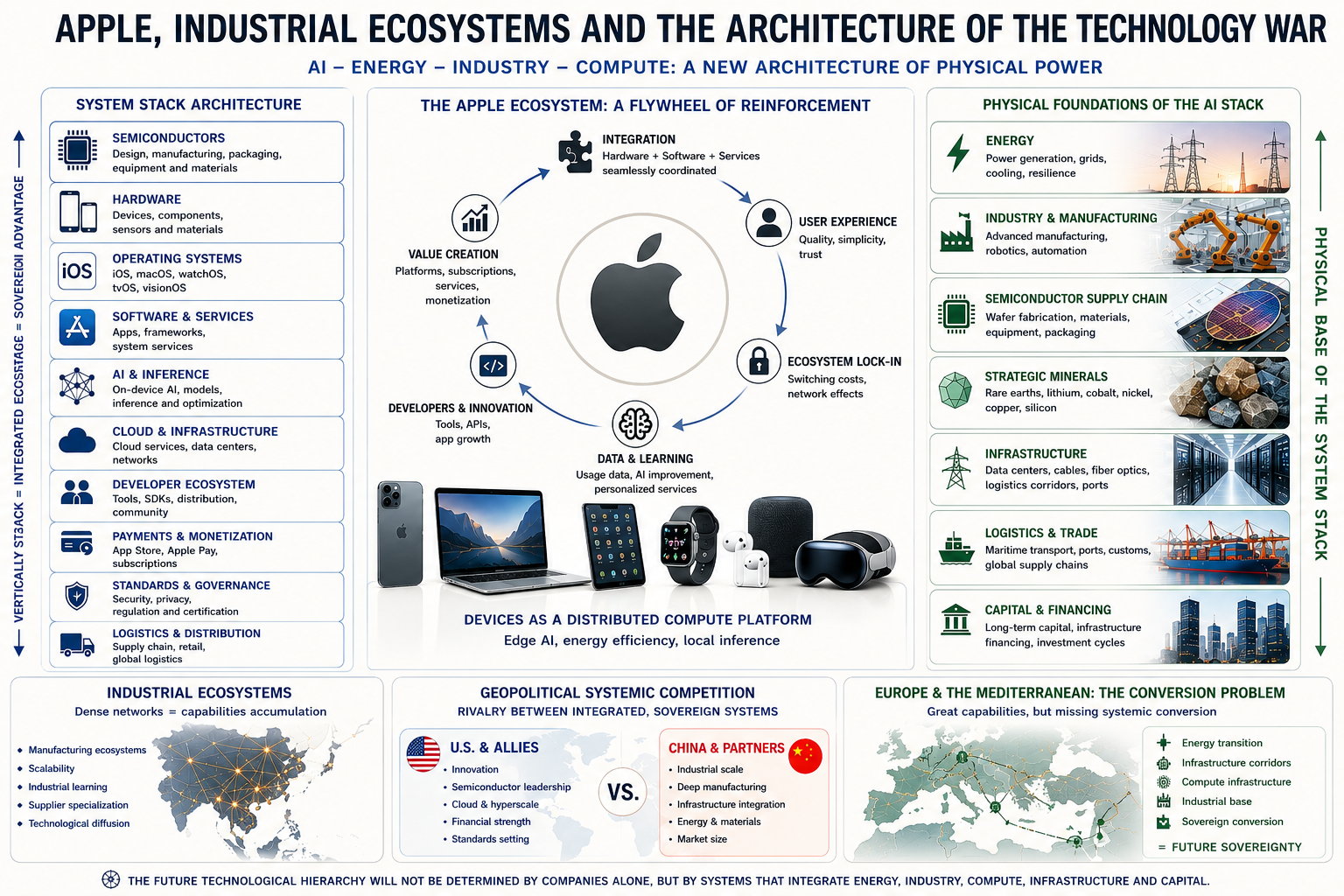
Within this transition, Apple represents more than a technology company.
It increasingly functions as a case study in ecosystem sovereignty operating across the energy–industry–compute stack.
II. Apple as Ecosystem Sovereignty
Apple’s strategic significance does not primarily derive from individual products.
Its importance derives from the architecture of integration that coordinates multiple technological layers within a tightly controlled ecosystem structure.
Apple simultaneously integrates semiconductor design, operating systems, hardware ecosystems, software ecosystems, AI inference layers, cloud coordination, logistics systems, developer ecosystems, standards governance, platform monetisation architectures, and increasingly localised compute capabilities.
This level of vertical integration increasingly matters under AI–energy conditions because technological competition is progressively shifting away from isolated products and toward integrated ecosystem architectures.
In earlier phases of globalisation, technological competition often focused on innovation at the level of individual firms or devices.
Under contemporary conditions, competitive advantage increasingly emerges from the ability to coordinate entire technological stacks across multiple system layers simultaneously.
Apple’s ecosystem demonstrates how control over hardware, software, semiconductors, operating systems, developer environments, cloud integration, distribution channels, and standards architectures can generate powerful forms of ecosystem lock-in and infrastructure coordination.
This architecture allows Apple to maintain unusually high levels of control across the full technological environment in which users, developers, applications, and services operate.
Under ecosystem sovereignty conditions, this form of integration becomes strategically significant because ecosystem coordination increasingly determines how computational systems scale, how industrial learning accumulates, how infrastructure dependencies form, and how economic value is captured.
The strategic importance of Apple therefore lies not only in commercial success, but in its demonstration of how vertically integrated ecosystems increasingly function as sovereignty architectures within the emerging technological order.
This broader transition is explored further in:
These analyses examine how integrated device ecosystems increasingly function not merely as commercial platforms, but as infrastructural governance systems embedded within the wider architecture of technological sovereignty.
III. Industrial Ecosystems and Capability Accumulation
Apple also occupies a central position within the history of global industrial transformation during the globalisation era.
Its supply-chain architecture contributed significantly to the concentration of advanced electronics manufacturing capacity inside China’s coastal production ecosystems.
Over time, these ecosystems evolved far beyond simple low-cost manufacturing platforms.
Dense production concentration generated powerful systems of industrial learning.
As suppliers, engineers, component manufacturers, logistics providers, and assembly systems clustered together geographically, the resulting ecosystems accelerated engineering adaptation, production iteration, tacit knowledge transfer, supplier specialisation, manufacturing flexibility, and industrial coordination.
These dynamics created powerful feedback loops capable of continuously compounding industrial capability.
Industrial ecosystems therefore functioned not merely as production zones, but as engines of technological accumulation.
This process illustrates one of the central structural dynamics of the globalisation era.
Global value chains did not merely distribute production geographically.
They redistributed industrial capability.
As advanced manufacturing ecosystems expanded, engineering expertise, process knowledge, supply-chain coordination capacity, and production specialisation increasingly accumulated within highly concentrated regional systems.
Over time, these capabilities diffused outward across adjacent sectors including semiconductors, batteries, telecommunications equipment, robotics, advanced electronics, and industrial automation systems.
This process helped support the emergence of China as a major technological-industrial power.
The broader implication is increasingly important under AI–energy conditions.
Technological leadership does not emerge solely from scientific invention.
It increasingly emerges from dense industrial ecosystems capable of integrating production, infrastructure, logistics, engineering, energy systems, semiconductor ecosystems, and compute architectures at scale.
Industrial ecosystems therefore become forms of strategic infrastructure.
The future technological hierarchy will increasingly depend upon which states and ecosystem architectures can successfully sustain dense industrial learning systems across the full physical AI stack.

IV. Distributed Compute and Energy-Constrained AI
Apple’s ecosystem architecture also reflects a broader transition occurring within computational geography.
For much of the cloud era, technological scaling depended heavily upon centralised hyperscale infrastructure.
Large data centres concentrated compute capacity within massive infrastructure clusters requiring enormous quantities of electricity, cooling systems, transmission infrastructure, and capital investment.
This model remains highly important for frontier AI training.
However, under AI–energy conditions, distributed compute architectures are becoming increasingly significant.
Apple’s ecosystem increasingly distributes computational capability directly across smartphones, laptops, tablets, wearables, and embedded systems.
This transition allows increasing amounts of AI inference and computational processing to occur locally rather than exclusively through remote cloud infrastructure.
The significance of this shift is not merely technological.
It is infrastructural and energetic.
Distributed inference architectures can reduce transmission load, latency dependence, hyperscale energy concentration, and reliance upon permanently centralised compute systems.
As artificial intelligence scales further, these distinctions increasingly become questions of energy architecture and sovereignty architecture rather than merely software design.
The convergence between edge AI, distributed compute, localised processing, semiconductor efficiency, and energy optimisation therefore becomes strategically significant.
Under energy-bound conditions, compute locality increasingly functions as a form of infrastructural resilience.
This transition also helps explain why hardware–software integration is becoming increasingly important within the AI era.
Apple Silicon illustrates how tightly integrated semiconductor design, operating-system optimisation, battery efficiency, thermal management, and localised AI inference can improve computational efficiency across distributed ecosystems.
This transition increasingly connects Apple to the wider strategic reorganisation of compute geography explored in:
The broader implication is that future technological competition may increasingly depend not only upon hyperscale concentration, but upon the ability to coordinate hybrid compute architectures combining centralised AI infrastructure, distributed edge computation, localised processing, and energy-efficient device ecosystems.
V. Stack Architectures and Platform Sovereignty
The emerging technological order increasingly operates through interconnected system stacks rather than isolated technological sectors.
Semiconductors, operating systems, cloud systems, AI models, industrial infrastructure, logistics systems, developer ecosystems, standards frameworks, payment architectures, and platform governance systems increasingly function as interdependent layers within larger sovereign architectures.
Apple’s ecosystem illustrates this transition clearly.
The company simultaneously operates across semiconductor stacks, operating-system stacks, cloud-device coordination layers, AI inference systems, developer ecosystems, payment infrastructures, hardware ecosystems, standards governance systems, and increasingly integrated edge-compute architectures.
This level of stack integration creates significant structural advantages.
Integrated ecosystems can coordinate optimisation simultaneously across multiple technological layers.
They can also accelerate ecosystem lock-in, strengthen standards control, improve interoperability, reinforce infrastructure dependency, and capture larger proportions of system-wide economic value.
Under ecosystem sovereignty conditions, platform governance therefore becomes inseparable from infrastructure governance.
The strategic issue is no longer simply who manufactures devices.
The deeper issue increasingly concerns who controls the architecture of the technological environments within which computation, communication, software deployment, payments, AI inference, and industrial coordination occur.
This transition also alters the relationship between capital and technological infrastructure.
Integrated platform ecosystems increasingly function not merely as technology environments, but as systems of capital concentration capable of capturing:
recurring platform rents,
developer dependency,
payment flows,
data concentration,
subscription ecosystems,
and standards leverage simultaneously.
Under AI–energy conditions, this increasingly allows ecosystem architectures to consolidate technological, infrastructural, and financial power within tightly integrated systems.
The broader structural implication is explored further in:
These analyses examine how AI scaling increasingly exposes the divergence between financialised digital abstraction and the underlying physical infrastructure systems upon which computational expansion ultimately depends.
Technological competition therefore increasingly resembles competition between integrated sovereign ecosystems rather than competition between individual firms alone.
VI. Strategic Minerals and the Physical AI Stack
The AI transition is also reconnecting advanced technological systems to underlying material infrastructures.
Semiconductor fabrication, AI hardware, batteries, cooling systems, electrical infrastructure, robotics systems, renewable-energy systems, transmission systems, and hyperscale compute infrastructures all depend increasingly upon concentrated ecosystems of strategic minerals and advanced industrial processing capacity.
Under these conditions, computation itself increasingly becomes physically embedded within wider industrial-material systems.
Apple’s ecosystem therefore cannot be understood solely through software or consumer-device analysis.
It is increasingly embedded within the wider physical AI stack that includes semiconductor fabrication systems, rare earth processing, electrical infrastructure, logistics corridors, advanced manufacturing ecosystems, mineral-processing systems, and strategic supply chains.
This transition reflects a wider structural shift within the global technological order.
Strategic minerals no longer function merely as commodities within industrial markets.
They increasingly function as foundational infrastructure inputs into computational civilisation itself.
The strategic issue therefore increasingly concerns control over integrated industrial ecosystems rather than simple ownership of raw materials.
This is one reason why technological sovereignty increasingly converges simultaneously with industrial sovereignty, energy sovereignty, infrastructure sovereignty, semiconductor sovereignty, and mineral-processing sovereignty.
As artificial intelligence expands, the future balance of technological power will increasingly depend not only upon algorithmic sophistication, but upon the ability to secure and coordinate the physical infrastructure layers supporting computation itself.
This broader physical transition is examined further in:
Together, these analyses explain how semiconductor systems, mineral-processing ecosystems, industrial manufacturing capacity, and energy infrastructures increasingly form the physical substrate of technological sovereignty.
VII. Europe, the Mediterranean, and the Conversion Problem
The emerging AI–energy order also creates major implications for Europe and the Mediterranean system.
Europe retains significant industrial capability, advanced research systems, engineering capacity, regulatory influence, and infrastructure sophistication.
However, Europe often struggles to convert these advantages into integrated sovereign technological ecosystems.
This increasingly represents a conversion problem rather than a purely innovation problem.
Under AI–energy conditions, technological power increasingly depends upon the ability to integrate energy systems, industrial ecosystems, compute infrastructure, logistics systems, semiconductor capacity, infrastructure financing, and sovereign coordination mechanisms.
The Mediterranean increasingly occupies a strategically important position within this transition.
The region functions simultaneously as an energy corridor, maritime infrastructure system, logistics interface, cable and transmission geography, and potential compute-infrastructure zone linking Europe, Africa, and the Middle East.
As AI infrastructure expands, geography increasingly matters again.
Energy availability, grid resilience, cooling capacity, subsea cable systems, industrial corridors, and infrastructure integration increasingly shape where computational systems can scale efficiently.
The Mediterranean therefore increasingly functions as a potential conversion interface connecting energy systems, industrial infrastructure, distributed compute architectures, logistics corridors, and European sovereignty capacity.
The central strategic question is whether Europe can successfully convert energy transition, infrastructure investment, industrial capability, and Mediterranean geography into sovereign ecosystem architectures capable of sustaining long-term technological power.
Without this conversion layer, Europe risks remaining dependent upon external ecosystem architectures despite retaining substantial industrial and infrastructural capacity.
This dependency increasingly extends beyond hardware or software procurement and into platform governance, operating-system dependency, cloud coordination, developer ecosystems, semiconductor ecosystems, and external stack architectures.
The broader European sovereignty implications are explored further in:
Together, these analyses examine how Europe’s long-term technological sovereignty increasingly depends upon its ability to transform infrastructure, energy systems, industrial geography, and digital ecosystems into coherent sovereign architectures rather than fragmented dependency layers.
VIII. Technological Competition as System Competition
The Tech War is often described as a competition over innovation, semiconductors, tariffs, or artificial intelligence models.
Yet the deeper structural contest increasingly concerns the organisation of entire sovereign systems.
The central issue is progressively becoming the ability to integrate energy, industry, computation, infrastructure, logistics, standards, ecosystems, finance, and capital coordination within scalable technological architectures.
Under AI–energy conditions, technological power increasingly emerges from system integration capacity rather than isolated technological breakthroughs alone.
This transition fundamentally alters the nature of sovereignty itself.
Economic power, industrial power, computational power, infrastructural power, platform power, and monetary power increasingly converge within integrated ecosystem architectures.
Apple therefore illustrates a wider systemic transformation.
The company represents not merely a successful platform or hardware manufacturer.
It represents a model of how technological ecosystems increasingly function as integrated sovereignty architectures inside the emerging energy–industry–compute order.
This broader transition is becoming increasingly visible across:
semiconductor ecosystems,
AI infrastructure systems,
cloud and edge architectures,
industrial manufacturing systems,
logistics corridors,
platform governance systems,
and sovereign energy infrastructures.
The future technological hierarchy will therefore likely be shaped less by isolated innovation and more by the ability of states, blocs, and ecosystem architectures to coordinate the full physical and computational infrastructure stack upon which artificial intelligence now depends.
Under these conditions, technological competition increasingly becomes a contest over:
industrial density,
energy availability,
compute geography,
infrastructure integration,
ecosystem coordination,
standards control,
and long-term capital allocation capacity.
The wider implication is increasingly clear.
Artificial intelligence is not simply creating a new software cycle.
It is restructuring the relationship between energy, industry, infrastructure, computation, capital, and sovereignty simultaneously.
The emerging technological order therefore increasingly resembles a competition between integrated civilisational systems rather than a conventional market competition between technology firms.
References
Patrick McGee — Apple in China: The Capture of the World’s Greatest Company (2025)
Gary Gereffi — research on Global Value Chains
AnnaLee Saxenian — regional innovation systems and industrial ecosystems
Chris Miller — Chip War
Jeffrey Ding — Technology and the Rise of Great Powers
Vaclav Smil — research on energy systems, industrial scaling, and material infrastructures