AI Energy Sovereignty (Meso)-Article II/III : The Missing Middle: GVCs, SMEs, and Ecosystems
Why Productivity Failed to Diffuse — and Why Europe Misread Its Own Strengths
Preface — The Layer Europe Dismantled
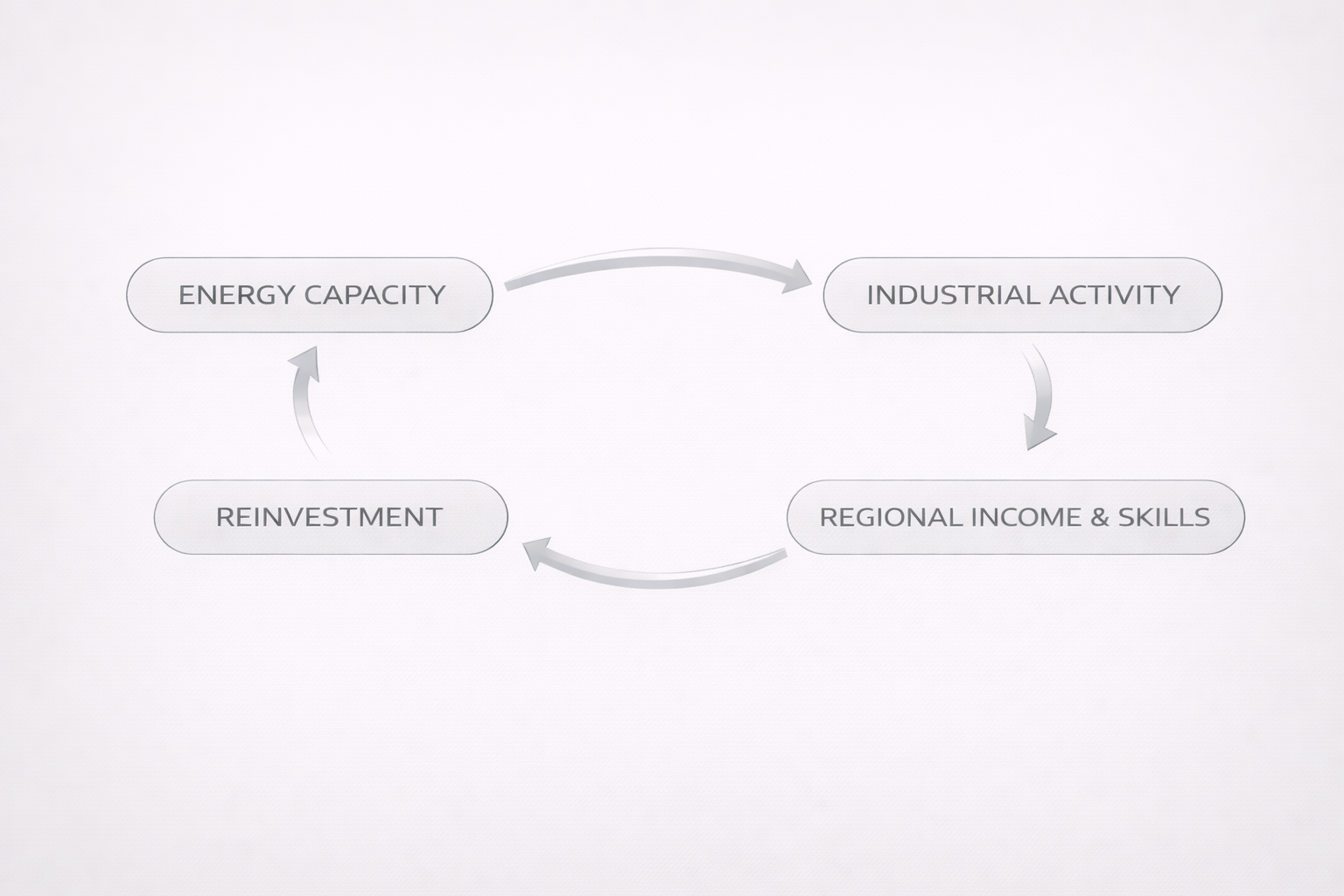
This article examines the ecosystem layer — the meso level between firms and states — where productivity either diffuses or concentrates. It focuses on how supplier density, financial allocation, interoperability, and learning time determine whether AI strengthens systems or fragments them.
Europe’s difficulty with AI, productivity, and the Fourth Industrial Revolution is routinely misdiagnosed. Debate oscillates between firms and states: adoption strategies on one side, sovereignty and geopolitics on the other. What is consistently missing is the layer in between.
That missing middle consists of ecosystems: SMEs, suppliers, skills pipelines, standards bodies, applied engineering cultures, infrastructure, and regional coordination. This layer is neither micro nor macro. It is the machinery through which productivity historically diffused.
Europe did not lose this machinery by accident. It was systematically thinned during the global value chain era, under a neo-liberal policy settlement that privileged capital mobility, cost efficiency, and abstract comparative advantage over ecosystem continuity. AI now exposes the consequences. Productivity does not diffuse where the mechanisms of diffusion have been dismantled.
1. Global Value Chains and the Original Learning Logic
Global value chains were not conceived as instruments of hollowing-out. Their original promise lay in learning and upgrading.
Early value-chain theory treated production networks as developmental structures. Firms entering a global chain could move from assembly toward process capability, quality control, and higher-value functions by meeting standards and absorbing know-how. Vertical specialisation was expected, over time, to generate horizontal specialisation within local and regional economies.
Multinational enterprises functioned as conduits of standards and demand. Technology transfer—formal and tacit—was understood as the engine of convergence. Integration into GVCs was promoted as a transitional phase toward industrial maturity, not permanent dependency.
This logic assumed time, sequencing, and institutional support. Those assumptions were later abandoned.
2. From Learning to Liquidity: When Capital Mobility Took Precedence
As GVCs became policy orthodoxy, learning was subordinated to capital efficiency.
Comparative advantage was treated as static. Efficiency was reduced to cost minimisation. Production was assumed to be modular, mobile, and endlessly substitutable. Ecosystems were treated as interchangeable.
At the same time, the monetary and financial economy consistently outperformed investment in the real economy. Asset inflation, financial intermediation, mergers and acquisitions, and global capital mobility delivered faster, higher, and more liquid returns than long-term investment in manufacturing, infrastructure, and skills.
Manufacturing ecosystems are slow, capital-intensive, and politically exposed. They tolerate early inefficiency and deliver returns over decades. Financial activities offered immediacy, leverage, and valuation gains. Capital flowed accordingly.
The result was a structural bias in allocation. Industrial depth underperformed financially even when it remained technologically viable. Ecosystems were dismantled not because they failed to innovate, but because they failed to compete with financial returns.
In effect, Europe experienced a financialised form of Dutch Disease: not natural resources, but monetary and financial returns crowded out productive investment. Under these incentives, deindustrialisation was not an anomaly; it was the rational outcome of a distorted return structure.
3. Deindustrialisation as Ecosystem Failure
At ecosystem level, production is not a collection of firms but a coordinated system in which failure can be productive if learning survives.
As lead firms offshored and vertically disintegrated, Europe lost more than employment. It lost supplier density, tacit production knowledge, applied engineering cultures, and the capacity to recompose after shocks. SMEs upgraded, automated, and specialised—and still disappeared—because learning horizons were longer than capital mobility.
Europe conflated firm upgrading with ecosystem resilience. Without coordination, upgrading firms do not produce durable systems.
4. Germany and the Politics of Capacity Injection
Germany’s post-reunification trajectory is often misread as organic resilience. In reality, it was the result of an extraordinary state-led injection of productive capacity.
The integration of the eastern Länder involved massive fiscal transfers, infrastructure build-out, capital stock renewal, and the extension of Western industrial and social institutions eastward. Germany tolerated inefficiency, over-investment, and long adjustment periods in order to rebuild ecosystems at scale.
This intervention preserved supplier networks, industrial coordination, and applied capabilities at precisely the moment when much of Europe was dismantling them. Convergence was uneven and costly, but the strategic outcome was decisive: ecosystem depth was retained.
Productivity diffusion followed investment and coordination, not market exposure alone.
5. SMEs, Failure, and the Time Constant of Learning
SMEs are the primary vessels of learning in advanced economies. Innovation diffuses through thousands of small experiments, most of which fail. This is not inefficiency; it is exploration.
The decisive distinction is whether failure remains productive.
Large firms can absorb prolonged loss-making phases. They refinance, cross-subsidise, and wait. SMEs cannot. For them, slow finance, slow permitting, slow infrastructure, and slow skills pipelines turn learning into extinction.
This makes time a strategic variable. Where capital, standards, energy, and infrastructure arrive slowly, the failure curve steepens. Ecosystems collapse before learning can accumulate.
Treating SME failure as neutral market selection accelerates concentration and dependency.
6. Interoperability, IP, and the Political Economy of Sequencing
Debates around intellectual property and technology transfer are often framed as moral disputes. This obscures how industrial systems actually develop.
China’s core industrial digital infrastructure has, for decades, been built largely on open, Unix-based and open-source architectures. This reflected a strategic priority: interoperability over enclosure.
The Fourth Industrial Revolution depends on system integration — machines, sensors, software, energy systems, logistics, and data flows operating together in real time. In such environments, closed proprietary systems increase friction. Open architectures lower coordination costs, accelerate diffusion, and allow ecosystems to form across firms and regions.
For most of its development trajectory, China treated technology transfer not as loss but as market creation. Building domestic markets, supplier networks, and value chains mattered more than extracting rents from intellectual property. Transfer of know-how was a precondition for scale.
This sequencing is critical.
In Beyond Ideology, I argue that the neo-liberal policy tradition that shaped the global value chain era elevated deregulation and exposure to first principles while underweighting sequencing and ecosystem consolidation.
The full argument is developed in Beyond Ideology Extended analysis on East Asian economies did not become “tiger economies” by dismantling buffers and exposing firms prematurely to global competition. They liberalised selectively and sequentially — after ecosystems had thickened, not before. Competition was introduced into strength, not fragility.
Europe, by contrast, dismantled its buffers early. Under the GVC model, exposure preceded consolidation. Ecosystems were thinned before learning stabilised.
The structural lesson is not ideological. It is temporal.
Premature enclosure strangles diffusion. Premature exposure accelerates collapse. In 4IR conditions, sequencing matters more than speed.
7. Rare Earths and the Geography of Capability
Rare Earth Elements are not scarce in geological terms. Their strategic significance lies in processing, separation, refining, environmental management, and the infrastructure required to integrate them into production systems.
Rare earths are therefore an ecosystem problem, not a resource problem.
China’s leverage derives from decades of investment in refining capacity, downstream manufacturing, and human expertise, both domestically and across Africa and Latin America. Under conventional capitalist return horizons, such systems appear unattractive: capital-intensive, environmentally costly, and slow to pay back. Strategically, they are foundational.
Access to materials without processing ecosystems produces dependency, not sovereignty.
8. 4IR and the Return of the Middle Layer
The Fourth Industrial Revolution is frequently reduced to AI. In reality, it is cyber-physical integration: AI, IoT, robotics, energy systems, materials, logistics, and real-time coordination.
Most of this integration occurs outside hyperscalers. It takes place in factories, workshops, grids, and supply chains—precisely where SME ecosystems matter.
AI amplifies ecosystems where they exist. It concentrates power where they do not.
Treating AI as an intangible substitute for industrial depth repeats the GVC error: abstraction over production, liquidity over learning, efficiency over endurance.
9. Europe’s Strategic Reframe
Europe’s dense SME landscape is often treated as a liability in a world of scale. Strategically, it is an asset—if ecosystems are allowed to function.
SMEs are flexible, adaptive, and close to physical systems. They are natural carriers of 4IR, provided the learning phase is survivable. That requires sequencing, speed, and coordination, not blind exposure.
Productivity does not diffuse firm by firm. It diffuses ecosystem by ecosystem. Markets alone do not build ecosystems.
Conclusion — Diffusion Is Not Automatic
Productivity does not spread because technology exists. It spreads because ecosystems carry it.
SMEs, supplier networks, standards bodies, financing structures, and regional coordination systems are the machinery through which learning compounds. When that machinery is dismantled, innovation concentrates. When time is compressed, failure cascades.
Europe did not lose productivity because its firms lacked intelligence. It lost diffusion capacity because it dismantled the structures that once absorbed learning shocks.
AI will amplify what exists. Where ecosystems are dense, productivity compounds. Where they are hollow, disruption deepens.
The question at the ecosystem level is structural:
Can Europe rebuild the middle layer through which productivity once flowed?
The answer depends on the layer beneath.
Bridge to Article III - From Ecosystems to Infrastructure
Ecosystems do not float above physical constraints.
Their survival depends on energy systems, grids, materials, and infrastructure capable of supporting electrified, compute-intensive industry.
The final article moves to this system layer — where AI becomes inseparable from energy capacity, infrastructure speed, and geopolitical power.
For the full framework AI Energy Sovereignty Stress Test
AI Energy System Architecture Index
EU_Energy_Exposure_Sov_Data_Companion