Operating Systems and System Control
Operating Systems as Governance Architectures for Computational Civilisation
System Navigation
This article forms part of the wider architecture linking energy systems, semiconductor ecosystems, compute infrastructure, orchestration power, digital ecosystems, and sovereignty under AI–energy conditions.
The contemporary system increasingly propagates through the following chain:
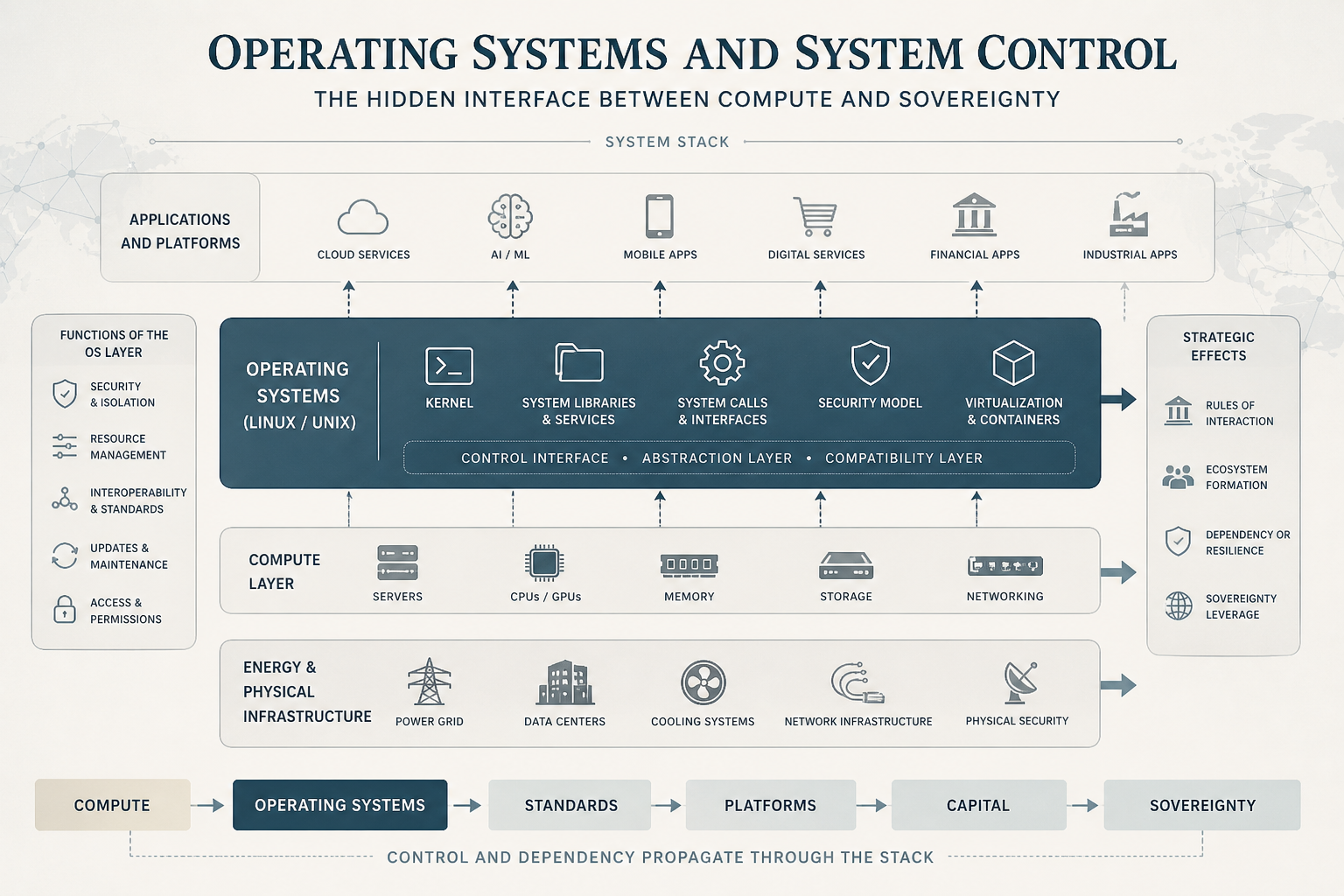
Energy → Infrastructure → Semiconductors → Compute → Operating Systems → Orchestration → Standards → Ecosystems → Platforms → Capital → Sovereignty
It should be read together with:
Keynote
Operating systems are often described as software environments that allow applications to run on hardware.
Under AI–energy conditions, this description has become increasingly incomplete.
The rapid expansion of artificial intelligence, hyperscale compute infrastructure, semiconductor dependency, cloud-native coordination systems, and distributed industrial automation is transforming the strategic meaning of the operating-system layer itself.
The AI transition is not reducing dependence on physical infrastructure.
It is intensifying it.
Artificial intelligence increasingly depends upon:
semiconductor fabrication,
energy systems,
electrical grids,
cooling infrastructure,
cloud environments,
orchestration systems,
transmission networks,
logistics systems,
industrial coordination,
and planetary-scale compute infrastructure.
Yet these systems cannot function coherently through hardware alone.
They require operational environments capable of governing execution, permissions, interoperability, scheduling, optimisation, identity, security, deployment, and ecosystem coordination across increasingly complex infrastructures.
The operating system sits at the centre of this coordination problem.
It mediates between:
hardware and software,
semiconductors and applications,
compute and orchestration,
infrastructure and ecosystems,
and increasingly between industrial systems and sovereignty itself.
This gives the operating-system layer significance far beyond software engineering.
Operating systems increasingly function as:
governance architectures through which physical compute becomes organised civilisation-scale coordination.
From Software Utility to Infrastructure Governance
Earlier phases of the digital era encouraged the perception that software systems existed independently from physical constraint.
Cloud computing, financial abstraction, mobile applications, and platform economics reinforced the assumption that digital scale could increasingly detach itself from geography, industrial systems, infrastructure density, and material dependency.
The AI transition is progressively reversing that assumption.
As computational intensity expands, software becomes increasingly reconnected to:
electricity systems,
semiconductor ecosystems,
strategic minerals,
cooling infrastructure,
logistics corridors,
transmission systems,
industrial automation,
and sovereign infrastructure capacity.
Under these conditions, the operating-system layer can no longer be understood merely as a software category.
It increasingly functions as an infrastructural governance layer coordinating the interaction between physical compute systems and wider digital ecosystems.
This transition fundamentally alters the geopolitical significance of operating systems.
The operating system no longer simply manages a device.
It increasingly governs how computational civilisation itself functions.
The Strategic Position of the Operating-System Layer
Within the contemporary system stack, the operating-system layer occupies a uniquely important position.
The stack increasingly functions through the following architecture:
Energy → Infrastructure → Semiconductors → Compute → Operating Systems → Orchestration → Standards → Ecosystems → Platforms → Capital → Sovereignty
This position gives the operating-system layer extraordinary strategic leverage because it translates raw compute capability into coordinated operational systems.
Without operating environments, compute infrastructure remains inert.
At the same time, operating systems do far more than simply activate hardware.
They increasingly govern:
how workloads execute,
how software environments interact,
how orchestration systems coordinate,
how developers build,
how ecosystems scale,
how standards propagate,
and how dependency structures become embedded within wider digital architectures.
This means the operating-system layer increasingly determines whether digital systems become:
sovereign or subordinate,
interoperable or captive,
distributed or centralised,
resilient or externally dependent.
The strategic importance of operating systems therefore derives not from software alone, but from their role in governing how computational systems become usable economic and geopolitical power.

Integrated Sovereignty and Closed-Stack Coordination
One strategic model attempts to maximise coherence through tightly integrated control.
The clearest example remains the Apple ecosystem.
Its power does not derive from software alone.
It derives from the integration of semiconductors, hardware, operating systems, developer frameworks, cloud services, application distribution, payments infrastructure, identity systems, and ecosystem governance within one coordinated architecture.
This produces:
high optimisation,
security coherence,
ecosystem discipline,
strong performance integration,
and durable user retention.
Yet this integration also centralises authority.
Within such systems, the operating-system layer increasingly functions simultaneously as:
a permissions architecture,
a standards architecture,
a distribution architecture,
an optimisation architecture,
and a capital-capture architecture.
The operating system therefore becomes inseparable from ecosystem governance itself.
Under vertically integrated models, software governance extends outward into industrial coordination, developer dependency, standards control, and long-term ecosystem leverage.
This is why closed-stack systems increasingly function not merely as products, but as:
sovereignty architectures embedded within digital ecosystems.
Semi-Open Systems and Conditional Autonomy
Other systems appear substantially more open.
Android represents the clearest example.
Its architecture permits broad hardware participation and wide-scale adoption across multiple manufacturers and regions.
Yet this openness remains structurally conditional.
The wider Android ecosystem continues to depend heavily upon Google-governed services, APIs, developer pathways, identity systems, distribution infrastructures, and ecosystem standards.
This produces a hybrid structure in which openness at one layer coexists with concentrated governance at another.
The result is not fully decentralised sovereignty.
It is:
distributed participation operating within externally governed ecosystem architecture.
This distinction is strategically important because openness at the hardware or device layer does not necessarily produce autonomy at the orchestration, standards, ecosystem, or deployment layers.
Under AI–energy conditions, partial openness can still coexist with highly concentrated systems of coordination and dependency.
Linux and the Infrastructure of Computational Civilisation
Linux represents a fundamentally different operating-system model.
Its significance derives not primarily from consumer visibility, but from its infrastructural role within global computational systems.
Linux increasingly underpins:
cloud infrastructure,
hyperscale compute,
AI training environments,
networking infrastructure,
telecommunications systems,
industrial systems,
robotics,
sovereign cloud initiatives,
embedded infrastructure,
supercomputing,
defence systems,
and distributed compute architectures.
This makes Linux one of the foundational infrastructural substrates of contemporary computational civilisation.
Its geopolitical importance lies in the fact that it demonstrates a critical structural reality:
infrastructural openness does not automatically dissolve concentrated power.
Much of the global cloud system operates on Linux foundations.
Yet the orchestration environments, hyperscale coordination systems, AI deployment infrastructures, cloud-native execution environments, and developer ecosystems operating above Linux remain increasingly concentrated within a relatively small number of hyperscalers.
This creates a hybrid structure in which distributed infrastructural openness coexists with concentrated orchestration power.
Linux therefore reveals one of the defining paradoxes of the AI era.
Distributed infrastructure and concentrated sovereignty can coexist simultaneously.
For this reason, Linux should not be understood merely as software.
It increasingly functions as geopolitical infrastructure embedded within the wider architecture of global compute systems.
Operating Systems and Orchestration Power
The AI transition is progressively extending the operating-system layer upward into orchestration architectures governing distributed computation itself.
In earlier digital environments, operating systems primarily coordinated applications running on individual devices or enterprise systems.
Under AI–energy conditions, operating systems increasingly underpin distributed orchestration systems spanning:
hyperscale AI clusters,
cloud-native environments,
container ecosystems,
edge-compute systems,
distributed inference systems,
industrial automation networks,
robotics infrastructures,
and machine-to-machine coordination architectures.
This transition changes the strategic meaning of the operating-system layer.
The key question is no longer simply:
Which operating system runs the machine?
The more important question increasingly becomes:
Which operational environment governs the execution architecture of computational civilisation?
This includes orchestration systems capable of governing:
workload distribution,
AI deployment,
distributed execution,
scheduling environments,
runtime governance,
infrastructure permissions,
cloud coordination,
API integration,
and GPU allocation across planetary-scale compute infrastructure.
Under these conditions, hyperscalers increasingly extend the operating-system layer upward into orchestration architectures governing AI deployment itself.
This transition is strategically critical because control over orchestration increasingly shapes:
AI deployment capability,
infrastructure leverage,
developer dependency,
standards propagation,
ecosystem gravity,
and sovereignty asymmetry across the wider stack.
The centre of gravity therefore shifts progressively upward from the operating-system kernel toward the orchestration environments layered above it.
Europe and the Operating-System Problem
Europe possesses substantial scientific capability, industrial infrastructure, engineering depth, and regulatory influence.
Yet Europe retains comparatively limited influence over the operating-system, orchestration, cloud-native, and AI deployment environments governing much of contemporary digital activity.
This creates a structural asymmetry.
Infrastructure may physically exist within Europe.
European regulation may shape market behaviour.
European energy systems may increasingly support local compute infrastructure.
Yet the underlying coordination architectures governing execution, orchestration, deployment, standards, and ecosystem gravity frequently remain externally controlled.
This means Europe risks becoming:
operationally integrated while remaining structurally subordinate.
The problem therefore extends beyond missing platforms or insufficient scale.
It increasingly reflects a missing infrastructure-governance layer within the wider European system architecture.
Without stronger positioning across the deeper layers of the stack, Europe risks participating within computational systems whose core operational logic remains governed elsewhere.
Sovereign Adaptation and Controlled Divergence
China increasingly demonstrates a different strategic pathway.
Rather than attempting complete technological isolation, China increasingly adapts open infrastructural systems into partially sovereign digital architectures aligned with national industrial objectives.
This frequently involves:
controlled adaptation of Linux-based systems,
sovereign cloud environments,
localised standards,
ecosystem substitution,
reduction of external dependencies,
and tighter integration between software governance and industrial strategy.
The objective is not necessarily total technological separation.
The objective is strategic reduction of vulnerability while preserving sufficient interoperability for industrial scaling and ecosystem continuity.
This model demonstrates that sovereign adaptation increasingly functions through selective divergence rather than complete decoupling.
At the same time, it also introduces risks associated with fragmentation, standards divergence, ecosystem bifurcation, maintenance burden, and reduced interoperability across wider digital systems.
The Mediterranean and Distributed Infrastructure Sovereignty
The Mediterranean increasingly occupies a strategic position within the emerging geography of AI infrastructure.
This transition is being driven by the convergence of:
energy corridors,
subsea cable systems,
electrical interconnectors,
distributed compute infrastructure,
logistics systems,
renewable-energy geography,
cloud expansion,
and AI deployment corridors.
Under AI–energy conditions, compute infrastructure increasingly follows energy availability, infrastructure stability, transmission integration, cooling potential, and connectivity density.
This progressively transforms the Mediterranean from a peripheral geography into a strategic infrastructure interface linking:
Europe,
Africa,
the Middle East,
energy systems,
compute corridors,
cloud infrastructure,
and distributed AI deployment environments.
Within this architecture, operating systems and orchestration environments become inseparable from physical infrastructure geography itself.
They increasingly function as governance layers coordinating distributed systems across:
ports,
grids,
edge-compute systems,
cloud corridors,
industrial clusters,
logistics infrastructure,
and energy-aware compute environments.
This matters because the future AI system will not function exclusively through centralised hyperscale concentration.
It will increasingly rely upon hybrid architectures combining:
hyperscale coordination,
distributed inference,
edge compute,
industrial automation,
and geographically distributed infrastructure systems.
The Mediterranean therefore increasingly functions as:
a distributed compute–energy coordination zone within the wider European conversion architecture.
Operating Systems and Sovereignty Propagation
The operating-system layer matters strategically because it determines whether digital activity compounds locally or leaks outward through externally governed infrastructure systems.
This affects:
industrial sovereignty,
AI deployment,
cloud dependence,
standards governance,
developer ecosystems,
infrastructure coordination,
capital formation,
and long-term geopolitical leverage.
Weakness at the operating-system and orchestration layers propagates upward into:
fragile ecosystem formation,
platform dependency,
infrastructure asymmetry,
capital leakage,
and strategic subordination.
Strength at these layers enables:
ecosystem compounding,
standards influence,
infrastructure integration,
developer retention,
sovereign deployment capacity,
and long-term system resilience.
The operating-system layer therefore functions as one of the principal propagation mechanisms through which sovereignty either consolidates or fragments across the wider stack.
Conclusion
Operating systems are no longer merely software environments.
Under AI–energy conditions, they increasingly function as governance architectures for computational civilisation itself.
They coordinate the interaction between:
semiconductors,
compute infrastructure,
orchestration systems,
AI deployment environments,
cloud-native coordination,
developer ecosystems,
industrial systems,
and sovereign infrastructure architectures.
This transforms the operating-system layer into a hidden constitutional architecture embedded within contemporary digital civilisation.
Its significance derives not simply from software capability, but from its role in governing how physical compute systems become organised political, economic, industrial, and geopolitical order.
Under these conditions, sovereignty no longer depends only upon ownership of infrastructure.
It increasingly depends upon governing the operational environments through which infrastructure becomes coordinated civilisation-scale power.
The operating system is one of those environments.
For that reason, it now belongs near the centre of geopolitical and infrastructural analysis rather than at the margins of software discussion.