Mediterranean Conversion Architecture
Energy, Compute, Infrastructure, and the System Conversion of the Mediterranean
System Navigation
This article connects the Mediterranean layer across:
GLOBAL
TECHWAR
EU SOVEREIGNTY
and should be read alongside:
Core Thesis
The Mediterranean question is no longer fundamentally a regional question.
It is increasingly becoming a systemic question concerning the future architecture of European sovereignty under conditions of energy constraint, AI-driven infrastructure expansion, industrial restructuring, and geopolitical fragmentation.
The Mediterranean possesses strategic geography, maritime depth, renewable-energy potential, logistical positioning, intercontinental connectivity, and growing infrastructure relevance.
Yet strategic geography alone does not generate sovereign power.
The decisive variable is conversion capacity.
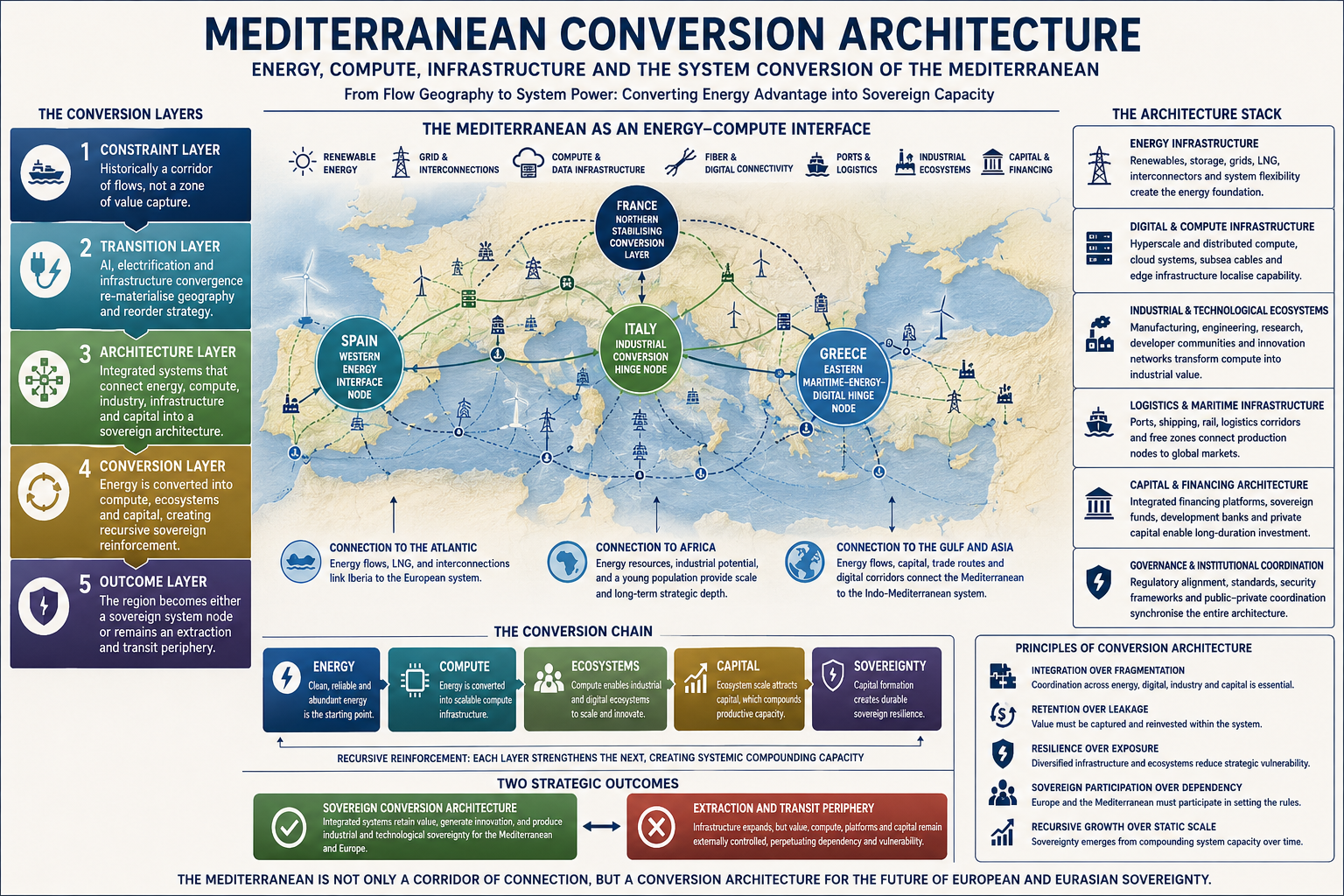
In the emerging energy-bound order, power increasingly derives not from the possession of isolated assets, but from the ability to coordinate interconnected systems capable of transforming energy into compute capacity, compute capacity into industrial ecosystems, industrial ecosystems into capital formation, and capital formation into durable sovereign resilience.
This is the central Mediterranean conversion problem.
Historically, the Mediterranean often functioned primarily as a corridor of circulation rather than a zone of systemic retention.
Energy flowed through the region.
Trade crossed it.
Shipping networks connected through it.
Tourism concentrated around it.
Capital entered intermittently.
Yet substantial portions of industrial scaling, technological orchestration, financial concentration, platform control, and ecosystem compounding accumulated elsewhere.
The Mediterranean therefore frequently generated connectivity without fully retaining the strategic value generated by that connectivity.
The emerging transition increasingly destabilises this historical model.
As artificial intelligence scales, electrification accelerates, compute infrastructure expands, industrial reshoring intensifies, and supply chains reorganise around resilience and energy availability, geography itself is being reordered through infrastructure density and conversion capability.
Under these conditions, the Mediterranean increasingly shifts from peripheral geography toward systemic interface.
The strategic question is therefore no longer whether the Mediterranean matters.
The strategic question is whether the Mediterranean can develop the conversion architecture necessary to transform structural position into sovereign system capacity.
I. From Flow Geography to Conversion Geography
For decades, large portions of the Mediterranean economy operated through flow-based integration into wider external systems.
Energy entered Europe through Mediterranean corridors, while higher-value industrial coordination and technological scaling often concentrated elsewhere.
Southern Europe participated in globalisation, but frequently through asymmetric structures in which:
infrastructure expanded faster than ecosystem density,
connectivity deepened faster than technological retention,
and capital inflows accumulated faster than sovereign productive compounding.
This asymmetry became increasingly visible after the financial crisis period, when several Mediterranean economies experienced simultaneous dependence upon:
external energy systems,
external financing conditions,
external technological infrastructure,
and externally concentrated digital platforms.
The result was not merely economic vulnerability.
It was incomplete system conversion.
The Mediterranean possessed infrastructure relevance without equivalent orchestration capacity across the wider stack.
The Fourth Industrial Revolution increasingly alters this equation because digital systems are becoming materially constrained.
Artificial intelligence, cloud systems, semiconductor scaling, compute localisation, industrial automation, and electrified infrastructure all require increasing concentrations of:
energy availability,
transmission capacity,
compute infrastructure,
cooling systems,
fibre connectivity,
industrial coordination,
and long-duration capital.
As these layers converge, infrastructure geography regains strategic importance.
The Mediterranean therefore becomes increasingly important not because geography suddenly matters again, but because geography never ceased to matter beneath the abstraction layers of the previous globalisation cycle.
The AI-energy transition is now re-materialising the system.
Infrastructure, electricity systems, logistics corridors, ports, grids, semiconductor supply chains, industrial ecosystems, and compute density increasingly determine where sovereign capacity can scale sustainably.
Under these conditions, the Mediterranean transitions from:
a circulation corridor
toward
a potential conversion architecture.
This transformation represents one of the most important structural shifts within the wider European system.
II. The Mediterranean as an Energy–Compute Interface
Artificial intelligence is often described primarily as a software revolution.
In practice, the AI transition increasingly behaves as an infrastructure revolution operating through enormous material requirements.
Large-scale computation depends simultaneously upon:
stable electricity systems,
scalable transmission networks,
semiconductor supply chains,
cooling infrastructure,
fibre connectivity,
industrial engineering capacity,
and deep capital intensity.
As AI systems scale, compute infrastructure increasingly localises around regions capable of coordinating these interconnected requirements efficiently.
This transformation directly alters the strategic meaning of the Mediterranean.
Southern Europe possesses several structural advantages under conditions of AI-energy convergence.
High solar potential, expanding interconnection systems, maritime infrastructure, subsea cable geography, proximity to African energy expansion, connectivity to Gulf capital flows, industrial manufacturing capability, and integration within European institutional systems collectively position the Mediterranean as a potentially critical infrastructure layer within the emerging AI economy.
However, structural advantage alone remains insufficient.
The Mediterranean simultaneously suffers from:
fragmented energy coordination,
uneven capital-market integration,
incomplete digital sovereignty,
limited hyperscale ecosystem density,
regulatory fragmentation,
and inconsistent industrial synchronisation across national systems.
This contradiction defines the central dialectic of the Mediterranean transition.
The region increasingly possesses strategic infrastructure relevance while simultaneously remaining vulnerable to external orchestration across compute, platform, semiconductor, and financial layers.
This distinction is decisive.
Infrastructure deployment alone does not generate sovereignty.
A region may host:
energy systems,
data centres,
cable landings,
logistics corridors,
and industrial facilities,
while still remaining structurally dependent if orchestration capacity, ecosystem density, capital formation, and technological governance remain externalised.
The Mediterranean transition therefore cannot be reduced to infrastructure expansion alone.
It increasingly concerns whether infrastructure becomes integrated into sovereign conversion architecture capable of retaining value recursively across the wider system stack.
III. The Architecture of Conversion
Mediterranean conversion architecture refers to the integrated coordination layer through which energy, infrastructure, compute systems, industrial ecosystems, and capital formation become synchronised into sovereign systemic capacity.
This architecture cannot emerge through isolated sectoral policy.
It requires cross-layer coordination capable of linking electricity systems, industrial infrastructure, digital ecosystems, financing mechanisms, logistics architecture, and technological deployment into a coherent strategic framework.
The energy layer forms the material base of this architecture.
Electricity generation, grid modernisation, interconnection systems, storage capacity, LNG infrastructure, and transmission resilience determine whether the Mediterranean possesses scalable energy availability under conditions of rising electrification and AI-driven demand growth.
Yet energy systems alone do not produce strategic autonomy.
Energy must be converted into compute capacity.
This requires integrated infrastructure architectures capable of supporting:
hyperscale compute,
distributed compute networks,
cloud infrastructure,
fibre corridors,
subsea cable systems,
semiconductor-linked logistics,
and edge deployment systems.
Compute infrastructure must then connect into industrial ecosystems capable of retaining productive value.
This increasingly requires manufacturing systems, engineering capacity, research institutions, developer ecosystems, logistics coordination, industrial SMEs, universities, and software ecosystems capable of operating as interconnected multipliers rather than isolated sectors.
The emerging order increasingly rewards ecosystem density rather than isolated productive capacity.
This distinction is central to the Mediterranean challenge.
Europe possesses substantial industrial, scientific, engineering, and infrastructural capabilities.
However, fragmentation across the wider stack often weakens recursive compounding capacity.
The problem is therefore not simply technological weakness.
It is incomplete cross-layer synchronisation.
Mediterranean conversion architecture attempts to solve precisely this problem by integrating:
energy systems,
compute infrastructure,
industrial ecosystems,
logistics coordination,
and capital formationinto interoperable sovereign architecture.
Under these conditions, sovereignty increasingly emerges not from isolated national assets alone, but from the coordination capacity of interconnected systems operating recursively across the full stack.
IV. Recursive Sovereignty and Ecosystem Density
The Mediterranean transition increasingly depends on whether infrastructure expansion produces recursive sovereign reinforcement or merely expanded systemic exposure.
This distinction sits at the centre of the emerging European transition.
In earlier industrial phases, infrastructure growth alone could generate substantial economic expansion because industrial systems remained comparatively linear.
The emerging AI-energy system behaves differently.
Infrastructure now operates through recursive interdependence.
Electricity systems affect compute scalability.
Compute infrastructure affects industrial coordination.
Industrial ecosystems affect capital retention.
Capital formation affects infrastructure financing capacity.
Infrastructure financing affects long-duration technological scaling.
Under these conditions, isolated infrastructure investment produces diminishing sovereign returns unless the surrounding ecosystem architecture scales simultaneously.
This is why ecosystem density becomes increasingly decisive.
Technological power no longer derives primarily from isolated productive assets.
It increasingly derives from the interaction between:
infrastructure systems,
developer ecosystems,
semiconductor access,
cloud orchestration,
industrial coordination,
logistics networks,
research capacity,
financing structures,
and institutional continuity.
The systems capable of synchronising these layers generate recursive reinforcement mechanisms through which each layer strengthens the next.
This recursive logic increasingly defines sovereign durability.
The United States retains structural advantage largely because hyperscale cloud systems, venture capital, semiconductor ecosystems, software infrastructure, research institutions, and platform coordination reinforce one another recursively across a unified ecosystem architecture.
China increasingly pursues a parallel form of recursive scaling through state-directed industrial coordination, infrastructure synchronisation, domestic ecosystem density, semiconductor localisation, and integrated platform expansion.
Europe possesses many of the individual components required for sovereign scaling, including industrial depth, scientific capability, infrastructure quality, engineering expertise, regulatory capacity, and energy-transition leadership.
However, Europe frequently struggles to synchronise these layers into coherent recursive architecture.
The Mediterranean reveals this challenge clearly.
Infrastructure expansion across Southern Europe often progresses faster than:
ecosystem retention,
compute sovereignty,
capital-market integration,
and technological orchestration.
This creates a structural asymmetry in which:
infrastructure scales,
connectivity deepens,
and energy capacity expands,
while substantial portions of platform control, compute concentration, financial capture, and technological governance remain externalised.
The Mediterranean conversion challenge therefore concerns retention as much as expansion.
Without retention mechanisms, infrastructure growth may increase dependency rather than sovereignty.
This is one of the defining contradictions of the contemporary transition.
V. Mediterranean Nodes and System Roles
The Mediterranean system does not operate as a uniform geographical block.
Different Mediterranean nodes perform distinct conversion functions within the wider European and Eurasian architecture.
These differences are not secondary.
They increasingly determine how sovereign capacity distributes across the wider regional system.
Spain increasingly functions as the western energy-interface node of the Mediterranean architecture.
Its strategic relevance derives from the interaction between renewable-energy expansion, LNG infrastructure, Atlantic connectivity, interconnection potential, and industrial positioning within the Iberian system.
Spain’s challenge is therefore not simply energy production.
Its deeper challenge concerns whether expanding energy capacity can become integrated into wider European compute, industrial, and ecosystem scaling rather than remaining partially isolated through interconnection limitations and fragmented continental coordination.
Italy functions increasingly as the primary industrial conversion hinge of the Mediterranean system.
Its importance derives from the interaction between:
industrial manufacturing depth,
engineering ecosystems,
logistics infrastructure,
energy exposure,
SME industrial density,
and strategic positioning within wider European supply chains.
Italy therefore occupies a uniquely important position within the Mediterranean transition because it represents one of the few Southern European systems possessing substantial industrial conversion capability across multiple layers simultaneously.
Its strategic role increasingly concerns whether industrial capacity can successfully synchronise with:
energy transition systems,
AI infrastructure,
compute deployment,
and sovereign capital formation.
Greece increasingly functions as the eastern maritime-energy-digital hinge node.
Its strategic relevance derives not merely from geography itself, but from its intersection with:
shipping systems,
subsea cable geography,
energy corridors,
logistics positioning,
Eastern Mediterranean infrastructure,
Gulf connectivity,
and emerging digital infrastructure routes linking Europe with Asia and the wider Indo-Mediterranean corridor.
Greece therefore increasingly operates as:
a transmission node between systems.
Its challenge concerns whether this transmission role remains externally orchestrated or evolves into sovereign conversion capacity capable of retaining ecosystem value internally.
France functions as the northern stabilising layer of the wider Mediterranean-European conversion architecture.
French nuclear baseload capacity, industrial scale, financing capability, institutional continuity, military-industrial infrastructure, and grid stability provide structural balancing capacity for the wider southern transition layer.
Without a stable northern conversion layer, Mediterranean infrastructure risks remaining disconnected from durable continental scaling mechanisms.
The Mediterranean therefore cannot be understood independently from wider European restructuring.
It increasingly functions as an integrated sovereignty interface connecting:
Europe,
Africa,
the Atlantic,
the Gulf,
and Eurasian infrastructure corridors simultaneously.
VI. Digital Sovereignty and Mediterranean Stack Formation
Digital sovereignty increasingly depends upon physical infrastructure coordination.
Cloud systems, AI infrastructure, edge compute, telecommunications systems, semiconductor logistics, cybersecurity architecture, and industrial software ecosystems all depend upon underlying energy systems, infrastructure resilience, and ecosystem density.
This increasingly transforms digital sovereignty into a material sovereignty question.
The Mediterranean therefore becomes progressively more important within the wider European digital architecture because it sits directly at the intersection of:
electricity systems,
subsea cable corridors,
maritime infrastructure,
logistics systems,
industrial reshoring,
and compute localisation.
This creates the conditions for Mediterranean stack formation.
Stack formation refers to the gradual integration of multiple system layers into coherent sovereign architecture capable of retaining value recursively across the full infrastructure chain.
This process increasingly requires synchronisation between:
electricity generation,
transmission systems,
compute infrastructure,
cloud architecture,
industrial production,
software ecosystems,
logistics coordination,
research systems,
and financing structures.
The Mediterranean transition remains incomplete precisely because these layers often continue to evolve asymmetrically.
Infrastructure expansion frequently outpaces ecosystem integration.
Digital connectivity frequently outpaces sovereign compute retention.
Energy deployment frequently outpaces industrial coordination.
This asymmetry creates a structurally unstable transition model.
The Mediterranean may become:
physically indispensable,
digitally connected,
and infrastructurally dense,
while still remaining externally orchestrated at the platform, compute, semiconductor, and capital layers.
Under such conditions, sovereignty remains incomplete despite infrastructure expansion.
Mediterranean conversion architecture therefore requires more than infrastructure quantity.
It requires orchestration architecture.
This increasingly means building:
sovereign compute coordination,
interoperable cloud ecosystems,
industrial software ecosystems,
regional developer density,
infrastructure financing continuity,
research integration,
and cross-border strategic synchronisation mechanisms.
Without these layers, infrastructure expansion alone risks reinforcing external dependency through technologically advanced forms of integration.
The Mediterranean question therefore increasingly concerns:
who governs the architecture of interdependence itself.
VII. Capital Architecture and the Problem of System Retention
The Mediterranean transition increasingly reveals that infrastructure expansion without capital retention produces structurally incomplete sovereignty.
Historically, many Mediterranean economies experienced recurring cycles in which infrastructure modernised, connectivity deepened, and external investment entered the region, while large portions of long-duration value capture accumulated elsewhere.
This pattern did not emerge accidentally.
It reflected the interaction between:
fragmented industrial coordination,
uneven financial depth,
external technological dependence,
limited ecosystem scaling,
and incomplete sovereign capital architecture.
Under the emerging AI-energy transition, these dynamics intensify because the infrastructure required for compute-era scaling is exceptionally capital intensive.
Artificial intelligence infrastructure requires simultaneous investment across:
electricity systems,
grid modernisation,
cooling infrastructure,
cloud systems,
fibre networks,
semiconductor-linked logistics,
industrial automation,
and software ecosystems.
These systems cannot scale sustainably through fragmented short-term financing structures alone.
They increasingly require:
long-duration investment horizons,
coordinated infrastructure financing,
industrial policy synchronisation,
sovereign strategic planning,
and ecosystem-oriented capital allocation.
This increasingly favours systems capable of integrating:
infrastructure,
industry,
compute,
and capital formationwithin coherent recursive architectures.
The Mediterranean therefore faces a structural divergence.
One trajectory leads toward infrastructure expansion without sovereign retention.
Under this model:
ports expand,
grids modernise,
energy corridors scale,
subsea cables multiply,
and data centres proliferate,
while orchestration capacity, compute governance, ecosystem control, and financial capture remain concentrated externally.
Under such conditions, Mediterranean infrastructure may become strategically important while Mediterranean sovereignty remains structurally constrained.
The alternative trajectory involves sovereign conversion architecture.
Under this model, infrastructure investment becomes synchronised with:
industrial scaling,
regional compute ecosystems,
sovereign financing mechanisms,
research integration,
developer ecosystems,
and technological retention strategies.
This creates recursive sovereign compounding.
Energy capacity supports compute infrastructure.
Compute infrastructure supports industrial ecosystems.
Industrial ecosystems support capital formation.
Capital formation reinforces infrastructure resilience and technological scaling.
The result is not merely economic growth.
It is sovereign reinforcement capacity.
This distinction increasingly determines which systems consolidate durable strategic autonomy under conditions of global fragmentation.
VIII. MECIP and the Logic of Coordinated Conversion
The Mediterranean Energy–Compute Investment Platform (MECIP) emerges directly from this structural requirement for coordinated conversion architecture.
MECIP should not be understood merely as an infrastructure-financing proposal.
It represents a systemic coordination framework designed to reduce fragmentation across the Mediterranean transition layer.
Historically, European governance often treated:
energy policy,
industrial policy,
digital policy,
infrastructure financing,
and capital-market development
as partially separate institutional domains.
The AI-energy transition increasingly renders this separation structurally obsolete.
Compute infrastructure now depends directly upon:
energy availability,
transmission capacity,
industrial coordination,
financing continuity,
semiconductor logistics,
and digital ecosystem integration.
As these layers converge, fragmented governance structures increasingly weaken sovereign scaling capacity.
MECIP therefore functions conceptually as:
a conversion coordination architecture.
Its strategic purpose is to synchronise:
energy systems,
compute infrastructure,
industrial ecosystems,
logistics networks,
subsea connectivity,
and financing mechanisms
into interoperable sovereign infrastructure.
This coordination logic becomes increasingly necessary because the Mediterranean transition is not fundamentally sectoral.
It is systemic.
The Mediterranean cannot successfully scale through isolated investments in:
energy,
data centres,
ports,
or digital infrastructure
if these systems remain disconnected from ecosystem formation and sovereign capital retention.
The central challenge is therefore not merely infrastructure deployment.
It is recursive coordination.
This distinction becomes critical under conditions in which:
compute demand accelerates,
energy systems face increasing strain,
industrial competition intensifies,
and geopolitical fragmentation deepens.
The systems capable of synchronising infrastructure layers into coherent conversion architecture increasingly consolidate disproportionate strategic advantage.
IX. Europe and the Missing Conversion Layer
The Mediterranean transition increasingly exposes a wider European structural problem.
Europe possesses:
advanced industrial capacity,
scientific depth,
engineering expertise,
infrastructure quality,
regulatory capability,
and substantial energy-transition leadership.
Yet Europe frequently struggles to convert these capabilities into durable system power across the full stack.
This problem increasingly concerns conversion rather than capability alone.
Europe often succeeds in:
infrastructure deployment,
industrial specialisation,
scientific production,
and regulatory coordination,
while struggling to retain:
platform power,
compute concentration,
ecosystem density,
software orchestration,
and capital compounding.
The Mediterranean makes this asymmetry visible because it sits directly at the convergence point of:
electrification,
logistics expansion,
compute localisation,
infrastructure scaling,
and industrial restructuring.
Energy enters the system.
Infrastructure expands.
Connectivity deepens.
Yet substantial portions of digital orchestration and ecosystem capture often remain concentrated externally.
This is Europe’s missing conversion layer.
Without coherent conversion architecture, Europe risks reproducing a structurally dependent model in which:
infrastructure scales physically,
energy systems expand,
AI deployment accelerates,
while strategic control over:
compute infrastructure,
platform ecosystems,
semiconductor coordination,
and recursive capital formation
remains externally concentrated.
Under such conditions, Europe may modernise technologically while weakening systemically.
The Mediterranean therefore increasingly functions as:
the test zone of European sovereign conversion.
If conversion succeeds, Southern Europe may become:
a sovereign infrastructure frontier,
a compute-interface layer,
an industrial reinforcement zone,
and a stabilising pillar of wider European resilience.
If conversion fails, the Mediterranean risks becoming:
an extraction corridor,
a digitally connected dependency zone,
and a strategically fragmented interface shaped primarily by external actors.
The Mediterranean question therefore increasingly concerns the future architecture of Europe itself.
X. AI Infrastructure, Compute Locality, and the Return of Material Sovereignty
The expansion of artificial intelligence increasingly transforms sovereignty into an infrastructural question.
Earlier phases of digital globalisation often created the perception that geography, energy systems, and industrial infrastructure were becoming progressively less important relative to software abstraction and platform scalability.
The AI transition increasingly reverses this perception.
Large-scale AI systems require extraordinary concentrations of:
electricity,
compute density,
cooling capacity,
fibre infrastructure,
semiconductor supply chains,
industrial engineering,
and capital intensity.
As a result, digital power increasingly re-materialises around infrastructure geography.
This transformation changes the strategic meaning of sovereignty itself.
Sovereignty increasingly depends not only upon legal authority or regulatory competence, but upon the capacity to coordinate the physical systems that sustain computation at scale.
Artificial intelligence therefore reconnects:
energy systems,
industrial systems,
infrastructure systems,
and digital systemsinto a unified material architecture of power.
The Mediterranean sits directly within this reorganisation.
Southern Europe increasingly occupies a strategic position because the region intersects:
renewable-energy expansion,
maritime infrastructure,
fibre connectivity,
intercontinental logistics,
industrial reshoring,
and subsea cable geography simultaneously.
This creates the conditions for compute localisation.
Compute localisation refers to the tendency of computational infrastructure to concentrate geographically around regions capable of supporting scalable energy and infrastructure coordination efficiently.
Under conditions of accelerating AI demand, compute no longer scales independently from:
electricity systems,
transmission capacity,
industrial infrastructure,
cooling availability,
and sovereign financing structures.
The Mediterranean therefore increasingly shifts from:
peripheral geography
toward
compute-interface geography.
Greece and Distributed Infrastructure Sovereignty
Greece increasingly illustrates how distributed infrastructure architectures may operate under conditions of AI–energy transition.
Its strategic relevance derives not only from geography itself, but from the interaction between:
- islanded energy systems,
- maritime routing,
- subsea cable geography,
- interconnector expansion,
- port infrastructure,
- decentralised renewable deployment,
- and emerging East Mediterranean digital corridors.
In the emerging compute era, infrastructure resilience increasingly favours distributed topology rather than excessive concentration.
This alters the strategic meaning of fragmented geography.
What previously appeared as peripheral dispersion can increasingly function as infrastructural redundancy, energy balancing capacity, maritime resilience and distributed compute optionality.
Greek geography therefore aligns unexpectedly well with several emerging requirements of the AI–energy transition:
- distributed energy production,
- edge compute deployment,
- subsea cable diversification,
- maritime infrastructure resilience,
- and interconnector-based balancing systems.
Under these conditions, Greece increasingly functions not simply as a peripheral European economy, but as a potential distributed infrastructure node within the wider Mediterranean conversion architecture.
This transition is explored further in:
→ Greece — Distributed Infrastructure Sovereignty
However, compute presence alone does not produce sovereignty.
This distinction is essential.
The Mediterranean may host:
data centres,
fibre corridors,
energy systems,
logistics infrastructure,
and AI deployment zones,
while still remaining structurally dependent if:
cloud orchestration,
semiconductor governance,
software ecosystems,
platform control,
and capital formation
remain externally concentrated.
The strategic issue is therefore not merely whether AI infrastructure enters the Mediterranean.
The strategic issue concerns whether the Mediterranean develops:
sovereign compute ecosystems
capable of retaining recursive value across the wider stack.
This increasingly requires:
interoperable cloud coordination,
industrial software ecosystems,
sovereign AI infrastructure layers,
developer density,
research integration,
semiconductor access,
and financing continuity.
Without these layers, AI infrastructure risks deepening dependency through technologically advanced forms of extraction.
The Mediterranean transition therefore increasingly concerns:
whether digital infrastructure becomes integrated into sovereign conversion architecture or remains subordinated to external platform systems.
XI. The Mediterranean as Europe’s Southern Conversion Layer
The Mediterranean increasingly functions as Europe’s southern conversion layer within the emerging energy-bound order.
This does not mean that Southern Europe replaces the northern industrial core.
Rather, the energy-compute transition increasingly redistributes strategic importance toward regions capable of supporting:
electrification,
infrastructure expansion,
AI scaling,
maritime connectivity,
and intercontinental coordination simultaneously.
The Mediterranean intersects multiple strategic systems at once.
It connects:
African energy expansion,
Gulf capital flows,
European industrial restructuring,
Indo-Mediterranean trade corridors,
Eurasian logistics systems,
and emerging global compute geography.
Very few regions operate simultaneously at the intersection of all these transitions.
This creates both exceptional opportunity and significant vulnerability.
Without coherent conversion architecture, the Mediterranean risks becoming:
an extraction interface,
a transit corridor,
and a strategically fragmented infrastructure surface
shaped primarily by external technological, financial, and geopolitical actors.
Under these conditions, infrastructure may scale while sovereignty weakens.
The Mediterranean could become:
energy-rich but externally orchestrated,
digitally connected but platform-dependent,
and infrastructurally dense but strategically incomplete.
The alternative trajectory involves sovereign conversion.
Under this model, the Mediterranean increasingly functions as:
a compute-interface system,
a sovereign infrastructure corridor,
an industrial reinforcement zone,
and a stabilising pillar of wider European resilience.
This transition requires more than regional development policy.
It requires systemic coordination capable of integrating:
energy systems,
compute infrastructure,
industrial ecosystems,
logistics architecture,
capital formation,
and governance coordination
into recursive sovereign architecture.
This is why the Mediterranean question increasingly becomes inseparable from the wider European sovereignty question.
Europe cannot successfully consolidate strategic autonomy while its southern infrastructure frontier remains only partially integrated into sovereign conversion architecture.
The Mediterranean therefore becomes:
not a peripheral extension of Europe,
but one of the principal locations through which the future structure of European sovereignty will be determined.
XII. Conclusion — From Geography to Sovereignty
The Mediterranean transition is ultimately a transition from geography toward architecture.
Strategic geography alone no longer guarantees durable power.
In the emerging system, power increasingly depends upon the capacity to transform geography into coordinated infrastructure systems capable of generating recursive sovereign reinforcement across multiple interconnected layers simultaneously.
The Mediterranean possesses:
energy potential,
maritime positioning,
logistical centrality,
industrial capability,
intercontinental connectivity,
and growing infrastructure relevance.
Yet these assets alone remain insufficient without conversion capacity.
The decisive variable increasingly becomes whether the region can synchronise:
energy,
infrastructure,
compute,
ecosystems,
capital,
and governanceinto coherent sovereign architecture.
This is the central Mediterranean challenge of the emerging era.
The transition now underway increasingly reorganises:
where computation scales,
where industrial ecosystems consolidate,
where infrastructure stabilises,
where capital compounds,
and where sovereign resilience ultimately accumulates.
Artificial intelligence, electrification, industrial restructuring, compute localisation, and geopolitical fragmentation are collectively transforming sovereignty itself into a systems-coordination problem.
Under these conditions, the Mediterranean increasingly emerges not as a peripheral regional category, but as a strategic conversion interface between:
Europe,
Africa,
the Atlantic,
the Gulf,
and the wider Eurasian system.
Its future therefore depends on whether infrastructure expansion remains fragmented across disconnected sectors, or becomes integrated into recursive conversion architecture capable of retaining strategic value internally across the full stack.
The Mediterranean question is therefore no longer simply:
whether the region possesses strategic relevance.
The Mediterranean question increasingly becomes:
whether the region can convert structural position into sovereign system power.
The answer to that question will increasingly shape the future architecture of Europe itself.