Stack-Level Fractures in the Tech War
System Stress, Control Layers, and the Architecture of Power
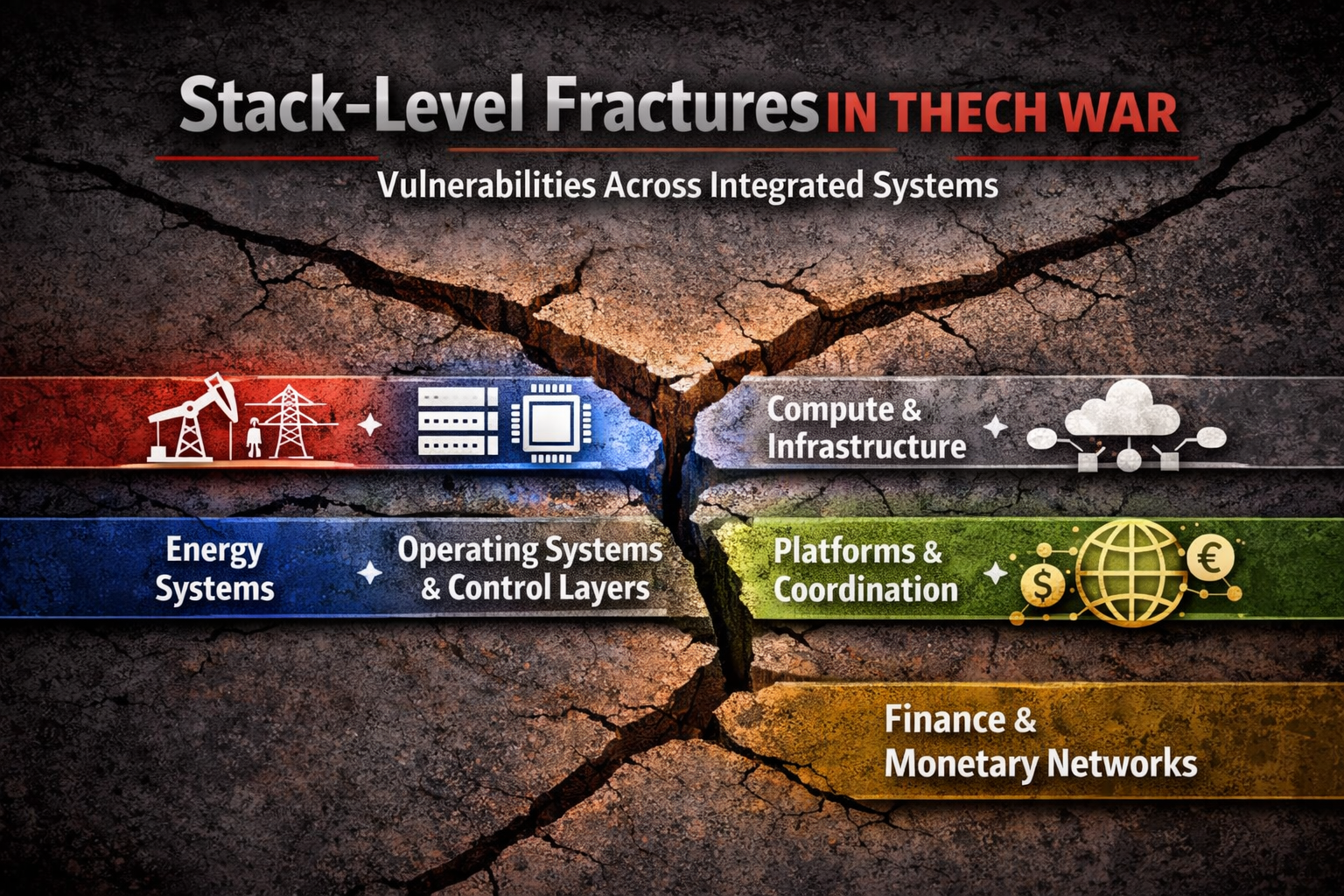
Keynote
Technological competition is no longer decided by innovation
speed.
It is decided by which systems fracture under pressure — and
which endure.
In integrated stacks, power resides not in products but in control over the layers through which energy, computation, coordination, and finance flow.
Sanctions, export controls, platform exclusion, and energy leverage succeed because they target structural dependencies. They do not destroy systems. They apply stress at fracture points.
The tech war is not a race.
It is a contest over system resilience.
Preface — From Innovation to Architecture
This paper does not evaluate technological leadership.
It examines structural exposure.
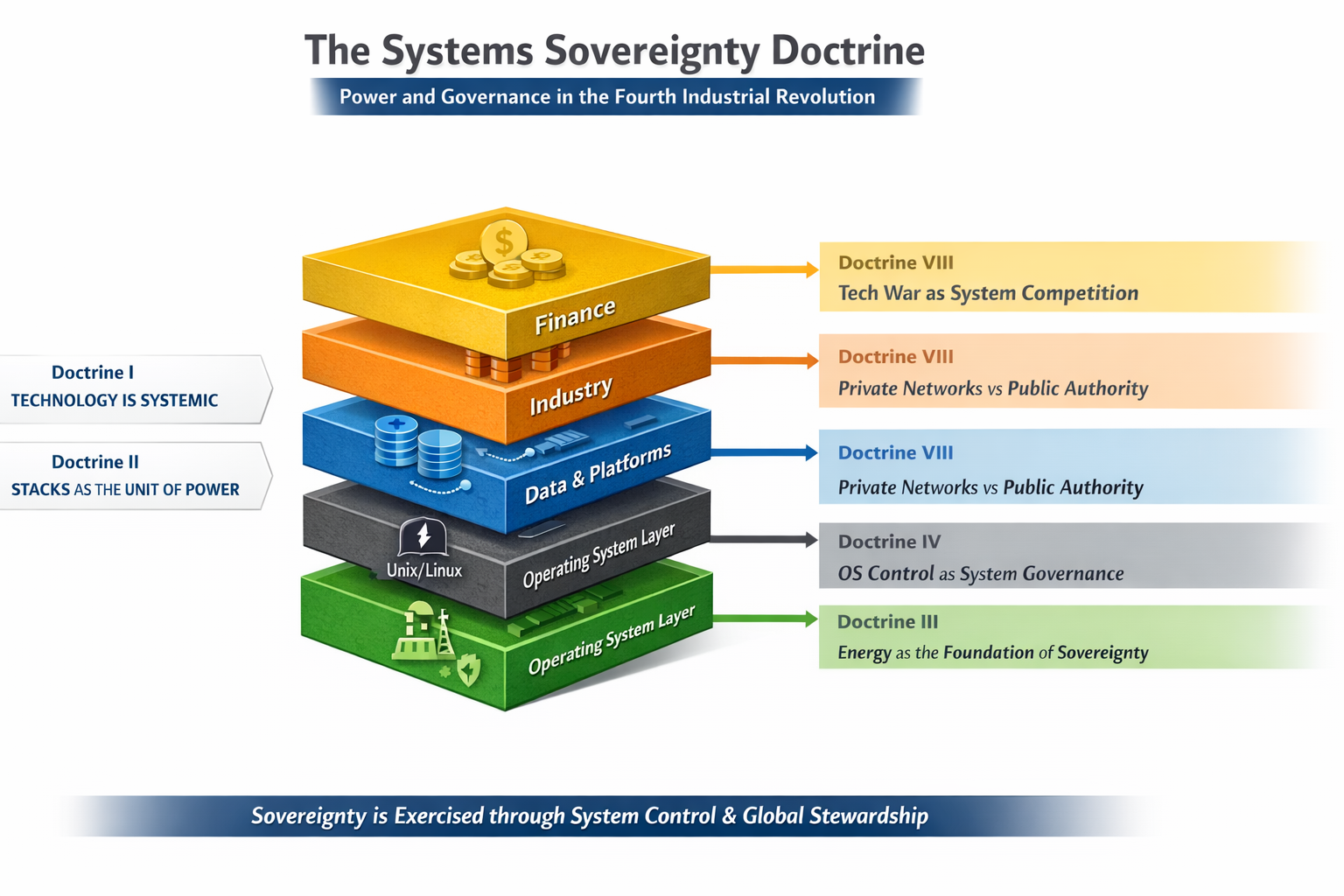
Modern power operates through tightly coupled stacks:
energy → compute → operating systems → data → platforms → industry → finance
These layers are interdependent.
Failure propagates upward.
Control concentrates at interfaces.
Where integration is deep but governance is fragmented, fracture risk increases.
Where integration and governance align, endurance increases.
The strategic variable is not invention.
It is architectural control.
I. Stack-Level Fractures
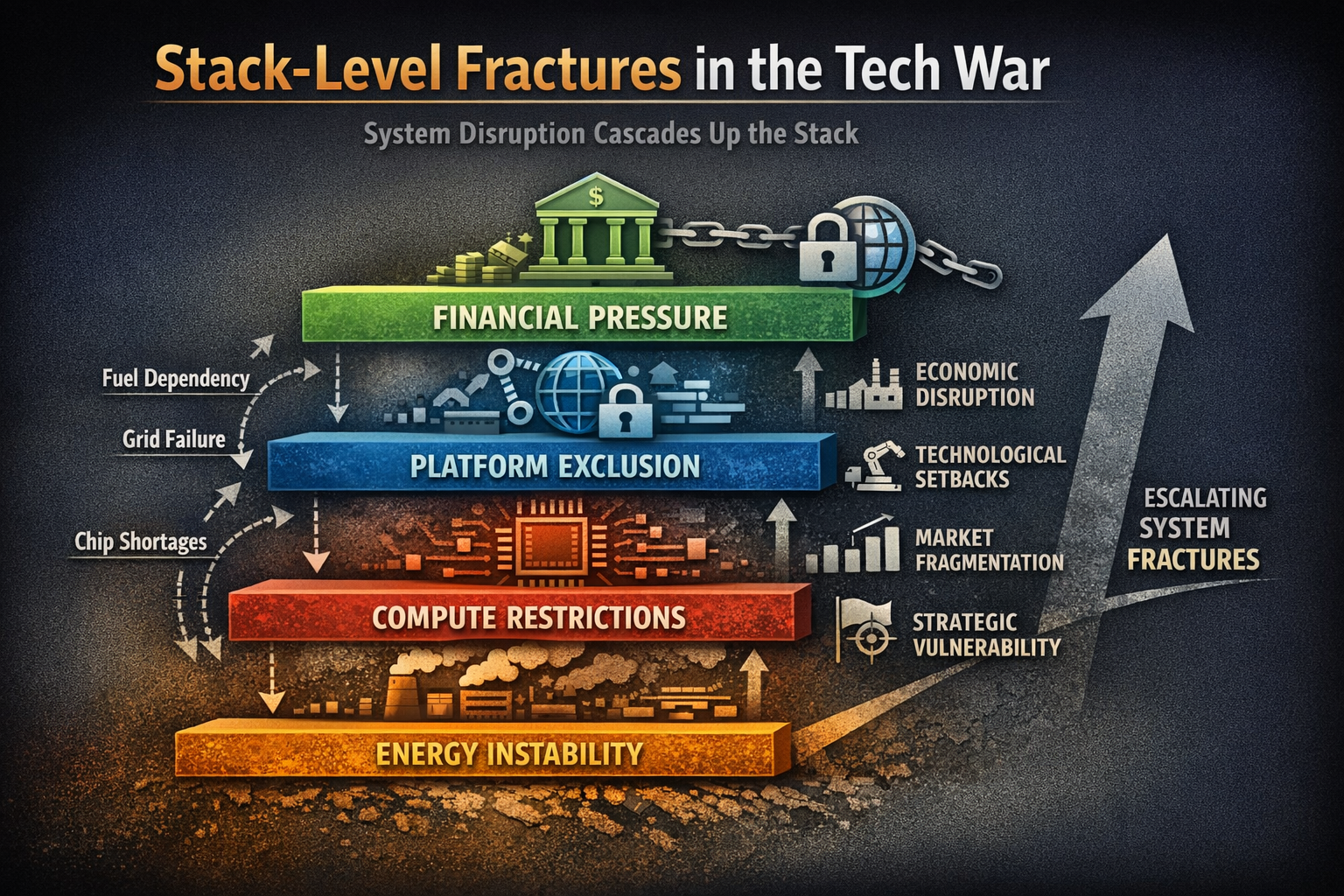
A stack-level fracture occurs when disruption or control at one layer cascades across the system.
Fractures emerge from:
dependency,
concentration,
coordination failure,
or externally applied constraint.
They convert technical vulnerability into strategic leverage.
In an integrated stack, no layer is isolated.
Energy instability constrains compute.
Compute limits constrain platforms.
Platform governance constrains markets.
Financial controls constrain sovereignty.
Fractures are therefore systemic phenomena.
They are predictable.
They are manageable.
They are exploitable.
II. Why Architecture Dominates Innovation
Innovation diffuses.
Architecture locks in.
A state or firm may lead in AI models, advanced robotics, or digital services and remain structurally constrained if it does not control:
energy systems,
semiconductor supply,
operating environments,
platform coordination layers,
monetary infrastructure.
Technological sophistication without stack control produces dependency.
The decisive variable is not frontier research.
It is the capacity to maintain system function under stress.
III. Structural Fracture Zones
Fractures cluster around foundational layers.
Energy
Energy is the base layer of modern power.
Electrified industry, AI training, data centres, grid automation, and digital finance are energy-intensive.
Fractures arise through:
fuel dependency,
price volatility,
grid instability,
software-mediated dispatch systems.
Energy shocks propagate across every upper layer.
Energy is no longer a sector.
It is the operating substrate.
Compute
Semiconductors, data centres, and networks define computational capacity.
Concentration in fabrication, hyperscale cloud dependency, and cross-border infrastructure exposure create structural chokepoints.
Control over compute determines who can scale artificial intelligence, coordinate industrial automation, and maintain digital sovereignty.
Operating Systems and Orchestration
Between hardware and platforms lies the orchestration layer — overwhelmingly Unix- and Linux-derived.
This layer governs:
update authority,
security enforcement,
interoperability,
system recovery.
Dependency here is embedded and durable.
Loss of control at this layer constrains sovereignty regardless of nominal infrastructure ownership.
Platforms
Platforms coordinate economic and social activity at scale.
They structure:
access,
standards,
participation,
data flows.
Because platforms sit between infrastructure and users, they enable non-territorial forms of power.
Exclusion at this layer can disable economic participation without physical confrontation.
Finance
Financial systems are programmable networks.
Settlement controls, sanctions enforcement, correspondent banking access, and digital payment infrastructures create monetary chokepoints.
Monetary sovereignty is not purely legal.
It is infrastructural.
When financial rails migrate into private or foreign-controlled systems, enforcement authority weakens.
IV. Fractures as Instruments of Power
Contemporary power instruments operate at fracture zones:
Sanctions exploit financial chokepoints.
Export controls target compute and foundational technologies.
Standards-setting embeds long-term dependency.
Platform exclusion restricts market access.
Energy leverage constrains industrial capacity.
These tools apply pressure at control layers.
Their objective is not destruction.
It is structural constraint.
V. Divergent Stack Architectures
Fracture exposure differs by system design.
China
China prioritises vertical integration.
Energy coordination, industrial policy, foundational software development, and platform governance are increasingly aligned.
The objective is internalised resilience and reduced external chokepoint exposure.
United States
The United States operates through layer dominance.
Platform ecosystems, financial infrastructure, semiconductor ecosystems, and standards institutions create leverage at upper control layers.
Rather than eliminating fractures, the U.S. system exploits them.
Europe
Europe possesses industrial capacity and regulatory authority but fragmented stack governance.
Energy coordination is uneven.
Hyperscale compute is externally concentrated.
Platform dominance lies elsewhere.
Financial infrastructure remains globally embedded.
Europe’s exposure is architectural.
Resilience therefore depends on coordinated stack governance rather than isolated innovation.
VI. Open Systems and Controlled Interdependence
Open technologies reduce certain fracture risks by:
limiting vendor lock-in,
enabling auditability,
supporting interoperability.
But openness reallocates risk toward:
maintenance gaps,
coordination failure,
governance fragmentation.
Open systems require structured stewardship.
Interdependence without governance produces fragility.
VII. Strategic Implications
If power operates through stacks, strategy must operate through stacks.
States must:
map fracture zones,
reduce foundational dependencies,
align energy and compute planning,
govern operating environments,
maintain monetary enforcement capacity,
coordinate resilience across borders.
Innovation remains necessary.
Endurance depends on structural coherence.
Conclusion — Power Under Pressure
The tech war is not fought at the frontier of invention.
It is fought at the seams of integration.
Stack-level fractures reveal where sovereignty is operational and where it is nominal. They explain how power can be exercised without occupation, how sanctions can outperform force, and why energy, computation, platforms, and finance now constitute a single strategic domain.
In the Fourth Industrial Revolution, power belongs to those who can sustain system function under sustained pressure.