Centralised vs Decentralised Compute — System Architectures of AI
Compute Topology, Energy Constraint, and the Fragmentation of AI Power
System Navigation
The system unfolds across three layers:
Constraint → Architecture → Sovereignty
Centralised vs Decentralised Compute
Keynote — AI Is Splitting Into Two System Architectures
AI is no longer scaling through a single infrastructural model.
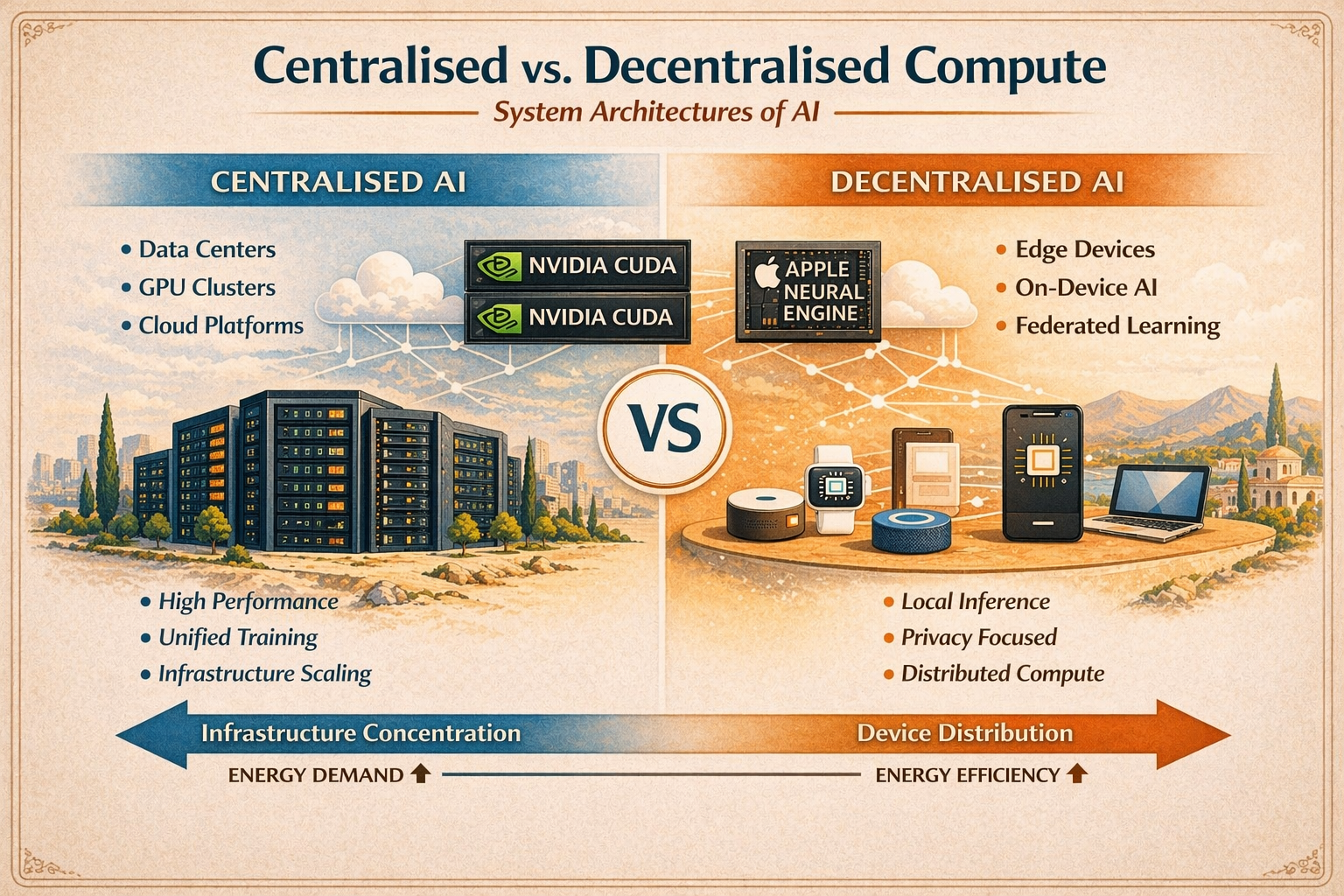
The compute layer is diverging into two distinct architectures:
Centralised compute systems
and
decentralised compute systems
This divergence is not simply technological.
It is energetic, infrastructural, geopolitical, and systemic.
The emerging AI economy is therefore not evolving toward one universal compute structure, but toward a layered and increasingly fragmented system in which different architectures optimise for different forms of scale, resilience, energy allocation, and sovereignty.
Under conditions of abundant capital and unconstrained energy, centralisation appeared structurally superior because concentration maximised computational intensity, model scale, and training efficiency.
Under energy constraint, however, the logic of scaling changes.
As electricity, infrastructure, cooling capacity, grid stability, and physical deployment limitations become binding constraints, distribution itself becomes strategically valuable.
The result is the emergence of a dual compute order.
The Centralised Compute Model
Infrastructure as the Core of AI Power
The first architecture is the hyperscale infrastructure model.
This system concentrates compute into massive clusters of energy-intensive infrastructure:
hyperscale data centres
GPU clusters
cloud infrastructure
AI training facilities
integrated networking systems
high-density power systems
This architecture is led primarily by:
NVIDIA
hyperscalers
cloud platforms
large-scale AI laboratories
Its scaling logic is straightforward:
Concentrate compute
→ maximise model capability
→ scale through infrastructure expansion
This model dominates:
frontier model training
large-scale simulation
foundational AI systems
centralised orchestration
high-performance compute-intensive tasks
The centralised model therefore treats infrastructure itself as the primary source of AI power.
The Decentralised Compute Model
Distribution as a Scaling Architecture
The second architecture distributes intelligence across devices rather than concentrating it inside hyperscale infrastructure.
This model relies on:
edge devices
local inference
embedded AI
operating-system-level integration
distributed processing networks
device ecosystems
Rather than scaling through infrastructure concentration, decentralised systems scale through proliferation.
Their logic is fundamentally different:
Distribute compute
→ embed intelligence locally
→ scale through network distribution
This model is most visibly associated with:
Apple
edge AI ecosystems
mobile compute systems
distributed device architectures
The importance of this architecture is not that it replaces hyperscale systems.
It does not.
Its importance lies in the fact that it solves different problems under different constraints.
Energy Constraint — The Structural Divider
AI Has Become Physical
The divergence between these architectures becomes clear only when AI is understood as a physical system rather than a purely digital one.
AI scaling is now constrained by:
electricity availability
grid stability
cooling systems
transmission infrastructure
semiconductor supply chains
physical deployment capacity
This is the core logic of the:
Under this framework, compute is no longer limited primarily by software capability.
It is limited by the ability to sustain physical scaling under energy and infrastructure pressure.
Centralised Systems Under Constraint
Centralised AI systems require:
concentrated electricity demand
large-scale cooling
uninterrupted grid access
infrastructure density
massive capital expenditure
As AI scales, these systems increasingly encounter:
grid bottlenecks
energy pricing volatility
infrastructure delays
transmission constraints
political resistance to energy-intensive buildouts
The constraint therefore becomes:
not whether compute can scale,
but whether concentrated infrastructure can scale fast enough and cheaply enough
This transforms energy geography into a strategic determinant of AI power.
Decentralised Systems Under Constraint
Decentralised systems operate differently.
Rather than concentrating energy consumption into singular infrastructure nodes, they distribute compute across already-deployed devices.
This creates several structural advantages:
lower marginal infrastructure demand
distributed energy utilisation
reduced transmission dependence
local processing capability
resilience through redundancy
The scaling logic therefore changes from:
infrastructure concentration
to:
infrastructure distribution
Under energy constraint, this becomes increasingly important.
Distribution does not maximise raw computational intensity.
But it does improve systemic resilience.
Compute Geography and Sovereignty
AI Infrastructure Is Geographic
The compute layer is becoming geographically uneven.
Centralised AI systems cluster around regions capable of supporting:
massive electricity generation
stable grids
water availability
semiconductor ecosystems
hyperscale infrastructure financing
This increasingly favours:
the United States
selected Gulf states
China
limited northern European corridors
AI infrastructure therefore follows energy geography.
This creates a widening asymmetry between regions capable of sustaining compute concentration and regions structurally excluded from it.
Europe’s Structural Position
Europe faces a particularly difficult position inside this transition.
The continent retains:
advanced industrial capability
scientific capacity
regulatory influence
consumer scale
But it lacks:
hyperscale dominance
energy abundance
integrated compute infrastructure
sovereign cloud scale
semiconductor concentration
This creates a structural vulnerability in the centralised compute race.
Europe therefore cannot rely exclusively on hyperscale imitation.
Its comparative advantage may instead emerge through hybrid and distributed infrastructure architectures.
The Mediterranean and Distributed Infrastructure
Distribution as Strategic Opportunity
The Mediterranean introduces a different infrastructural logic into the compute transition.
Rather than competing directly with hyperscale concentration, the region possesses advantages associated with distributed systems:
subsea cable geography
maritime positioning
renewable energy potential
distributed solar generation
interconnector expansion
island-network architectures
edge infrastructure deployment
logistical connectivity
Under a decentralised compute paradigm, these characteristics become strategically significant.
This is particularly relevant for:
Greece
Southern Europe
distributed energy systems
edge compute coordination
localised AI deployment
resilient infrastructure networks
The strategic question therefore shifts from:
“Who owns the largest hyperscale clusters?”
toward:
“Which systems can distribute intelligence most efficiently under physical constraint?”
Functional Divergence — Not Winner-Takes-All
Different Systems for Different Functions
The centralised and decentralised models are not mutually exclusive.
Nor are they direct substitutes.
They optimise for different layers of the AI stack.
Centralised systems dominate:
frontier model training
massive compute aggregation
high-intensity AI workloads
foundational model development
Decentralised systems dominate:
edge inference
local processing
embedded intelligence
autonomous coordination
distributed resilience
real-time deployment
This creates:
functional divergence rather than total replacement
The future system is therefore unlikely to become fully centralised or fully distributed.
It is moving toward layered hybridisation.
Hybrid Infrastructure Sovereignty
The Emerging AI Architecture
The long-term trajectory points toward a hybrid compute system:
centralised training
decentralised inference
distributed edge coordination
cloud-edge integration
local intelligence operating atop hyperscale foundations
This creates a new sovereignty architecture in which control no longer emerges from a single infrastructure layer alone.
Power increasingly depends on the integration of:
energy systems
compute infrastructure
operating systems
semiconductor ecosystems
cloud orchestration
edge deployment
platform ecosystems
physical networks
This is the logic of:
Conclusion — Compute Topology in an Energy-Bound World
The AI transition is no longer merely a software revolution.
It is a reorganisation of physical infrastructure, energy allocation, and systemic power.
The core divide is not simply between companies.
It is between two different scaling logics:
concentration
versus
distribution
Centralised systems maximise computational intensity.
Decentralised systems maximise systemic dispersion and resilience.
Under conditions of abundance, concentration dominates.
Under conditions of constraint, distribution becomes increasingly strategic.
The future AI order will therefore not be defined by a singular architecture.
It will be defined by the interaction between:
hyperscale concentration,
distributed intelligence,
energy geography,
and sovereign infrastructure capacity.