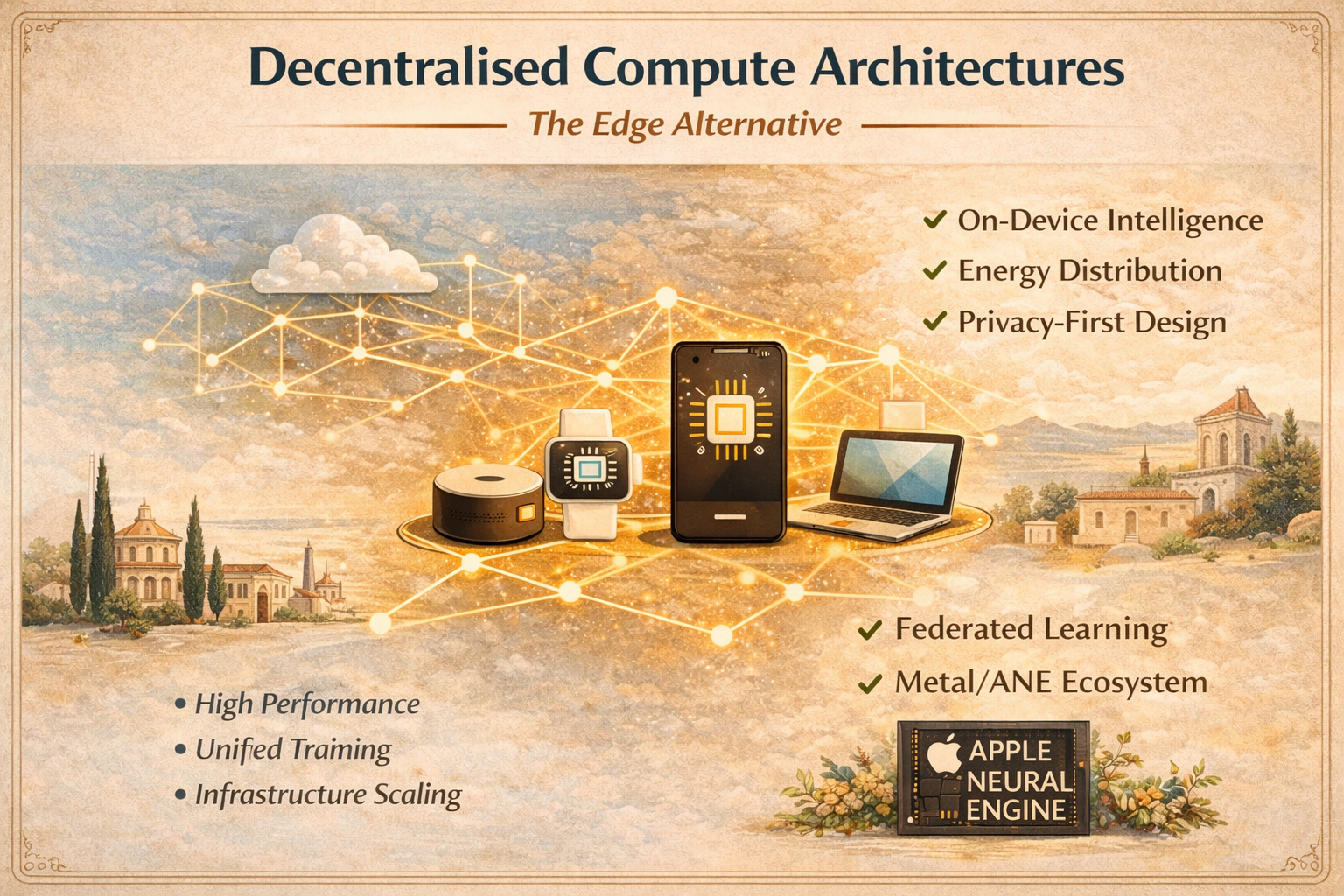
Decentralised Compute Architectures — The Edge Alternative
Distributed Intelligence and System Scaling Under Constraint
System Navigation
The system unfolds across three layers:
Foundations → Dynamics → Outcomes
Decentralised Compute Architectures
Keynote — Compute Is Distributing
Compute is no longer scaling exclusively through centralisation.
A second architecture is emerging:
Decentralised compute — where intelligence is distributed across devices rather than concentrated in infrastructure
This is not a marginal shift.
It is a system-level reconfiguration of the compute layer.
Core Architecture — Distributed Compute Networks
Decentralised compute is defined by:
on-device processing
embedded AI in operating systems
distributed inference across nodes
reduced reliance on centralised infrastructure
At scale, this creates:
a network of compute embedded in billions of devices
Led by:
- Apple
Enabled by:
Apple Neural Engine
Metal
System Mechanism — Compute Without Concentration
Unlike centralised systems, decentralised compute:
does not require data aggregation
does not require large-scale GPU clusters
does not scale through infrastructure buildout
Instead:
compute scales through device proliferation and network distribution
Energy Logic — Distribution as Advantage
The significance of decentralised compute becomes clear under energy constraint.
Centralised Model (Reference System)
concentrated electricity demand
data centre dependency
infrastructure bottlenecks
→ exposed to:
Decentralised Model
leverages already-deployed device energy
distributes computational load
reduces marginal infrastructure demand
Energy is not concentrated—it is distributed across the system
Federated Intelligence — The Coordination Layer
Distributed systems require coordination without centralisation.
Enabled by:
- Federated Learning
Mechanism:
Data remains local
→ models update across nodes
→ intelligence scales without central data pooling
System Position — Compute in the Stack
Decentralised compute reshapes the system hierarchy:
Energy → Infrastructure → Compute → Industry → Capital → Currency → Sovereignty
It weakens dependence on:
centralised infrastructure
hyperscale compute concentration
And strengthens:
platform ecosystems
device-level intelligence
distributed system resilience
Strategic Interpretation — A Different Scaling Path
Apple is not optimising for hyperscale AI.
It is building:
a decentralised compute network embedded in consumer devices
This represents:
distribution over concentration
integration over scale
control over openness
Limitations — Not a Substitute System
Decentralised compute does not replace centralised systems.
It cannot:
train frontier models at scale
match hyperscale compute intensity
replace infrastructure-heavy AI systems
Instead:
it defines a different functional layer
Outcome — Toward a Hybrid Compute System
The system is converging toward:
Dual Architecture
centralised compute → training and model development
decentralised compute → deployment and inference
This creates:
a layered system where intelligence is produced centrally but executed locally
Conclusion — Compute Under Constraint
In an energy-bound system:
The constraint is not access to compute.
It is the ability to scale compute efficiently under energy and infrastructure limits.
Centralisation maximises performance.
Decentralisation maximises distribution.
Under constraint, distribution becomes a structural advantage.