AI, Energy, and Platform Power
The System Architecture of the US MAG7
System Navigation
The system unfolds across three layers:
Foundations → Dynamics → Outcomes
Energy-Bound System → AI–Energy–Cost Chasm → Energy Constraint and the Monetary Ceiling
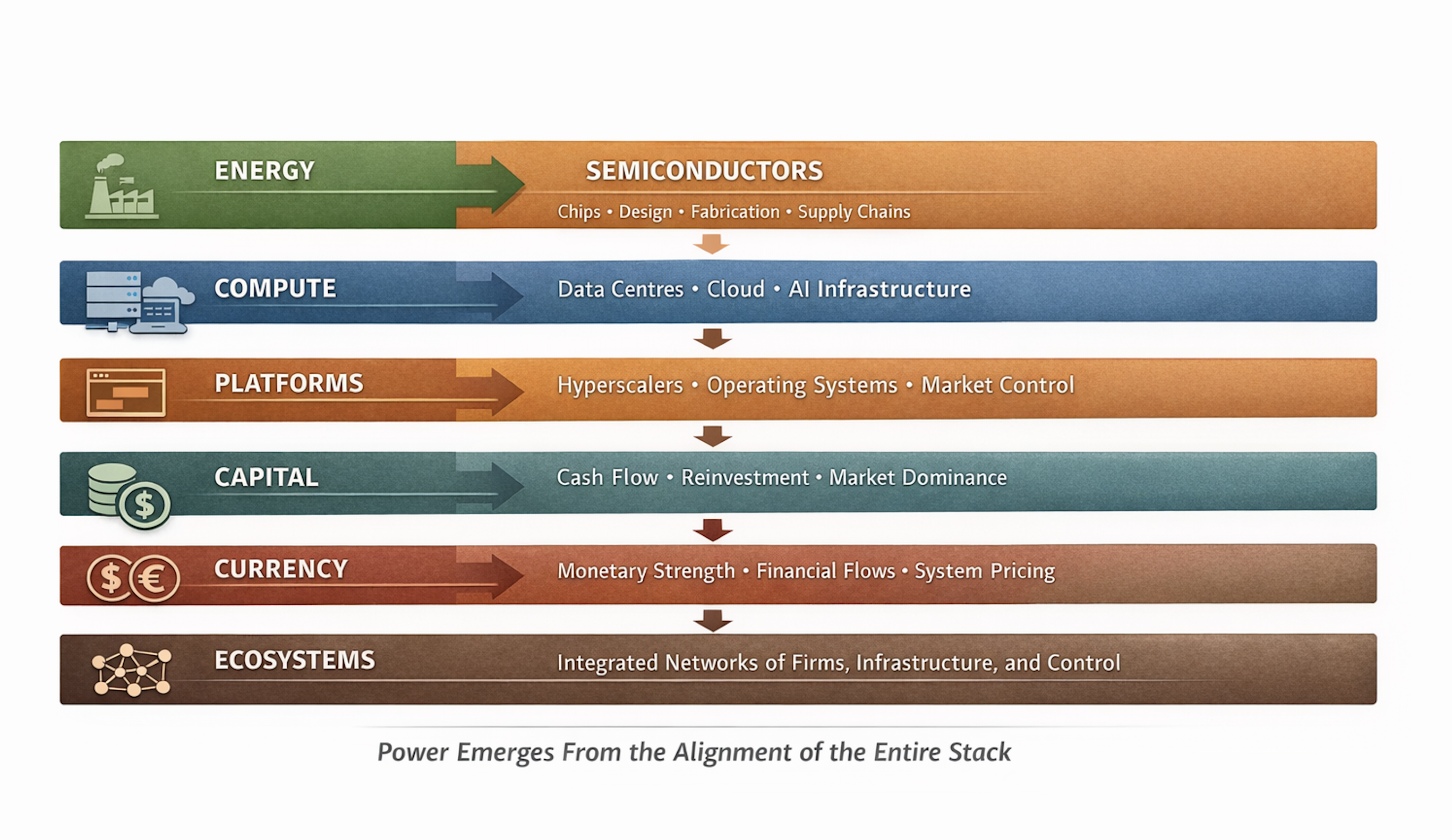
System Architecture — Energy to Monetary Power
I. The Misreading of Power
The dominance of US technology firms is often explained through:
innovation
software ecosystems
entrepreneurial culture
These explanations are incomplete.
They describe outcomes, not structure.
The US MAG7 — Apple, Microsoft, Amazon, Google, Meta, Nvidia, and Tesla — should be understood as a system, not a collection of firms.
A system defined by the integration of:
energy
compute infrastructure
semiconductor ecosystems
global value chains
capital markets
→ See also:
Energy–Industry–Compute
Convergence
Energy
Systems and the Tech War
II. Compute is Energy Infrastructure
AI scaling is not primarily a software problem.
It is an energy problem.
Training, inference, and continuous deployment require:
large-scale data centres
high-density compute clusters
stable and abundant electricity
Compute scaling = energy scaling
The geography of AI is therefore constrained by:
access to low-cost power
grid capacity
infrastructure deployment speed
→ See:
Compute
Locality in an Energy-Bound System
Energy–Compute
Infrastructure Geography
III. The Semiconductor Layer: Control of the Bottleneck
At the core of the system sits the semiconductor stack.
Advanced AI systems depend on:
- high-performance GPUs
- specialised chips
- tightly integrated hardware–software ecosystems
This creates a structural bottleneck.
Control is not exercised at the level of individual firms
alone.
It is embedded within semiconductor ecosystems that
combine:
- design
- fabrication
- tooling
- and supply chain coordination
Semiconductors are the gating mechanism of the AI system
→ See:
AI
Compute Ecosystems
Semiconductor
Ecosystems
IV. Global Value Chains and Ecosystem Control
The system extends beyond national borders through global value chains.
The work of Patrick McGee on Apple’s supply chain illustrates this clearly.
Apple is not simply a product company.
It is:
- an orchestrator of a global manufacturing ecosystem
- deeply embedded in Chinese industrial capacity
- structurally dependent on coordinated production networks
This reveals a key principle:
Control does not require domestic production.
It requires control over ecosystems — design, coordination, and value capture.
The MAG7 system operates through:
- distributed production
- centralised coordination
- ecosystem dependency
→ See:
Global
Value Chains in an Energy-Bound World
Corridors,
Chokepoints, and the Geography of Leverage
V. Ecosystems as the Unit of Power
In industrial-era analysis, firms were the primary unit of competition.
In the AI and energy-constrained era, this has shifted.
The relevant unit is the ecosystem.
An ecosystem combines:
- infrastructure
- firms
- supply chains
- capital flows
- and coordination mechanisms
The US advantage lies not only in leading companies, but in:
- tightly integrated compute ecosystems
- dominant semiconductor ecosystems
- globally embedded production networks
- capital markets that reinforce system expansion
Power now resides in the ability to build, coordinate, and scale ecosystems — not in isolated firms.
→ See:
AI
Compute Ecosystems
Semiconductor
Ecosystems SME Innovation
Networks
VI. Platform Power as System Integration
The MAG7’s advantage lies in integration across layers.
But this integration is not vertical in a traditional industrial sense.
It is ecosystem-based integration:
- energy systems enable compute ecosystems
- compute ecosystems enable platform ecosystems
- platform ecosystems generate capital flows
- capital flows reinforce infrastructure expansion
Increasingly, platforms also operate as monetary layers within the system:
- controlling payment flows
- shaping digital transaction environments
- influencing currency usage and capital circulation
Platforms do not simply intermediate economic activity.
They increasingly define the terms under which value is created, exchanged, and retained.
Platform power is ecosystem power expressed at scale — and increasingly, monetary power.
This is not firm-level competition.
It is competition between integrated systems.
→ See:
Digital Sovereignty
Reading Map SME Innovation
Networks Digital
Economy: Platforms and Currencies
VII. Europe: Demand Without Control
Europe participates in this system primarily as:
a consumer of platforms
a host of demand
a regulatory actor
But not as:
a controller of compute infrastructure
a leader in semiconductor design
a coordinator of capital at comparable scale
This produces a structural imbalance:
costs are imported
value is externalised
capital formation weakens
→ See:
Europe’s
Challenge
EU
Asymmetry Under Stress
VIII. The Alternative: Architecture, Not Protectionism
The strategic question for Europe is not replication.
It is architecture.
Possible pathways include:
decentralised energy systems
localised compute deployment
SME-integrated digital ecosystems
hybrid cloud–edge infrastructure
Sovereignty emerges from system design, not policy declaration
→ See:
EU
Energy Paradigm Shift — Part I
Strategic Autonomy Without Illusions (planned)
IX. Investor Implications
Where value accrues:
energy-abundant systems
semiconductor control points
hyperscale compute infrastructure
integrated platform ecosystems
Where value leaks:
high-cost energy regions
systems without compute ownership
fragmented capital environments
Where opportunity emerges:
energy–compute integration
infrastructure deployment
regional system nodes
hybrid and decentralised architectures
→ See:
- Investor
Framework - Capital Allocation in an Energy-Bound System
X. Conclusion
The dominance of the US MAG7 is not accidental.
It is the outcome of a system in which:
energy
compute
semiconductors
capital
and global value chains
are aligned.
Power in the AI era does not reside in software alone.
It resides in the system that sustains it.