System Foundations of the Energy–AI–Industrial Economy
Why economic and technological power now follow energy, industry, and compute
Keynote
The defining feature of the current era is not technological
acceleration, but structural constraint.
As the global economy moves from fossil abundance to an energy-bound
order, power no longer flows primarily through markets, innovation
cycles, or alignment. It flows through systems: energy systems that
determine cost and resilience, industrial systems that anchor production
and scale, and compute systems that amplify control across data,
platforms, finance, and security.
This shift has not dematerialised the economy. It has re-embedded it in
physical infrastructure, coordination capacity, and long-cycle
investment. Understanding how these layers now form a single operating
system is a prerequisite for interpreting the tech war,
reindustrialisation, and sovereignty in the twenty-first century.

Energy, industry, and compute as a single operating system.
Preface — From Energy Constraint to System Competition
This article sits within the Global Energy Paradigm Shift framework and should be read as its system-architecture companion.
Where The Global Energy Paradigm Shift establishes why the global economy has moved from fossil-fuel abundance to an energy-bound order, this analysis explains how that constraint reorganises the foundations of economic and technological power. It makes explicit the system logic linking energy systems, industrial capacity, and artificial intelligence — and why these domains can no longer be treated independently.
The rapid expansion of AI, electrified manufacturing, and digital infrastructure has not dematerialised the economy. It has re-embedded it in physical systems: electricity, grids, industry, and infrastructure coordination. As a result, competition over technology increasingly takes the form of competition over system architecture, not innovation cycles.
This article provides the conceptual bridge between energy constraint and the emerging tech war. It formalises the Energy–Industry–Compute Stack as the operating structure of the modern economy and clarifies why sovereignty, reindustrialisation, and technological capability now depend on control over foundational systems rather than alignment, regulation, or innovation alone.
Read together with The Tech War Is an Energy War and Energy Sovereignty as System Control, this analysis completes the system-level picture of how power is generated, concentrated, and contested in an energy-bound world.
The contemporary debate about artificial intelligence, reindustrialisation, and technological sovereignty often treats these domains as separable. They are not. In an energy-bound global system, economic and technological power increasingly flows through a tightly coupled architecture linking energy systems, industrial capacity, and compute infrastructure. This architecture — rather than innovation alone — determines where productivity scales, where industry locates, and where sovereignty can be exercised.
The purpose of this analysis is to make explicit the system foundations of the modern economy: how energy enables industry, how industry anchors compute, and how compute amplifies control across data, platforms, and finance. Understanding this hierarchy is essential to interpreting the tech war, industrial policy, and the reorganisation of global value chains.
This article establishes the baseline system logic assumed by all subsequent analyses of technology competition, industrial policy, and sovereignty.
Figure X illustrates how modern energy systems are organised as layered socio-technical hierarchies, with societal purpose and economic functions resting on sequentially deeper levels of physical infrastructure, technology, and resource extraction.
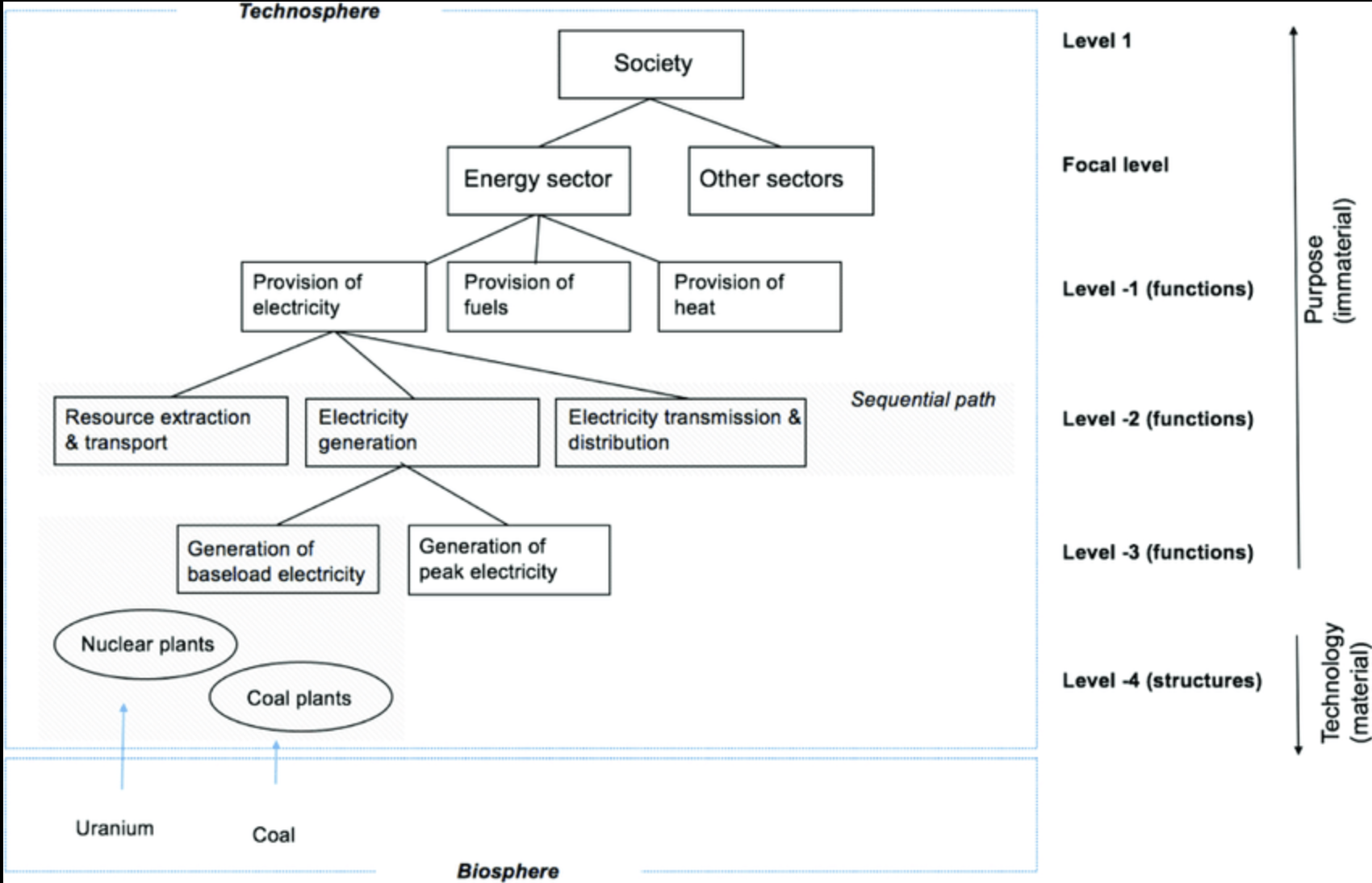
The energy system as a layered socio-technical hierarchy.
Purpose and societal demand sit at the top, while physical technologies, infrastructure, and resource extraction form the base. Functions and services emerge sequentially from material structures, illustrating how higher-level economic and social outcomes remain constrained by lower-level energy systems and technologies.
From digital promise to physical constraint
Artificial intelligence is frequently framed as a software revolution. In practice, it is a physical system with extreme requirements for electricity, cooling, materials, and infrastructure. Training large models, operating dense data centres, and deploying AI across industry demand continuous, reliable, low-cost power and robust industrial ecosystems.
As a result, AI does not loosen material constraints. It tightens them.
This shift marks a break from the late-globalisation era, when digital technologies appeared to float above physical systems. In the current phase, compute follows grids, algorithms follow energy costs, and innovation clusters where infrastructure can scale. The decisive variable is no longer access to talent or code alone, but the capacity to coordinate energy, industry, and compute within a single operational framework.
The Energy–Industry–Compute Stack
The modern economy is organised around an integrated stack:
Energy → Industry → Compute → Data → Platforms
This is not a metaphor. It is a dependency structure. This article establishes the logic of the stack; its fractures, vulnerabilities, and points of leverage are examined separately.
- Energy determines cost, reliability, and scalability.
- Industry converts energy into productive capacity, equipment, and infrastructure.
- Compute transforms capacity into technological advantage.
- Data and platforms concentrate coordination, control, and leverage.
Disruption or dependency at the base of the stack propagates upward. Control at the base amplifies power across the entire system.
This logic explains why:
- AI advantage clusters in regions with abundant electricity and grid capacity,
- industrial policy and energy policy have converged,
- and technology competition increasingly takes the form of infrastructure competition rather than innovation races.
Energy as the binding constraint
In an electrified, AI-intensive economy, energy is no longer a background input. It is the binding constraint.
Electricity demand is rising rapidly due to data centres, automation, electrified manufacturing, and digital services. Unlike past energy transitions, demand is both continuous and inelastic: compute cannot pause during price spikes or grid stress without severe economic cost. This makes energy system design — generation mix, grids, storage, digital control — decisive.
Where energy systems are slow to expand, fragmented, or expensive, industrial activity stalls and compute clusters migrate. Where energy systems are integrated, scalable, and digitally coordinated, industry and AI consolidate. Energy policy therefore functions as industrial policy by other means.
Industry as the anchor of compute
Compute does not exist in isolation. It is embedded in industrial ecosystems that produce servers, cooling systems, semiconductors, power electronics, and the physical infrastructure of data centres and factories.
This is why reindustrialisation has returned as a strategic priority. Without domestic or regional industrial depth, states struggle to scale compute, absorb technological shocks, or sustain complex supply chains. Financial subsidies or regulatory ambition cannot compensate for missing industrial capacity.
Industry anchors compute geographically and institutionally. It links energy systems to labour, skills, logistics, and standards. In this sense, industrial capacity is the bridge between energy availability and technological power.
Compute as a multiplier, not a driver
Compute amplifies power, but it does not generate it independently.
Advanced computing increases productivity, accelerates learning, and enables new forms of coordination. But its effectiveness depends entirely on the energy and industrial systems beneath it. Jurisdictions that treat AI as a standalone sector risk overestimating its autonomy and underestimating their exposure to infrastructure constraints.
This is why the tech war increasingly manifests as competition over:
- data-centre siting,
- chip fabrication capacity,
- grid access,
- export controls on equipment and materials,
- and standards governing digital infrastructure.
These are not peripheral issues. They are struggles over control of the stack.
Implications for sovereignty and global competition
In the Energy–AI–Industrial economy, sovereignty is exercised through system control, not formal independence. States and regions retain autonomy to the extent that they can:
- secure affordable, reliable electricity,
- sustain industrial ecosystems,
- finance long-cycle infrastructure,
- and govern the digital layers that sit atop physical systems.
This explains why power is concentrating in a small number of system-builders, why global value chains are regionalising, and why technology competition increasingly takes the form of denial, dependence, and leverage rather than open conflict.
Europe illustrates these dynamics clearly. The challenge is not a lack of innovation, but insufficient control over the foundations of the stack. High energy costs, fragmented grids, and industrial erosion translate directly into technological vulnerability. Alignment without rebuilding these foundations risks accelerating deindustrialisation and locking in dependency.
Conclusion: the operating system of the modern economy
The Energy–AI–Industrial economy operates on a simple but unforgiving logic: power follows the stack.
Energy enables industry. Industry anchors compute. Compute amplifies control across data, platforms, finance, and security. When these layers are integrated, states can absorb shocks, scale technology, and project power. When they are fragmented, even advanced economies experience constraint.
The tech war, reindustrialisation debates, and sovereignty discussions are all downstream of this reality. Understanding the system foundations is therefore not an academic exercise. It is a prerequisite for credible strategy in an energy-bound world. Strategy in the twenty-first century begins not with ambition, but with control over system foundations.
Suggested Reading
- **Global Energy Paradigm Shift (Global
- **Europe’s Energy Paradigm Shift (EU Sovereignty)
- Energy–Industry–Compute Stack— architectural formalisation
- Agency Under Constraint (global)— human and institutional limits downstream