Mediterranean AI Infrastructure Geography
Why AI Scaling Reconfigures Mediterranean Strategic Geography
System Navigation
This article connects the Mediterranean transition layer to the emerging AI infrastructure layer:
Central Thesis
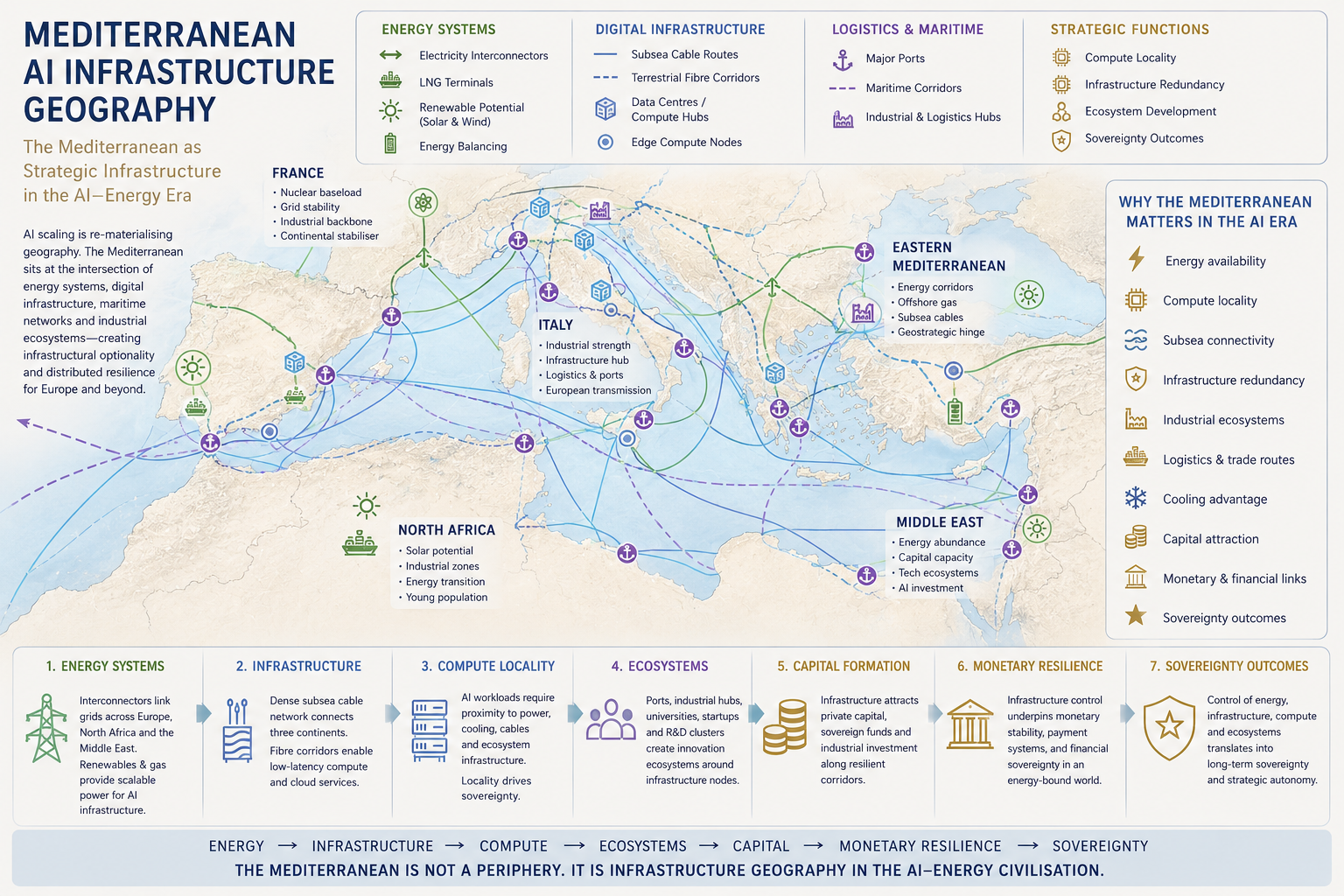
The Mediterranean is re-emerging not primarily as a regional geography, but as an infrastructure geography.
Under AI–energy scaling conditions, strategic relevance increasingly derives from the capacity to support:
large-scale electrification,
compute infrastructure,
subsea connectivity,
energy balancing,
distributed logistics,
industrial transmission,
and resilient infrastructure routing.
This transformation alters the geopolitical meaning of the Mediterranean itself.
For decades, the Mediterranean was often interpreted through fragmentation, debt asymmetry, migration pressure, tourism dependence and uneven industrialisation.
Under AI–energy conditions, however, many of these same geographic characteristics begin to acquire new strategic functions.
What previously appeared peripheral increasingly functions as infrastructural optionality.
What appeared fragmented increasingly functions as distributed resilience.
What appeared geographically dispersed increasingly functions as redundancy capacity within energy, compute, logistics and cable architectures.
The Mediterranean therefore becomes increasingly important because AI infrastructure scaling is re-materialising geography.
AI Infrastructure is Physical Infrastructure
Artificial intelligence is frequently described through software, models and algorithms.
In practice, large-scale AI increasingly functions as a physical infrastructure system.
Its expansion depends simultaneously upon:
electricity availability,
grid continuity,
cooling systems,
fibre infrastructure,
subsea cable routing,
semiconductor supply chains, fabrication concentration and strategic compute dependencies,
industrial coordination,
capital intensity,
and infrastructure resilience.
As AI systems scale, compute becomes increasingly constrained by energy geography and infrastructure density.
This changes the strategic logic of infrastructure investment itself.
The emerging competition is no longer simply about digital services.
It increasingly concerns:
where compute can be deployed,
where electricity can be stabilised,
where grids can absorb scaling demand,
where cooling capacity exists,
where cable systems converge,
and where infrastructure concentration creates vulnerability.
Under these conditions, the Mediterranean becomes strategically important because it sits at the intersection of:
energy systems, maritime systems, interconnector systems, subsea cable systems, logistics systems and emerging distributed compute systems.
This is the deeper infrastructure logic underlying the Mediterranean transition.
The Return of Maritime Infrastructure Geography
The AI era is reintroducing maritime geography into technological sovereignty.
Subsea cables increasingly function as strategic infrastructure arteries for:
cloud systems,
AI workloads,
financial systems,
industrial coordination,
military communication,
and platform ecosystems.
Simultaneously, energy interconnectors, LNG routing, electricity balancing systems and port infrastructures are becoming increasingly integrated with digital infrastructure systems.
The Mediterranean occupies a uniquely important position within this emerging architecture because it connects:
Europe,
North Africa,
the Middle East,
the Atlantic system,
the Indo-Pacific trade system,
and emerging East Mediterranean infrastructure corridors.
This creates convergence between:
energy transmission,
compute transmission,
maritime routing,
industrial infrastructure,
and digital coordination systems.
The Mediterranean therefore increasingly functions as a strategic infrastructure interface between continents.
This transformation is reinforced by the growing vulnerability of excessive concentration.
As AI infrastructure scales, hyperscale concentration itself creates systemic risk through:
grid stress,
cooling constraints,
infrastructure bottlenecks,
geopolitical exposure,
cable concentration,
ecosystem dependency,
and energy transmission asymmetries.
The system increasingly requires redundancy.
This strengthens the strategic logic of distributed infrastructure architectures.
Distributed Compute and Mediterranean Geography
The emerging AI system is unlikely to remain entirely centralised.
Although hyperscale concentration will remain dominant in core layers, infrastructure stress increasingly favours hybrid architectures combining:
centralised compute,
regional compute,
edge compute,
distributed energy systems,
and geographically diversified infrastructure nodes.
This transition aligns unexpectedly well with several Mediterranean characteristics.
The region increasingly offers:
solar scaling potential,
maritime cooling environments,
port infrastructure,
subsea cable density,
interconnector expansion,
distributed coastal geography,
logistics connectivity,
and proximity to both European and non-European energy corridors.
Under AI–energy conditions, these characteristics become increasingly valuable.
The Mediterranean therefore shifts from being interpreted primarily as Europe’s southern periphery toward functioning as part of Europe’s distributed infrastructure layer.
This directly connects Mediterranean geography to emerging AI infrastructure architecture.
Infrastructure Geography and Ecosystem Concentration
AI infrastructure does not operate independently from ecosystems and platform architectures.
Cloud systems, hyperscalers, semiconductor supply chains, developer ecosystems, industrial software coordination and AI service layers increasingly concentrate around infrastructure environments capable of supporting large-scale compute deployment.
This creates reinforcing feedback loops between:
energy availability,
compute concentration,
ecosystem density,
capital attraction,
and platform power.
As a result, infrastructure geography increasingly shapes not only industrial capacity, but also ecosystem formation and technological dependency structures.
The strategic importance of the Mediterranean therefore derives not only from energy or logistics alone, but from its growing role within the wider territorial architecture of European compute, cloud and industrial ecosystems.
Greece and Distributed Infrastructure Logic
Greece increasingly illustrates how fragmented geography may operate differently under AI–energy conditions.
Its strategic relevance increasingly derives from the interaction between:
islanded energy systems,
maritime routing,
subsea cable corridors,
decentralised renewable deployment,
interconnector expansion,
port infrastructure,
and East Mediterranean infrastructure connectivity.
Under older industrial paradigms, fragmentation often reduced efficiency.
Under distributed infrastructure paradigms, however, controlled dispersion can increasingly enhance resilience.
This changes the strategic meaning of Greek geography itself.
Distributed topology increasingly supports:
energy balancing,
redundancy,
cable diversification,
edge compute deployment,
maritime continuity,
and infrastructure survivability.
Greece therefore increasingly functions not simply as a peripheral economy, but as a potential distributed infrastructure node within the wider Mediterranean conversion architecture.
This logic is explored further in:
→ Greece — Distributed Infrastructure Sovereignty
Italy, Spain, and Industrial Transmission
Italy and Spain occupy different but complementary positions within this emerging architecture.
Italy increasingly matters because it retains substantial industrial transmission capacity connecting:
infrastructure,
manufacturing,
logistics,
energy systems,
industrial ecosystems,
and European industrial continuity.
Its strategic role increasingly concerns the conversion of infrastructure access into industrial continuity.
Spain increasingly matters because the Iberian system combines:
renewable scaling potential,
LNG infrastructure,
Atlantic connectivity,
and electrification opportunity.
However, Iberian isolation also illustrates the importance of conversion architecture itself.
Energy advantage alone does not automatically produce sovereignty.
Infrastructure transmission, interconnection capacity, compute integration, ecosystem density and capital retention remain decisive.
The Mediterranean architecture therefore cannot be reduced to energy production alone.
Its strategic importance derives from the capacity to convert infrastructure position into system-level capability.
France and Continental Stabilisation
The Mediterranean transition cannot be separated from continental stabilisation.
France increasingly functions as a strategic conversion stabiliser between Mediterranean infrastructure geography and wider European industrial continuity.
Its role derives particularly from:
nuclear baseload continuity,
grid stabilisation capacity,
industrial transmission,
electrification support,
sovereign infrastructure depth,
and continental energy continuity.
This becomes increasingly important under AI-electricity scaling conditions.
Without stabilising continental conversion layers, Mediterranean infrastructure expansion risks remaining disconnected from broader European sovereignty capacity.
The Mediterranean therefore does not replace continental Europe.
It increasingly functions as one of the infrastructural foundations through which European sovereignty may be reconstituted under AI–energy conditions.
This broader continental architecture is explored further in:
→ European Conversion Architecture
Mediterranean Infrastructure and the Return of Sovereignty
The AI transition is often described as a digital transition.
In reality, it increasingly represents the return of material sovereignty.
As compute scales, technological power increasingly depends upon:
electricity systems,
infrastructure resilience,
industrial ecosystems,
maritime routing,
semiconductor supply chains,
platform coordination,
capital depth,
monetary resilience,
and territorial infrastructure continuity.
The emerging technological order therefore increasingly reconnects:
geography, infrastructure, energy, industry, compute, ecosystems, capital formation and sovereignty.
Infrastructure control increasingly shapes the capacity to retain industrial value, attract capital formation, stabilise monetary systems and sustain long-term sovereignty under AI–energy conditions.
This is why the Mediterranean matters again.
Not as nostalgia.
Not as regional identity.
But as strategic infrastructure geography inside an energy-bound AI civilisation.