Energy as Europe’s Strategic Constraint: Why Decarbonisation Is the Only Path to Autonomy
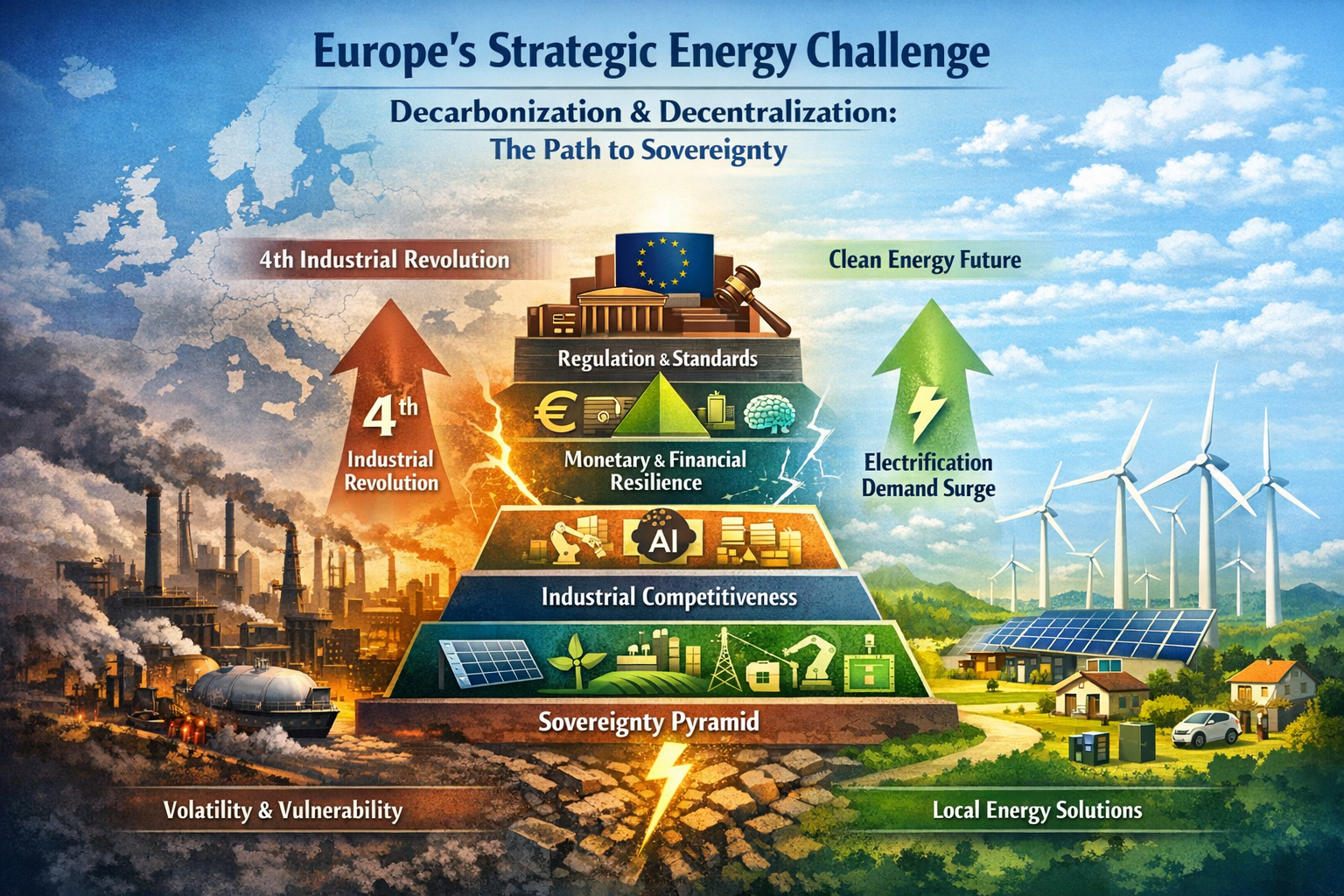
As established in the previous article, European sovereignty in the 21st century is no longer defined by borders alone, but by control over the systems that power modern economies: energy, industry, and technology.
As Europe enters an era of geopolitical fragmentation and rapid technological change, energy has become the binding constraint on competitiveness, security, and autonomy. In an electrified, AI-driven world, sovereignty begins with energy.
Energy Is No Longer a Sector
Modern power systems—economic, military, and technological—are energy-intensive by design. Artificial intelligence, automation, robotics, advanced manufacturing, data centres, logistics, and communications all depend on reliable electricity at scale. Defence systems and resilience planning increasingly do as well.
This marks a structural shift. In earlier industrial eras, energy was largely fuel-based and geographically concentrated. Today, power flows through electricity networks whose stability, price, and reliability directly shape economic performance and strategic freedom.
As a result, energy can no longer be treated as a downstream policy concern.. It sets the ceiling on what Europe can do—industrially, digitally, and geopolitically.
The 4IR Reality: Electrification Is Not Optional
The Fourth Industrial Revolution (4IR) is fundamentally an electrification revolution.
AI models, automated production lines, smart logistics, edge computing, and digital platforms all run on electricity. Unlike previous technological waves, the 4IR does not substitute energy demand; it raises it, particularly in three areas:
- Peak demand, as compute-intensive systems scale
- Reliability, as continuous operation becomes essential
- Local stability, as production and data move closer to the edge
This is not a political choice. It is a technological fact.
Once industrial systems electrify, the strategic question is no longer whether energy demand increases, but whether that demand can be met reliably, affordably, and under domestic control. For Europe, this question is decisive.
Why Fossil Energy Fails the Autonomy Test
Fossil fuels can electrify systems—but for Europe, they cannot deliver autonomy.
Europe is structurally import-dependent for oil and gas. Prices are shaped by global markets and geopolitical shocks beyond European control. Supply chains are exposed to coercion, conflict, and strategic disruption. Even when supply is available, volatility transmits directly into industrial costs and household bills.
Electrification built on imported fossil fuels therefore deepens dependence rather than reducing it. It locks Europe into a cycle of vulnerability in which competitiveness, fiscal stability, and political legitimacy are constantly exposed to external shocks. Decarbonisation is therefore not presented here as climate policy, but as the only energy system compatible with European sovereignty under conditions of electrification, automation, and geopolitical constraint.
This is not an argument about climate targets. It is a structural assessment of sovereignty under conditions of electrification and geopolitical constraint.
No amount of regulatory sophistication can compensate for an energy system whose inputs are priced and supplied elsewhere.
Decarbonisation as a Strategic Conclusion
For Europe, decarbonisation emerges not as an environmental preference, but as a strategic conclusion.
Domestic and near-domestic low-carbon energy—renewables, storage, electrification, and where applicable nuclear—offers what fossil systems cannot: predictability, controllability, and resilience once deployed. While upfront investment is significant, operating costs are structurally more stable and far less exposed to geopolitical volatility.
In an electrified, AI-driven economy, decarbonised energy is the only scalable way to align three imperatives simultaneously:
- rising electricity demand
- energy security
- strategic autonomy
This is why decarbonisation is inseparable from sovereignty. It is the system design that allows Europe to meet the demands of the 4IR without importing instability into its economic core.
Decentralisation: Where Strategy Meets Political Legitimacy
Energy autonomy cannot remain an abstract, continental objective. If it is to be politically sustainable, it must be experienced locally—by firms, communities, and regions.
Decentralised energy systems are critical here.
Distributed generation, storage, and digitally managed grids allow energy to be produced, optimised, and partially controlled closer to where it is consumed. Crucially, the same digital technologies driving the 4IR—AI, sensors, edge computing—also make decentralised energy viable at scale by balancing supply and demand, managing volatility, and improving efficiency.
For SMEs, this represents a qualitative shift:
- Energy costs become more predictable
- Exposure to geopolitical shocks is reduced
- Energy can move from a passive input cost to a managed asset
New local ecosystems emerge around installation, maintenance, optimisation, flexibility services, and digital energy management. Value that once left regions through fuel imports can instead be retained locally, supporting investment, employment, and regeneration.
This is the political hinge of the transition. Energy autonomy succeeds only when it delivers visible benefits at the firm and community level.
The Sovereignty Pyramid
At this point, the hierarchy becomes clear:
- Energy autonomy (electrified, decarbonised, resilient)
- Industrial competitiveness
- AI and digital capability
- Monetary and financial resilience
- Regulation, standards, and norms
If the energy base is unstable or dependent, every layer above it weakens. Competitiveness erodes, digital ambitions hollow out, and regulation becomes performative rather than effective.
This is why energy must be treated as the primary strategic variable, not one concern among many.
No Shortcut Around Energy
In an era shaped by electrification, automation, and geopolitical uncertainty, Europe cannot regulate or outsource its way into sovereignty.
For Europe, this means recognising energy autonomy—decarbonised, resilient, and increasingly decentralised—not as an environmental preference, but as the foundation upon which industrial competitiveness, technological capability, and democratic stability ultimately rest.
The following articles move from diagnosis to the institutional and strategic design required to rebuild European industrial power.
References
International Energy Agency
World Energy Outlook (Europe sections)
https://www.iea.org/reports/world-energy-outlook-2023
European Central Bank
Energy Prices and the Macroeconomy
https://www.ecb.europa.eu/pub/economic-research/resbull/2022/html/ecb.rb220419.en.html
Bruegel
European Electricity Market Reform: Structural Limits
https://www.bruegel.org/analysis/european-electricity-market-reform
OECD
The Economic Consequences of Energy Price Shocks
https://www.oecd.org/energy/
European Commission
Affordable Energy for Europe
https://commission.europa.eu/energy-policy/energy-prices-and-security_en
#EuropeanSovereignty #EnergyAutonomy #Decarbonisation #IndustrialCompetitiveness #AIandEnergy #StrategicAutonomy