Standards as Power: Protocol Sovereignty in Digital Systems
How rules, interfaces, and governance define control beyond infrastructure
Keynote
Technological power is often understood in terms of infrastructure:
energy systems
semiconductor capacity
compute infrastructure
Yet control over digital systems is not determined by infrastructure alone.
It is defined by standards and protocols — the rules that govern how systems interact, how data flows, and how participation is structured.
In an energy-bound system, standards determine not only interoperability, but who can access computation, under what conditions, and at what cost.
Sovereignty is therefore exercised not only through ownership, but through control of the rules of the system.
I. Protocols as System Architecture
Digital systems operate through layered protocols:
communication protocols
data formats
APIs and software interfaces
cloud and AI orchestration layers
These define:
how components connect
how information is exchanged
and how systems scale
Protocols are therefore not neutral.
They are architectural decisions that shape the structure of the system itself.
II. Standards as Control Mechanisms
Standards determine:
compatibility and interoperability
barriers to entry
switching costs and lock-in
long-term system evolution
Control over standards enables:
preferential positioning of certain technologies
exclusion or marginalisation of alternatives
shaping of entire ecosystems over time
In this sense, standards function as invisible control layers.
They define the boundaries of participation without requiring direct ownership.
III. From Open Systems to Controlled Ecosystems
Digital systems are often described as open.
In practice, many have evolved into controlled ecosystems, where:
standards are nominally open but practically governed
APIs define access conditions
interoperability is selectively enabled
This creates a structure in which:
access is mediated
dependency is reinforced
and autonomy is constrained
Control is exercised through design of the system, not only through legal authority.
IV. Standards, IP, and Structural Lock-In
Standards do not operate in isolation.
They are closely linked to:
intellectual property regimes
licensing frameworks
and proprietary implementations
Together, these create:
long-term dependency pathways
barriers to technological substitution
and constraints on future system development
This transforms standards from coordination tools into mechanisms of durable control.
Sovereignty is therefore not only a present condition.
It is a path-dependent structure.
V. The Geopolitics of Standards
Control over standards has become a central dimension of technological competition.
It determines:
which systems become globally dominant
which firms and countries capture value
and how technological trajectories evolve
In an energy-bound system, this has additional implications:
standards shape how energy and computation are integrated
they influence efficiency, scalability, and deployment
and they define who can participate in high-value segments
Standards are therefore not technical details.
They are strategic instruments of power.
VI. Implications for European Sovereignty
Europe has focused on:
regulation
competition policy
and digital rights
While important, these do not equate to control over standards.
Without:
active participation in standard-setting bodies
capacity to define protocols and interfaces
and alignment between industry, infrastructure, and governance
Europe risks remaining:
a rule-taker within externally defined systems
rather than a rule-maker shaping system architecture
This has cascading effects on:
industrial competitiveness
technological autonomy
and long-term sovereignty
Conceptual Summary
Infrastructure enables systems.
Standards define them.
Protocols determine:
how systems connect
who can participate
and how value flows
Control over standards is therefore control over:
system architecture
ecosystem evolution
and long-term dependency
Digital sovereignty depends not only on building systems, but on defining the rules by which they operate.
Brief Reading Framework
To understand how standards function as a layer of power within digital systems:
System Architecture (Foundation)
→ AI Compute Ecosystems (Global Context)Hardware and Dependency (Constraint Layer)
→ Microprocessors and the Architecture of the Tech WarPlatform Control (Access Layer)
→ Platform Sovereignty: Apple and the Control of the EdgeStandards and Protocols (Rule Layer)
→ This articleEuropean System Response (Application Layer)
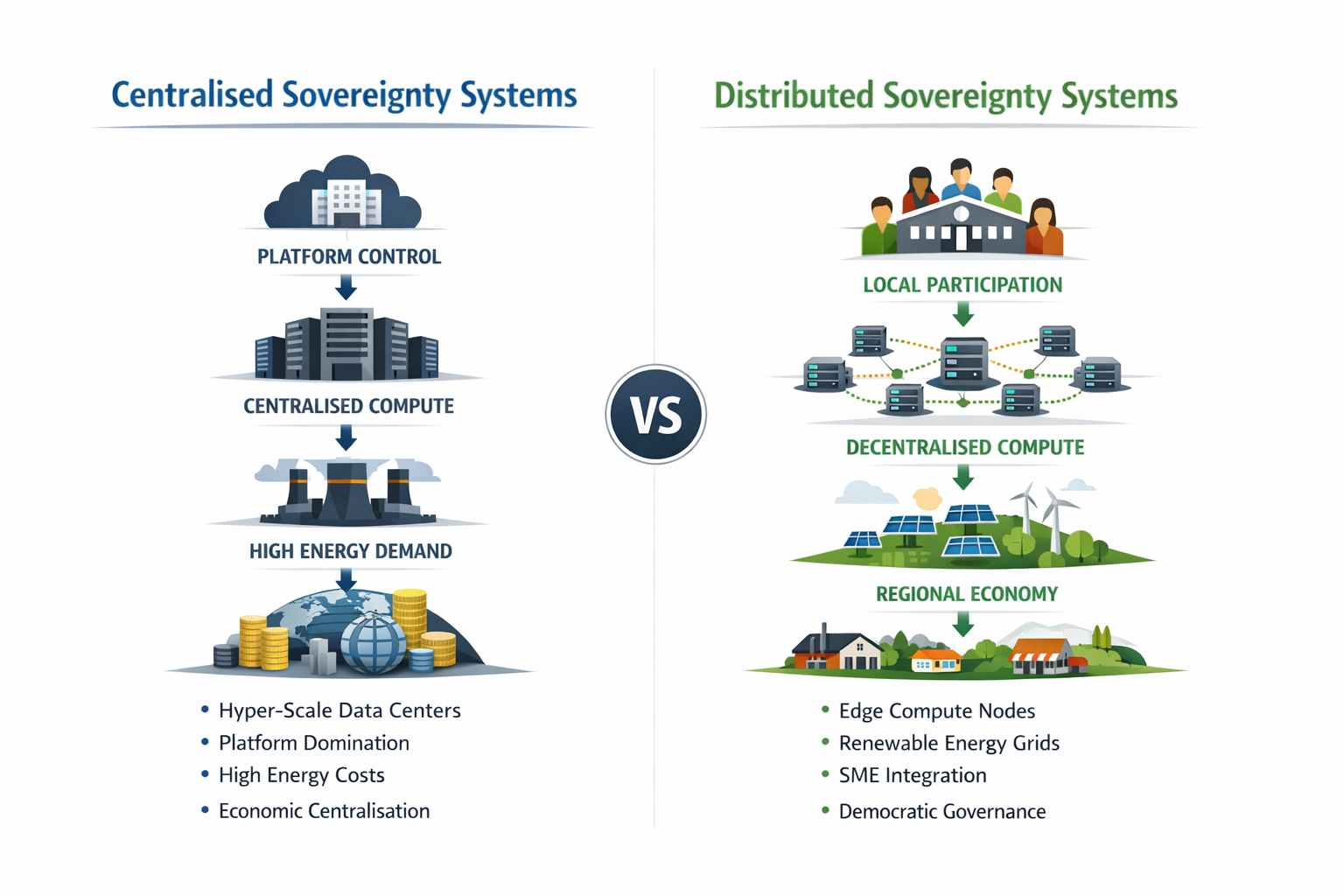
→ Distributed Sovereignty Systems: Energy, Compute, and Democratic Control