Greece Energy Transition Annex — Energy as an Internet-Scale System Shift
System Architecture, Distributed Capacity, and the Reorganisation of Sovereignty
System Navigation
This annex extends the systemic transition layer connecting:
Purpose of this Annex
This annex expands the core argument developed throughout the Mediterranean system framework:
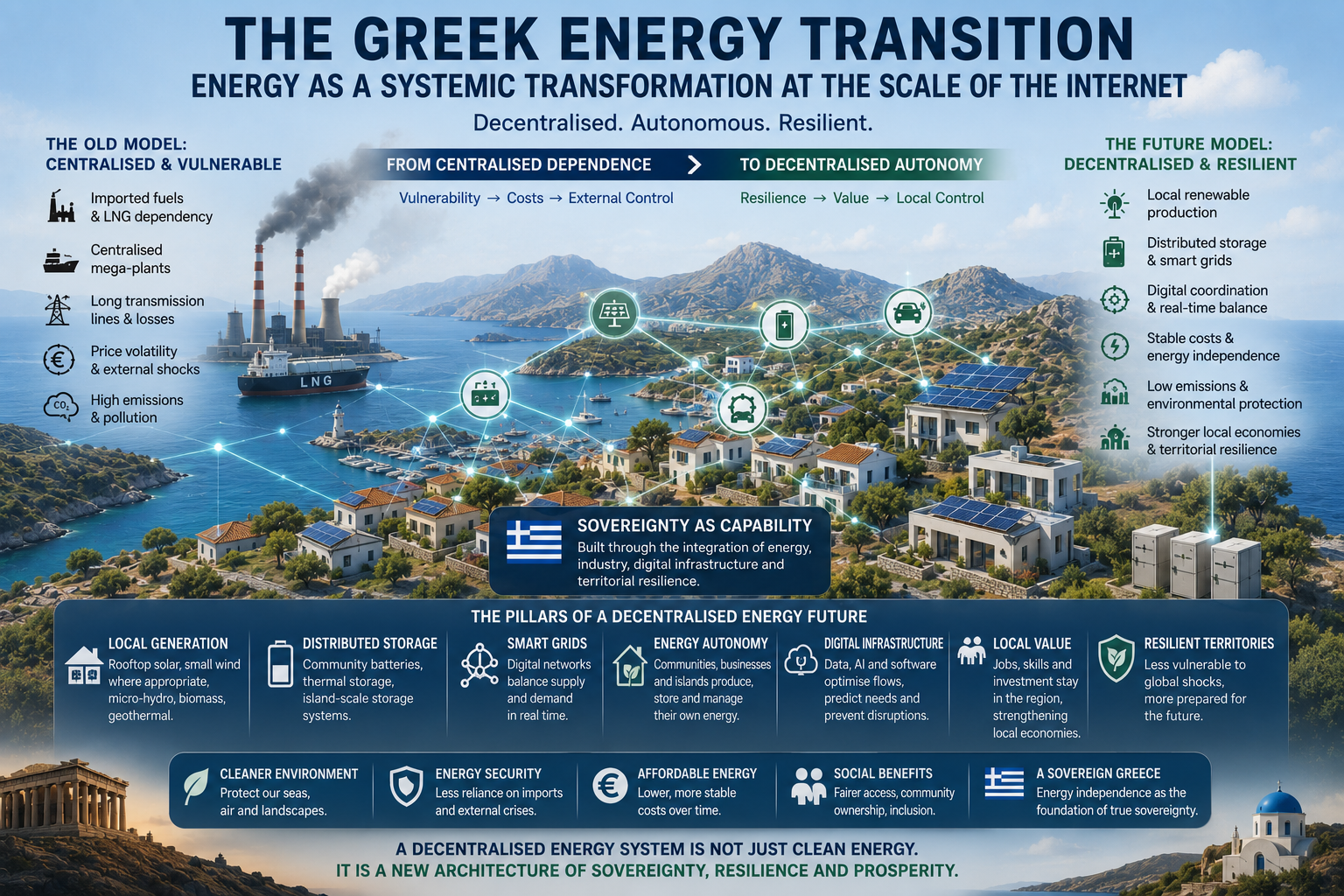
the transition toward decentralised, digitally coordinated energy systems is not a sectoral energy adjustment. It is a structural transformation of economic architecture comparable in scale to the emergence of the Internet itself.
The comparison matters because the Internet did not simply introduce a new communications technology. It reorganised the architecture of economic coordination, redistributed productive capability across networks, reduced the importance of physical concentration in some domains while increasing the strategic importance of infrastructure and standards in others, and shifted power toward actors capable of governing systems rather than merely participating within them.
Energy is now entering a similar phase transition.
Within an energy-bound system, the organisation of energy increasingly determines the organisation of production, compute, infrastructure, industrial ecosystems, capital formation, territorial resilience, and sovereignty capacity itself.
This annex therefore focuses not on technological detail in isolation, but on structural consequence.
The central question is how changes in energy system architecture alter economic capability, regional resilience, governance capacity, capital retention, and long-term sovereign positioning.
The argument unfolds through the broader doctrinal sequence that increasingly defines the Mediterranean framework:
Constraint → Transition → Architecture → Outcome
Under conditions of energy constraint, decentralisation changes the structure of adaptation itself.
I. An Internet-Scale Transformation of the Energy System
The Internet did not merely accelerate communication.
It reorganised economic systems.
It reduced coordination costs across distance, redistributed productive capability toward network edges, altered institutional scale requirements, and transferred increasing strategic importance toward protocols, standards, infrastructure layers, and platform coordination.
At the same time, the Internet did not eliminate centralisation.
It transformed the location of centralisation.
Participation became more distributed, while coordination became more architectural.
The emerging energy transition follows an increasingly similar logic.
The transition away from fossil-fuel systems organised around concentrated extraction, imported hydrocarbons, centralised generation, and physical chokepoints toward distributed renewable production embedded across territories does not remove the need for coordination.
It relocates coordination into new infrastructural and digital layers.
Production becomes geographically distributed.
Coordination moves upward into:
grid architecture
storage systems
interoperability standards
financing structures
digital optimisation layers
software-defined energy management
and AI-enabled balancing systems
The result is not fragmentation.
It is system redesign.
This distinction is critical.
Fragmentation weakens coordination.
Decentralised architecture restructures coordination.
This is why the transition should not be understood primarily as climate policy.
For systems capable of adapting successfully, it represents a structural upgrade of productive capability itself.
II. Why the Transformation Is Structurally Different for Greece
For Greece, the implications are unusually significant because characteristics historically treated as structural disadvantages begin to change systemic function within decentralised architectures.
As explored in Greece Under External Constraint — Energy, Demographics, and System Pressure, Greece entered the transition carrying multiple interconnected constraints simultaneously:
fragmented geography
dependence on imported energy
SME-dominated productive structures
demographic pressure
territorial dispersion
and external cost exposure
Under the twentieth-century fossil-energy model, these characteristics increased vulnerability because the system rewarded concentration.
Scale reduced cost.
Centralisation improved coordination.
Industrial viability depended heavily on proximity to large infrastructures, imported fuel systems, and concentrated production networks.
Within decentralised renewable systems, however, these same structural conditions begin to invert.
Fragmentation increasingly becomes deployability.
Territorial dispersion increasingly becomes resilience.
Local demand increasingly becomes the basis for local productive capacity.
This does not eliminate constraint altogether.
But it changes the architecture through which constraint operates.
The significance of this shift is therefore not incremental.
It is positional.
The transition changes where productive viability can emerge.
III. From External Cost Exposure to Structural Cost Control
Within fossil-based systems, energy enters the economy primarily as an externally priced constraint.
Imported hydrocarbons transmit volatility directly into domestic cost structures.
This volatility propagates across transport, industry, agriculture, logistics, household expenditure, inflation transmission, financing conditions, and fiscal pressure.
This dynamic forms part of the structural mechanism described in the Energy–Capital–Currency Hierarchy.
Under decentralised renewable systems, however, energy becomes increasingly internalised within domestic productive structures.
Production moves geographically closer to consumption.
Operating costs become more stable over long horizons.
Exposure to externally priced volatility begins to decline.
For Greece’s islands, mountain regions, agricultural territories, and dispersed local economies, this shift is especially important because local energy generation increasingly alters the economics of territorial survival itself.
The immediate effects appear operational:
more stable energy costs
improved local operating conditions
stronger resilience against external price shocks
But the deeper transformation is systemic.
Energy gradually shifts from functioning primarily as a source of external vulnerability toward functioning as a stabilising layer of domestic economic architecture.
This transition alters not only energy systems, but the structure of economic continuity itself.
IV. Coordination Without Physical Centralisation
A central misunderstanding often emerges within debates surrounding decentralised systems.
Decentralisation is frequently interpreted as the weakening of coordination.
In practice, advanced decentralised systems require more sophisticated coordination than older centralised systems.
The difference lies in where coordination occurs.
Under industrial-fossil architectures, coordination depended heavily on physical concentration.
Under digital-networked architectures, coordination increasingly depends on interoperability, software layers, standards, algorithmic balancing systems, and infrastructure intelligence.
This is precisely the transition the Internet underwent.
The same logic now applies to energy.
Thousands of distributed production nodes can operate coherently when coordination is embedded digitally rather than geographically.
Local autonomy therefore increases simultaneously with deeper system integration.
This produces a structurally different form of resilience.
The system becomes less dependent on a limited number of concentrated chokepoints while becoming more dependent on the quality of coordination architecture itself.
This is why digital infrastructure increasingly becomes inseparable from energy infrastructure.
V. Regional Economic Reorganisation and the Return of Territorial Production
As energy production becomes more distributed, production systems themselves begin to reorganise geographically.
This is especially important in economies such as Greece, where productive activity already operates through dispersed SMEs, regional industries, logistics corridors, maritime systems, agricultural zones, and fragmented territorial networks.
When energy becomes increasingly local, predictable, and digitally coordinated, industrial activity begins to follow energy stability.
Logistics systems stabilise.
Production continuity improves.
Regional productive systems become economically more viable over long durations.
This does not produce isolated local economies detached from larger systems.
It produces interconnected regional systems operating with lower structural cost and greater territorial resilience.
The underlying geography of economic viability therefore begins to shift.
Economic organisation no longer depends exclusively on concentration and scale alone.
It increasingly depends on alignment between energy systems, productive systems, infrastructure systems, and digital coordination layers.
This is a fundamental architectural shift in economic geography.
VI. Demographics and the Constraint of System Time
Greece’s demographic trajectory introduces a further systemic constraint: time.
As explored in Greece — Constraint Layer Brief, ageing populations, labour-force contraction, and prolonged outward migration reduce fiscal flexibility, weaken productive continuity, and lower tolerance for repeated economic shocks.
Demographic pressure therefore compresses adaptation capacity.
Decentralised energy systems interact directly with this constraint because they influence the operational sustainability of regions themselves.
When operating costs decline and local economic conditions stabilise, territorial systems become more capable of retaining productive activity, younger populations, SMEs, and investment continuity.
Decentralisation does not reverse demographic trends on its own.
But it can extend the adaptive horizon within which societies respond to them.
This distinction is strategically important.
Under conditions of demographic pressure, reducing systemic volatility becomes increasingly valuable because resilience increasingly depends on preserving continuity rather than maximising short-term expansion alone.
VII. Digital Infrastructure as a Sovereignty Layer
Decentralised energy systems cannot scale effectively without digital coordination systems.
As grids become software-defined, optimisation increasingly becomes data-driven, predictive, algorithmic, and computational.
Energy infrastructure therefore converges directly with digital infrastructure.
This introduces a second layer of sovereignty capability.
Energy autonomy without digital coordination capacity remains structurally incomplete.
This connects directly to:
→ Mediterranean Energy–Compute Transition
The significance for Greece is substantial.
The transition creates not only an opportunity to deploy decentralised energy systems, but also an opportunity to develop embedded digital capability alongside them.
This includes:
software-defined infrastructure
energy-data systems
distributed optimisation
AI-enabled balancing
cybersecurity layers
edge compute integration
and regional infrastructure intelligence
Together, these layers form the basis of distributed technological sovereignty embedded directly into territorial infrastructure.
VIII. The Role of the State — Architecture Rather Than Direct Control
This system transformation does not emerge spontaneously.
At the same time, it does not require comprehensive centralised operational control.
The decisive role of the state is architectural rather than purely managerial.
The state defines the conditions under which distributed systems can scale coherently.
This includes regulatory stability, infrastructure investment frameworks, digital-energy integration, financing conditions, interoperability standards, and long-term strategic coordination.
Private actors deploy, innovate, operate, and mobilise capital.
The state maintains systemic coherence.
This distinction is important because it avoids the false binary between centralised state control and fragmented market disorder.
The future system increasingly depends on hybrid coordination architectures combining public strategic direction with distributed private execution.
IX. Energy, Democratic Legitimacy, and System Durability
Energy systems are not merely economic systems.
They are political stabilisation systems.
As explored in Energy Constraint, Transmission, and Dependence, centralised systems that continuously transmit instability, external dependence, and rising costs into households eventually weaken social legitimacy and democratic resilience.
Decentralised systems operate differently when local populations experience visible participation in system benefits.
Lower operating costs, stronger local resilience, regional economic continuity, and visible territorial benefit strengthen social consent because infrastructure legitimacy becomes materially tangible.
This does not eliminate political conflict.
But it changes the relationship between infrastructure and democratic durability.
Energy autonomy therefore becomes simultaneously economic, political, social, and institutional.
X. Sovereignty as Constructed Capability
The broader implication is doctrinal.
Sovereignty is not simply declared through formal political authority.
It is constructed through the interaction of energy systems, industrial structures, digital infrastructure, demographic resilience, territorial continuity, and long-duration productive capability.
This is why decentralised energy should not be understood as a secondary policy domain.
For Greece, it increasingly functions as a foundational capability layer shaping:
economic resilience
regional cohesion
digital sovereignty
productive continuity
capital retention
and long-term strategic positioning
The transition therefore concerns not merely electricity generation, but the architecture through which sovereign capacity itself is reproduced over time.
Final Insight
The transformation is already underway.
The central question is no longer whether the system changes.
The question is whether Greece participates early enough to shape its position within the emerging architecture — or whether it adapts later under conditions of tighter constraint, weaker leverage, and externally imposed system design.
This is ultimately the deeper significance of the decentralised transition.
The struggle concerns not only energy production.
It concerns who governs the architecture through which future economic systems operate.
Final Doctrine Line
In a decentralised energy system, sovereignty no longer scales primarily from the centre. It increasingly compounds through the capacity to coordinate resilient productive systems from the edge.