INDUSTRIAL ECOSYSTEMS
Capability Formation, Scaling, and Sovereignty in an Energy-Bound System

Keynote
Technological power does not emerge from isolated technologies, firms, or infrastructure assets.
It emerges from ecosystems.
Industrial ecosystems transform energy, infrastructure, knowledge, capital, and compute into productive capability.
They determine whether innovation scales, whether industry adapts, and whether technological leadership can be sustained over time.
As artificial intelligence becomes increasingly physical, ecosystems are becoming more important rather than less important.
The AI era is not reducing the importance of industrial systems. It is increasing it.
Semiconductors, electricity networks, data centres, industrial supply chains, developer communities, standards, and capital allocation systems must operate as integrated ecosystems if technological power is to scale.
In an energy-bound world, ecosystems function as the conversion layer between physical resources and strategic power.
Ecosystems determine whether energy becomes production, whether compute becomes capability, and whether innovation becomes sovereignty.
System Position — The Conversion Layer
Industrial ecosystems occupy the central conversion layer of the system.
They connect physical capacity to economic and technological outcomes.
The system can be understood as:
Energy → Industry → Compute → Ecosystems → Platforms → Standards → Capital → Currency → Sovereignty
Where:
energy defines physical constraint
industry transforms energy into production
compute accelerates capability
ecosystems organise and scale capability
platforms coordinate access and interaction
standards structure interoperability and control
capital determines allocation and accumulation
monetary systems reflect long-term system stability
Without ecosystems:
energy remains latent capacity
compute remains isolated infrastructure
innovation remains fragmented
and sovereignty remains unattainable
Ecosystem Architecture
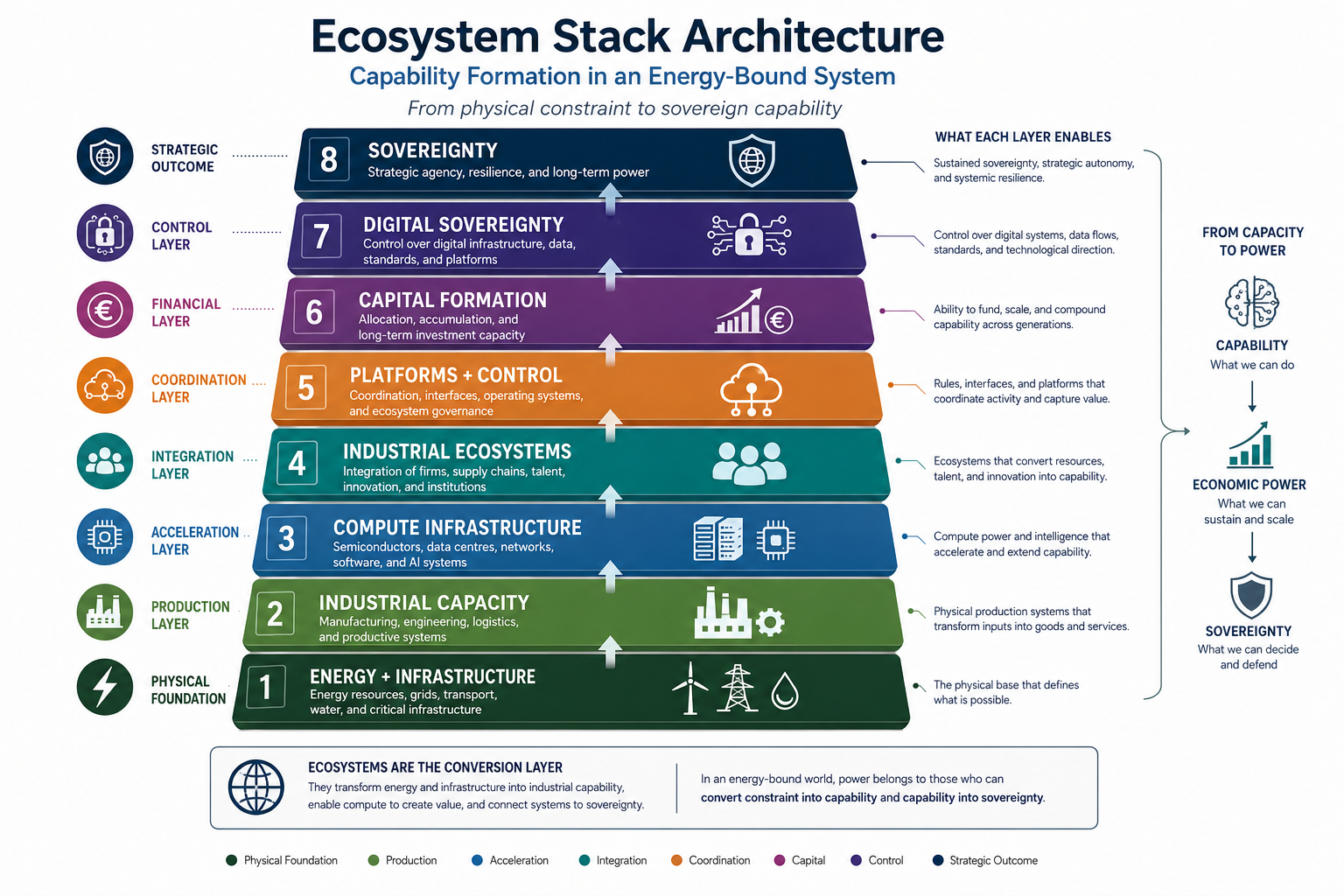
Industrial ecosystems connect:
energy systems
industrial capacity
compute infrastructure
developer communities
platforms
capital formation
into coherent architectures capable of producing durable power.
They are the layer through which technological capability becomes scalable and persistent.
Reading Sequence
I. Ecosystem Foundations
The conceptual foundations of capability formation, industrial organisation, and technological power.
II. AI Has Become Physical
The AI transition is increasingly constrained by infrastructure, energy, industrial capacity, and ecosystem depth.
III. Industrial Architecture
How ecosystems organise production, innovation, and industrial capability.
IV. Compute and Industrial Integration
How compute systems become embedded within industrial ecosystems.
V. Platforms, Control, and Digital Sovereignty
How ecosystems evolve into control systems.
VI. Ecosystem Competition
Competing models of industrial organisation and capability formation.
Distributed Ecosystems
Centralised Ecosystems
VII. Mediterranean System Interface
The Mediterranean increasingly functions as a strategic interface where energy systems, infrastructure, logistics, compute, and industrial ecosystems converge.
Related Foundational Reading
System Constraint and Scaling
Cross-Panel Bridges
GLOBAL
STACKS
EU SOVEREIGNTY
Position in the System
GLOBAL explains the physical foundations of power.
INDUSTRIAL ECOSYSTEMS explains how capability forms.
STACKS explains how capability is coordinated and controlled.
EU SOVEREIGNTY examines the economic, political, and strategic outcomes that emerge from those architectures.
Together these sections explain how energy, industry, compute, ecosystems, platforms, capital, and sovereignty interact within an energy-bound world.
Scope
This section focuses on:
industrial ecosystems
innovation systems
semiconductor ecosystems
AI compute ecosystems
developer ecosystems
industrial scaling
platform power
digital sovereignty
distributed industrial architectures
ecosystem competition
capability formation
sovereignty outcomes
Its purpose is to explain how systems convert physical resources into durable economic, technological, and geopolitical power.