TECHWAR


_Energy, Compute, Industry, and Control in an Energy-Bound System_


→ START HERE

•  AI, Energy, and the Future of Sovereignty


Foundational Transition


•  AI Has Become Physical

•  System Stack Architecture

•  Ecosystem Sovereignty

•  Hybrid Infrastructure Sovereignty

•  Hyperscaler Infrastructure Sovereignty

•  Financialised AI and the Infrastructure Reality


I. Foundations — Technology as Physical Infrastructure


• System Foundations — Energy, AI, and the Industrial Economy

• Technology As A Physical System

•  AI, Energy Constraint, and Compute Infrastructure

• Energy–Industry–Compute Stack

• Energy, Industry, and Compute Convergence

• Infrastructure Currency Doctrine

• Global Value Chains as Innovation Systems

• Prov Compute Efficiency As Strategic Variable


II. Stacks — Compute, Control, and System Architecture


• Stack Index Reference

• Digital Sovereignty — Reading Map

•  Digital Sovereignty — Control, Compute, and Economic Power

• Stacks, Systems, and Sovereignty

• Stack-Level Fractures in the Tech War

• Cloud and Edge AI

• The MAG7 System Architecture — AI, Energy, and Platform Power

•  Decentralised Compute Architectures

•  Decentralised vs Centralised Compute

•  Developer Ecosystems and Scaling

•  Open vs Closed System Architectures

•  Operating Systems and System Control

•  Semiconductor Control and Compute Sovereignty

•  Microprocessors, AI, and Energy Sovereignty

• Microprocessors and the Architecture of the Tech War

•  Standards, Protocols, and System Control


III. Dynamics — System Behaviour Under Constraint


• Dynamics — Index

• Decarbonisation as a Tech War Instrument

• Decarbonisation and Economic Regeneration

• Compute Locality as Energy Sovereignty

• Grid Intelligence as Industrial Sovereignty

• AI and Smart Tech Sovereignty

• Standards as Energy Lock-In

• Capital Duration as System Power

• Energy, Compute, and the Geography of Infrastructure


IV. Energy Base Layer — Infrastructure, Electrification, and System Drivers


• The Fourth Industrial Revolution as a Systems Revolution

• Decarbonisation as Industrial System Transformation

• Energy Geopolitics

• The Global Compute Shift

•  Strategic Minerals in the AI–Energy System


V. Ecosystems — Industrial Density and Technological Scale


• Ecosystems — Index

• Industrial Ecosystems — Cross-Panel Index

• Industrial Ecosystems and Technological Power

• AI and Compute Ecosystems

• Semiconductor Ecosystems

• Global Value Chains as Innovation Systems

•  Why China Scales — and Why Europe Does Not (Yet)

• Hyperscalers and Centralised Compute Power

•  Platform Sovereignty — Apple

•  Apple and Ecosystem Sovereignty

•  Apple, Industrial Ecosystems, and the Architecture of the Tech War

• Standards and Protocol Sovereignty

• SME Innovation Networks

•  Why China Scales — Industrial Ecosystem Density


VI. Monetary Architecture — Capital, Infrastructure, and Sovereignty


• Digital Infrastructure and Monetary Sovereignty

• Energy Constraint and the Monetary Ceiling

•  From Petrodollar to Electrodollar

•  Financialised AI and the Infrastructure Reality


VII. Security and System Conflict


• Industrial Power after Globalisation

• The Global Tech War

• Tech War as Energy War

•  Security Architecture and Technological Sovereignty


VIII. Applied Systems Layer — Evidence, Transition, and Deployment


•  System Evidence — Validation Layer

• Strategic Tipping Point

• Energy System Data Companion

• Investor Reframing

•  Greece — Energy Transition Annex

•  Greece — Decentralised Energy Transition


IX. Mediterranean and European Conversion Layer


•  Mediterranean Conversion Architecture

•  Mediterranean AI Infrastructure Geography

•  Europe — The Missing Conversion Layer

• Digital Sovereignty — Index


X. Core System Chain


**Energy → Infrastructure → Compute → Ecosystems → Platforms → Capital → Sovereignty**

STACKS

Control Architectures in an Energy-Bound System

Keynote

Technological power no longer emerges from individual technologies.

It emerges from control of interconnected system layers.

As artificial intelligence becomes increasingly physical, technological competition is shifting away from software alone and toward infrastructure, compute, operating systems, developer ecosystems, standards, platforms, and capital allocation systems.

The ability to control and coordinate these layers increasingly determines economic power, technological leadership, and sovereignty.

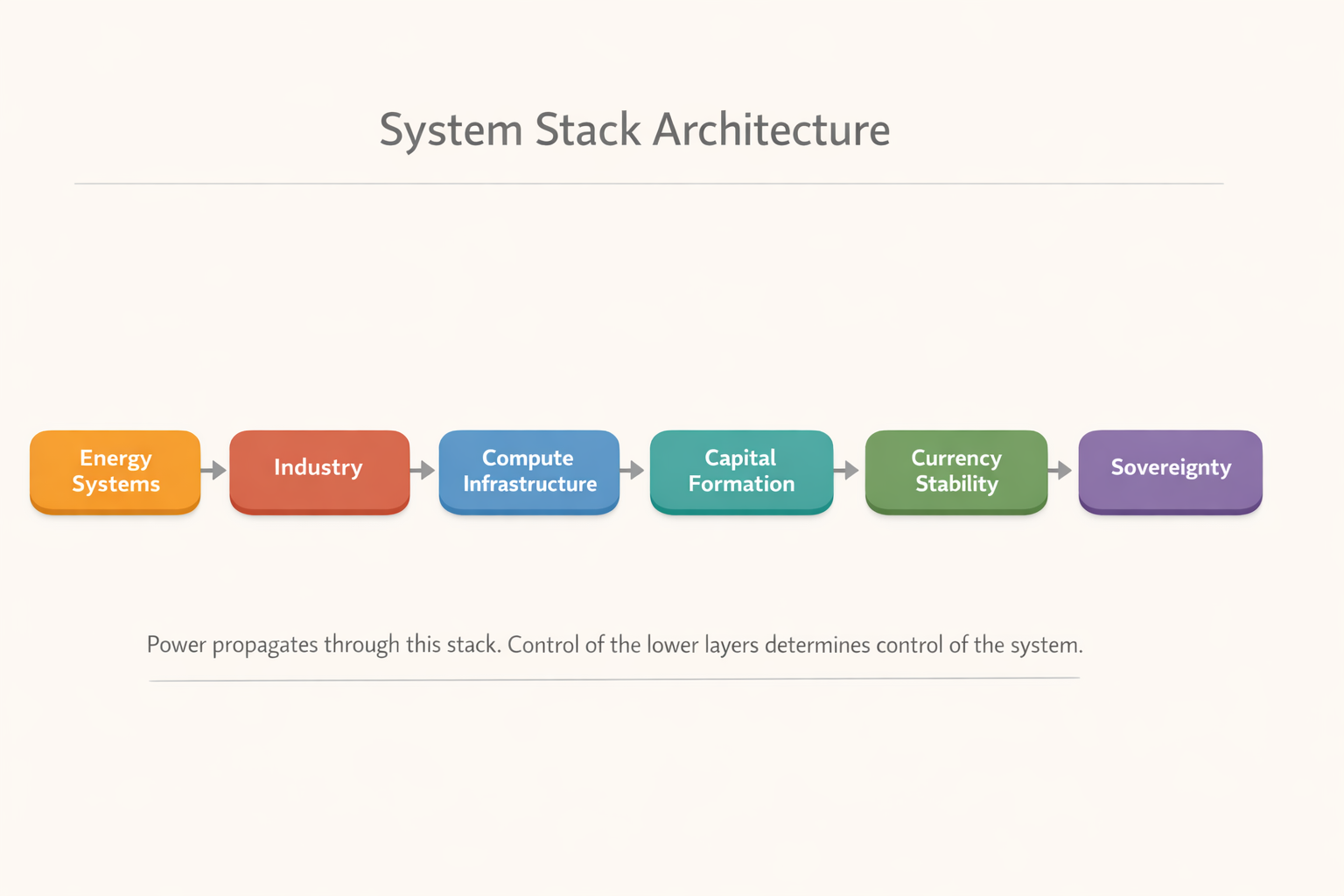
The stack can be understood as:

Energy → Industry → Compute → Operating Systems → Ecosystems → Platforms → Standards → Capital → Currency → Sovereignty

Control of lower layers determines the structure, limits, and behaviour of higher layers.

This section examines the architecture through which power propagates across technological systems and explains how infrastructure, control, scaling, and sovereignty interact in an energy-bound world.


Reading Sequence

I. Sovereignty and Stack Logic

Start here to understand how stack architectures translate into economic and geopolitical power.


II. Compute Infrastructure

The physical layer that converts energy into computational capability.


III. Control Architecture

The coordination layers that determine how systems operate and who exercises control.


IV. Ecosystems and Platform Power

The mechanisms through which compute scales into economic power.


V. Fracture and Competition

Where technological competition produces systemic vulnerabilities and strategic leverage.


The stack cannot be understood independently of the broader energy transition and the physical foundations of artificial intelligence.

Energy, Compute, and Sovereignty


Infrastructure and System Constraint


Cross-Panel Bridges

Ecosystems


European Sovereignty


Digital Sovereignty


Position in the System

The STACKS section sits between infrastructure and outcomes.

GLOBAL explains the physical foundations of power.

STACKS explains how control propagates through technological systems.

ECOSYSTEMS explains how technological systems scale.

EU SOVEREIGNTY examines the economic, political, and strategic outcomes that emerge from those architectures.

Together they describe how energy, compute, industrial capability, and digital control interact within an energy-bound world.


Scope

This section focuses on:

Its purpose is not to analyse individual technologies.

Its purpose is to explain how technological systems organise power.