Κεντρικοποιημένη έναντι Αποκεντρωμένης Υπολογιστικής Ισχύος — Συστημικές Αρχιτεκτονικές της Τεχνητής Νοημοσύνης
Τοπολογία Υπολογιστικής Ισχύος, Ενεργειακός Περιορισμός και ο Κατακερματισμός της Ισχύος της ΤΝ
Πλοήγηση Συστήματος
Το σύστημα εξελίσσεται μέσα από τρία επίπεδα:
Περιορισμός → Αρχιτεκτονική → Κυριαρχία
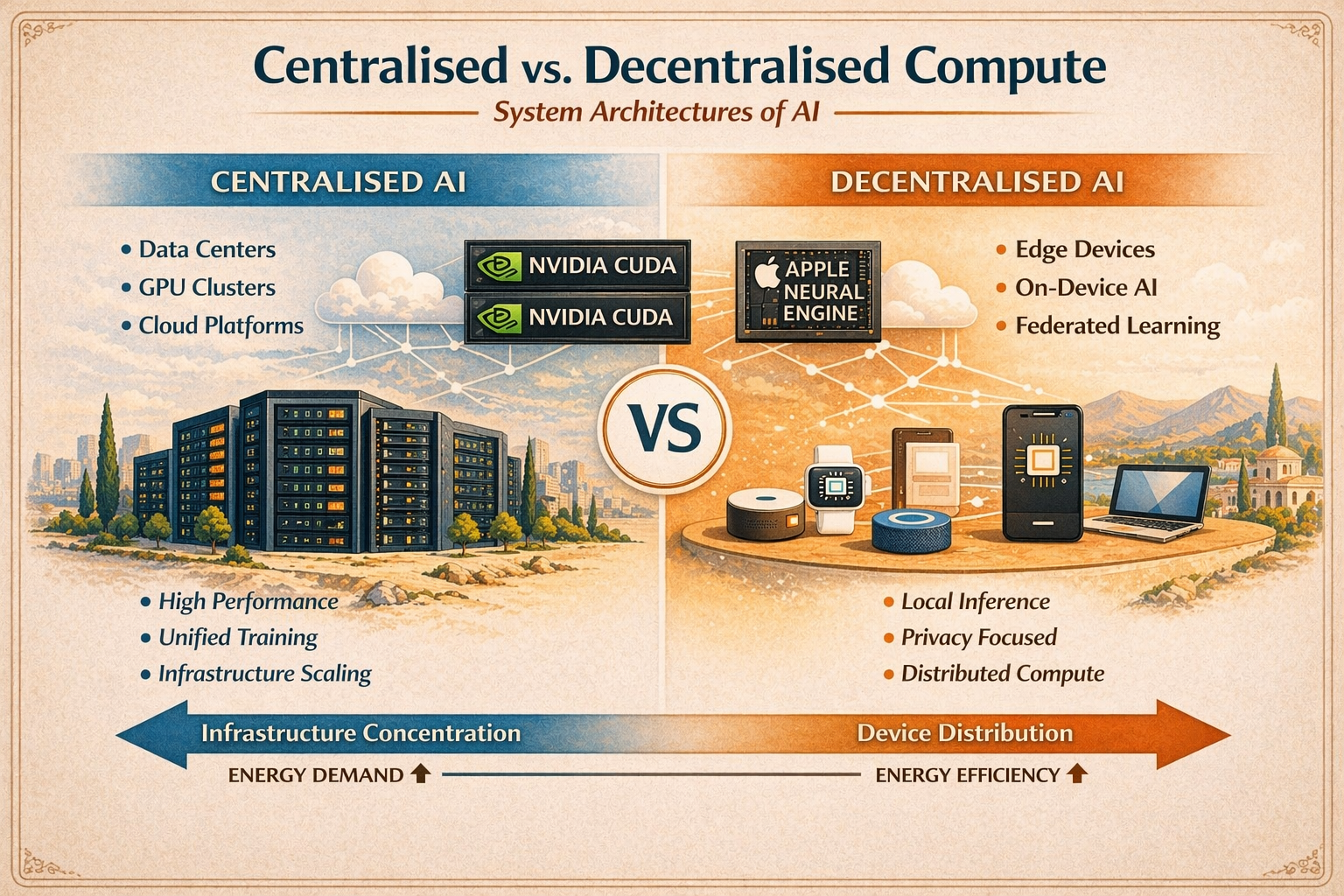
Centralised vs Decentralised Compute
Κεντρική Θέση — Η ΤΝ Διασπάται σε Δύο Συστημικές Αρχιτεκτονικές
Η τεχνητή νοημοσύνη δεν επεκτείνεται πλέον μέσω ενός και μόνο υποδείγματος υποδομής.
Το υπολογιστικό επίπεδο αποκλίνει πλέον προς δύο διακριτές αρχιτεκτονικές:
κεντρικοποιημένα υπολογιστικά συστήματα
και
αποκεντρωμένα υπολογιστικά συστήματα
Αυτή η απόκλιση δεν είναι απλώς τεχνολογική.
Είναι ενεργειακή, υποδομική, γεωπολιτική και συστημική.
Η αναδυόμενη οικονομία της ΤΝ δεν εξελίσσεται επομένως προς μία καθολική δομή υπολογιστικής ισχύος, αλλά προς ένα πολυεπίπεδο και ολοένα πιο κατακερματισμένο σύστημα, μέσα στο οποίο διαφορετικές αρχιτεκτονικές βελτιστοποιούνται για διαφορετικές μορφές κλίμακας, ανθεκτικότητας, ενεργειακής κατανομής και κυριαρχίας.
Υπό συνθήκες άφθονου κεφαλαίου και μη περιορισμένης ενέργειας, η κεντρικοποίηση φαινόταν δομικά ανώτερη, επειδή η συγκέντρωση μεγιστοποιούσε την υπολογιστική ένταση, την κλίμακα των μοντέλων και την αποδοτικότητα της εκπαίδευσης.
Υπό συνθήκες ενεργειακού περιορισμού, όμως, η λογική της κλιμάκωσης μεταβάλλεται.
Καθώς η ηλεκτρική ενέργεια, οι υποδομές, η ψύξη, η σταθερότητα των δικτύων και οι φυσικοί περιορισμοί ανάπτυξης μετατρέπονται σε δεσμευτικούς περιορισμούς, η ίδια η διανομή αποκτά στρατηγική αξία.
Το αποτέλεσμα είναι η ανάδυση μίας διττής υπολογιστικής τάξης.
Το Κεντρικοποιημένο Υπολογιστικό Μοντέλο
Η Υποδομή ως ο Πυρήνας της Ισχύος της ΤΝ
Η πρώτη αρχιτεκτονική είναι το υπόδειγμα υπερκλιμακούμενης υποδομής.
Αυτό το σύστημα συγκεντρώνει την υπολογιστική ισχύ σε τεράστιες συστάδες ενεργειακά εντατικών υποδομών:
hyperscale data centres
συστάδες GPU
cloud υποδομές
εγκαταστάσεις εκπαίδευσης ΤΝ
ολοκληρωμένα δικτυακά συστήματα
συστήματα υψηλής ενεργειακής πυκνότητας
Αυτή η αρχιτεκτονική καθοδηγείται κυρίως από:
τη NVIDIA
τους hyperscalers
τις cloud πλατφόρμες
τα μεγάλης κλίμακας εργαστήρια ΤΝ
Η λογική της κλιμάκωσης είναι ευθύγραμμη:
Συγκέντρωση υπολογιστικής ισχύος
→ μεγιστοποίηση δυνατοτήτων μοντέλου
→ κλιμάκωση μέσω επέκτασης υποδομών
Αυτό το μοντέλο κυριαρχεί:
στην εκπαίδευση frontier models
στις μεγάλης κλίμακας προσομοιώσεις
στα θεμελιώδη συστήματα ΤΝ
στην κεντρικοποιημένη ορχήστρωση
στις υψηλής έντασης υπολογιστικές εργασίες
Το κεντρικοποιημένο μοντέλο αντιμετωπίζει επομένως την ίδια την υποδομή ως την πρωταρχική πηγή ισχύος της ΤΝ.
Το Αποκεντρωμένο Υπολογιστικό Μοντέλο
Η Διανομή ως Αρχιτεκτονική Κλιμάκωσης
Η δεύτερη αρχιτεκτονική διανέμει τη νοημοσύνη σε συσκευές αντί να τη συγκεντρώνει μέσα σε υπερκλιμακούμενες υποδομές.
Αυτό το μοντέλο βασίζεται σε:
edge συσκευές
τοπική εξαγωγή συμπερασμάτων (local inference)
ενσωματωμένη ΤΝ
ενσωμάτωση σε επίπεδο λειτουργικού συστήματος
κατανεμημένα δίκτυα επεξεργασίας
οικοσυστήματα συσκευών
Αντί να κλιμακώνεται μέσω συγκέντρωσης υποδομών, τα αποκεντρωμένα συστήματα κλιμακώνονται μέσω πολλαπλασιασμού.
Η λογική τους είναι θεμελιωδώς διαφορετική:
Διανομή υπολογιστικής ισχύος
→ τοπική ενσωμάτωση νοημοσύνης
→ κλιμάκωση μέσω δικτυακής διανομής
Αυτό το μοντέλο συνδέεται πιο εμφανώς με:
την Apple
τα edge AI οικοσυστήματα
τα mobile compute συστήματα
τις κατανεμημένες αρχιτεκτονικές συσκευών
Η σημασία αυτής της αρχιτεκτονικής δεν έγκειται στο ότι αντικαθιστά τα hyperscale συστήματα.
Δεν τα αντικαθιστά.
Η σημασία της έγκειται στο ότι επιλύει διαφορετικά προβλήματα υπό διαφορετικούς περιορισμούς.
Ενεργειακός Περιορισμός — Η Δομική Γραμμή Διαχωρισμού
Η ΤΝ Έχει Καταστεί Φυσικό Σύστημα
Η απόκλιση μεταξύ αυτών των αρχιτεκτονικών καθίσταται σαφής μόνο όταν η ΤΝ κατανοηθεί ως φυσικό σύστημα και όχι ως αμιγώς ψηφιακό.
Η κλιμάκωση της ΤΝ περιορίζεται πλέον από:
τη διαθεσιμότητα ηλεκτρικής ενέργειας
τη σταθερότητα δικτύων
τα συστήματα ψύξης
τις υποδομές μεταφοράς
τις αλυσίδες εφοδιασμού ημιαγωγών
τη φυσική ικανότητα ανάπτυξης
Αυτή είναι η κεντρική λογική του:
Υπό αυτό το πλαίσιο, η υπολογιστική ισχύς δεν περιορίζεται πλέον πρωτίστως από τις δυνατότητες λογισμικού.
Περιορίζεται από την ικανότητα διατήρησης φυσικής κλιμάκωσης υπό ενεργειακή και υποδομική πίεση.
Τα Κεντρικοποιημένα Συστήματα Υπό Περιορισμό
Τα κεντρικοποιημένα συστήματα ΤΝ απαιτούν:
συγκεντρωμένη ζήτηση ηλεκτρικής ενέργειας
μεγάλης κλίμακας ψύξη
αδιάλειπτη πρόσβαση σε δίκτυα
υψηλή πυκνότητα υποδομών
τεράστιες κεφαλαιουχικές δαπάνες
Καθώς η ΤΝ κλιμακώνεται, αυτά τα συστήματα συναντούν ολοένα περισσότερο:
σημεία συμφόρησης δικτύων
μεταβλητότητα τιμών ενέργειας
καθυστερήσεις υποδομών
περιορισμούς μεταφοράς
πολιτική αντίσταση απέναντι σε ενεργειακά εντατικές επεκτάσεις
Ο περιορισμός επομένως μετατρέπεται σε:
όχι αν η υπολογιστική ισχύς μπορεί να κλιμακωθεί,
αλλά αν η συγκεντρωμένη υποδομή μπορεί να κλιμακωθεί αρκετά γρήγορα και αρκετά φθηνά
Αυτό μετατρέπει τη γεωγραφία της ενέργειας σε στρατηγικό καθοριστικό παράγοντα της ισχύος της ΤΝ.
Τα Αποκεντρωμένα Συστήματα Υπό Περιορισμό
Τα αποκεντρωμένα συστήματα λειτουργούν διαφορετικά.
Αντί να συγκεντρώνουν την κατανάλωση ενέργειας σε μοναδικούς κόμβους υποδομής, διανέμουν την υπολογιστική ισχύ σε ήδη εγκατεστημένες συσκευές.
Αυτό δημιουργεί αρκετά δομικά πλεονεκτήματα:
χαμηλότερη οριακή ζήτηση υποδομών
κατανεμημένη ενεργειακή αξιοποίηση
μειωμένη εξάρτηση από δίκτυα μεταφοράς
τοπική επεξεργαστική ικανότητα
ανθεκτικότητα μέσω πλεονασμού
Η λογική της κλιμάκωσης μετατοπίζεται επομένως από:
τη συγκέντρωση υποδομών
προς:
τη διανομή υποδομών
Υπό συνθήκες ενεργειακού περιορισμού, αυτό αποκτά ολοένα μεγαλύτερη σημασία.
Η διανομή δεν μεγιστοποιεί την ακατέργαστη υπολογιστική ένταση.
Βελτιώνει όμως τη συστημική ανθεκτικότητα.
Γεωγραφία Υπολογιστικής Ισχύος και Κυριαρχία
Η Υποδομή της ΤΝ Είναι Γεωγραφική
Το υπολογιστικό επίπεδο καθίσταται ολοένα πιο γεωγραφικά άνισο.
Τα κεντρικοποιημένα συστήματα ΤΝ συγκεντρώνονται γύρω από περιοχές ικανές να υποστηρίξουν:
τεράστια παραγωγή ηλεκτρικής ενέργειας
σταθερά δίκτυα
διαθεσιμότητα νερού
οικοσυστήματα ημιαγωγών
χρηματοδότηση hyperscale υποδομών
Αυτό ευνοεί ολοένα περισσότερο:
τις Ηνωμένες Πολιτείες
επιλεγμένα κράτη του Κόλπου
την Κίνα
περιορισμένους βόρειους ευρωπαϊκούς διαδρόμους
Η υποδομή ΤΝ ακολουθεί επομένως τη γεωγραφία της ενέργειας.
Αυτό δημιουργεί μία διευρυνόμενη ασυμμετρία μεταξύ περιοχών που μπορούν να στηρίξουν συγκέντρωση υπολογιστικής ισχύος και περιοχών που αποκλείονται δομικά από αυτήν.
Η Δομική Θέση της Ευρώπης
Η Ευρώπη βρίσκεται σε ιδιαίτερα δύσκολη θέση μέσα σε αυτή τη μετάβαση.
Η ήπειρος διατηρεί ακόμη:
προηγμένη βιομηχανική ικανότητα
επιστημονική δυναμική
κανονιστική επιρροή
καταναλωτική κλίμακα
Αλλά στερείται:
hyperscale κυριαρχίας
ενεργειακής αφθονίας
ολοκληρωμένης υπολογιστικής υποδομής
κυρίαρχης cloud κλίμακας
συγκέντρωσης ημιαγωγών
Αυτό δημιουργεί μία δομική ευαλωτότητα στον αγώνα της κεντρικοποιημένης υπολογιστικής ισχύος.
Η Ευρώπη επομένως δεν μπορεί να βασιστεί αποκλειστικά στη μίμηση των hyperscalers.
Το συγκριτικό της πλεονέκτημα ενδέχεται αντίθετα να προκύψει μέσω υβριδικών και κατανεμημένων αρχιτεκτονικών υποδομών.
Η Μεσόγειος και η Κατανεμημένη Υποδομή
Η Διανομή ως Στρατηγική Ευκαιρία
Η Μεσόγειος εισάγει μία διαφορετική λογική υποδομών μέσα στη μετάβαση της υπολογιστικής ισχύος.
Αντί να ανταγωνίζεται άμεσα τη hyperscale συγκέντρωση, η περιοχή διαθέτει πλεονεκτήματα που συνδέονται με τα κατανεμημένα συστήματα:
γεωγραφία υποθαλάσσιων καλωδίων
θαλάσσια γεωστρατηγική θέση
δυναμικό ανανεώσιμης ενέργειας
κατανεμημένη ηλιακή παραγωγή
επέκταση διασυνδέσεων
αρχιτεκτονικές νησιωτικών δικτύων
ανάπτυξη edge υποδομών
λογιστική συνδεσιμότητα
Υπό ένα αποκεντρωμένο υπολογιστικό παράδειγμα, αυτά τα χαρακτηριστικά αποκτούν στρατηγική σημασία.
Αυτό είναι ιδιαίτερα σημαντικό για:
την Ελλάδα
τη Νότια Ευρώπη
τα κατανεμημένα ενεργειακά συστήματα
τον συντονισμό edge υπολογιστικής ισχύος
την τοπικοποιημένη ανάπτυξη ΤΝ
τα ανθεκτικά δίκτυα υποδομών
Το στρατηγικό ερώτημα μετατοπίζεται επομένως από:
«Ποιος κατέχει τα μεγαλύτερα hyperscale clusters;»
προς:
«Ποια συστήματα μπορούν να διανείμουν νοημοσύνη με τον πιο αποδοτικό τρόπο υπό φυσικούς περιορισμούς;»
Λειτουργική Απόκλιση — Όχι Σύστημα Νικητή-Τα-Παίρνει-Όλα
Διαφορετικά Συστήματα για Διαφορετικές Λειτουργίες
Τα κεντρικοποιημένα και τα αποκεντρωμένα μοντέλα δεν είναι αμοιβαία αποκλειόμενα.
Ούτε αποτελούν άμεσα υποκατάστατα.
Βελτιστοποιούνται για διαφορετικά επίπεδα της στοίβας της ΤΝ.
Τα κεντρικοποιημένα συστήματα κυριαρχούν:
στην εκπαίδευση frontier models
στη μαζική συγκέντρωση υπολογιστικής ισχύος
σε υψηλής έντασης φόρτους ΤΝ
στην ανάπτυξη θεμελιωδών μοντέλων
Τα αποκεντρωμένα συστήματα κυριαρχούν:
στο edge inference
στην τοπική επεξεργασία
στην ενσωματωμένη νοημοσύνη
στον αυτόνομο συντονισμό
στην κατανεμημένη ανθεκτικότητα
στην ανάπτυξη σε πραγματικό χρόνο
Αυτό δημιουργεί:
λειτουργική απόκλιση αντί για πλήρη αντικατάσταση
Το μελλοντικό σύστημα είναι επομένως απίθανο να καταστεί πλήρως κεντρικοποιημένο ή πλήρως κατανεμημένο.
Κινείται προς πολυεπίπεδη υβριδοποίηση.
Υβριδική Κυριαρχία Υποδομών
Η Αναδυόμενη Αρχιτεκτονική της ΤΝ
Η μακροπρόθεσμη τροχιά δείχνει προς ένα υβριδικό υπολογιστικό σύστημα:
κεντρικοποιημένη εκπαίδευση
αποκεντρωμένο inference
κατανεμημένο edge coordination
cloud-edge ενσωμάτωση
τοπική νοημοσύνη που λειτουργεί πάνω σε hyperscale θεμέλια
Αυτό δημιουργεί μία νέα αρχιτεκτονική κυριαρχίας, μέσα στην οποία ο έλεγχος δεν προκύπτει πλέον από ένα μόνο επίπεδο υποδομής.
Η ισχύς εξαρτάται ολοένα περισσότερο από την ενσωμάτωση:
ενεργειακών συστημάτων
υπολογιστικών υποδομών
λειτουργικών συστημάτων
οικοσυστημάτων ημιαγωγών
cloud orchestration
edge deployment
οικοσυστημάτων πλατφορμών
φυσικών δικτύων
Αυτή είναι η λογική του:
Συμπέρασμα — Η Τοπολογία της Υπολογιστικής Ισχύος σε έναν Ενεργειακά Περιορισμένο Κόσμο
Η μετάβαση της ΤΝ δεν αποτελεί πλέον απλώς μία επανάσταση λογισμικού.
Αποτελεί αναδιοργάνωση φυσικών υποδομών, ενεργειακής κατανομής και συστημικής ισχύος.
Η βασική διαίρεση δεν βρίσκεται απλώς μεταξύ εταιρειών.
Βρίσκεται μεταξύ δύο διαφορετικών λογικών κλιμάκωσης:
συγκέντρωση
έναντι
διανομής
Τα κεντρικοποιημένα συστήματα μεγιστοποιούν την υπολογιστική ένταση.
Τα αποκεντρωμένα συστήματα μεγιστοποιούν τη συστημική διασπορά και ανθεκτικότητα.
Υπό συνθήκες αφθονίας, η συγκέντρωση κυριαρχεί.
Υπό συνθήκες περιορισμού, η διανομή καθίσταται ολοένα πιο στρατηγική.
Η μελλοντική τάξη της ΤΝ δεν θα καθοριστεί επομένως από μία μοναδική αρχιτεκτονική.
Θα καθοριστεί από την αλληλεπίδραση μεταξύ:
hyperscale συγκέντρωσης,
κατανεμημένης νοημοσύνης,
γεωγραφίας ενέργειας,
και κυρίαρχης υποδομικής ικανότητας.