Centralised vs Decentralised Compute — System Architectures of AI
Distribution, Scale, and Constraint in the Compute Layer
System Navigation
The system unfolds across three layers:
Foundations → Dynamics → Outcomes
Centralised vs Decentralised Compute
Infrastructure Currency Doctrine-Decentralised Compute Architecture
Keynote — Compute Is Diverging
AI is not scaling along a single trajectory.
It is diverging into two distinct system architectures:
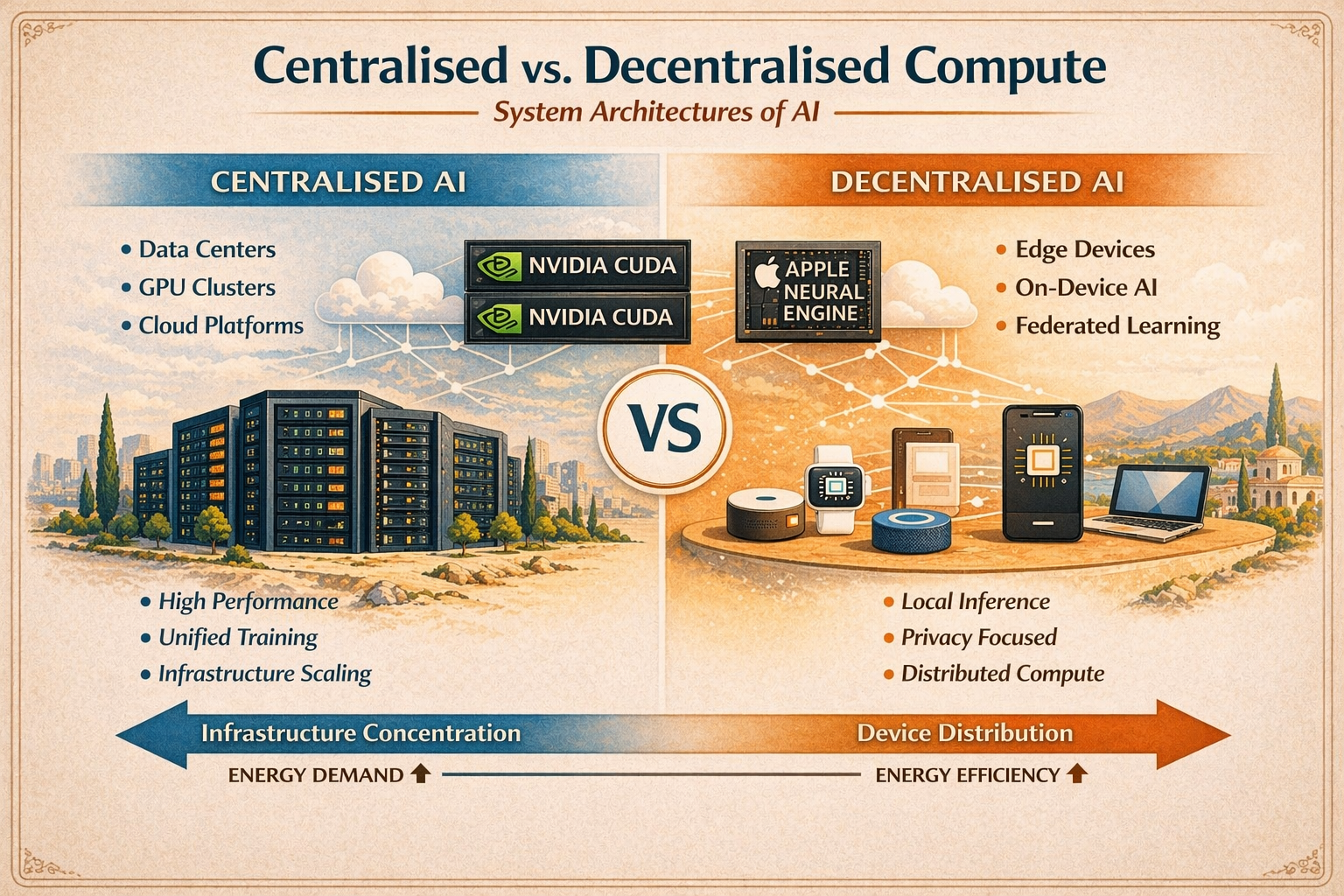
Centralised compute (infrastructure concentration)
Decentralised compute (device distribution)
This divergence is not technological alone.
It is energetic, infrastructural, and systemic.
System Architecture — Two Paths to Scale
1. Centralised Compute (Infrastructure Model)
hyperscale data centres
GPU clusters
cloud-based training environments
capital-intensive infrastructure
Led by:
NVIDIA
cloud and hyperscale platforms
Scaling logic:
Concentrate compute → maximise performance → scale through infrastructure
2. Decentralised Compute (Edge Model)
billions of connected devices
on-device inference
distributed processing
OS-integrated AI
Led by:
- Apple
Enabled by:
Apple Neural Engine
Metal
Scaling logic:
Distribute compute → embed intelligence → scale through proliferation
Core Mechanism — Distribution vs Concentration
This is a structural split in how compute scales:
Centralised Systems
require data aggregation
depend on energy concentration
scale through infrastructure expansion
Decentralised Systems
process data locally
distribute compute across nodes
scale through device ecosystems
Energy Constraint — The Hidden Variable
The divergence becomes clear under energy constraint.
Centralised AI
high and rising electricity demand
grid dependency
infrastructure bottlenecks
→ exposed to:
Scaling constraint: energy availability and cost
Decentralised AI
leverages already-deployed device energy
reduces marginal infrastructure demand
distributes compute load
Scaling advantage: energy distribution
Federated Intelligence — The Coordination Layer
Decentralised systems require coordination without centralisation.
Enabled by:
- Federated learning
Mechanism:
Data remains local
→ models update globally
→ intelligence scales without aggregation of raw data
System Position — Compute in the Stack
This divergence reshapes the system hierarchy:
Energy → Infrastructure → Compute → Industry → Capital → Currency → Sovereignty
Centralised compute reinforces infrastructure-dominant systems
Decentralised compute reinforces platform and device ecosystems
Strategic Implication — Functional Divergence
This is not a winner-takes-all dynamic.
It is functional differentiation:
Centralised systems dominate training and frontier model development
Decentralised systems dominate deployment and user-layer intelligence
Critical Insight
Apple is not competing directly with NVIDIA.
They operate at different layers:
NVIDIA → centralised AI infrastructure
Apple → distributed edge compute network
Outcome — Hybrid System Architecture
The system is converging toward a dual structure:
Hybrid Model
centralised training (data centres)
decentralised inference (edge devices)
This creates:
a layered compute system rather than a unified one
Conclusion — Compute Under Constraint
In an energy-bound system:
The constraint is not compute availability.
It is compute scalability under energy, infrastructure, and cost limits.
Centralisation maximises performance.
Decentralisation maximises distribution.
Under constraint, distribution becomes a strategic advantage.